Enterprise AI initiatives rarely fail because organizations choose the wrong language model. More often, they fail because the underlying data is incomplete, inconsistent, duplicated, poorly labeled, or too expensive to prepare at scale.
Most companies already own large volumes of valuable proprietary knowledge. It exists inside support tickets, contracts, policy documents, compliance reports, product manuals, chat logs, engineering notes, database exports, and internal knowledge bases. The problem is that this information rarely exists in a structure that modern language models can use directly for fine-tuning, evaluation, or preference alignment.
Synthetic data curation pipelines solve this problem by turning raw enterprise information into validated, versioned, high-quality datasets for production AI systems. Instead of relying only on manual labeling or ad-hoc prompt generation, these pipelines combine document processing, teacher-model generation, structured output validation, deduplication, quality scoring, human review, and dataset governance into one repeatable workflow.
This matters because the next phase of enterprise AI is not only about deploying larger models. It is about building reliable data infrastructure around those models. A company with a smaller model and a better curated dataset can often outperform a company using a larger model with noisy, poorly structured training data.
The same pattern appears across LoRA fine-tuning architectures, GenAI evaluation frameworks, GraphRAG systems, and multi-agent orchestration. The model is only one layer. The real production advantage comes from the pipeline that continuously improves the data feeding that model.
For enterprise teams, synthetic data curation pipelines are becoming a core AI infrastructure capability. They reduce labeling costs, improve dataset consistency, support privacy-preserving development, and make it possible to refresh training and evaluation datasets as business conditions change.
What Are Synthetic Data Curation Pipelines?
A synthetic data curation pipeline is an engineered workflow that generates, filters, validates, and governs artificial training examples for AI systems. These examples are usually derived from real enterprise knowledge, but they are transformed into structured formats such as instruction-response pairs, multi-turn conversations, classification examples, preference rankings, or evaluation questions.
The word synthetic does not mean fake in the sense of useless or disconnected from reality. In enterprise AI, synthetic data is usually grounded in existing source material. A policy document can produce compliance Q&A examples. A customer support ticket can produce troubleshooting conversations. A contract clause can produce legal review tasks. A system incident report can produce cybersecurity investigation scenarios.
The purpose of the pipeline is to convert messy corporate information into clean, repeatable, and machine-usable datasets. That requires more than calling an LLM once. A mature pipeline applies extraction, chunking, prompt templating, controlled generation, schema validation, deduplication, human sampling, quality scoring, and version control.
| Dataset Type | Purpose | Enterprise Example |
|---|---|---|
| Training Dataset | Improves model behavior through supervised fine-tuning | Instruction-response pairs generated from support tickets |
| Evaluation Dataset | Measures whether model quality improves or regresses | Golden test questions created from compliance procedures |
| Preference Dataset | Teaches models which answer is better through ranked examples | Preferred vs rejected legal summaries |
| Retrieval Dataset | Tests RAG accuracy, grounding, and answer faithfulness | Questions mapped to internal knowledge-base chunks |
| Safety Dataset | Tests boundary behavior, policy compliance, and refusal logic | Adversarial prompts against financial or healthcare policies |
This distinction matters. Many organizations say they need “synthetic data,” but the actual requirement may be more specific. A fine-tuning team needs instruction tuning datasets. A RAG team needs grounded evaluation sets. A governance team needs audit-ready validation samples. A product team may need synthetic conversations that represent realistic customer behavior.
Synthetic data curation pipelines provide a shared architecture for all of these needs. They give teams a way to generate data repeatedly, measure its quality, and track which dataset version was used for each model release.
Why Enterprises Need Synthetic Data
Enterprise AI teams face a data paradox. They have more internal information than ever, but very little of it is immediately usable for training or evaluating language models.
Raw corporate data is messy. It contains duplicated paragraphs, outdated procedures, personally identifiable information, inconsistent terminology, conflicting versions, scanned PDFs, incomplete emails, and domain-specific abbreviations. Even when the information is valuable, it usually lacks the clean structure needed for supervised fine-tuning or reliable evaluation.
Manual annotation can solve part of the problem, but it does not scale well. Human reviewers are expensive, slow, and inconsistent across teams. A legal reviewer, a customer support manager, and a data scientist may all interpret the same labeling instruction differently. Over time, these inconsistencies create uneven datasets that degrade model behavior.
Synthetic data curation pipelines reduce this bottleneck by using models and validation systems to generate structured examples at scale. Human reviewers are still important, but they move from labeling every sample to supervising quality, approving edge cases, and correcting high-risk outputs.
Privacy and Compliance
Many enterprises cannot freely expose raw data to model training workflows. Healthcare records, financial transactions, legal documents, employee files, and customer messages may contain sensitive information. Synthetic generation allows teams to preserve task structure while removing or transforming sensitive details.
This does not eliminate the need for privacy controls. Synthetic datasets can still leak sensitive patterns if the pipeline is poorly designed. However, with PII detection, redaction, anonymization, policy filters, and audit logging, synthetic data can reduce risk compared with training directly on raw production records.
Limited Labeled Data
Most enterprises do not have millions of clean labeled examples for every internal workflow. They may have a few thousand historical tickets, several hundred approved legal summaries, or a limited set of compliance scenarios. Synthetic generation can expand these small seed datasets into broader instruction sets that cover more variations, edge cases, and user intents.
This is especially useful for specialized domains where public datasets are not representative. A general customer-service dataset does not teach a model how a specific insurance company handles claim disputes. A public legal dataset does not teach a model how a particular organization structures contract risk reviews.
Continuous Learning
Enterprise knowledge changes constantly. Products evolve, regulations change, pricing models shift, support issues emerge, and internal policies are updated. A static dataset becomes stale quickly.
A synthetic data curation pipeline allows teams to refresh datasets continuously. New documents can trigger new synthetic examples. Failed model responses can become new evaluation cases. Human corrections can seed the next dataset version. This creates a closed loop between production behavior and dataset improvement.
Enterprise Architecture of Synthetic Data Curation Pipelines
A production synthetic data curation pipeline should be designed like an enterprise data platform, not like a notebook experiment. It needs clear stages, contracts between components, observability, versioning, and failure handling.
The architecture begins with source ingestion. Corporate documents are extracted from data lakes, knowledge bases, ticketing systems, SharePoint sites, customer relationship management platforms, code repositories, and databases. The ingestion layer normalizes formats and captures metadata such as source system, timestamp, business unit, confidentiality level, and document owner.
The next stage is cleaning and chunking. Documents are stripped of boilerplate, duplicate headers, navigation text, broken tables, and low-value fragments. Long documents are split into semantically coherent chunks so that generation prompts remain grounded and context windows are used efficiently.
Metadata extraction is critical. A chunk from a legal contract, a security incident report, and a customer support ticket should not be treated the same way. Metadata helps route each chunk into the correct generation template, validation rules, and approval workflow.
The prompt builder then converts cleaned source chunks into structured generation requests. These prompts define the task, expected output format, domain constraints, style, difficulty level, and rejection criteria. For example, a support-ticket chunk may produce a troubleshooting dialogue, while a compliance policy chunk may produce a question-answer pair with citation requirements.
The teacher model generates candidate examples. This may be a frontier API model, a self-hosted LLM, or a specialized internal model. The output is not trusted automatically. Every generated sample passes through validators that check schema correctness, factual grounding, toxicity, PII, duplication, semantic diversity, and confidence thresholds.
Human review is applied selectively. Instead of reviewing every sample, enterprise teams usually inspect statistically meaningful samples, high-risk domains, low-confidence outputs, rejected examples, and new generation templates. Approved data is then published to a dataset registry with version metadata and lineage.
Finally, the dataset is used for fine-tuning, RAG evaluation, preference optimization, or regression testing. Results from downstream model evaluation feed back into the pipeline, creating a continuous improvement loop.
| Pipeline Stage | Primary Responsibility | Production Risk If Missing |
|---|---|---|
| Source Ingestion | Collects and normalizes enterprise data | Incomplete or inconsistent source coverage |
| Cleaning | Removes noise, duplicates, and low-value fragments | Low-signal synthetic examples |
| Prompt Builder | Converts source chunks into controlled generation tasks | Prompt drift and inconsistent outputs |
| Teacher LLM | Generates candidate synthetic samples | Insufficient dataset volume or diversity |
| Validation Pipeline | Checks quality, safety, structure, and grounding | Training contamination and model degradation |
| Dataset Registry | Stores approved versioned datasets | No reproducibility or rollback path |
| Evaluation Loop | Measures downstream quality and triggers refreshes | Stale datasets and silent regressions |
Synthetic Dataset Generation Strategies for Enterprise AI
There is no single best way to generate synthetic enterprise data. The right approach depends on the task, domain risk, available source material, model budget, and quality requirements. Mature pipelines often combine several strategies instead of relying on one generation method.
Teacher Model Generation
The most common approach is to use a powerful teacher LLM to generate instruction-response pairs from trusted source material. The teacher model reads a document chunk and produces structured examples such as questions, answers, reasoning summaries, or task-specific outputs.
This works well when the source material is rich but unstructured. For example, a technical manual can produce troubleshooting questions, escalation scenarios, and step-by-step support responses. A compliance manual can produce policy interpretation questions and correct answer explanations.
LLM Knowledge Distillation
LLM knowledge distillation uses a large teacher model to create training examples for a smaller student model. This is useful when an enterprise wants domain-specific behavior but cannot afford to run a large frontier model for every production request.
The teacher model generates high-quality examples, while the student model learns the target behavior through fine-tuning. This pattern fits well with local LLM deployment infrastructure and adapter-based fine-tuning strategies, where compact models are optimized for latency, privacy, and cost.
RAG-Assisted Generation
Retrieval-Augmented Generation can improve synthetic data quality by grounding generation in retrieved enterprise documents. Instead of asking the teacher model to invent examples from memory, the pipeline retrieves relevant chunks and forces the model to generate only from that context.
This approach is useful for evaluation datasets because each synthetic question can be tied to a known source passage. It also supports faithfulness checks, since validators can compare the generated answer against the retrieved evidence.
Knowledge Graph Expansion
Knowledge graph expansion is useful when relationships matter. A GraphRAG system may extract entities, relationships, and communities from enterprise documents, then generate synthetic questions that test multi-hop reasoning across that graph.
For example, a financial compliance graph may connect regulations, controls, departments, risks, and audit findings. Synthetic questions can then test whether a model understands not just isolated facts but relationships between policies and business processes.
Multi-Agent Generation
Multi-agent generation uses specialized agents to create, critique, revise, and approve synthetic examples. One agent may generate the initial instruction, another may verify factual grounding, a third may introduce edge cases, and a critic agent may reject weak samples.
This pattern is powerful for complex workflows where one-step generation produces shallow examples. It is also useful for adversarial testing because one agent can deliberately create difficult or ambiguous cases that stress the model before production deployment.
Rule-Based and Programmatic Generation
Not every synthetic dataset requires a large language model. Some examples can be generated programmatically using templates, rules, or schema permutations. This is especially useful for structured domains such as invoices, forms, SQL queries, configuration files, and API requests.
Rule-based generation is less flexible than LLM generation, but it is deterministic, cheap, and easy to audit. Many enterprise pipelines combine programmatic generation for predictable cases with LLM generation for natural language variation.
Simulation-Generated Data
Simulation-generated data is common in robotics, autonomous systems, manufacturing, perception AI, and cybersecurity. Instead of deriving examples only from text, simulation environments create controlled scenarios that would be expensive, rare, or dangerous to collect in the real world.
For language-model workflows, simulation can also produce synthetic business events, customer journeys, incident timelines, and process variations. These scenarios become training or evaluation cases for agents, copilots, and decision-support systems.
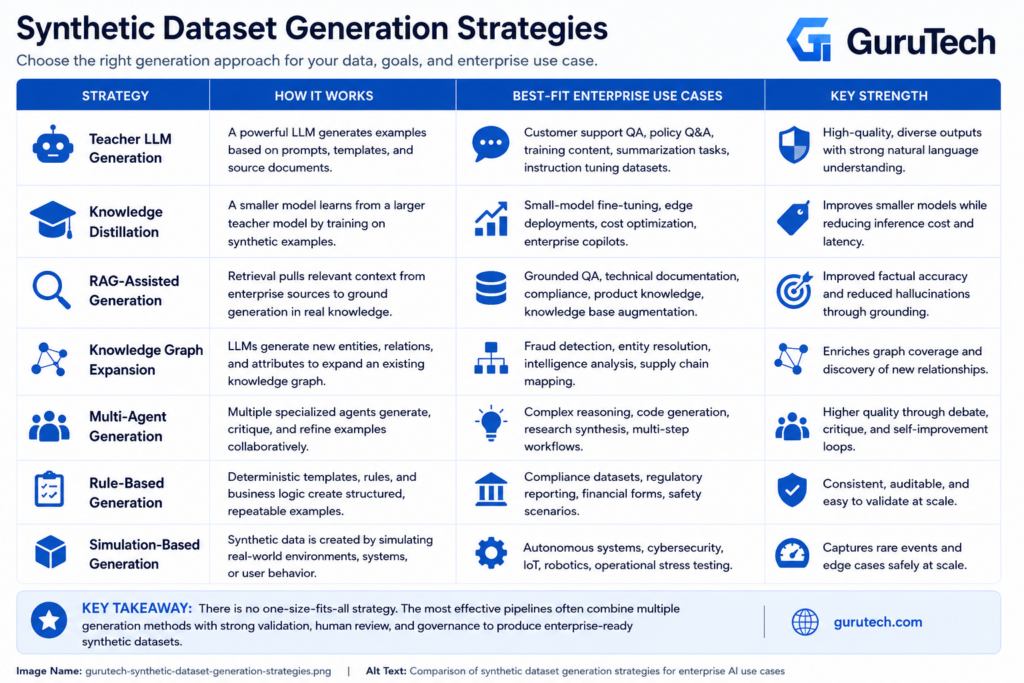
| Generation Strategy | Best Use Case | Main Trade-Off |
|---|---|---|
| Teacher LLM Generation | Instruction-response datasets | Can be expensive at scale |
| Knowledge Distillation | Training smaller domain models | Requires careful quality control |
| RAG-Assisted Generation | Grounded evaluation datasets | Depends on retrieval quality |
| Knowledge Graph Expansion | Multi-hop reasoning tasks | Requires graph construction |
| Multi-Agent Generation | Complex scenarios and adversarial tests | Higher orchestration complexity |
| Rule-Based Generation | Structured forms, APIs, and schemas | Limited natural language diversity |
| Simulation | Rare events and controlled scenarios | Can be domain-specific and costly to build |
The strongest enterprise systems do not choose one method permanently. They route generation tasks based on risk, cost, and required diversity. High-risk legal examples may require grounded RAG generation and human review. Low-risk formatting tasks may be generated programmatically. Complex agent workflows may use multi-agent generation and evaluation loops.
This routing mindset is what separates mature synthetic data curation pipelines from simple prompt automation. The goal is not to generate the most examples. The goal is to generate the most useful examples with the right controls at the right cost.
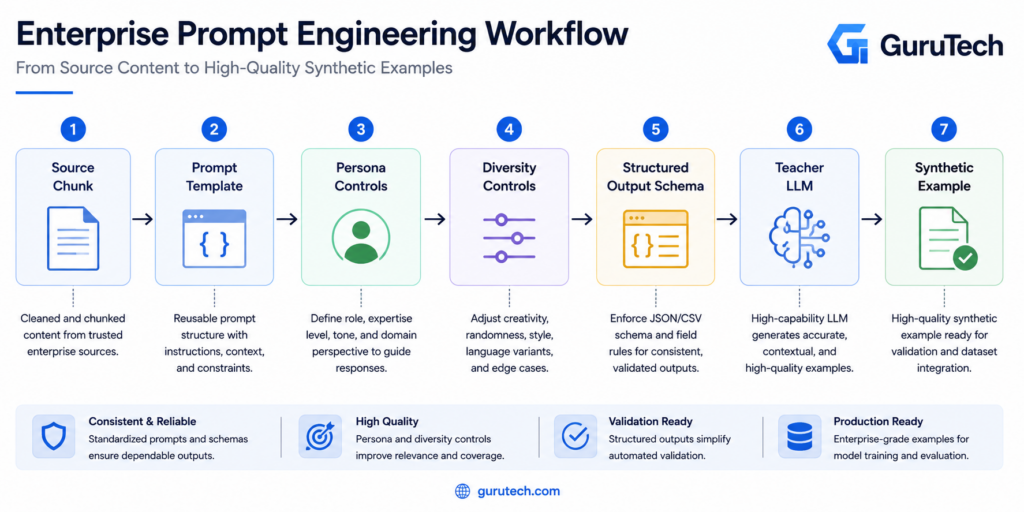
Prompt Engineering for Synthetic Dataset Generation
Synthetic dataset generation depends heavily on prompt design. A weak prompt produces generic examples that look polished but do not teach a model anything useful. A strong prompt turns enterprise source material into targeted training examples with clear task definitions, constraints, difficulty levels, expected output formats, and rejection rules.
In production environments, prompt engineering for synthetic data should not be treated as a creative writing exercise. It should be treated as a data specification layer. Each prompt template defines how source knowledge is converted into a training, evaluation, or preference example.
The most reliable teams version prompt templates the same way they version code. A small change in a generation prompt can alter the distribution of the entire dataset. If the prompt becomes more verbose, the model may learn longer responses. If the prompt removes citation requirements, the dataset may become less grounded. If the prompt overuses one style, the downstream model may become rigid.
Instruction Prompts
Instruction prompts generate the basic supervised fine-tuning examples used to teach a model how to respond to enterprise tasks. They usually take a source chunk and convert it into a clear user instruction plus a high-quality expected answer.
For example, a support-ticket record might generate an instruction such as: “Explain how to troubleshoot this billing integration failure using the internal escalation policy.” The expected output would then include the correct diagnostic steps, escalation conditions, and limitations based only on the source context.
The prompt should specify the task, audience, tone, constraints, and output format. Without those controls, the teacher model may generate examples that are technically fluent but inconsistent across the dataset.
Persona Prompts
Persona prompts introduce controlled diversity. Instead of generating every instruction from the same user perspective, the pipeline can simulate different roles such as compliance officer, support analyst, legal reviewer, database administrator, security engineer, procurement manager, or customer success representative.
This improves coverage because enterprise systems rarely serve one type of user. A finance analyst, a developer, and an executive may ask about the same underlying document in very different ways. Persona-based generation helps the dataset capture those differences before the model reaches production.
However, personas must be controlled. If the prompt simply asks the model to “act like a frustrated customer,” it may generate exaggerated or unrealistic examples. A better pattern is to define role, goal, knowledge level, allowed tone, and business context explicitly.
Diversity Prompts
One common failure mode in synthetic data is repetition. The model generates many examples that differ in wording but not in intent. This creates a dataset that appears large while adding little new signal.
Diversity prompts counter this by explicitly varying dimensions such as difficulty, department, query format, ambiguity level, required reasoning depth, and output structure. A compliance dataset may include direct policy questions, multi-step scenario questions, exception-handling questions, and adversarial misinterpretations.
Good diversity prompts do not ask for random variety. They define the axes of variation that matter for the business task. This makes the resulting dataset easier to measure and balance during validation.
| Prompt Dimension | Purpose | Enterprise Example |
|---|---|---|
| User Role | Varies the perspective of the request | Compliance officer vs support analyst |
| Difficulty | Controls reasoning depth | Simple lookup vs multi-policy interpretation |
| Output Format | Teaches structured response behavior | JSON, bullet summary, escalation note |
| Ambiguity | Tests clarification behavior | Incomplete request requiring follow-up |
| Risk Level | Routes review and validation intensity | Low-risk FAQ vs regulated financial advice |
Edge Case and Negative Example Prompts
Production models fail most visibly on edge cases. These include incomplete documents, conflicting policies, unusual customer requests, outdated procedures, ambiguous terminology, and queries that fall outside the system’s allowed scope.
Synthetic pipelines can generate these difficult examples deliberately. Instead of waiting for production failures, teams can create examples where the correct behavior is to ask a clarifying question, refuse unsupported claims, escalate to a human, or state that the available context is insufficient.
Negative examples are equally important. A model should learn not only what a good answer looks like, but also what an unacceptable answer looks like. Preference datasets can compare a grounded answer against a hallucinated answer, a concise answer against an overconfident answer, or a policy-compliant response against a risky one.
Structured Output Prompts
Many enterprise workflows require machine-readable outputs. A synthetic dataset for contract review may need fields such as risk category, clause reference, severity, summary, and recommended action. A support workflow may need intent, product area, urgency, answer, and escalation flag.
Structured output prompts define these schemas before generation. They reduce downstream parsing failures and make validation easier. They also help train models to behave consistently when integrated with APIs, workflow engines, or automation platforms.
Downstream Behavior Alignment: Compiling high-signal instruction pairs is only the first step in stabilizing enterprise model responses. By structuring your generation pipelines to produce contrastive preference pairs, you can feed these outputs directly into advanced dpo fine tuning architectures to mathematically eliminate hallucinations and enforce corporate compliance guidelines without the architectural complexity of legacy reinforcement learning frameworks.
Production Data Validation Pipeline
Generating synthetic data is the easy part. Validating it is the real engineering challenge.
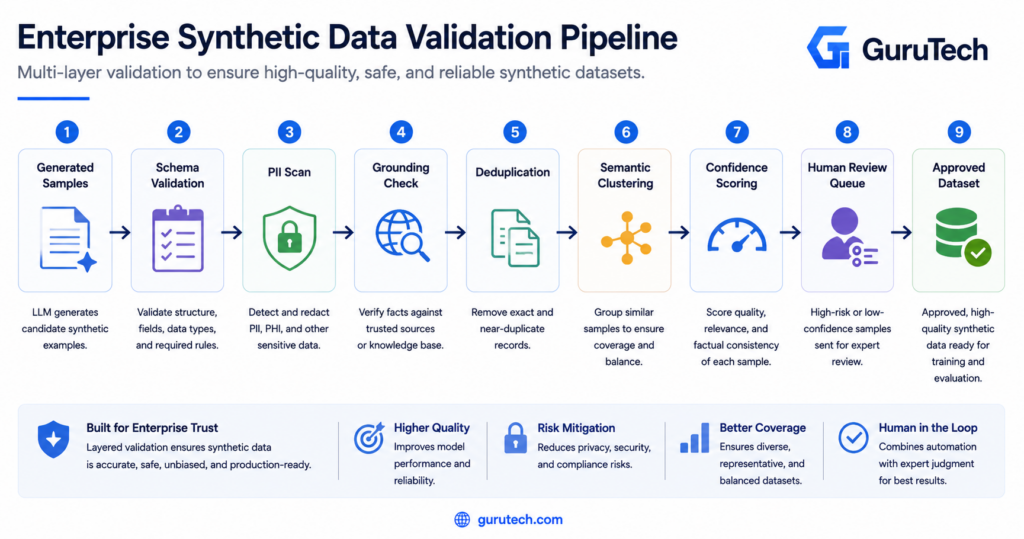
A synthetic data curation pipeline should assume that every generated sample is untrusted until it passes automated and, when necessary, human quality gates. This is especially important because LLM-generated examples can be fluent, plausible, and wrong at the same time.
Validation protects the downstream model from learning bad patterns. If synthetic data contains hallucinated facts, duplicated examples, unsafe instructions, malformed JSON, or low-diversity prompts, those defects can become embedded in the fine-tuned model.
Schema Validation
Schema validation checks whether each generated sample matches the expected structure. For instruction datasets, required fields might include instruction, context, expected output, task category, source identifier, confidence score, and dataset version.
This stage catches missing fields, incorrect types, invalid enum values, overly long strings, empty responses, and malformed JSON. It is one of the simplest validation layers to implement, but also one of the most important because bad structure can break training jobs and evaluation harnesses.
Deduplication and Semantic Similarity
Synthetic datasets often contain near-duplicates. The teacher model may generate the same question in slightly different wording or produce multiple examples with identical intent. If those examples are allowed into the dataset, the model may overfit to narrow patterns and appear better during evaluation than it actually is.
Deduplication usually combines exact matching, fuzzy text matching, and embedding similarity. Vector embeddings are especially useful because they detect semantic duplicates even when the wording is different. A cosine similarity threshold can remove redundant examples before training.
This connects naturally with vector database architectures. The same embedding infrastructure used for retrieval can also support dataset quality checks, clustering, and duplicate intent detection.
Grounding and Hallucination Checks
For enterprise use cases, generated answers should usually be grounded in source material. A compliance answer should not invent a policy. A support answer should not fabricate a product feature. A legal summary should not create obligations that do not exist in the contract.
Grounding checks compare the generated output against the source context. This can be done through citation requirements, retrieval overlap, entailment models, LLM-as-a-judge scoring, or rule-based checks for required references. The goal is to reject examples where the answer cannot be supported by the input material.
PII, Toxicity, and Safety Filtering
Enterprise synthetic data pipelines must inspect generated content for privacy and safety risks. Personally identifiable information may leak from source documents if redaction occurs too late or if the generator repeats sensitive values. Toxic or unsafe content may appear when generating edge cases, adversarial prompts, or customer conversations.
PII detection should run before and after generation. Pre-generation scanning reduces exposure to the teacher model. Post-generation scanning catches copied or reconstructed sensitive details. Safety classifiers then reject content that violates organizational policy or regulatory requirements.
Perplexity and Low-Signal Filtering
Perplexity-based filtering can identify text that is unusually repetitive, incoherent, or unnatural compared with the target distribution. While perplexity is not a complete quality measure, it is useful as one signal inside a broader validation pipeline.
Low-signal filtering also removes examples that are too short, too generic, unsupported by source context, or unlikely to teach the model anything specific. A sample such as “What is the policy?” with a vague answer should not enter a high-quality enterprise dataset.
Semantic Diversity and Topic Balancing
Even if every sample is individually valid, the dataset can still be weak if it overrepresents certain topics. For example, a customer support dataset may contain too many password reset examples and too few billing, integration, or escalation scenarios.
Semantic clustering helps teams understand the distribution of generated samples. Clusters that are too large may indicate duplication or overgeneration. Missing clusters may reveal gaps in source coverage. Balanced topic distribution improves the model’s ability to handle real production traffic.
| Validation Layer | Technical Purpose | Enterprise Recommendation |
|---|---|---|
| Schema Validation | Ensures each sample follows the required structure | Use JSON Schema, Pydantic, or typed validators before publishing |
| Embedding Deduplication | Removes semantically redundant examples | Use cosine similarity thresholds and cluster analysis |
| Grounding Check | Verifies that outputs are supported by source context | Require citations or source references for regulated domains |
| PII Detection | Prevents sensitive data leakage | Scan before and after generation |
| Toxicity Filtering | Blocks unsafe or policy-violating examples | Use safety classifiers and human escalation for edge cases |
| Perplexity Filtering | Detects repetitive or unnatural text | Use as a secondary signal, not the only quality metric |
| Semantic Diversity | Balances topic coverage across the dataset | Cluster examples and enforce distribution targets |
| Confidence Scoring | Ranks samples by expected reliability | Route low-confidence samples to review or rejection |
Human Review and Active Learning Loops
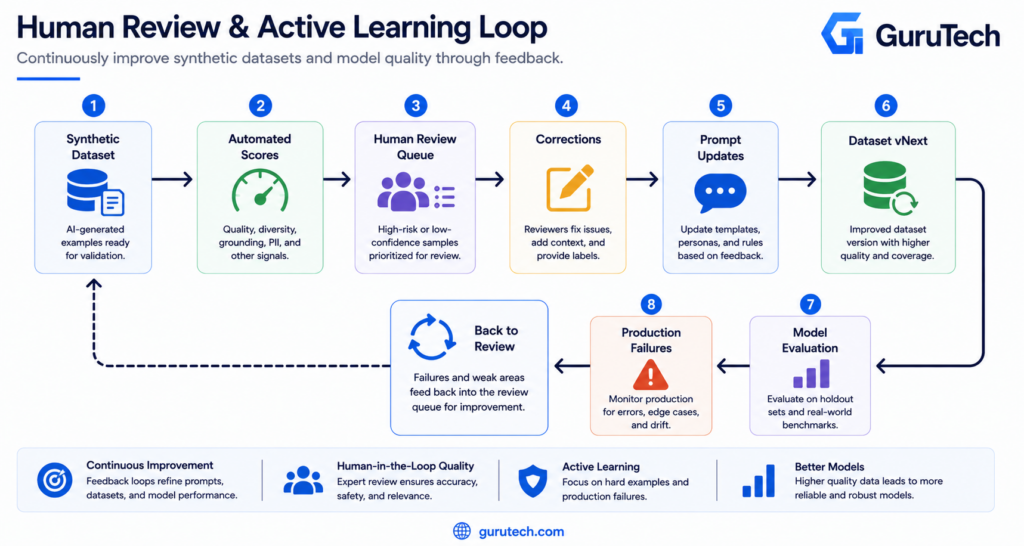
Synthetic data pipelines do not remove humans from the process. They change where human expertise is applied.
In traditional annotation workflows, humans label large volumes of individual examples. In a mature synthetic pipeline, humans focus on higher-value activities: reviewing samples, correcting templates, approving edge cases, defining quality criteria, and inspecting failure patterns.
This is especially important in regulated or high-risk domains. A healthcare dataset, legal review dataset, or financial compliance dataset should not be published solely because an automated validator accepted it. Human review provides domain judgment that automated checks cannot fully replace.
Sampling-Based Review
Reviewing every synthetic example defeats much of the purpose of automation. Instead, teams often review statistically meaningful samples from each dataset batch. Sampling can be random, risk-based, or confidence-based.
Random sampling gives a general quality estimate. Risk-based sampling prioritizes regulated domains, high-impact outputs, or new source systems. Confidence-based sampling sends low-scoring or borderline examples to reviewers first.
Correction Loops
Human corrections should not remain isolated edits. They should feed back into the pipeline. If reviewers repeatedly fix the same issue, the generation prompt, validator, or source-cleaning rule should be updated.
This is how synthetic data pipelines improve over time. Reviewers are not just approving examples; they are improving the system that generates future examples.
Active Learning
Active learning focuses human attention where it produces the highest value. Instead of reviewing easy examples that validators already score highly, reviewers inspect uncertain examples, underrepresented clusters, failed model responses, and production queries where the model performed poorly.
Those reviewed examples can seed new synthetic data generation. A failed support answer can become a new training example. A confusing compliance query can become a new evaluation case. A human-approved correction can become a preferred response in a preference dataset.
Production Structured Output Validation
Structured output validation is one of the most practical controls in synthetic data curation pipelines. It ensures that generated examples can be consumed reliably by training jobs, evaluation harnesses, annotation tools, workflow automations, and downstream applications.
For enterprise AI systems, free-form text is often not enough. A dataset example may need a task category, source reference, risk level, confidence score, expected output, reviewer status, and dataset version. Without strict validation, small formatting inconsistencies can propagate into large operational failures.
The following example shows a concise Pydantic schema for validating synthetic instruction-response pairs before publication.
from enum import Enum
from typing import List, Optional
from pydantic import BaseModel, Field, field_validator


class RiskLevel(str, Enum):
    low = "low"
    medium = "medium"
    high = "high"


class SyntheticTrainingPair(BaseModel):
    instruction: str = Field(
        ...,
        min_length=20,
        description="The enterprise task or user request."
    )
    context: str = Field(
        ...,
        min_length=50,
        description="Verified source context used to generate the answer."
    )
    expected_output: str = Field(
        ...,
        min_length=50,
        description="The approved response generated by the teacher model."
    )
    source_ids: List[str] = Field(
        ...,
        min_length=1,
        description="Source document or chunk identifiers."
    )
    task_category: str = Field(
        ...,
        description="Dataset category such as compliance, support, legal, or security."
    )
    risk_level: RiskLevel = Field(
        ...,
        description="Risk tier used to route validation and human review."
    )
    confidence_score: float = Field(
        ...,
        ge=0.0,
        le=1.0,
        description="Automated quality score assigned by validators."
    )
    dataset_version: str = Field(
        ...,
        pattern=r"^v\d+\.\d+\.\d+$",
        description="Semantic dataset version identifier."
    )
    reviewer_status: Optional[str] = Field(
        default="pending",
        description="Review status such as pending, approved, or rejected."
    )

    @field_validator("expected_output")
    @classmethod
    def reject_generic_outputs(cls, value: str) -> str:
        weak_phrases = [
            "it depends",
            "consult your administrator",
            "more information is needed"
        ]
        if any(phrase in value.lower() for phrase in weak_phrases):
            raise ValueError("Expected output is too generic for training.")
        return value


example = SyntheticTrainingPair(
    instruction="Explain how a support analyst should handle a failed invoice sync for an enterprise customer.",
    context="Source chunk from billing integration procedure DOC-4412 describing retry logic, escalation rules, and audit requirements.",
    expected_output="The analyst should first verify the integration status, check retry logs, confirm whether the invoice payload passed validation, and escalate to billing operations if the retry queue fails twice within the documented SLA.",
    source_ids=["DOC-4412:chunk-08"],
    task_category="customer_support",
    risk_level="medium",
    confidence_score=0.91,
    dataset_version="v1.2.0",
    reviewer_status="pending"
)
This schema does not guarantee semantic correctness by itself. It guarantees that the generated sample follows the minimum structural contract required by downstream systems. Semantic validators, grounding checks, and human review still matter.
In production, this kind of schema is usually paired with an LLM structured output framework such as Instructor or function calling, a JSON Schema contract, and a dataset registry. Failed records are rejected, repaired, or routed to a review queue.
The key architectural principle is simple: do not let unvalidated synthetic data reach model training. Once bad examples enter a fine-tuning run, the cost of correction increases significantly because the team must identify whether the failure came from the model, the training data, the prompt template, or the validation system.
Once every generated record satisfies structural and semantic validation, the next architectural requirement is reproducibility. Enterprise AI teams must be able to trace every deployed model back to the exact dataset, prompt template, validation rules, and source documents that produced it. Dataset versioning provides that operational foundation.
Dataset Versioning for Synthetic Data Curation Pipelines
Synthetic datasets should be versioned with the same discipline as application code, model weights, and infrastructure configurations. Without versioning, an enterprise team cannot reliably answer a simple but critical question: which dataset produced this model behavior?
This question becomes urgent when a fine-tuned model begins producing incorrect answers, unsafe recommendations, or inconsistent outputs. If the team cannot trace the model back to a specific dataset version, prompt template, generator model, validation threshold, and source document set, root-cause analysis becomes guesswork.
Dataset versioning gives synthetic data curation pipelines reproducibility. Every approved dataset should be treated as an immutable artifact. Once published, it should not be silently modified. If corrections are required, a new version should be created with documented changes.
What Must Be Versioned?
Many teams assume dataset versioning means saving a CSV file with a date in the filename. That is not enough for enterprise AI. Synthetic datasets are generated through many moving parts, and each part can change the final distribution.
A complete version record should include the approved dataset, source document references, chunking configuration, prompt templates, generator model, sampling parameters, validation rules, reviewer decisions, rejected sample counts, and downstream evaluation results.
| Versioned Component | Why It Matters | Example Metadata |
|---|---|---|
| Source Documents | Identifies what corporate knowledge was used | Document IDs, timestamps, owners, confidentiality labels |
| Chunking Rules | Controls how context is split before generation | Chunk size, overlap, semantic splitter version |
| Prompt Templates | Defines how synthetic examples are created | Template ID, template version, role controls |
| Generator Model | Affects style, reasoning, and output quality | Model name, endpoint, temperature, seed |
| Validation Rules | Determines which examples are accepted | Thresholds, schema version, safety policy version |
| Human Review | Tracks approval decisions and corrections | Reviewer group, approval rate, rejection reasons |
| Evaluation Results | Links dataset quality to model performance | Accuracy, hallucination rate, RAG faithfulness, regression score |
Immutable Dataset Releases
Once a dataset is approved, it should be published as an immutable release. This means the training system, evaluation harness, and governance workflow all reference the same dataset artifact by a stable version ID.
For example, a dataset version such as support_sft_v2.3.0 might correspond to a specific support-ticket corpus, a specific prompt template library, and a specific validation threshold. If a later review identifies weak examples, the team should create support_sft_v2.3.1 or support_sft_v2.4.0, not silently change the existing version.
This matters for rollback. If a new fine-tuned model performs worse than the previous version, the team can compare dataset versions directly and determine whether the regression came from the model configuration, training hyperparameters, or synthetic data changes.
Governance and Compliance Controls
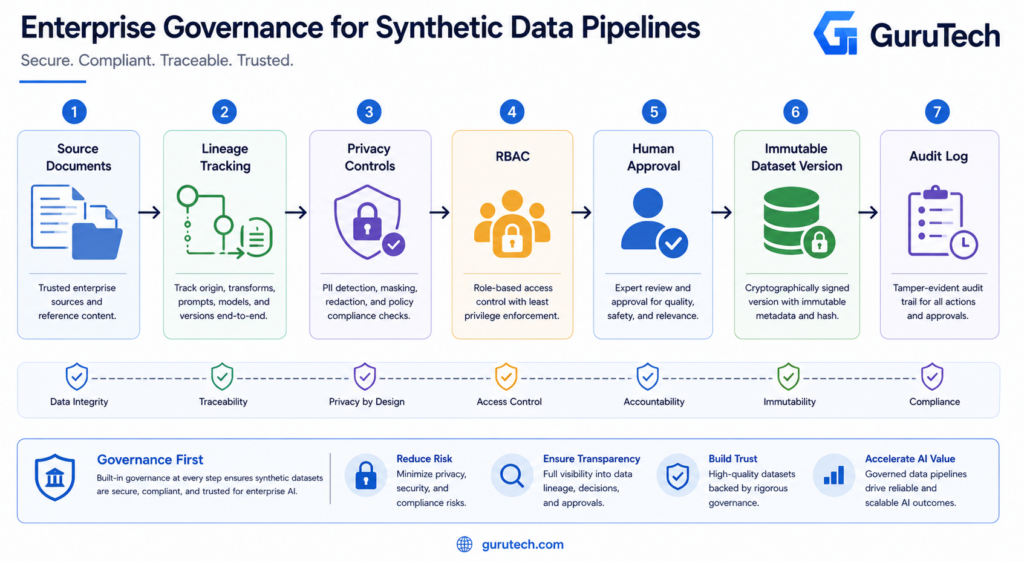
Governance is where synthetic data curation becomes enterprise infrastructure. Without governance, teams may generate large datasets quickly, but they cannot prove where those examples came from, how they were validated, who approved them, or whether they comply with internal policy.
AI data governance should be embedded directly into the pipeline. It should not be a manual review step added after the dataset has already been created. The earlier governance controls are applied, the lower the risk of privacy leakage, compliance drift, or training contamination.
Lineage Tracking
Lineage tracking records the chain from source material to final dataset example. A single synthetic instruction should be traceable back to the source chunk, prompt template, generator model, validation results, and approval event that produced it.
This is especially important when synthetic data is generated from internal documents that change over time. If a policy is updated, the organization needs to identify which synthetic examples were derived from the old policy and whether those examples should be regenerated or retired.
Access Control
Not every team should have access to every dataset. A synthetic dataset derived from legal records, employee data, financial information, or healthcare content may still require strict access controls even if sensitive values were removed.
Role-based access control should apply to source documents, generated samples, rejected records, review queues, and published dataset versions. The pipeline should log who accessed, approved, exported, or trained on each dataset.
Privacy and Retention Policies
Synthetic data does not automatically eliminate privacy obligations. If the generator model copies sensitive details, reconstructs private information, or produces examples too close to real individuals, the dataset can still carry compliance risk.
Retention policies should define how long intermediate artifacts are kept. Raw source chunks, rejected generations, and validation logs may contain more sensitive information than the final approved dataset. Enterprises should decide which artifacts are archived, which are deleted, and which are retained only as hashed references.
Approval Workflows
High-risk datasets should require approval before publication. A support chatbot dataset may only need engineering review, while a healthcare or financial compliance dataset may require sign-off from legal, risk, privacy, and subject matter experts.
Approval workflows should be tied to dataset versions. This prevents a common governance failure where a dataset is approved informally but later changed without reapproval. Every published version should have an approval record that matches the exact artifact used for training or evaluation.
MLOps Integration for Continuous Dataset Delivery
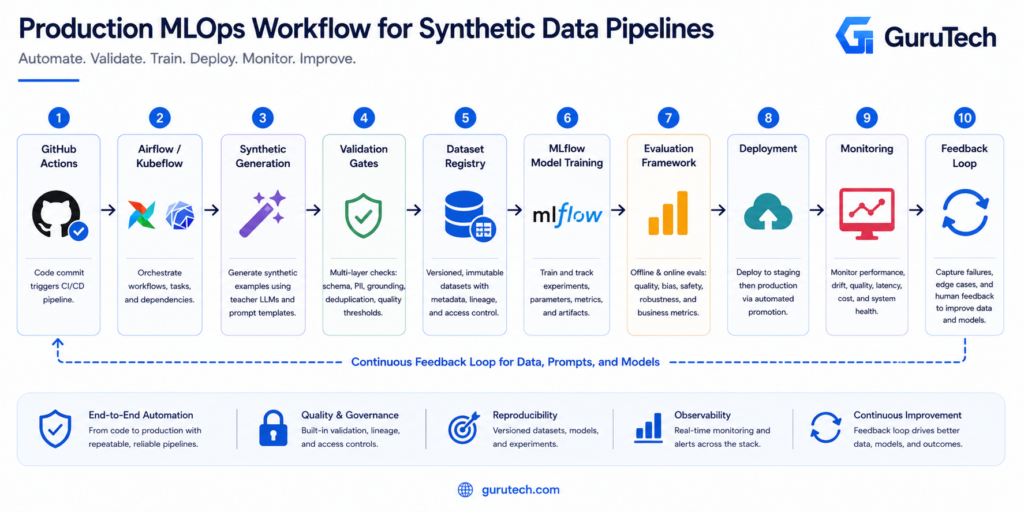
Synthetic data curation pipelines should not operate outside the production AI lifecycle. They should integrate with the same MLOps systems that orchestrate training, evaluation, deployment, monitoring, and rollback.
The goal is to make dataset generation repeatable, testable, and observable. When new source documents arrive, a workflow can generate candidate examples. When validation thresholds fail, the dataset release is blocked. When model evaluation improves, the dataset can be promoted. When production failures appear, the pipeline can create new test cases and training examples.
CI/CD for Synthetic Data
CI/CD concepts apply directly to synthetic datasets. A prompt template change should trigger a generation test. A schema change should trigger validation. A new dataset release should trigger evaluation before it is allowed to train a production model.
For example, a GitHub pull request that changes a compliance prompt template could run a small synthetic generation batch, validate the outputs, compare quality metrics against the previous version, and block the merge if hallucination rate or schema failures increase.
Orchestration with Airflow, Prefect, or Kubeflow
Orchestration tools coordinate long-running pipeline stages. Document ingestion, redaction, chunking, LLM generation, embedding, deduplication, validation, review routing, and dataset publishing may all run as separate tasks with dependencies and retry logic.
Airflow and Prefect are common choices for data workflows. Kubeflow is useful when dataset generation is tightly connected to model training on Kubernetes. The best choice depends on the existing data platform and whether the organization is already operating ML workflows at scale.
Model Registry and Dataset Registry Alignment
A model registry records trained model artifacts, but that is not sufficient by itself. Every model artifact should be linked to the dataset version used to train it and the evaluation dataset used to approve it.
This alignment prevents a common operational gap: teams can find the model checkpoint but cannot reproduce the dataset. For production AI, the dataset registry and model registry should work together as one release system.
GitHub Pull Request
        ↓
Prompt Template Test
        ↓
Synthetic Batch Generation
        ↓
Validation Gates
        ↓
Dataset Registry
        ↓
Fine-Tuning Job
        ↓
Evaluation Suite
        ↓
Model Registry
        ↓
Deployment Approval
        ↓
Production Monitoring
        ↓
Failure Cases Back to Dataset Pipeline
Enterprise Case Study: Synthetic Data for a Financial Support Model
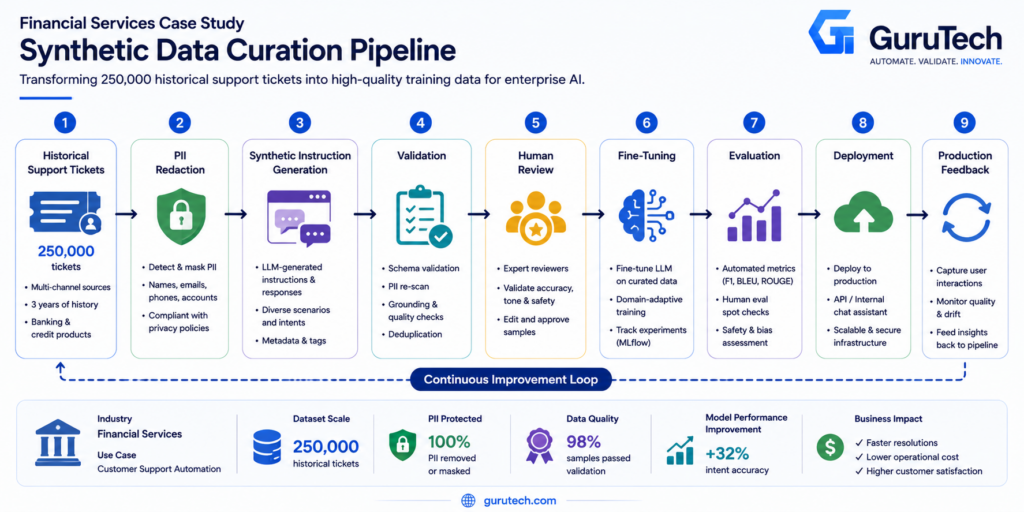
Consider a financial services company building an internal support assistant for analysts, operations staff, and customer service representatives. The organization has 250,000 historical support tickets, several thousand procedure documents, compliance policies, product guides, and internal escalation notes.
The company wants a smaller domain-specific model that can answer operational questions, summarize support issues, and recommend next steps. The model must run inside a private environment, respect compliance rules, and avoid exposing sensitive customer information.
Step 1: Source Ingestion and Redaction
The pipeline ingests support tickets, knowledge-base articles, and policy documents. Before generation begins, the system scans for names, account numbers, email addresses, phone numbers, transaction IDs, and other sensitive fields. Some values are removed entirely, while others are replaced with controlled placeholders.
Each document chunk receives metadata such as product area, issue category, document owner, last updated date, and confidentiality level. This metadata later controls prompt selection and review routing.
Step 2: Synthetic Instruction Generation
A teacher model generates instruction-response pairs from approved source chunks. The prompt template requires the answer to stay grounded in the provided context and to include escalation conditions when the issue involves compliance, billing, account access, or unresolved system errors.
The pipeline generates several example types: direct support questions, multi-turn troubleshooting dialogues, escalation summaries, policy interpretation examples, and negative examples where the correct behavior is to refuse unsupported conclusions or ask for clarification.
Step 3: Validation and Deduplication
Generated samples pass through schema validation, PII detection, grounding checks, similarity deduplication, and topic clustering. Examples that copy sensitive values, cite unsupported procedures, or fall below confidence thresholds are rejected automatically.
The deduplication stage identifies thousands of near-identical password reset, login failure, and invoice sync examples. The pipeline keeps a representative subset and reallocates generation budget toward underrepresented topics such as account reconciliation, compliance exceptions, and cross-border payment issues.
Step 4: Human Review
Subject matter experts review samples from each cluster. Compliance reviewers inspect high-risk categories. Support managers review troubleshooting accuracy. Data scientists examine rejection reasons and adjust validation thresholds.
Reviewers discover that some generated examples overstate escalation requirements. Instead of manually fixing thousands of samples, the team updates the prompt template and adds a validation rule that checks whether escalation language is supported by the source chunk.
Step 5: Fine-Tuning and Evaluation
The approved dataset is published as an immutable version and used to fine-tune a compact internal model. The model is evaluated against a held-out test set containing real historical issues, synthetic edge cases, and policy-sensitive scenarios.
The evaluation suite measures answer accuracy, hallucination rate, escalation correctness, retrieval grounding, and response consistency. Only after the model beats the previous baseline across the required metrics is it promoted to a staging environment.
Step 6: Continuous Improvement
After deployment, unresolved user queries and low-confidence model responses are routed back into the dataset pipeline. Human-reviewed corrections become new seed examples. The next dataset version targets observed production failures rather than generating random additional samples.
This is the real value of synthetic data curation pipelines. They do not only create the first training dataset. They create a continuous improvement mechanism that connects production behavior to future model quality.
Enterprise Tools for Synthetic Data Curation Pipelines
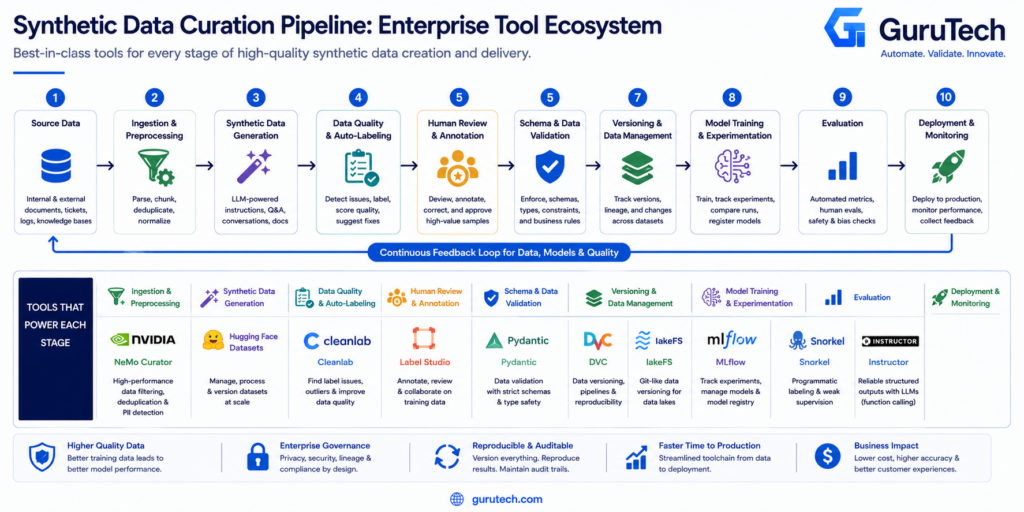
No single tool handles the entire synthetic data lifecycle perfectly. Enterprise teams usually combine generation frameworks, validation libraries, annotation platforms, dataset registries, versioning tools, and MLOps systems.
The right toolset depends on whether the organization is building text datasets, tabular synthetic data, preference datasets, evaluation sets, or multimodal simulation data. It also depends on privacy requirements, deployment model, and existing cloud or on-prem infrastructure.
| Tool | Primary Role | Best Fit | Enterprise Consideration |
|---|---|---|---|
| NVIDIA NeMo Curator | Large-scale data curation and filtering | GPU-accelerated dataset cleaning and synthetic data workflows | Strong fit for high-volume AI infrastructure teams |
| Argilla | Human feedback and dataset review | Instruction data, preference data, human validation | Useful for active learning and reviewer workflows |
| Label Studio | Annotation and review platform | Human labeling, QA, and dataset inspection | Flexible across text, image, audio, and structured tasks |
| Cleanlab | Data quality and label issue detection | Finding noisy labels and low-quality examples | Helpful when combining human and synthetic datasets |
| Snorkel | Programmatic labeling and weak supervision | Rule-driven dataset creation and labeling functions | Strong for structured enterprise labeling logic |
| Hugging Face Datasets | Dataset storage and transformation | Open and internal ML dataset workflows | Useful for reproducible preprocessing pipelines |
| Instructor | Structured LLM outputs | Pydantic-based generation and validation | Practical for enforcing schema contracts |
| Pydantic | Type validation and data modeling | Schema validation before publishing | Simple, reliable guardrail for generated records |
| DVC | Dataset and model versioning | Git-style data versioning workflows | Useful when teams want reproducible ML artifacts |
| lakeFS | Data lake version control | Branching and versioning large datasets | Strong fit for lakehouse-based enterprise data teams |
| MLflow | Experiment and model tracking | Training runs, metrics, models, artifacts | Should be linked with dataset registry metadata |
Tool selection should follow the architecture rather than the other way around. If the organization needs human review, choose tools that support reviewer workflows. If dataset reproducibility is the main pain point, prioritize versioning and registry layers. If validation is failing, invest in schema enforcement, semantic scoring, and quality dashboards before generating more data.
Common Mistakes When Building Synthetic Data Curation Pipelines
Many enterprise teams assume that generating more synthetic data automatically improves model quality. In reality, poor curation often amplifies weaknesses instead of fixing them. The objective is not maximum dataset size, but maximum signal-to-noise ratio.
| Mistake | Business Impact | Recommended Mitigation |
|---|---|---|
| Generating excessive low-value examples | Longer training with little improvement | Focus on coverage gaps rather than volume |
| No grounding to enterprise documents | Hallucination-prone models | Use RAG-assisted generation and source citations |
| No semantic deduplication | Overfitting to repeated intents | Cluster embeddings and remove near duplicates |
| Ignoring dataset versioning | Poor reproducibility | Publish immutable dataset releases |
| No human review | Hidden quality defects | Sample high-risk and low-confidence outputs |
| Weak prompt governance | Dataset drift | Version prompt templates with code reviews |
| No production feedback loop | Datasets become stale | Feed production failures back into curation |
Enterprise Best Practices
The most successful enterprise AI programs treat synthetic data as a continuously managed product. Every stage—from ingestion through deployment—should have measurable quality gates, ownership, and monitoring.
- Version prompt templates, datasets, and validation rules independently.
- Generate multiple dataset types (training, evaluation, preference, safety).
- Ground generation in trusted enterprise knowledge.
- Validate before publishing, never after training.
- Review statistically meaningful samples instead of every record.
- Track lineage from source documents to deployed models.
- Continuously regenerate data from production failures.
- Monitor downstream metrics such as hallucination rate and task accuracy.
Future Trends in Synthetic Data Curation
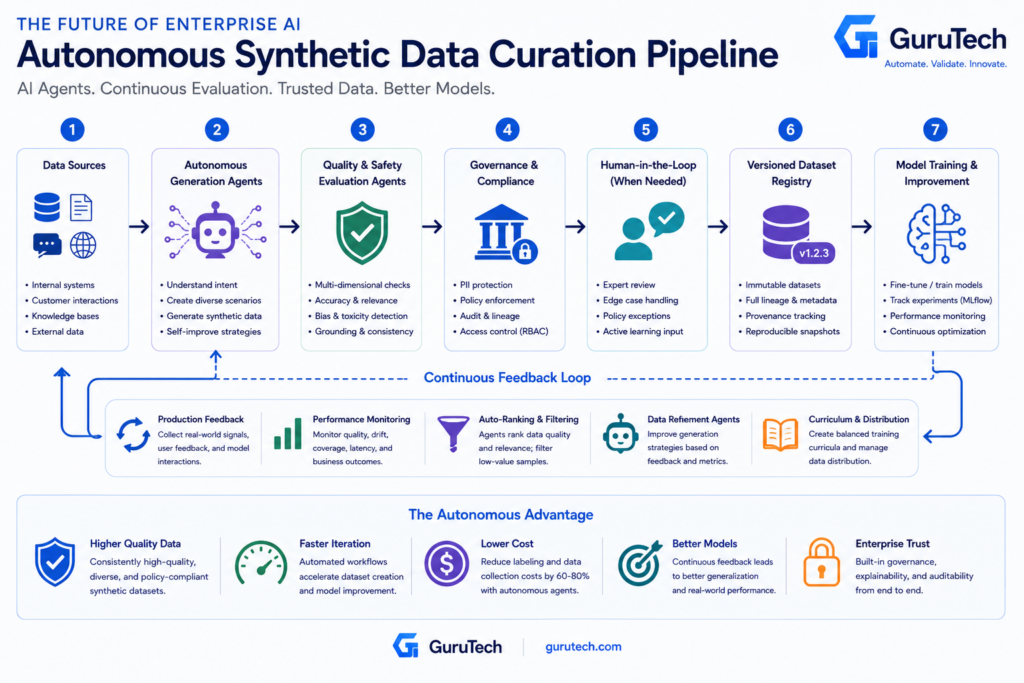
Synthetic data pipelines are evolving from batch generation systems into autonomous data engineering platforms. Emerging enterprise architectures increasingly combine retrieval, agents, evaluators, and continuous monitoring into closed feedback loops.
- Agentic dataset generation where specialized agents generate, critique, revise, and approve examples.
- Continuous dataset refresh triggered by production failures and knowledge-base updates.
- LLM-as-a-Judge integrated directly into validation pipelines.
- Synthetic benchmark creation for regression testing before deployment.
- Dataset marketplaces with governance metadata and lineage.
- Retrieval-aware generation that guarantees traceability back to enterprise sources.
Enterprise Readiness Checklist
| Capability | Status |
|---|---|
| Source ingestion pipeline | □ |
| Document cleaning and chunking | □ |
| Prompt template library | □ |
| Structured output validation | □ |
| Semantic deduplication | □ |
| Grounding verification | □ |
| PII and safety filtering | □ |
| Human review workflow | □ |
| Dataset registry | □ |
| Versioning and lineage | □ |
| MLOps integration | □ |
| Continuous production feedback | □ |
Frequently Asked Questions
Can synthetic data replace human labeling?
No. Synthetic generation dramatically reduces manual effort, but human expertise remains essential for governance, high-risk domains, validation, and continuous improvement.
How much synthetic data should I generate?
Generate enough data to improve coverage rather than maximize volume. Measure downstream model performance and stop when additional data no longer produces meaningful gains.
Which models work best as teacher models?
Organizations typically use their strongest available models for generation and then fine-tune smaller deployment models using the validated synthetic datasets.
How often should datasets be regenerated?
Whenever significant source knowledge changes, production failures accumulate, or evaluation metrics regress. Many organizations schedule incremental refreshes weekly or monthly.
How do you measure synthetic dataset quality?
Use multiple signals including schema compliance, grounding, semantic diversity, hallucination rate, downstream task accuracy, human review scores, and evaluation benchmark performance.
Can synthetic datasets introduce bias?
Yes. Synthetic data reflects the assumptions encoded in the source material, prompt templates, and teacher model. Enterprises should monitor representation, diversity, and downstream performance instead of assuming generated data is inherently unbiased.
Can LoRA fine-tuning use synthetic datasets?
Absolutely. High-quality synthetic instruction datasets are commonly used to specialize LoRA adapters for legal, finance, healthcare, engineering, and customer support workloads while keeping the base model frozen.
Which KPI should be monitored continuously?
Track grounding accuracy, hallucination rate, schema compliance, semantic diversity, human approval rate, dataset freshness, and downstream task success after deployment.
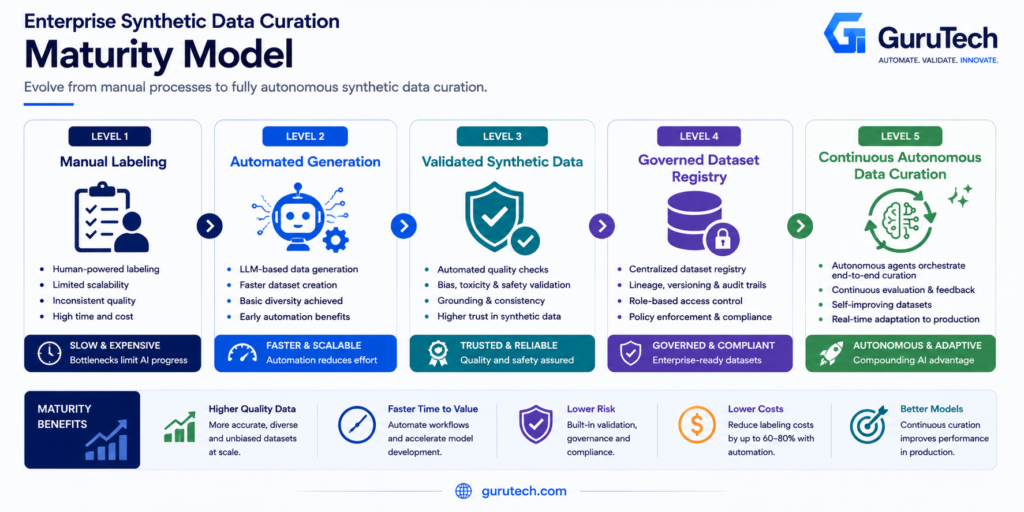
Enterprise AI Maturity Model
| Level | Characteristics |
|---|---|
| 1 | Manual labeling |
| 2 | Automated prompt generation |
| 3 | Validated synthetic datasets |
| 4 | Governed dataset registry and lineage |
| 5 | Continuous autonomous synthetic data factory |
Operational KPI Dashboard
| KPI | Purpose |
|---|---|
| Grounding score | Measures factual alignment to enterprise sources |
| Hallucination rate | Tracks unsupported outputs |
| Schema compliance | Ensures structured output quality |
| Semantic diversity | Avoids over-representation |
| Dataset freshness | Confirms knowledge is current |
| Human approval rate | Measures overall dataset quality |
Synthetic Data Curation Pipelines
Synthetic data curation pipelines have become a foundational layer of enterprise AI. Organizations are discovering that sustainable competitive advantage comes less from deploying the largest language models and more from building governed, continuously improving data pipelines that feed those models with accurate, diverse, and production-ready examples.
By combining structured generation, rigorous validation, human oversight, dataset versioning, governance, and MLOps integration, enterprises can transform decades of proprietary knowledge into reusable AI assets. The result is faster iteration, lower labeling costs, stronger compliance, and more reliable models that continue improving as new information becomes available.
Whether you are building a domain-specific copilot, a GraphRAG platform, a LoRA fine-tuning workflow, or a multi-agent automation system, the same principle applies: high-quality synthetic datasets are no longer a supporting component—they are core production infrastructure.
If your organization is beginning its synthetic data journey, start with a small governed pipeline, measure dataset quality continuously, and expand incrementally. A disciplined approach to synthetic data curation will provide far more long-term value than simply generating larger volumes of AI-produced content.