
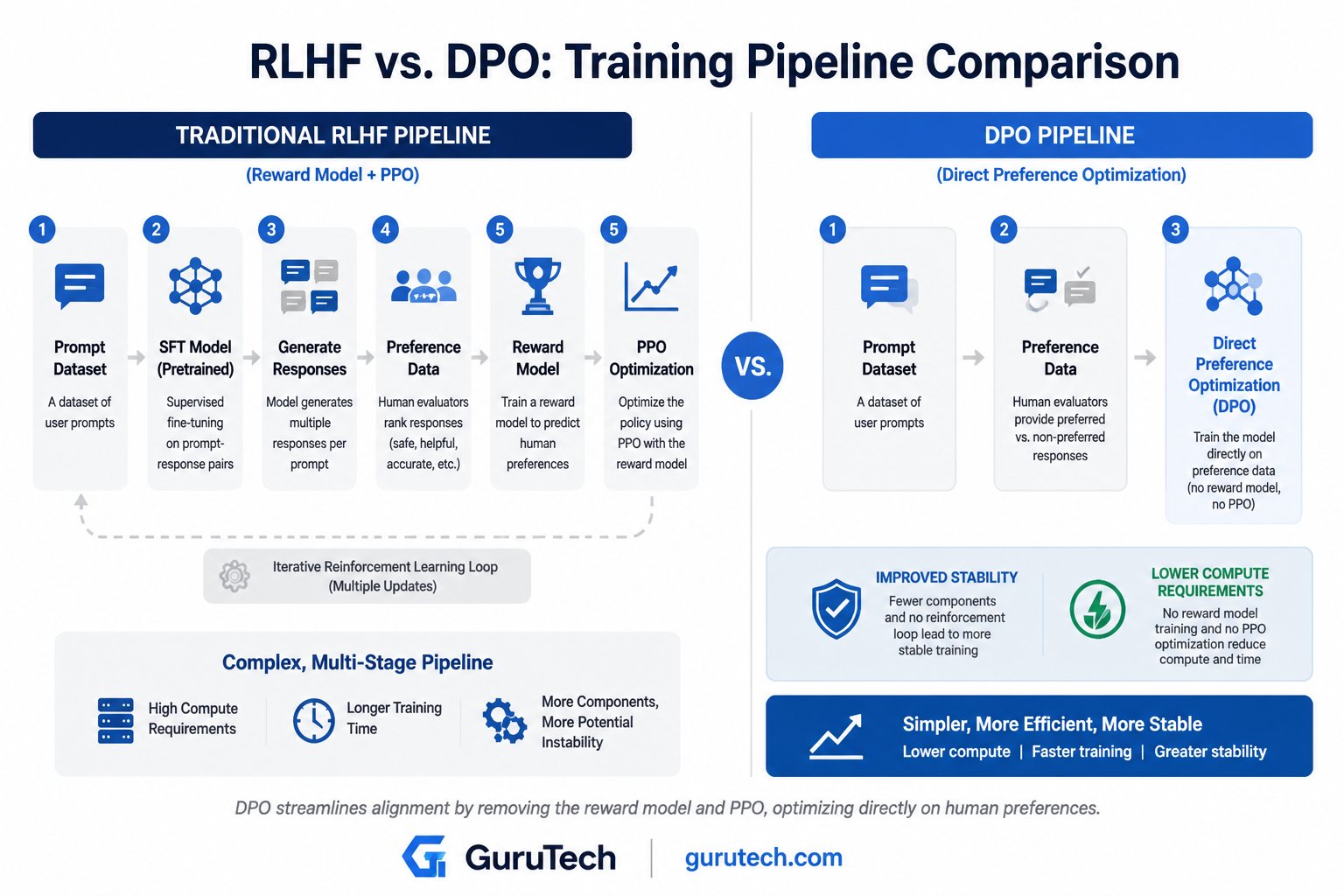
Enterprise AI teams are shifting from traditional Reinforcement Learning from Human Feedback (RLHF) to Direct Preference Optimization due to reduced architectural complexity and more stable training dynamics.
DPO Fine-Tuning Architectures
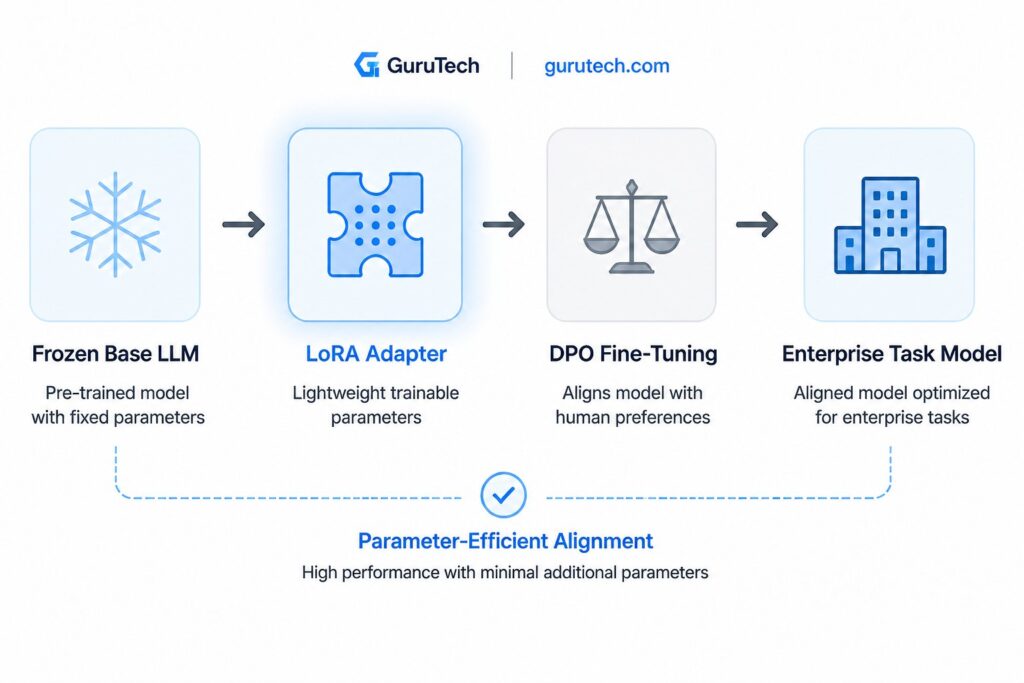
Direct Preference Optimization has become the preferred alignment technique for many enterprise AI teams because it simplifies the reinforcement learning pipeline into a stable supervised optimization problem. By eliminating the separate reward model while preserving high-quality preference learning, organizations can deploy aligned language models faster and with lower infrastructure costs.
Production success depends on more than the training algorithm. High-quality preference datasets, synthetic data curation, LoRA-based parameter-efficient fine-tuning, automated evaluation, and continuous production observability together form a complete enterprise alignment lifecycle.
As enterprise AI adoption accelerates, organizations that treat preference optimization as an ongoing engineering discipline rather than a one-time training exercise will be better positioned to maintain compliance, reduce hallucinations, and continuously improve model quality. If your team is implementing DPO fine-tuning architectures, share your preference pair generation strategy or the biggest optimization challenge you’re solving.
DPO architectures introduce specific mathematical trade-offs, hyperparameter sensitivities, and infrastructure constraints that differ meaningfully from supervised fine-tuning and traditional RLHF implementations. Understanding these technical distinctions enables teams to design robust preference optimization pipelines that balance alignment quality with computational efficiency.
DPO fine-tuning architectures eliminate the need for a separate reward model by directly optimizing language models on pairwise preference data, reducing both computational overhead and operational risk in production systems.
This architectural simplification allows DPO to align model outputs with subjective preferences while maintaining training stability across distributed infrastructure.
Direct Preference Optimization works by using pairwise comparisons where each training example contains a preferred and rejected response to the same prompt.
The method optimizes an implicit reward function through a closed-form loss calculation that adjusts model weights to favor preferred completions without requiring Monte Carlo sampling or policy gradient estimators.
High-quality preference datasets typically originate from synthetic data generation pipelines that produce on-brand responses, human annotation workflows with consistent ranking logic, or distillation from stronger foundation models.
Production DPO implementations require careful attention to hyperparameter selection, evaluation frameworks, and dataset quality metrics.
The data format requires a conversation structure containing system messages and user prompts paired with preference-ranked completions, making dataset preparation a critical engineering step.
Key Takeaways
- DPO eliminates the separate reward model required in RLHF by directly optimizing on preference pairs through implicit reward modeling
- Production DPO architectures require high-quality preference datasets with consistent ranking logic and careful hyperparameter tuning for stable training
- Enterprise deployments benefit from combining supervised fine-tuning before DPO and implementing robust evaluation frameworks for preference alignment metrics
What Is Direct Preference Optimization?
Direct Preference Optimization is a fine-tuning technique that aligns large language models with human preferences through a classification-based training objective, bypassing the reward modeling and reinforcement learning phases required in traditional RLHF implementations.
The method reparameterizes the RLHF reward model to derive an optimal policy in closed form, enabling direct optimization from preference pairs.
Preference Learning
Direct Preference Optimization LLM training operates on paired preference data where each example contains a prompt with two completions—one preferred and one rejected.
The algorithm treats the language model itself as an implicit reward model, eliminating the need for separate reward model training.
The DPO dataset format requires a conversation field containing the system message and initial user input, paired with two completions representing the preference ranking.
This structure differs fundamentally from supervised fine-tuning datasets that provide single ground-truth responses.
Engineers constructing preference datasets must ensure sufficient distributional coverage across the target task space.
Synthetic data curation pipelines often generate preference pairs by sampling multiple completions from a base model and ranking them through automated evaluation frameworks or human annotation workflows.
Why DPO Exists
Traditional RLHF implementations require training a separate reward model, then optimizing the language model policy using PPO or similar RL algorithms.
This pipeline introduces training instability, substantial computational overhead from policy rollouts, and complex hyperparameter tuning across multiple training stages.
Direct Preference Optimization eliminates these complexities by solving the RLHF objective through a binary cross-entropy loss function.
The method achieves comparable or superior alignment quality while requiring only standard supervised learning infrastructure.
Production teams benefit from reduced training time and computational resources.
DPO training typically completes in hours rather than days, with memory requirements similar to standard fine-tuning rather than the 2-3x overhead required for PPO-based approaches.
Reward-Model Elimination
The core innovation in Direct Preference Optimization stems from a mathematical reparameterization showing that the optimal RLHF policy can be expressed analytically in terms of the reward model and reference policy.
By substituting this closed-form solution into the training objective, the reward model becomes an intermediate variable that can be eliminated.
The resulting loss function directly compares the log-probability ratios of preferred versus rejected completions under the policy being optimized, relative to a frozen reference model.
This formulation maintains the KL-divergence constraint inherent in RLHF while avoiding explicit reward modeling.
Enterprise implementations typically store the reference model in FP16 or INT8 precision to minimize memory consumption during training.
LoRA adapters applied to the trainable policy enable efficient parameter updates while preserving the reference model for ratio calculations.
Enterprise Advantages
DPO’s computational efficiency makes it viable for enterprise teams with limited GPU budgets or strict latency requirements for model updates.
Training runs execute on standard supervised learning infrastructure without specialized RL frameworks or distributed rollout clusters.
The method integrates cleanly into existing MLOps pipelines.
Observability tooling tracks standard classification metrics—accuracy on preference pairs, margin distributions, and KL divergence from the reference policy—rather than the complex reward signals and value function diagnostics required in PPO workflows.
| Consideration | DPO | PPO-based RLHF |
|---|---|---|
| Training stages | Single | Multiple (reward model + RL) |
| GPU memory overhead | 1.2-1.5x base | 2-3x base |
| Hyperparameter sensitivity | Low | High |
| Rollout sampling required | No | Yes |
| Training stability | High | Moderate |
Teams should establish automated preference dataset refresh cycles to maintain alignment as deployment distributions shift.
Evaluation frameworks must validate both preference prediction accuracy and downstream task performance metrics.
How DPO Differs From Supervised Fine-Tuning
Supervised fine-tuning establishes foundational task competence by training models on high-quality demonstrations, while DPO refines preference alignment between response alternatives.
SFT optimizes log-likelihood of single target completions; DPO optimizes relative probability margins between paired options.
Production architectures typically apply SFT first to build a capable base policy, then use DPO to align that policy with nuanced human preferences.
The SFT phase ensures the model already generates reasonable responses before DPO fine-tunes the preference ranking between alternatives.
Engineers must recognize that DPO cannot compensate for fundamental capability gaps—if the base model cannot generate valid responses for a task, preference optimization will fail.
The technique excels at distinguishing between multiple plausible completions rather than teaching entirely new skills.
Enterprise recommendation: Implement a two-stage pipeline with SFT on curated demonstrations followed by DPO on ranked preference pairs, using separate LoRA adapters for each stage to enable independent iteration and rollback capabilities.
The Mathematics of DPO: Implicit Reward Modeling
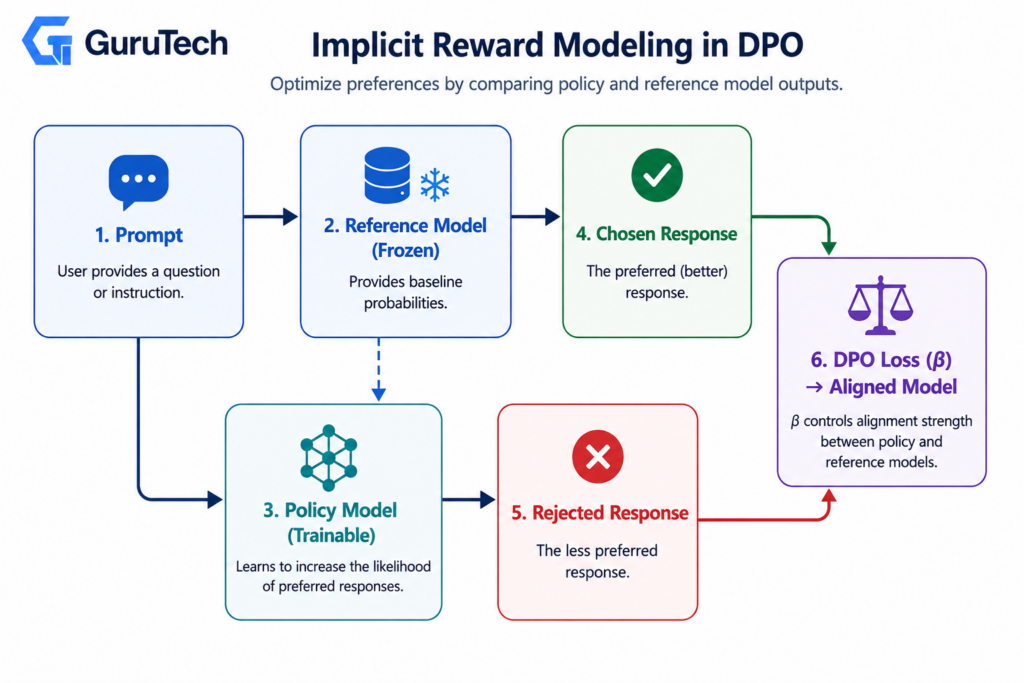
DPO eliminates the explicit reward model by directly optimizing language model policies through preference pairs, where the mathematical framework operates within an optimal policy-reward subspace that treats the reference model’s probability ratios as implicit rewards.
The beta parameter controls regularization strength while the objective maximizes log-likelihood of preferred responses relative to rejected ones.
Reference Model
The reference model serves as the frozen baseline policy πref that anchors the optimization process and prevents the fine-tuned model from diverging excessively from its original behavior.
This model typically represents the SFT checkpoint before preference learning begins.
The KL divergence constraint D_KL(π_θ || πref) ensures the learned policy maintains proximity to the reference distribution.
In production systems, the reference model consumes identical computational resources as the policy model during training since both require forward passes on each batch.
Enterprise teams often implement the reference model using quantized inference or LoRA adapters set to zero.
This approach reduces memory overhead when training large models across distributed GPU clusters.
Policy Model
The policy model π_θ represents the trainable language model that learns from preference data by adjusting its parameters θ to maximize the DPO objective.
Unlike RLHF approaches, DPO updates this model directly without intermediate reward model training.
The policy generates probability distributions over token sequences for both preferred and rejected completions.
The mathematical formulation computes log π_θ(y_w|x) – log π_θ(y_l|x) where y_w represents winning responses and y_l represents losing responses for prompt x.
LoRA fine-tuning proves particularly effective for policy model updates in enterprise deployments.
Adapter ranks between 8 and 64 typically balance parameter efficiency with expressiveness for instruction-following tasks.
Beta Parameter
The beta coefficient β controls the strength of the KL penalty between policy and reference models, directly influencing how aggressively the model deviates from its pre-trained behavior.
Higher beta values enforce stricter adherence to the reference distribution while lower values permit more dramatic policy shifts.
Typical production values range from 0.1 to 0.5 depending on task requirements and dataset quality.
Financial compliance applications often use β ≥ 0.3 to prevent hallucination and maintain conservative generation patterns.
The DPO objective incorporates beta as a temperature parameter that scales the implicit reward signal.
Empirically, beta requires tuning through held-out validation sets measuring both preference accuracy and downstream task performance.
Log-Likelihood Optimization
The DPO loss function maximizes -log σ(β log π_θ(y_w|x)/πref(y_w|x) – β log π_θ(y_l|x)/πref(y_l|x)) where σ represents the sigmoid function.
This formulation directly optimizes policy parameters without explicit reward model computation.
The optimization treats log probability ratios as implicit rewards, creating a self-normalizing objective that remains stable during training.
The sigmoid transformation maps raw preference margins into bounded loss values between 0 and 1.
Production implementations typically use AdamW with learning rates between 5e-7 and 5e-6 for full fine-tuning.
The learning rate reduction strategy can yield up to 25% relative performance gains in instruction-following benchmarks.
Gradient clipping at 1.0 prevents instability from outlier preference pairs in synthetic datasets.
Enterprise Financial Compliance Example
Financial institutions deploying compliance chatbots require models that prioritize accuracy over creativity while maintaining strict regulatory adherence.
A typical DPO pipeline for this domain curates preference pairs from human auditor reviews where y_w represents factually correct, compliant responses and y_l contains incorrect or non-compliant outputs.
Beta values of 0.4-0.5 prevent hallucination in regulatory citations while maintaining sufficient flexibility for natural language generation.
The reference model typically consists of a domain-adapted foundation model already fine-tuned on financial documentation through SFT.
Observability frameworks track implicit reward distributions across preference categories to detect dataset bias or reward hacking.
MLOps teams implement evaluation suites measuring both preference win rates and downstream metrics like citation accuracy and regulatory violation rates.
Deploy DPO with beta ≥ 0.4 for compliance-critical applications and integrate continuous evaluation pipelines measuring both preference alignment and domain-specific accuracy metrics.
Hyperparameter Configuration and Training Dynamics Matrix
The beta parameter controls preference strength while reference model handling and gradient accumulation directly impact memory efficiency and training stability across distributed systems.
These three configurations form the foundation of production DPO implementations at scale.
Beta Scaling Value (β)
The beta parameter ranges between 0 and 2, controlling the trade-off between preserving base model capabilities and enforcing preference alignment.
Lower beta values (0.1-0.3) maintain stronger ties to the reference model’s distribution, suitable for domain-specific applications where foundation model knowledge must be preserved.
Higher values (0.5-1.0) increase preference signal strength but risk mode collapse or overfitting to the preference dataset.
Enterprise teams typically start with β=0.1 for models larger than 70B parameters and β=0.3 for 7B-13B models.
Learning dynamics analysis shows that beta interacts nonlinearly with batch size and learning rate during influence accumulation.
Teams should log KL divergence between policy and reference models to detect when beta settings cause excessive drift from the base distribution.
Recommended beta ranges by model size:
| Model Size | Beta Range | Use Case |
|---|---|---|
| 7B-13B | 0.3-0.5 | General preference alignment |
| 30B-70B | 0.2-0.4 | Balanced capability retention |
| 70B+ | 0.1-0.3 | Minimal distribution shift |
Reference Model Offloading
Reference model memory requirements double VRAM consumption during DPO training since both policy and reference models must compute log probabilities.
Offloading the reference model to CPU or secondary GPUs reduces primary GPU memory by 40-50% but introduces latency in gradient computation.
PEFT techniques like LoRA enable efficient reference model handling by freezing base weights and training only rank decomposition matrices.
Production implementations should evaluate three offloading strategies: full CPU offloading with prefetching, quantized reference models (INT8/INT4), or shared-weight architectures where LoRA adapters differentiate policy from reference.
Quantized reference models reduce memory by 75% with minimal impact on training dynamics when using GPTQ or AWQ quantization.
Teams running multi-node training with DeepSpeed ZeRO-3 can distribute reference model shards across nodes to eliminate single-GPU bottlenecks.
Monitor reference model inference time as a percentage of total step time—values exceeding 30% indicate offloading overhead requires optimization through batched reference inference or async computation.
Gradient Accumulation Steps
Gradient accumulation enables effective batch sizes larger than GPU memory constraints allow by accumulating gradients across multiple forward-backward passes before optimizer updates.
DPO training benefits from larger effective batch sizes (64-256 samples) to stabilize preference learning across diverse example pairs.
Configuration of accumulation steps directly impacts training throughput and convergence characteristics.
Calculate accumulation steps as effective_batch_size / (per_device_batch_size * num_gpus * num_nodes).
For 8xA100 systems with per-device batch size of 2, achieving an effective batch size of 128 requires 8 accumulation steps.
Increasing accumulation reduces optimizer step frequency but maintains gradient stability.
Teams should track gradient norm statistics across accumulation boundaries to detect numerical instability from excessive accumulation.
Distributed training with HuggingFace Accelerate or DeepSpeed automatically synchronizes gradients across accumulation steps.
Set gradient clipping to 1.0 when using more than 16 accumulation steps to prevent exploding gradients from accumulated numerical errors.
Profile GPU utilization to ensure accumulation steps don’t introduce idle time from sequential computation patterns.
Legacy RLHF vs. DPO Tuning Architectures for Enterprise LLMs
RLHF architecture requires three distinct model components: a supervised fine-tuned policy model, a separate reward model trained on preference pairs, and a reinforcement learning optimizer typically using PPO.
This three-stage RLHF pipeline introduces significant operational complexity for production deployments.
DPO eliminates the reward model and RL components entirely by reformulating preference optimization as a classification problem.
The architecture integrates seamlessly into transformer fine-tuning pipelines like those used for LLaMA and Mistral models.
Teams can apply standard supervised learning infrastructure without specialized RL frameworks.
Architectural Comparison
| Component | RLHF | DPO |
|---|---|---|
| Models Required | Policy + Reward + Reference | Policy + Reference |
| Training Paradigm | Reinforcement Learning (PPO) | Supervised Classification |
| Gradient Flow | Non-differentiable sampling | Direct backpropagation |
| Memory Footprint | 3x base model size | 2x base model size |
| Hyperparameter Sensitivity | High (KL penalty, RL params) | Moderate (beta coefficient) |
RLHF’s reward model struggles with distribution shift when the policy generates outputs far from training data.
The RL optimization phase adds computational overhead and requires careful tuning of KL divergence penalties to prevent policy collapse.
DPO’s direct optimization approach leverages pairwise preference data without intermediate reward modeling, reducing training instability.
Enterprise teams implementing DPO with LoRA adapters achieve 40-60% reduction in GPU memory compared to full RLHF pipelines.
The simplified architecture enables faster iteration cycles and easier integration with existing MLOps workflows for model versioning and deployment.
For production systems requiring strict alignment guarantees, combine DPO fine-tuning with adversarial evaluation frameworks that test edge cases beyond training distribution.
Implement observability hooks to monitor preference satisfaction metrics across diverse prompt distributions.
Enterprise DPO Training Pipeline
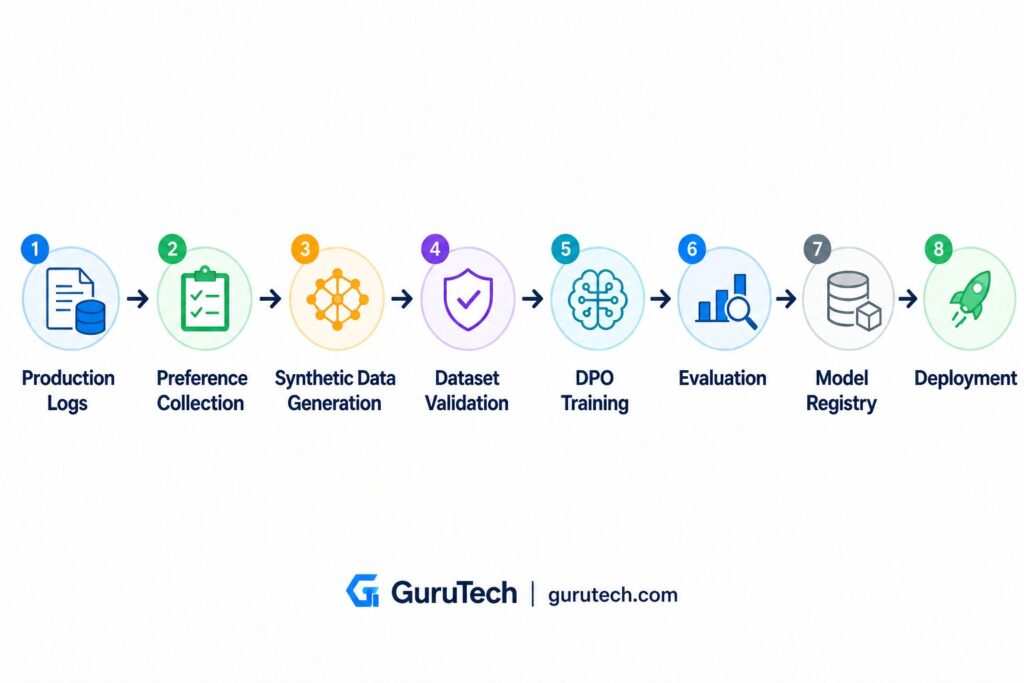
Building a production DPO training pipeline requires orchestrating data collection from live systems, curating preference pairs through synthetic generation or human annotation, and implementing robust validation before model updates reach users.
Enterprise teams typically structure offline model alignment workflows to minimize deployment risk while maximizing signal quality from operational data.
Production Logs
Enterprise systems generate preference signals through implicit feedback mechanisms embedded in production deployments.
User interactions like thumbs up/down ratings, regeneration requests, and session abandonment rates provide direct indicators of response quality.
A/B test results comparing model variants reveal which outputs users prefer in specific contexts.
Engineers instrument logging layers to capture the full conversation context, model outputs, and user reactions with millisecond-precision timestamps.
This telemetry feeds into data warehouses where SQL queries extract candidate preference pairs based on engagement metrics.
Organizations often have preference data already collected from user logs and A/B tests before initiating formal DPO projects.
Production logs typically require aggregation across multiple dimensions—user cohorts, geographic regions, feature flags—to ensure preference pairs represent genuine quality differences rather than random variance.
Synthetic Preference Generation
Teams supplement production data with synthetically generated preference pairs when operational logs lack sufficient coverage or introduce sampling bias.
LLM-as-judge frameworks use frontier models to evaluate candidate responses against rubrics for helpfulness, safety, and task completion.
Engineers prompt judge models with scoring criteria and chain-of-thought reasoning to generate preference labels at scale.
Synthetic generation enables targeted dataset creation for edge cases underrepresented in production traffic.
Teams craft prompts covering compliance scenarios, adversarial inputs, and domain-specific requirements that real users encounter infrequently.
The preferred responses align with brand guidelines and safety policies while non-preferred outputs demonstrate common failure modes.
Quality control mechanisms validate judge model decisions through inter-rater reliability checks and human spot audits.
Engineers track agreement rates between synthetic labels and human annotations to calibrate confidence thresholds.
Filtering
Raw preference data contains noise from ambiguous cases, near-identical response pairs, and systematic labeling errors that degrade training signal.
Engineers implement automated filters removing pairs where preferred and non-preferred responses differ by fewer than ten tokens or share near-identical semantic embeddings.
Statistical outlier detection flags pairs with suspiciously uniform engagement patterns suggesting bot traffic.
Domain-specific filters enforce business logic constraints—medical advice responses must cite sources, financial recommendations require disclaimers, customer service replies maintain consistent tone.
Regular expression patterns and classifier models screen for policy violations in both preferred and non-preferred outputs.
| Filter Type | Purpose | Typical Rejection Rate |
|---|---|---|
| Length similarity | Remove ambiguous pairs | 15-25% |
| Semantic duplication | Eliminate redundancy | 10-15% |
| Policy violation | Ensure compliance | 5-10% |
| Low confidence scores | Remove uncertain labels | 20-30% |
Teams preserve audit trails documenting which filters removed specific pairs to enable retrospective analysis when models underperform on particular query types.
Validation
Held-out validation sets provide unbiased estimates of how well DPO training generalizes beyond the training distribution.
Engineers stratify validation data across prompt categories, user segments, and difficulty levels to detect performance degradation in specific slices.
Time-based splits ensure validation pairs come from periods after training data collection, simulating realistic deployment conditions.
Cross-validation across multiple random seeds quantifies training stability and identifies whether hyperparameter choices produce consistent improvements.
Teams track validation metrics throughout training to implement early stopping when preference accuracy plateaus or begins declining.
Validation protocols include human evaluation on representative samples, measuring agreement between model preferences and expert annotator judgments.
Red team exercises probe for safety regressions and jailbreak vulnerabilities introduced during alignment.
DPO Training
The DPO training pipeline loads the base model and configures LoRA adapters to minimize memory overhead while maintaining alignment quality.
Engineers set rank values between 16-64 for the low-rank matrices, balancing expressiveness against computational cost.
Quantized training with QLoRA enables fine-tuning larger models on available GPU infrastructure.
Hyperparameter selection focuses on learning rate multipliers (typically 0.5-2.0), batch size constrained by memory limits, and epoch counts (usually 2-5) to prevent overfitting.
The beta parameter controlling the strength of the KL divergence penalty requires tuning—higher values preserve more base model behavior while lower values enable stronger preference optimization.
method={
    "type": "dpo",
    "dpo": {
        "hyperparameters": {
            "n_epochs": 3,
            "batch_size": 1,
            "learning_rate_multiplier": 1.0
        }
    }
}
Training infrastructure spans distributed GPU clusters with gradient accumulation to simulate larger effective batch sizes.
Teams checkpoint models every few hundred steps, preserving artifacts for rollback if downstream evaluation reveals issues.
Evaluation
Comprehensive evaluation goes beyond validation loss to measure real-world performance across multiple dimensions. Automated benchmarks assess instruction following, factual accuracy, reasoning capability, and task-specific metrics relevant to the deployment context.
Win-rate calculations compare DPO-tuned models against base models and previous production versions using pairwise human judgments. Safety evaluations probe for increased toxicity, bias amplification, or jailbreak susceptibility introduced during preference optimization.
Red team prompts attempt to elicit harmful outputs, measuring refusal rates and response appropriateness. Regression testing ensures capabilities not targeted by DPO training remain intact.
| Evaluation Category | Metrics | Target Threshold |
|---|---|---|
| Preference accuracy | Win rate vs baseline | >60% |
| Safety | Harmful output rate | <0.5% |
| Capability retention | Benchmark score delta | >-2% |
| Latency | P95 inference time | <500ms |
Teams establish statistical significance requirements before promoting models to production. Evaluations are run on sample sizes exceeding 1,000 examples per capability dimension.
Deployment
Gradual rollout strategies mitigate risk by exposing the DPO-tuned model to progressively larger groups of users while continuously monitoring alignment quality, latency, hallucination rates, and business-specific compliance metrics. Canary deployments, feature flags, and automated rollback mechanisms enable engineering teams to validate model behavior under real production workloads before broad release.
Every deployment should be accompanied by continuous evaluation pipelines that compare the aligned model against previous production versions using standardized benchmarks, preference win rates, regression tests, and domain-specific quality metrics. Integrating the deployment workflow with a model registry, experiment tracking system, and observability platform ensures that every aligned model remains reproducible, auditable, and compliant throughout its production lifecycle.
Code-Level Implementation: Instantiating a DPOTrainer Config Block
The DPOTrainer configuration requires explicit parameter definitions for loss functions, reference model handling, and dataset formatting. Engineers must account for beta scheduling, label smoothing, and whether to maintain a separate reference model copy in memory or leverage implicit differentiation.
Production-Grade DPOTrainer Example
The DPOConfig object extends TrainingArguments with DPO-specific parameters including beta, loss_type, and reference_free flags. Setting beta between 0.1 and 0.5 controls the deviation penalty from the reference model, with higher values enforcing stricter alignment to the base policy.
Production deployments typically use loss_type="sigmoid" for standard DPO or loss_type="ipo" for identity preference optimization when dealing with noisy preference labels. The max_prompt_length and max_length parameters must align with the model’s context window, typically 512 and 1024 tokens respectively for 7B parameter models.
LoRA integration requires setting peft_config with target modules covering query and value projection layers. Engineers should enable gradient_checkpointing=True and optim="paged_adamw_8bit" to reduce memory footprint on consumer GPUs.
The remove_unused_columns=False flag prevents the trainer from dropping preference-specific columns during preprocessing. For multi-node training, deepspeed integration with ZeRO Stage 2 or 3 optimizes reference model memory usage by sharing weights across devices.
Preference Dataset Structure
The dataset must contain four columns: prompt, chosen, rejected, and optionally margin for weighted preferences. Each row represents a single preference judgment where the chosen response demonstrates superior quality over the rejected alternative for the given prompt.
| Column | Type | Purpose |
|---|---|---|
prompt | string | User query or instruction context |
chosen | string | Preferred model response |
rejected | string | Dispreferred model response |
margin | float | Optional confidence score |
The preference data format expects tokenized sequences where chosen and rejected completions share identical prompt prefixes. Engineers must verify that rejected samples represent plausible but suboptimal outputs rather than random or adversarial text, as preference margins drive the optimization signal.
Synthetic data curation pipelines often generate rejected samples through temperature sampling at 1.2-1.5 or by prompting stronger models to produce subtly flawed responses. Validation sets should maintain similar chosen vs rejected distributional characteristics to prevent train-test mismatch in preference alignment metrics.
Common DPO Training Mistakes
DPO fine-tuning introduces several failure modes that degrade model alignment, from poorly curated preference pairs to misconfigured hyperparameters. These errors compound during training and often remain undetected until production deployment reveals preference drift or task-specific regression.
Noisy Preference Labels
Inconsistent or contradictory preference labels corrupt the training signal that DPO relies on to align model outputs. When annotators disagree on which completion is preferred, or when preference criteria shift across batches, the model learns spurious patterns rather than genuine quality distinctions.
Label noise typically originates from ambiguous annotation guidelines, insufficient annotator training, or attempting to capture subjective preferences without clear criteria. Multi-annotator disagreement rates above 15-20% indicate systematic labeling problems that require guideline revision.
Enterprises should implement calibration sets where ground-truth preferences are established through expert consensus. Track inter-annotator agreement using Fleiss’ kappa or Krippendorff’s alpha, and exclude pairs below threshold agreement scores.
Some teams maintain dedicated annotation quality models that flag suspect pairs for human review before training ingestion.
Preference Leakage
Preference leakage occurs when training data contains information about test set preferences, causing inflated evaluation metrics that don’t reflect true generalization. This frequently happens when practitioners generate chosen/rejected pairs from the same distribution used for final evaluation.
The issue intensifies when using synthetic preferences generated by state-of-the-art models like GPT-4, since these models may have already been exposed to similar prompts during their own training. Leakage also occurs through prompt templates that inadvertently encode evaluation criteria.
Production systems require strict train/test separation with temporally partitioned data where test prompts postdate training cutoff. Enterprises should maintain held-out preference sets collected through independent user interactions rather than synthetic generation.
When using model-generated preferences, ensure the generator model differs from the evaluation harness and employs different prompt distributions.
Duplicate Prompts
Duplicate prompts in DPO datasets cause the model to memorize specific prompt-response mappings rather than learning general preference patterns. Multiple ranked responses for the same input can be valid for methods like RRHF, but standard DPO expects unique prompts across the dataset.
Duplicates emerge during dataset construction when combining multiple preference sources, through data augmentation gone wrong, or when synthetic generation pipelines produce similar prompts. Each duplicate effectively increases the loss weight for that specific example, skewing the learned preference distribution.
Engineers should deduplicate prompts before training using exact matching and semantic similarity thresholds (cosine similarity > 0.95). Maintain prompt frequency statistics and cap maximum occurrences per unique prompt.
For enterprise deployments handling multi-turn conversations, implement session-aware deduplication that considers dialogue context rather than just the immediate prompt.
Excessive Beta Values
The beta hyperparameter controls the KL divergence penalty between the policy model and reference model in DPO’s objective function. Excessive beta values (typically > 0.5) over-regularize the model, preventing it from deviating sufficiently from the reference policy to capture preference distinctions.
Conversely, beta values too low (< 0.01) allow the policy to drift arbitrarily far from the reference model, leading to reward hacking where the model exploits spurious correlations in preference labels. The optimal beta range typically falls between 0.1-0.3 for most applications, though this varies by model architecture and domain.
Production teams should grid search beta values on a held-out validation set, monitoring both preference accuracy and KL divergence from the reference model. Plot the Pareto frontier of these two metrics to identify the optimal trade-off point.
For LoRA-based DPO training, lower beta values (0.05-0.15) often work better since the parameter-efficient approach naturally constrains deviation.
Reference Model Mismatch
DPO requires a reference model that represents the starting policy before preference alignment, yet practitioners frequently use incorrect snapshots or entirely different models. The most common error involves using a reference model that doesn’t match the initialized policy model’s weights.
When the reference model diverges from the policy initialization, DPO’s implicit reward signal becomes miscalibrated. The method assumes the policy starts as a copy of the reference, so any mismatch introduces bias in the learned preference function.
This error amplifies when teams apply DPO after supervised fine-tuning but use the base pretrained model as reference. Always initialize the reference model from the exact checkpoint used to start policy training.
For multi-stage fine-tuning pipelines (pretrain → SFT → DPO), the reference model should match the post-SFT checkpoint, not the base model. Enterprises running distributed training must ensure reference model sharding aligns with policy model parallelization to avoid weight loading errors.
Synthetic Preference Errors
Generating preferences using SFT models introduces systematic biases when the generation configuration doesn’t produce sufficient response diversity. Teams often sample both chosen and rejected responses at similar temperatures, yielding minimal quality differentiation.
The SPIN approach uses SFT model outputs as rejected responses and gold labels as chosen responses, but this only works when the SFT model exhibits clear failure modes. When synthetic generation uses deterministic decoding or low temperature (< 0.7), both preference options become nearly identical, providing no learning signal.
For synthetic preference generation, sample chosen responses at lower temperatures (0.3-0.5) and rejected responses at higher temperatures (0.9-1.2) to maximize quality divergence. Some implementations use top-p sampling with p=0.9 for chosen and p=0.95 for rejected.
Track BLEU score and ROUGE-L metrics between preference pairs; differences below 0.15 indicate insufficient diversity. Consider using rejection sampling where multiple responses are generated and ranked by a reward model before pair selection.
Skipping Evaluation
Many teams train DPO models without domain-specific evaluation, relying solely on aggregate metrics that mask task-level degradation. Alignment methods show weaknesses in mathematical operations, reasoning, and coding tasks that general benchmarks fail to detect.
That one is truncated as well. I’d replace it with this completed version:
Skipping Evaluation
Many teams train DPO models without domain-specific evaluation, relying solely on aggregate metrics that can mask task-level degradation. While overall preference scores may improve, alignment methods can still introduce weaknesses in mathematical reasoning, code generation, factual accuracy, or domain-specific decision making that general benchmarks fail to detect.
A robust evaluation pipeline should combine automated benchmarks, human preference assessments, regression testing, and application-specific metrics before deployment. Enterprise teams should also monitor hallucination rates, compliance adherence, response consistency, and production win rates to verify that alignment improvements do not come at the expense of reliability, safety, or core model capabilities. Continuous evaluation remains essential because user behavior, business requirements, and data distributions evolve over time.
Evaluating Enterprise DPO Models
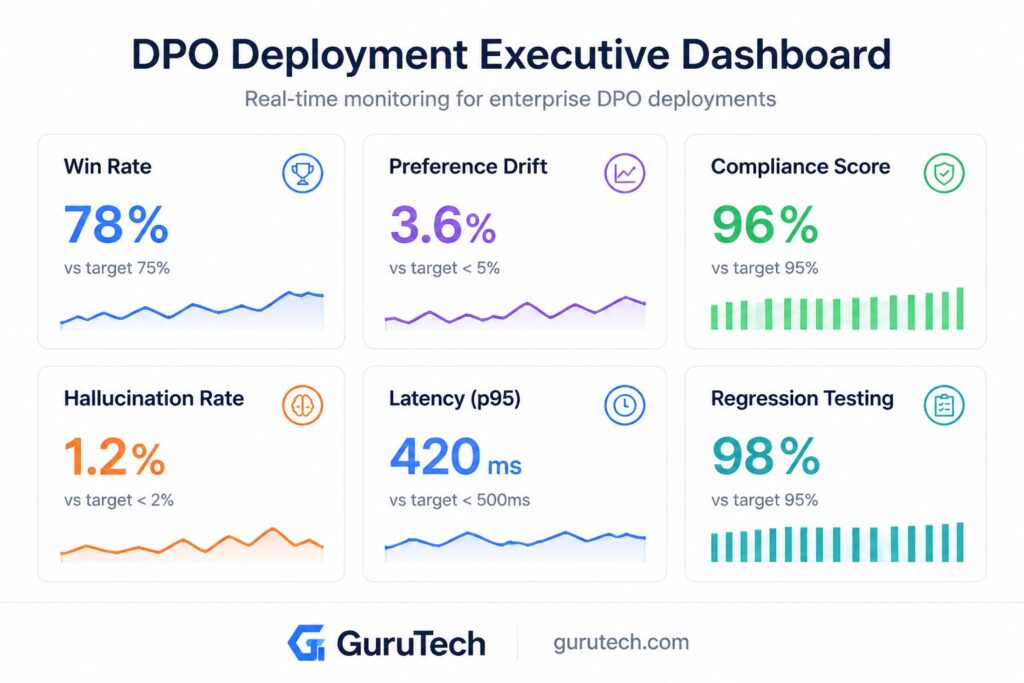
DPO-tuned models require systematic evaluation across multiple dimensions to validate alignment quality and production readiness. Quantitative metrics like win rate and hallucination rate must be combined with human evaluation and regression testing to ensure models meet enterprise requirements without degrading performance on core tasks.
Win Rate
Win rate measures how frequently a DPO-tuned model’s outputs are preferred over a baseline model in head-to-head comparisons. This metric typically involves presenting pairs of responses to human evaluators or using a judge model to select the superior output.
Enterprise teams should aim for win rates above 60% to justify deployment, though the threshold varies based on use case criticality. Computing win rates requires a representative test set that reflects production traffic distribution.
Teams should stratify evaluation data across different prompt types, user personas, and task complexities to identify where alignment improvements are strongest. A model might achieve 75% win rate on customer service queries but only 52% on technical documentation tasks, indicating uneven alignment gains.
Judge models like GPT-4 can accelerate win rate evaluation but introduce their own biases. Cross-validation with human raters on a subset of examples ensures automated judgments align with actual user preferences.
Track inter-annotator agreement to validate evaluation reliability, targeting Cohen’s kappa above 0.6 for production use.
Human Preference Score
Human preference scores quantify alignment quality through structured rating protocols rather than binary comparisons. Evaluators rate outputs on scales measuring helpfulness, harmlessness, factual accuracy, and adherence to brand guidelines.
This multi-dimensional approach reveals specific areas where DPO training succeeded or failed. Enterprise preference evaluation should employ domain experts rather than crowdsourced annotators for specialized applications.
A financial services chatbot requires raters who understand regulatory compliance, while a medical coding assistant needs clinical expertise. Rating rubrics must define clear criteria for each score level to maintain consistency across evaluators.
Preference scores enable tracking alignment quality over time as new data enters training pipelines. Establish baseline scores before DPO fine-tuning, then measure improvements post-training.
Models should demonstrate statistically significant gains (p < 0.05) across multiple rating dimensions to validate the alignment process.
Hallucination Rate
Hallucination detection becomes critical when evaluating DPO models, as preference optimization can inadvertently encourage confident but factually incorrect responses. Automated hallucination detection frameworks compare model outputs against ground truth sources, flagging unsupported claims or contradictions.
Enterprise systems should target hallucination rates below 5% for customer-facing applications. Implement multi-stage hallucination detection combining retrieval verification, fact-checking models, and uncertainty quantification.
When a model generates a claim, retrieve relevant documents and verify whether the claim is supported by retrieved evidence. Calibrated confidence scores help identify outputs where the model may be overconfident relative to its actual accuracy.
Domain-specific hallucination testing requires curated datasets with known correct answers. Financial models must be tested on numerical accuracy, medical models on clinical guideline adherence, and legal models on case law references.
Track hallucination rates across different output types—factual claims require stricter validation than subjective recommendations.
Compliance Score
Compliance scoring evaluates whether DPO-tuned models adhere to enterprise policies, regulatory requirements, and safety guidelines. This metric captures violations like generating prohibited content, failing to include required disclosures, or bypassing content filters.
Enterprise models must maintain near-zero compliance violation rates to avoid legal and reputational risks. Build compliance test suites that probe model behavior across adversarial scenarios.
Red team exercises should attempt to elicit policy violations through prompt injection, jailbreaking attempts, and edge case queries. Automated compliance scanning should run against every model checkpoint before deployment, blocking releases that fail critical safety tests.
Industry-specific compliance requirements demand tailored evaluation frameworks. Healthcare applications must validate HIPAA adherence, financial services need SOC 2 compliance verification, and consumer-facing products require age-appropriate content filtering.
Document compliance test results for audit trails and regulatory reporting.
Truthfulness
Truthfulness evaluation measures whether models generate accurate, honest responses rather than plausible-sounding but incorrect information. Research shows that using instruction-tuned models as DPO base models improves truthfulness compared to models trained without supervised fine-tuning.
Benchmark datasets like TruthfulQA provide standardized truthfulness assessments across question categories. Enterprise truthfulness testing should incorporate domain-specific fact verification beyond public benchmarks.
Proprietary knowledge bases, internal documentation, and verified data sources serve as ground truth for validation. Models deployed in high-stakes environments require continuous truthfulness monitoring rather than one-time evaluation.
Track truthfulness separately from helpfulness metrics, as these objectives sometimes conflict. Pareto frontier analysis identifies optimal tradeoffs between user satisfaction and factual accuracy for different application contexts.
Regression Testing
Regression testing ensures DPO fine-tuning doesn’t degrade performance on capabilities the base model already possessed. Evaluation should cover reasoning benchmarks, mathematical problem-solving, question answering, and domain-specific tasks beyond the alignment objective.
Studies indicate that alignment methods provide limited improvements on complex reasoning while enhancing mathematical capabilities. Maintain a comprehensive regression test suite spanning 10-15 established benchmarks relevant to the target application.
Compare DPO model performance against both the base model and instruction-tuned checkpoints to isolate alignment effects. Flag any benchmark where performance drops by more than 3% as requiring investigation.
Regression risks increase when DPO training data differs significantly from the base model’s pretraining distribution. Synthetic data generation for preference pairs should maintain coverage across task types to prevent capability loss.
If regression occurs, adjust the DPO training mix or reduce the learning rate to preserve general capabilities while achieving alignment goals.
Production Monitoring
Production monitoring tracks DPO model behavior in live deployments through continuous evaluation and observability tooling. Implement logging infrastructure that captures user interactions, model outputs, and feedback signals for ongoing analysis.
Real-world performance often diverges from offline benchmarks as users discover edge cases and adversarial patterns. Deploy shadow models running alternative DPO configurations to enable A/B testing and champion-challenger comparisons.
Route a percentage of traffic to experimental models while tracking differential metrics across variants. Automated alerts should trigger when key metrics like win rate or hallucination rate degrade beyond defined thresholds.
Collect implicit and explicit feedback from production users to identify alignment drift over time.
Best Practices for Enterprise Deployments
Enterprise LLM alignment through DPO requires careful orchestration of infrastructure, data governance, and evaluation pipelines. Organizations must establish robust data curation workflows that capture authentic human preferences while maintaining compliance with regulatory requirements.
Critical Infrastructure Components
| Component | Implementation Requirement |
|---|---|
| Preference Data Pipeline | Version-controlled dataset registry with PII redaction |
| Training Infrastructure | Multi-GPU clusters with checkpointing and fault tolerance |
| Evaluation Framework | Automated preference validation against holdout sets |
| Model Registry | Artifact versioning with metadata tracking |
Production DPO deployments demand integration with existing MLOps workflows rather than isolated experimentation. Teams should implement continuous evaluation pipelines that monitor alignment drift across deployment cycles.
Enterprise LLMOps architecture must include observability layers that track preference adherence in live traffic.
Data Quality and Human Alignment
Synthetic preference data generation can augment human annotations but requires validation against authentic user interactions. Organizations achieving enterprise-grade fine-tuning typically combine small high-quality human preference sets with carefully validated synthetic expansions.
LoRA adapters enable parameter-efficient DPO training while maintaining base model stability. This approach allows teams to deploy multiple alignment configurations for different business units without full model retraining overhead.
Deployment Recommendations
Implement A/B testing frameworks that compare DPO-aligned models against baseline responses using business-specific metrics. Establish clear rollback procedures when preference alignment degrades task-specific performance.
Monitor computational costs across the full training-to-inference lifecycle to justify alignment investment against business outcomes.
Advancing Token Preference Optimization in Enterprise AI
Token-level Direct Preference Optimization (TDPO) addresses a fundamental limitation in traditional DPO architectures by applying preference optimization at the token level rather than treating entire responses uniformly. This granular approach incorporates forward KL divergence constraints for each token, enabling more precise alignment while maintaining generation diversity in production systems.
Enterprise implementations benefit from TDPO’s enhanced control over response quality in high-stakes applications. The method utilizes a Bradley-Terry model for token-based reward computation, eliminating the need for explicit reward modeling infrastructure while improving regulatory compliance in sectors like healthcare and finance.
Key architectural considerations for production deployment:
| Component | TDPO Approach | Enterprise Impact |
|---|---|---|
| Divergence Control | Token-level KL constraints | Improved safety boundaries |
| Reward Attribution | Position-aware token weighting | Better alignment granularity |
| Training Efficiency | No separate reward model | Reduced infrastructure costs |
| Evaluation Framework | Token and sequence-level metrics | Enhanced observability |
Engineering teams should integrate token-weighted preference optimization with existing LoRA fine-tuning pipelines to minimize memory overhead. The approach scales efficiently across multi-turn dialogue systems and controlled generation tasks where response consistency matters.
Observability frameworks must track both token-level and response-level preference metrics to detect alignment drift. TDPO implementations demonstrate superior performance in balancing alignment with diversity compared to standard DPO in controlled sentiment generation and dialogue applications.
Production teams should benchmark TDPO against PPO-based RLHF methods using synthetic data curated for domain-specific preferences. Implementation requires careful calibration of token-level divergence thresholds to prevent over-optimization while maintaining response coherence across enterprise use cases.
Frequently Asked Questions
Below are concise answers to common engineering questions about deploying Direct Preference Optimization in enterprise environments.
How does DPO differ from PPO-based RLHF?
DPO replaces reward-model training and reinforcement learning with a single supervised optimization objective over preference pairs, reducing infrastructure complexity and improving training stability.
What dataset format is required?
Each example contains a prompt, a chosen response, and a rejected response. Both responses must correspond to the same prompt.
Can DPO be combined with LoRA?
Yes. LoRA enables parameter-efficient preference alignment while minimizing GPU memory usage and training costs.
How should the beta parameter be tuned?
Begin around 0.1–0.3 and adjust using validation metrics. Higher beta keeps the policy closer to the reference model; lower beta allows stronger adaptation.
Is DPO suitable for regulated industries?
Yes. It integrates well with governance, evaluation, audit logging, and compliance validation pipelines used in finance, healthcare, and legal AI.
How should DPO models be monitored after deployment?
Continuously measure win rate, hallucination rate, compliance score, latency, regression benchmarks, and preference drift to detect alignment degradation over time.
How does the Direct Preference Optimization objective differ mathematically from PPO-style RLHF, and what are the practical implications for stability and compute cost?
DPO eliminates the reward model and policy optimization loop entirely by reparameterizing the RLHF objective into a classification loss over preference pairs.
The standard PPO-RLHF pipeline requires training a separate reward model on preference data, then using that model to score generated outputs during policy optimization with PPO. DPO collapses this into a single stage by deriving an analytical mapping between the reward function and the optimal policy under the KL-constrained objective.
The mathematical formulation treats the language model itself as an implicit reward model. Given a preference pair (y_w, y_l) for prompt x where y_w is preferred over y_l, DPO optimizes the policy π_θ to maximize log σ(β log π_θ(y_w|x)/π_ref(y_w|x) – β log π_θ(y_l|x)/π_ref(y_l|x)).
The beta parameter controls KL divergence from the reference policy π_ref, which remains frozen throughout training. This reformulation reduces training time by 40-60% compared to PPO-based RLHF since it eliminates the reward model training phase and the iterative sampling-scoring-updating loop.
Memory requirements drop significantly because the system only maintains the policy model and frozen reference model rather than policy, value, reward, and reference models simultaneously. Gradient variance decreases substantially since DPO computes exact gradients from preference pairs rather than estimating policy gradients through sampled trajectories.
Training stability improves because DPO avoids the coupled instabilities of reward model training and policy optimization. PPO requires careful tuning of clipping parameters, advantage estimation windows, and value function learning rates to prevent policy collapse.
DPO’s single-stage optimization with direct supervision from preferences eliminates these failure modes.
What model components and training pipeline stages are required to implement preference-based optimization with a frozen reference model in production?
Production DPO architectures require a frozen reference model that provides stable probability baselines throughout training. The reference model typically initializes from the supervised fine-tuned checkpoint that serves as the starting point for alignment.
Teams must maintain separate memory allocations for the trainable policy model and the frozen reference model. Both models evaluate the same prompts and completions during each training step.
The training pipeline begins with data ingestion that validates preference triplets contain properly formatted prompts, chosen responses, and rejected responses. Data validation should verify that chosen responses actually represent higher-quality outputs to prevent noisy preferences from degrading model behavior.
Batch construction must pair chosen and rejected completions from the same prompt to ensure valid pairwise comparisons. The forward pass evaluates both policy and reference models on chosen and rejected completions to compute log probabilities.
Engineers should implement efficient batching strategies that process both completions in a single forward pass when possible rather than sequential evaluation. The loss computation applies the DPO objective using the log probability ratios weighted by the beta hyperparameter.
Gradient computation and optimization proceed only for the policy model while reference model parameters remain frozen. Mixed precision training with bfloat16 reduces memory consumption by 30-40% without measurable quality degradation.
LoRA adapters enable parameter-efficient DPO fine-tuning by training low-rank decomposition matrices rather than full model weights. This reduces trainable parameters from billions to millions.
Checkpoint management must save both policy checkpoints and maintain access to the frozen reference model. Evaluation stages should run preference-based metrics that measure alignment quality rather than perplexity alone.
Production systems benefit from staged deployments that compare DPO-tuned models against supervised baselines using A/B testing on representative user traffic.
How should the reward/score signal be represented from pairwise preferences, and how does that choice affect the loss, gradients, and convergence behavior?
Binary preferences provide the simplest representation where annotators select one response as preferred without quantifying the preference magnitude. This representation works well when preferences exhibit clear quality differences but may struggle with subtle distinctions.
The binary cross-entropy formulation in DPO’s objective function optimizes the policy to maximize the log-odds ratio between chosen and rejected completions. Margin-based preferences incorporate confidence scores or quality gaps between responses, enabling the loss function to weight strong preferences more heavily than weak ones.
Teams can extend the DPO loss to L = -log σ(β * (r_w – r_l) – margin) where margin represents the annotated quality difference. This formulation helps prevent the model from over-optimizing on ambiguous preference pairs where annotator agreement is low.
Multi-way rankings that order three or more completions per prompt provide richer supervision than pairwise comparisons. Converting rankings to pairwise preferences generates O(n²) training pairs from n ranked completions, though this introduces correlations between pairs that may require adjusted batch sampling strategies.
Alternatively, teams can implement listwise ranking losses that directly optimize the full ordering. Implicit preferences derived from user behavior signals like completion acceptance rates, edit frequencies, or dwell time offer scalable alternatives to manual annotation.
These signals require careful normalization and filtering to remove confounding factors like prompt difficulty or user expertise. Converting behavioral signals to preference pairs enables leveraging production logs without expensive human annotation, though noise levels typically exceed manually curated datasets.
The reward representation directly affects gradient magnitude and direction during optimization. Larger preference margins produce stronger gradient signals that accelerate convergence but increase overfitting risk.
Teams should monitor the distribution of implicit rewards (log probability ratios) during training to detect reward hacking where the model exploits spurious correlations in preference data.
What are the key hyperparameters (e.g., beta/temperature, batch construction, KL control) that most strongly influence alignment quality and regression risk?
The most influential DPO hyperparameter is the beta (β) coefficient, which controls how strongly the policy model is allowed to diverge from the frozen reference model. Lower beta values encourage stronger preference learning but increase the risk of overfitting or capability regression, while higher values preserve more of the base model’s behavior at the cost of slower alignment.
Beyond beta, effective batch size—determined by per-device batch size and gradient accumulation—plays a major role in training stability. Larger effective batches generally produce smoother gradients and more consistent convergence, especially when training on diverse preference datasets.
Unlike PPO-based RLHF, DPO does not require explicit KL penalty tuning because the reference model is incorporated directly into the loss function. Nevertheless, teams should continuously monitor KL divergence, validation win rate, hallucination rate, and downstream benchmark performance to ensure the model remains well aligned without sacrificing general capabilities. For most enterprise deployments, beta tuning, dataset quality, and validation metrics have a greater impact on final model quality than aggressive optimization of secondary training parameters.