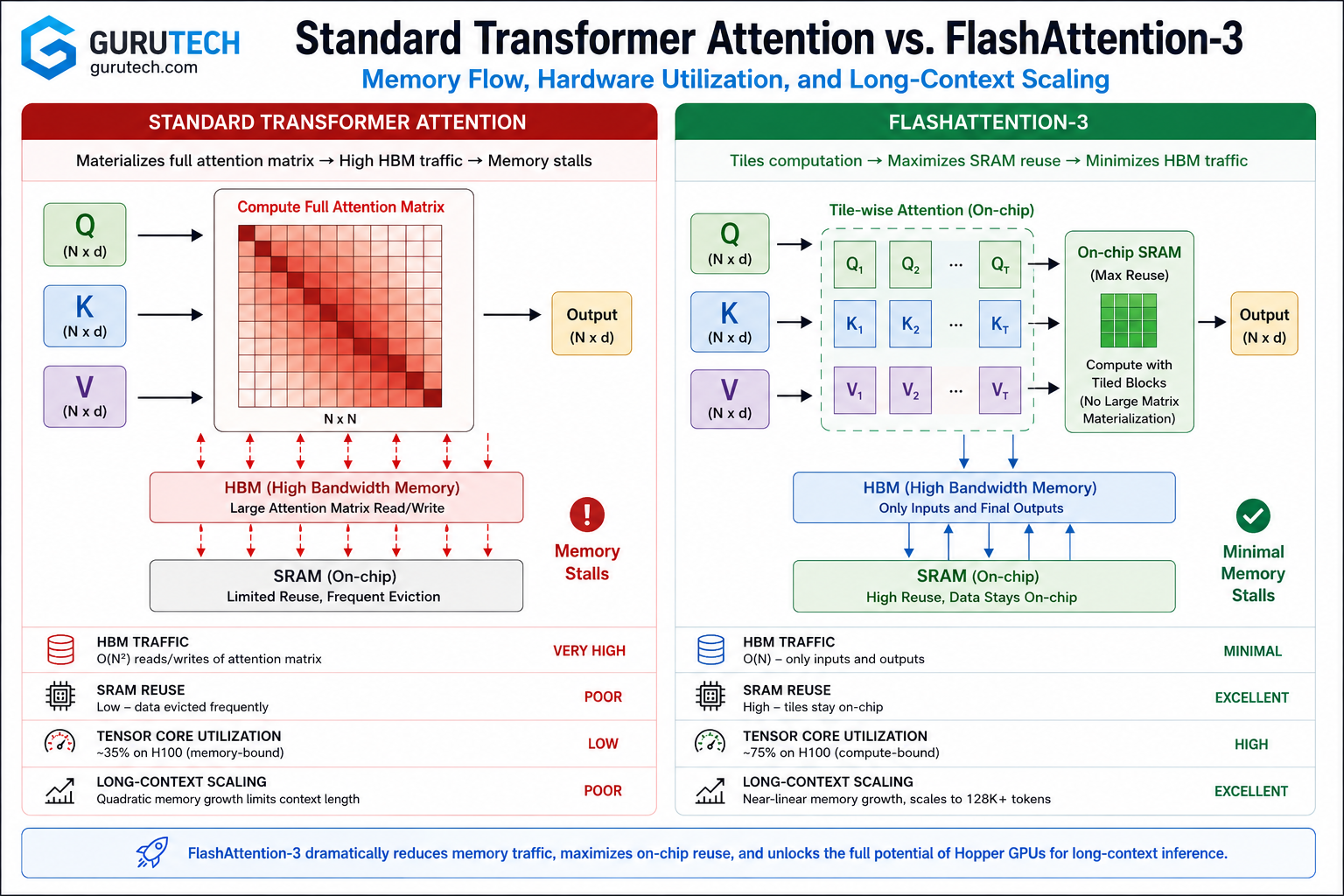
Speculative Decoding Architecture: Accelerating Enterprise LLM Inference Without Sacrificing Accuracy

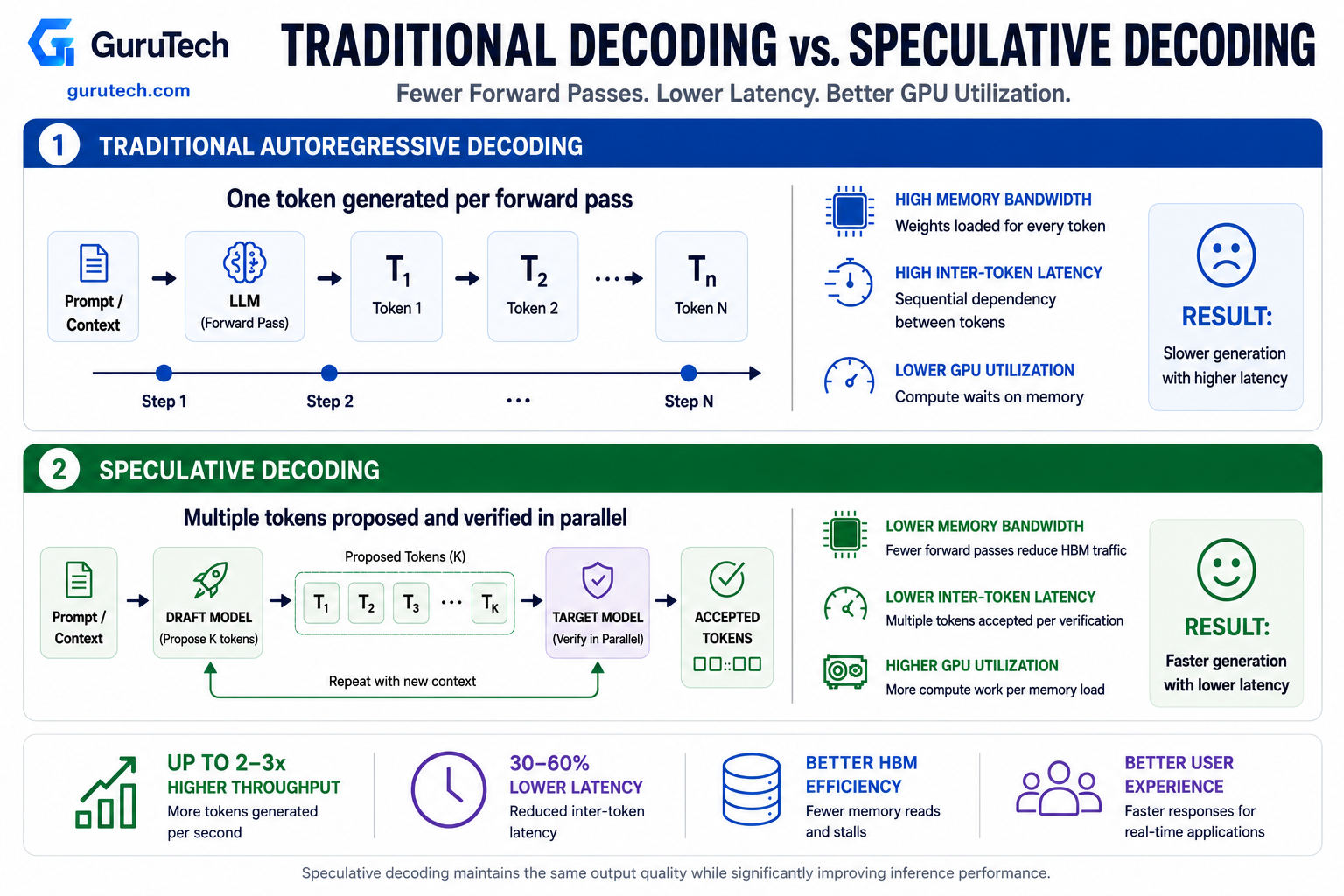
Traditional autoregressive decoding compared with speculative decoding architecture using draft models, parallel token verification, lower latency, and higher GPU utilization.

Large language model inference in production environments faces a fundamental constraint that no amount of hardware can fully eliminate. Every token your model generates requires loading billions of parameters from GPU memory, creating a memory bandwidth bottleneck that leaves compute cores underutilized. Speculative decoding architecture addresses this inefficiency by pairing your target model with a … Read more

DPO Fine-Tuning Architectures for Enterprise AI and Model Alignment

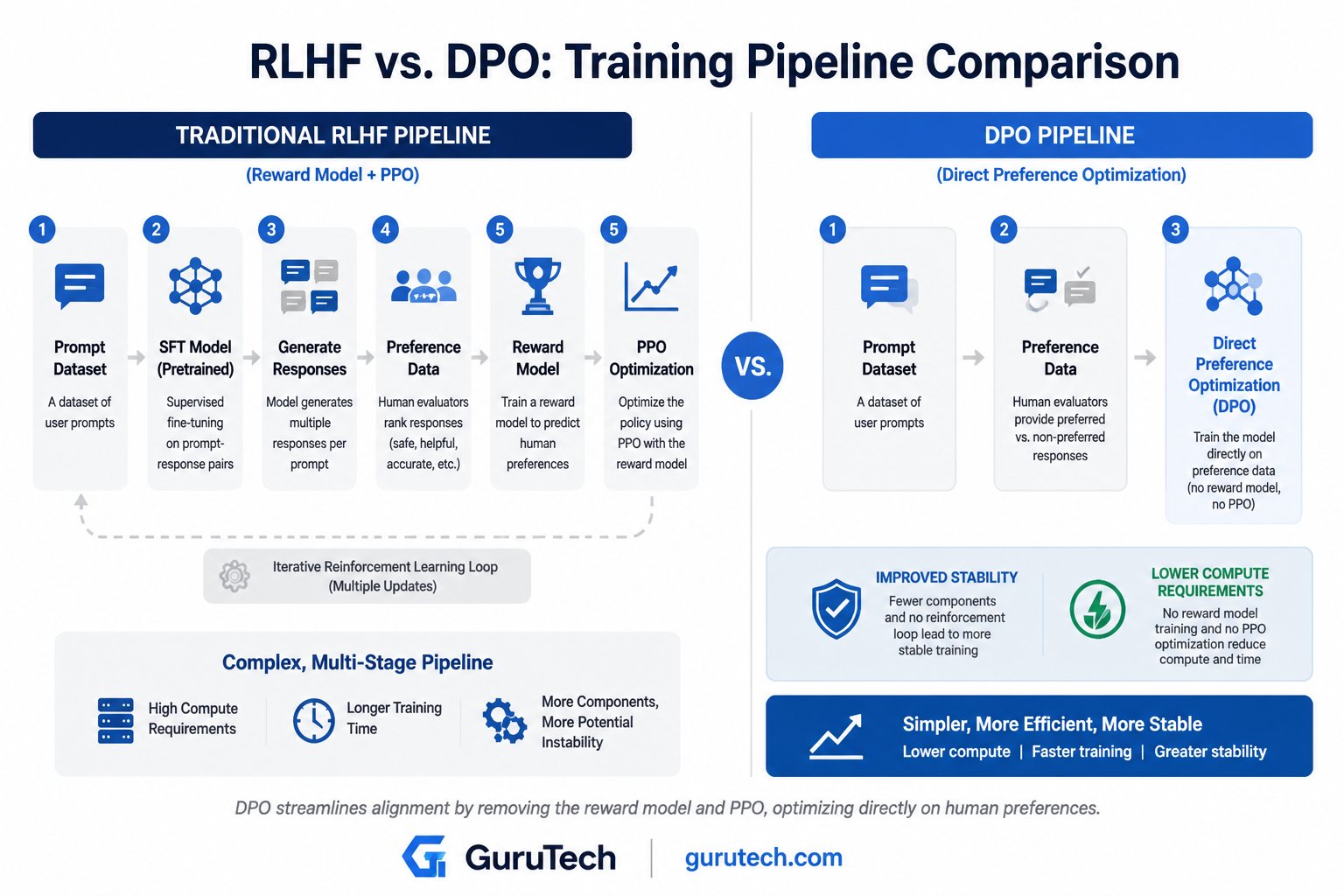
Comparison infographic showing the Traditional RLHF pipeline with reward model and PPO versus the simplified Direct Preference Optimization (DPO) pipeline for enterprise LLM alignment.

Enterprise AI teams are shifting from traditional Reinforcement Learning from Human Feedback (RLHF) to Direct Preference Optimization due to reduced architectural complexity and more stable training dynamics. DPO Fine-Tuning Architectures Direct Preference Optimization has become the preferred alignment technique for many enterprise AI teams because it simplifies the reinforcement learning pipeline into a stable supervised … Read more

Synthetic Data Curation Pipelines: The Complete Enterprise Guide

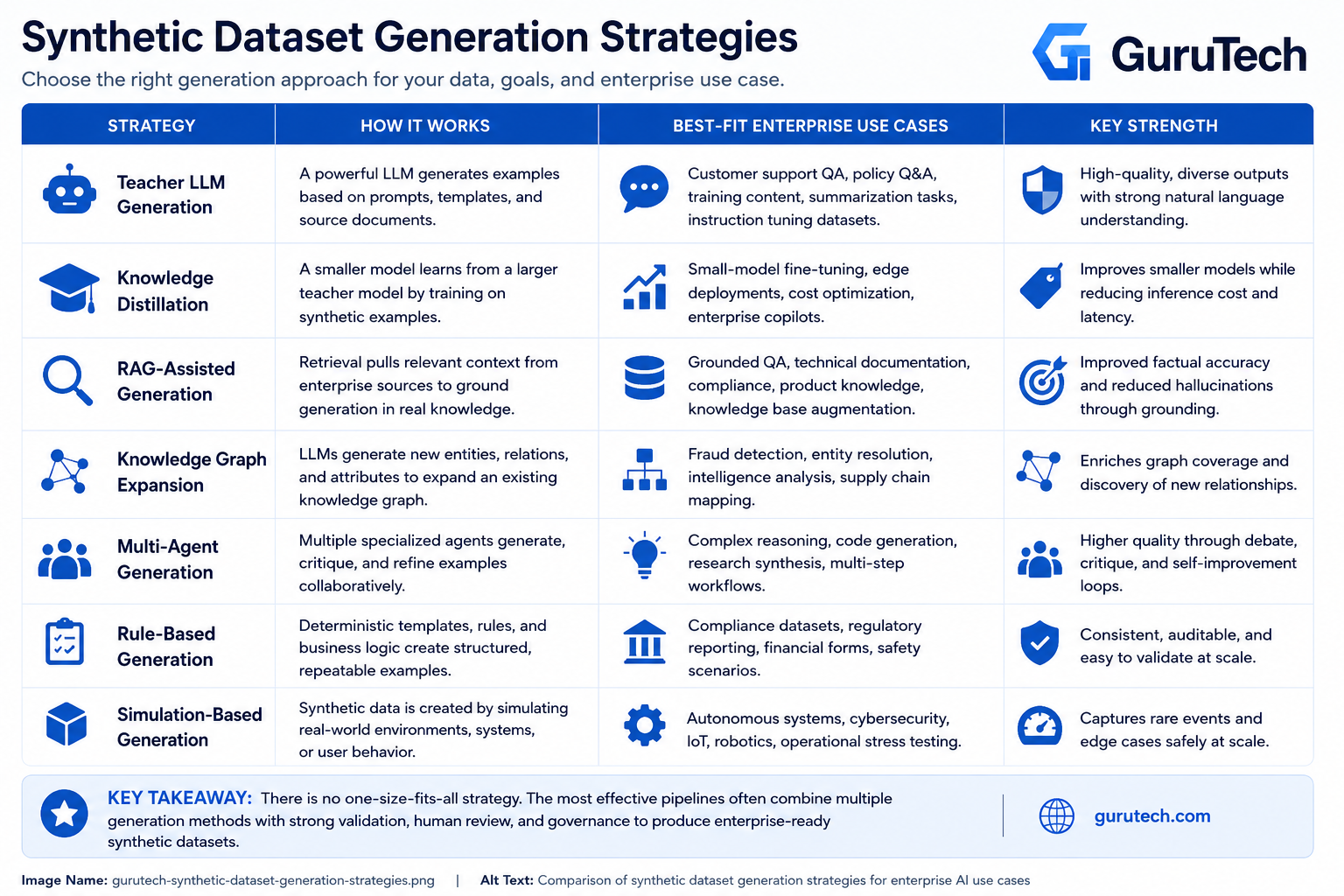
Comparison infographic showing synthetic dataset generation strategies including Teacher LLM Generation, Knowledge Distillation, RAG-Assisted Generation, Knowledge Graph Expansion, Multi-Agent Generation, Rule-Based Generation, and Simulation for enterprise AI use cases.

Enterprise AI initiatives rarely fail because organizations choose the wrong language model. More often, they fail because the underlying data is incomplete, inconsistent, duplicated, poorly labeled, or too expensive to prepare at scale. Most companies already own large volumes of valuable proprietary knowledge. It exists inside support tickets, contracts, policy documents, compliance reports, product manuals, … Read more

LoRA Fine Tuning Architectures: Advanced Guide to Enterprise AI Deployment

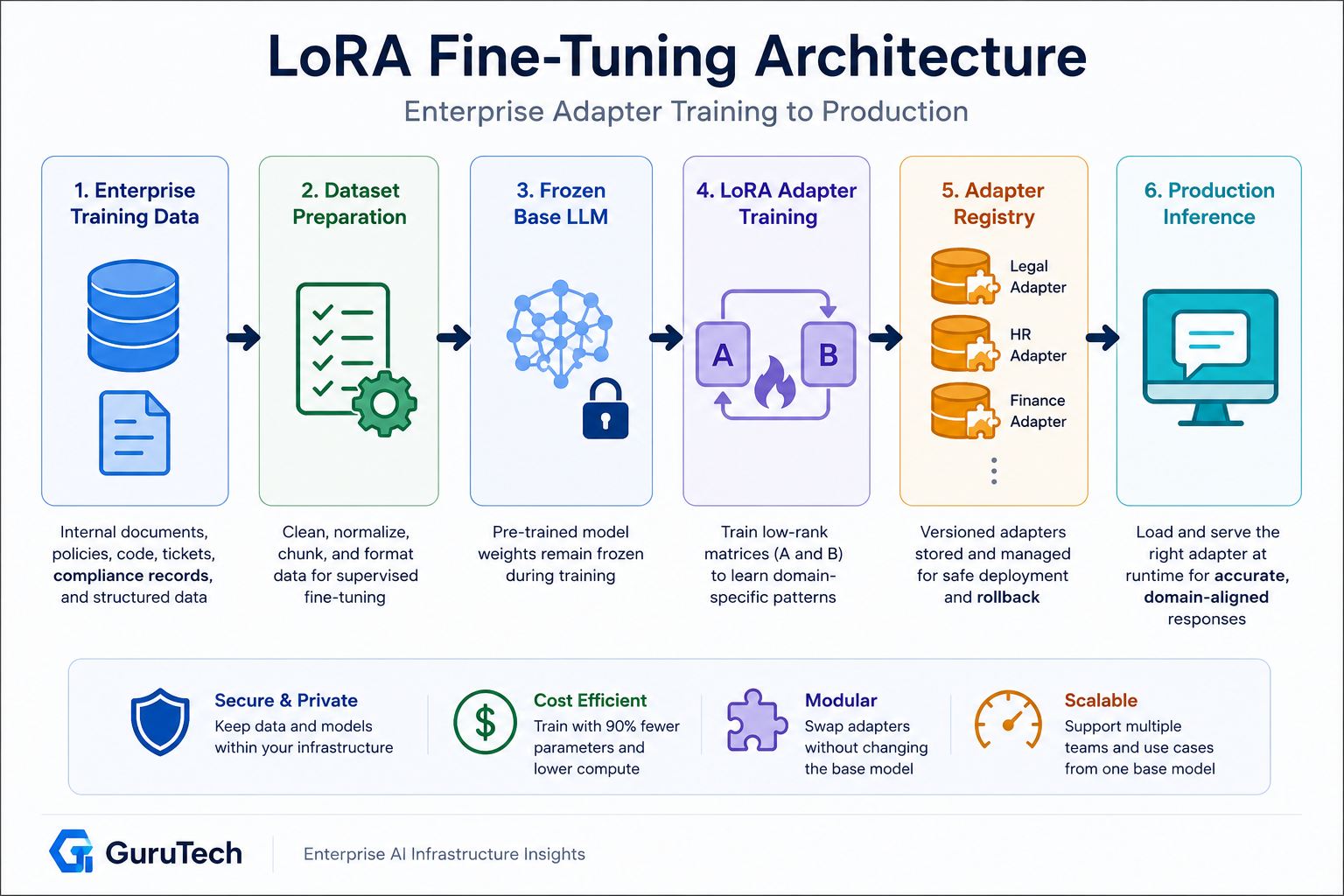
Enterprise LoRA fine-tuning architecture showing enterprise training data flowing through dataset preparation, frozen base LLM, LoRA adapter training, adapter registry, and production inference.

Many organizations successfully deploy Retrieval-Augmented Generation (RAG) for dynamic knowledge retrieval but eventually discover that retrieval alone cannot teach a model proprietary reasoning patterns, company-specific terminology, structured output formats, or internal coding conventions. RAG excels at surfacing relevant context from vector databases, yet the base model continues to generate responses using its pre-trained behavior rather … Read more

Local LLM Deployment Infrastructure: Zero-Trust Architectures for Secure Enterprise AI at Scale

Enterprise local LLM deployment infrastructure architecture showing user applications, API gateway, authentication, vLLM or Ollama model server, GPU workers, vector database, monitoring dashboard, and Kubernetes orchestration.

Organizations running production AI workloads face mounting pressure around data privacy regulations, API cost volatility, and network latency constraints that cloud-hosted language models cannot adequately address. Local LLM deployment infrastructure enables enterprises to achieve complete data sovereignty, sub-100ms inference latency, and predictable capital expenditure while maintaining full control over model versioning and security policies. The … Read more

Evaluation Frameworks GenAI Production: Reliable Enterprise-Scale Testing

Enterprise AI evaluation lifecycle diagram showing development, evaluation framework, CI/CD pipeline, production deployment, and monitoring feedback loop with automated quality gates for production GenAI systems.

An enterprise AI team replaces their vector database with a graph-based retriever, adjusts the prompt template, and switches from GPT-4 to Claude 3.5. The new system feels more coherent during spot checks, but no one can prove whether accuracy improved, latency degraded, or hallucination rates changed. Without systematic measurement, every deployment becomes a gamble dressed … Read more

GraphRAG Architecture for Enterprise AI: Building Knowledge Graph Retrieval Systems Beyond Vector Search

Microsoft GraphRAG architecture diagram comparing local search using entity-level graph traversal with global search using community summaries for enterprise knowledge retrieval.

Most enterprises deploying Retrieval-Augmented Generation systems quickly discover that vector search alone cannot handle complex organizational knowledge. GraphRAG architecture for enterprise AI combines knowledge graphs with vector embeddings to enable multi-hop reasoning, relationship-aware retrieval, and hierarchical query strategies that traditional semantic similarity approaches cannot achieve. Microsoft’s GraphRAG implementation represents a production-grade reference architecture that extracts … Read more

Enterprise Semantic Caching AI: Reduce LLM Costs with Vector-Based Query Reuse

Enterprise semantic caching AI architecture showing user query, embedding model, vector database cache layer, cache hit or miss routing, LLM processing, and response generation with reduced token usage and lower AI costs.

Enterprise AI adoption is moving quickly from experimentation to production. Customer support bots, internal copilots, document assistants, sales enablement agents, compliance chatbots, and workflow automation systems are no longer small proof-of-concept tools. They are becoming always-on infrastructure. That shift creates a new financial problem: every repeated user question can trigger a fresh large language model … Read more

10 Essential AI Token Observability Dashboard Metrics for Smarter AI Cost Control

Enterprise AI token observability dashboard showing token usage, cost per request, latency metrics, cache hit rates, workflow cost attribution, and model utilization across OpenAI, Claude, and n8n workflows.

Production AI systems burn through thousands of dollars in token costs each month. Most engineering teams have no visibility into where that spend goes or why certain requests cost 10x more than others. An AI token observability dashboard gives platform teams real-time telemetry on token consumption, model performance, latency percentiles, and cost attribution across every … Read more

Vector Databases for AI: Unlocking Robust Memory Architecture explained in 2026

Learn how vector databases for AI power memory systems, semantic search, and RAG workflows in 2026. Explore embeddings, AI agents, retrieval architecture, chunking strategies, and enterprise AI orchestration.

AI applications often stumble in production because they cannot reliably retrieve the right information at the right moment. Large language models process queries in isolation unless someone hooks them up to real knowledge systems. Vector databases for AI tackle this core problem by giving AI applications persistent, queryable memory—unlocking retrieval augmented generation, semantic search, and … Read more