
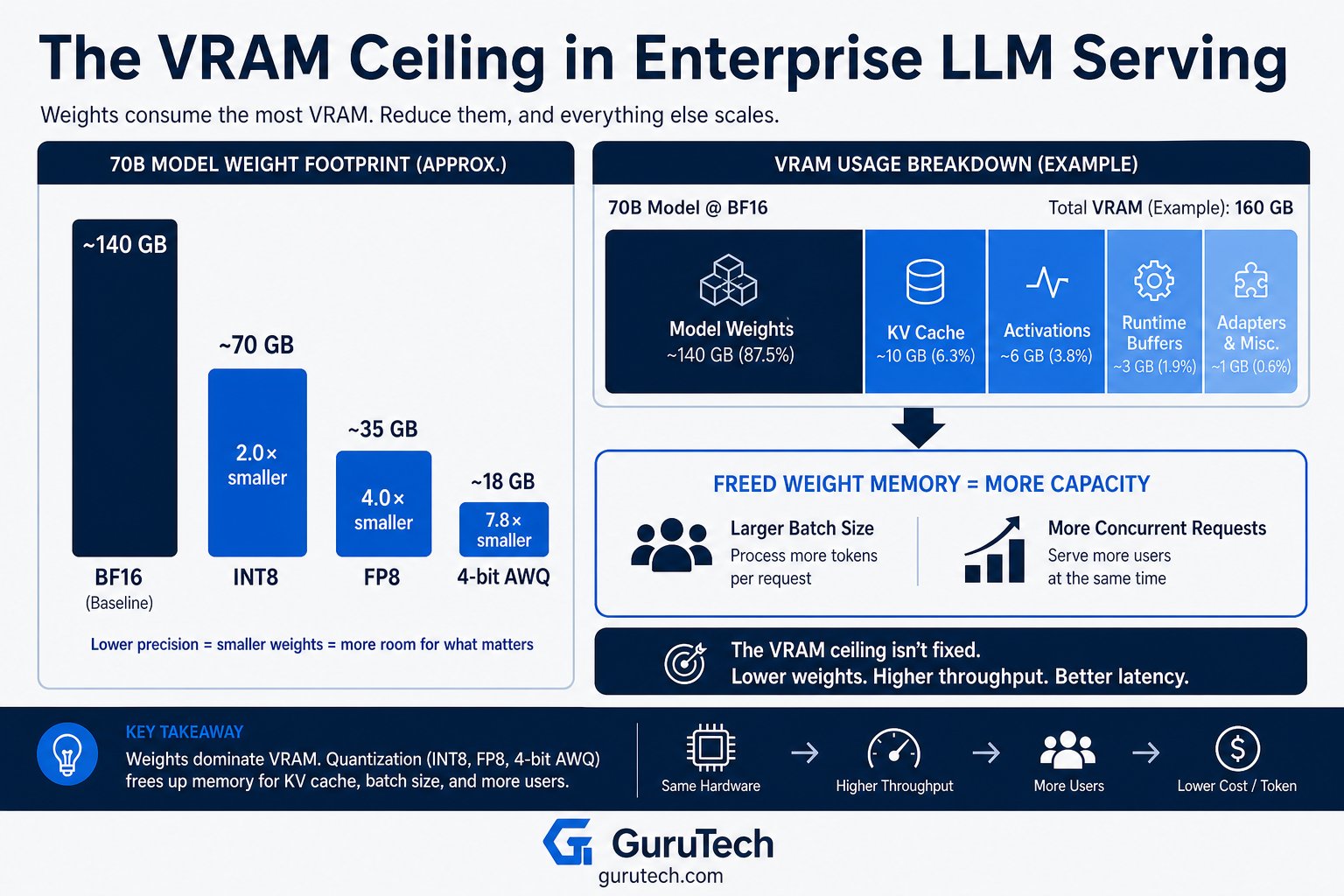
Serving FP16 or BF16 foundation models creates a near-linear relationship between parameter count, GPU memory allocation, and deployment cost. A 70-billion-parameter model stored in a 16-bit format requires approximately 140 GB for its weights alone, before the serving stack reserves memory for activations, KV cache, temporary tensors, communication buffers, and framework overhead.
Model quantization architectures are systemized methods for reducing the numerical precision used to store model weights, represent activations, or execute matrix operations. Their purpose is not merely to produce a smaller checkpoint, but to change the memory, bandwidth, concurrency, and hardware requirements of the complete inference system.
For a broader foundation in the underlying methods, the official PyTorch quantization documentation explains core concepts such as observers, calibration, static quantization, dynamic quantization, and quantization-aware training.
Kernel optimizations such as FlashAttention-3 Hardware Acceleration reduce attention-related memory movement and improve runtime execution. Quantization operates at a different layer by compressing the underlying model representation, freeing VRAM that can be reassigned to larger KV caches, longer context windows, continuous batches, additional adapters, or more concurrent sequences.
Quantization is not mandatory for every deployment. It becomes a practical requirement when model size, latency objectives, concurrency targets, or infrastructure budgets make full-precision serving operationally inefficient.
Key Takeaways
- Quantization reduces persistent model-weight memory and can improve serving density, but nominal bit depth does not equal end-to-end VRAM savings.
- AWQ prioritizes aggressive weight compression, while FP8 emphasizes hardware-native low-precision execution on compatible accelerators.
- Accuracy must be validated on domain-specific tasks because quantization error is not distributed uniformly across model capabilities.
- The correct decision depends on GPU generation, kernel support, batch behavior, context length, and cost per successful task.
The Mechanics of Quantization: Weight-Only vs. Activation-Aware Compression
Quantization maps high-precision tensor values into a smaller representable range. A scale factor defines the relationship between the original values and their lower-precision representation, while some asymmetric schemes also use a zero-point to shift the quantized range.
Weight-only quantization compresses persistent model parameters while keeping activations and many accumulation paths at higher precision. It can sharply reduce checkpoint and VRAM requirements, although the serving engine may still need to unpack or dequantize weights inside specialized kernels during execution.
Weight-and-activation quantization extends compression into runtime activations. This can reduce memory traffic further and enable native low-precision matrix operations, but activation distributions are more dynamic than static weights and are therefore more sensitive to clipping and outlier behavior.
Symmetric and Asymmetric Quantization
Symmetric quantization centers the representable integer range around zero and commonly uses one scale factor per tensor, channel, or group. Its simpler arithmetic and lack of a zero-point make it attractive for highly optimized kernels.
Asymmetric quantization adds a zero-point so non-centered distributions can use the available numerical range more effectively. The potential accuracy improvement must be balanced against metadata requirements and any extra arithmetic introduced by the execution path.
Per-Tensor, Per-Channel, and Per-Group Scaling
Per-tensor quantization uses one scale for an entire tensor. It minimizes metadata, but a small number of outlier values can force a wide quantization range and reduce effective resolution for the majority of weights.
Per-channel quantization derives separate scales for individual output channels, improving fidelity when channels have different distributions. Per-group quantization divides channels into groups, often providing a practical balance between compression quality, scale metadata, and kernel efficiency.
The finest scaling granularity does not automatically produce the fastest deployment. More scale values consume memory, increase lookup activity, and may not align with the grouping expected by the target CUDA or tensor-core kernel.
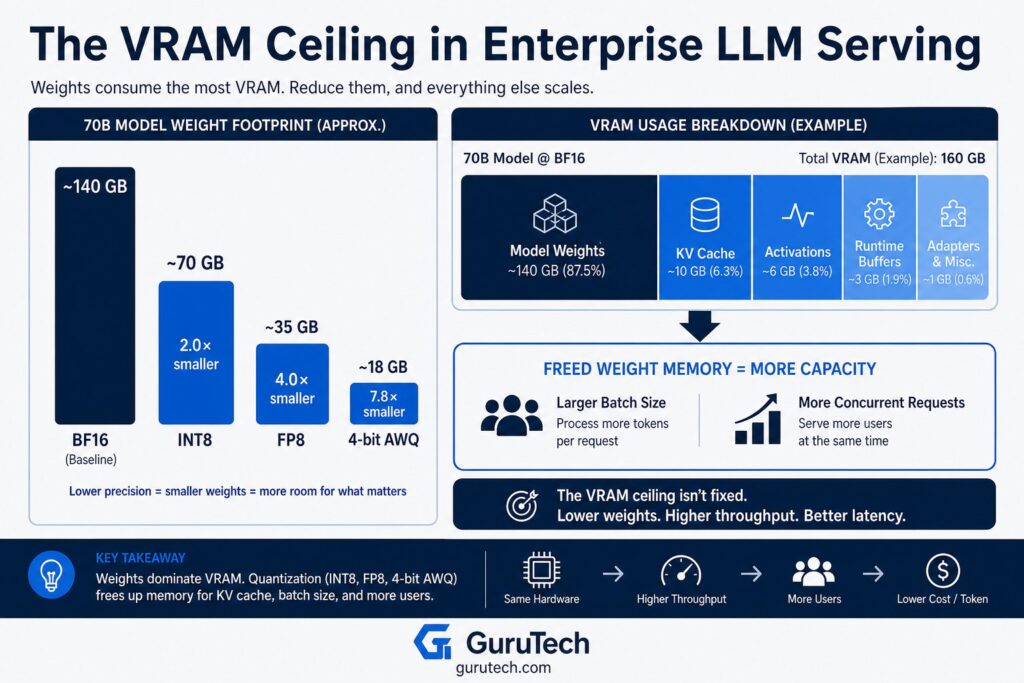
How Activation-Aware Weight Quantization Protects Salient Channels
Naive uniform weight quantization treats all channels as if their errors have equal downstream impact. In practice, a small subset of weights interacts with high-magnitude activations and contributes disproportionately to the model output.
Activation-Aware Weight Quantization uses a representative calibration pass to observe activation distributions and identify activation-sensitive channels. AWQ then adjusts scaling so important weights experience less destructive rounding while less influential weights absorb more of the compression error.
AWQ should not be described as preserving a universal fixed percentage of parameters. The effective protection strategy depends on the model, calibration data, grouping configuration, and implementation.
The original Activation-Aware Weight Quantization research paper describes how activation statistics identify salient weight channels and how protective scaling reduces quantization error without requiring full model retraining.
Enterprise Legal-Document Example
Consider an automated parser that extracts obligations, exclusions, and breach conditions from commercial contracts. A small probability shift involving words such as “shall,” “may,” “unless,” or “material” can change whether a clause is interpreted as mandatory, optional, conditional, or legally significant.
A general-purpose calibration corpus may underrepresent those rare but consequential patterns. A production calibration set should therefore include representative legal clauses, nested conditions, unusual formatting, long definitions, and the document types that generate the highest business risk.
Aggregate perplexity alone may not reveal the regression. Teams should measure clause classification, entity extraction, structured-output validity, and human-review escalation rates before accepting a quantized model for compliance-sensitive workflows.
Quantization Bit-Depth and Memory Overhead Evaluation Matrix
Storage precision, execution precision, and accumulation precision are separate architectural choices. A model may store weights at 4 bits, unpack them into a compute-friendly format inside a fused kernel, retain activations in FP16 or BF16, and accumulate partial results at a higher precision.
Raw bit ratios provide only an upper bound on memory reduction. Scale factors, zero-points, packing metadata, unquantized layers, embeddings, output heads, KV cache, and temporary runtime buffers reduce the end-to-end savings visible to the serving platform.
| Quantization Precision Vector | Compute-to-Memory Bottleneck | Enterprise Engineering Recommendation |
|---|---|---|
| BF16 Baseline | High weight-memory consumption and memory-bandwidth demand, but broad accelerator support and stable numerical behavior. | Use as the reference baseline for quality, latency, throughput, and cost comparisons. Retain it for sensitive workloads when infrastructure capacity is sufficient. |
| INT8 Weight-and-Activation Quantization | Reduces raw weight and activation representation from 16 to 8 bits where supported, but requires calibrated activation ranges and efficient INT8 kernels. | Choose when broader hardware support and lower quality risk matter more than the maximum compression ratio. |
| 4-Bit GPTQ-Style Weight-Only Quantization | Strong reduction in weight traffic and VRAM usage, with runtime behavior determined by group size, packing format, and kernel support. | Use for post-training compression when a compatible checkpoint and optimized backend are available. Validate reasoning and code-generation regressions carefully. |
| 4-Bit AWQ Weights | Maximizes model-weight headroom while retaining higher-precision activations. Runtime unpacking or dequantization may constrain latency when optimized kernels are unavailable. | Prefer when VRAM capacity, model fit, or serving density is the primary constraint and representative calibration data is available. |
| Native FP8 Precision | Reduces weight and execution precision while leveraging native low-precision tensor-core paths on compatible modern data-center GPUs. | Prefer for newer Hopper- or Blackwell-class infrastructure when sustained throughput and hardware-native execution matter more than maximum compression. |
| Mixed-Precision Accumulation | Low-precision storage and multiplication reduce memory traffic, while higher-precision accumulation limits underflow, overflow, and accumulated rounding error. | Use as the default stability mechanism for compressed deployments unless validated kernels and workloads justify more aggressive accumulation precision. |
Vector databases operate in the retrieval layer and should be tuned independently from model-weight arithmetic. Embedding precision, index structure, and retrieval recall are related infrastructure decisions, but they do not determine the numerical accumulation path inside the language model.
AWQ vs. FP8 for Model Quantization Architectures
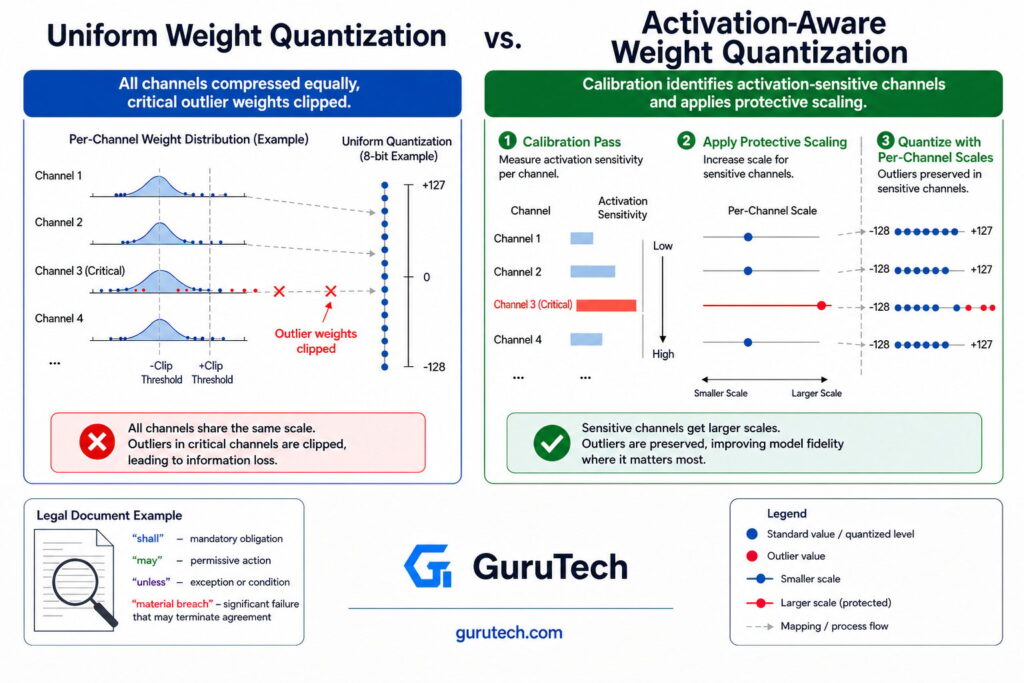
AWQ and FP8 occupy different positions in the inference stack. AWQ is primarily a weight-compression strategy, while FP8 is a low-precision floating-point format designed for native execution on supported accelerator hardware.
Four-bit AWQ can reduce raw weight storage to roughly one-quarter of a 16-bit representation before metadata and unquantized components are counted. This can make a large checkpoint fit within fewer GPUs or leave substantially more VRAM available for KV cache and continuous batching.
The trade-off is that compressed integer weights must be unpacked or dequantized into a representation usable by the matrix kernel. Highly optimized fused kernels can reduce that cost, but unsupported GPU and software combinations may deliver memory savings without proportional throughput gains.
FP8 generally consumes more weight memory than a 4-bit format, but compatible tensor cores can execute FP8 matrix operations directly. This can produce predictable high-throughput behavior on modern data-center accelerators without relying on the same integer-weight unpacking path.
The NVIDIA FP8 specification overview explains the standardized low-precision floating-point formats developed for AI workloads and their role in modern accelerator execution.
| Operational Benchmarking Vector | Activation-Aware (AWQ) 4-Bit | Native Data Center FP8 |
|---|---|---|
| Raw Weight Memory | Approximately one-quarter of a 16-bit weight representation before scales, metadata, and unquantized layers. | Approximately one-half of a 16-bit representation before runtime overhead. |
| Runtime Decompression | Usually requires unpacking or dequantization, often fused into specialized kernels. | No equivalent integer-weight unpacking path when executed natively on supported hardware. |
| Hardware Compatibility | Can support a wider range of GPUs, but performance varies sharply by backend and kernel implementation. | Requires accelerator and framework support for native FP8 execution. |
| Accuracy Retention | Strong for many workloads when calibration data represents production traffic, but task-specific regressions must be measured. | Typically closer to 16-bit behavior, although calibration and scaling strategy still matter. |
| Single-Request Latency | May improve, remain flat, or regress depending on memory bandwidth, unpacking overhead, and batch size. | Often benefits from native tensor-core execution on supported accelerators. |
| High-Concurrency Throughput | Can increase significantly when freed VRAM allows larger batches and more active sequences. | Strong fit for modern high-throughput data-center serving where native FP8 kernels are available. |
| Deployment Complexity | Requires compatible quantized checkpoints, calibration choices, group settings, and backend-specific kernels. | Requires newer hardware, compatible drivers, frameworks, and validated FP8 scaling behavior. |
| Best-Fit Enterprise Environment | Memory-constrained environments, infrastructure reuse, and deployments where fitting a larger model is the dominant objective. | Modern data-center fleets prioritizing native throughput, predictable acceleration, and standardized low-precision execution. |
Choose AWQ when model fit, VRAM capacity, or reuse of existing infrastructure matters most. Choose FP8 when the organization already operates compatible modern accelerators and sustained native throughput is the dominant requirement.
Post-Training Quantization vs. Quantization-Aware Training
Post-training quantization applies reduced-precision mappings after the base model has completed training. Engineers use a calibration dataset to estimate clipping ranges, group scales, zero-points, or activation statistics without repeating the full pretraining process.
This approach is attractive because it shortens the deployment cycle and allows infrastructure teams to test multiple precision formats against the same model baseline. AWQ, GPTQ-style methods, and many INT8 workflows fall into this operational category, although their internal optimization objectives differ.
For activation-sensitive INT8 deployment, the SmoothQuant research paper presents a post-training method that migrates quantization difficulty from activations into weights, helping transformers execute efficiently with W8A8 precision.
The quality of post-training quantization depends heavily on the calibration distribution. A small but representative corpus can be more useful than a large generic dataset when the production workload contains specialized vocabulary, structured outputs, code, multilingual content, or long-context retrieval prompts.
Quantization-aware training introduces simulated rounding, clipping, or reduced-precision effects during training or fine-tuning. The model learns parameters that are more resilient to the precision constraints it will encounter at inference time.
Teams implementing these workflows through common model libraries can consult the official Hugging Face Transformers quantization documentation for supported backends, configuration classes, and model-loading patterns.
This can preserve quality at aggressive bit depths, but it requires additional compute, training data, optimizer state, checkpoint management, and validation. It also introduces another model lineage that must be governed separately from the original full-precision model.
| Engineering Dimension | Post-Training Quantization | Quantization-Aware Training |
|---|---|---|
| Training Requirement | No full retraining; relies on calibration and offline weight transformation. | Requires additional training or fine-tuning with simulated quantization effects. |
| Deployment Speed | Fastest path for evaluating multiple backends and precision targets. | Longer iteration cycle due to training, checkpointing, and expanded regression testing. |
| Accuracy Retention | Often sufficient at INT8 or well-calibrated 4-bit weight-only precision, but workload dependent. | Can improve resilience at aggressive bit depths or on highly sensitive tasks. |
| Engineering Cost | Lower, because the main work is calibration, conversion, and serving validation. | Higher, because it adds training infrastructure and model-governance overhead. |
| Best-Fit Scenario | Rapid optimization of an existing production model across several hardware targets. | High-volume deployments where a small quality improvement justifies a dedicated training pipeline. |
QLoRA is related but solves a different problem. It keeps a low-bit frozen base model in memory while training LoRA adapters, reducing fine-tuning memory requirements without making every resulting deployment equivalent to a quantization-aware training pipeline.
Teams using adapter-based domain specialization should evaluate the interaction between the quantized base model and adapter precision. The LoRA Fine-Tuning Architectures guide explains how shared base models, adapter routing, and parameter-efficient training affect the broader deployment design.
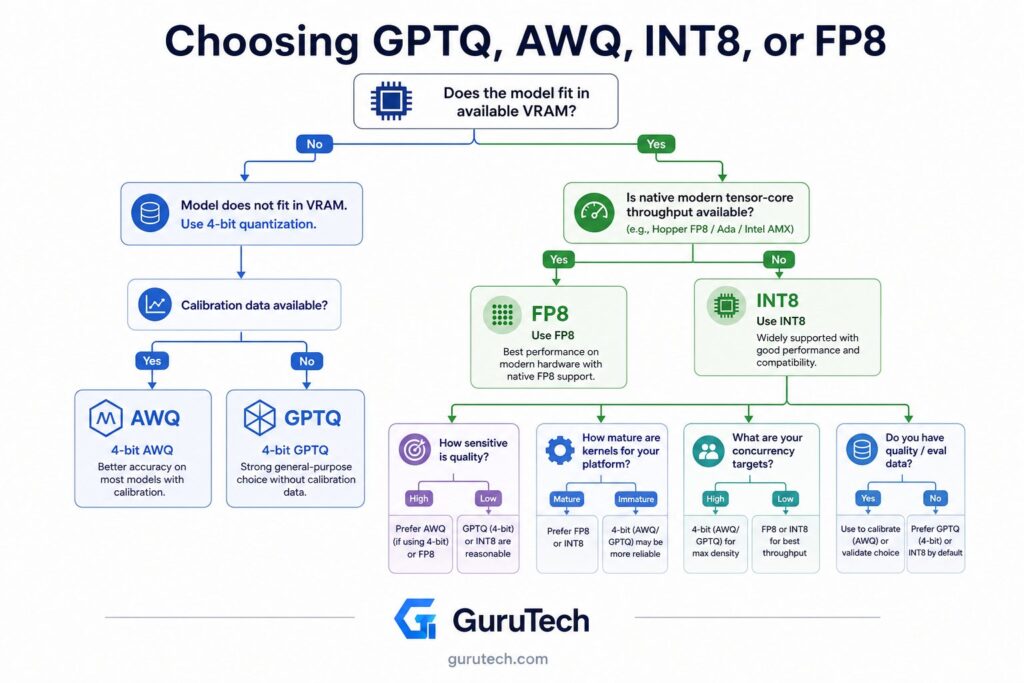
GPTQ, AWQ, and INT8: Choosing a Weight Compression Strategy
GPTQ-style quantization, AWQ, and INT8 compression should not be treated as interchangeable labels. Each method optimizes a different balance among reconstruction error, activation sensitivity, hardware support, checkpoint portability, and runtime kernel behavior.
GPTQ-style methods quantize weights while minimizing layer-level or block-level reconstruction error. They are useful when an existing model must be converted after training and when the target runtime provides kernels designed for the resulting packed format.
The original GPTQ research paper details the approximate second-order optimization used to produce accurate low-bit, post-training weight quantization for large transformer models.
AWQ uses activation statistics to identify weights that exert disproportionate influence on model outputs. It often performs well when calibration prompts accurately represent the production domain and when 4-bit model fit is more important than preserving a completely hardware-native floating-point execution path.
INT8 weight-only quantization provides a less aggressive compression ratio but usually carries lower accuracy risk. INT8 weight-and-activation schemes can reduce runtime memory traffic further, although they require activation calibration and hardware kernels capable of executing the selected format efficiently.
The correct choice depends on the bottleneck. A model that does not fit within the available VRAM pool may justify 4-bit AWQ even if isolated-request latency remains unchanged, because fitting the model on fewer devices can simplify topology and reduce replica cost.
A model that already fits comfortably but must serve a high sustained batch rate may benefit more from FP8 or INT8 paths that align directly with native tensor-core execution. In that case, maximum compression is less important than predictable throughput and operational consistency.
Checkpoint availability is also an architectural constraint. A theoretically attractive format has limited enterprise value when the model conversion pipeline is unstable, the runtime lacks mature kernels, or the chosen configuration cannot be reproduced across development, staging, and production.
Platform teams should maintain a compatibility matrix covering model family, quantization method, group size, GPU architecture, driver version, serving framework, tensor-parallel configuration, and supported attention kernels. This prevents a model artifact from being promoted into an environment where the packed format silently falls back to a slower execution path.
Code-Level Implementation: Initializing Quantized Serving Layers in vLLM
The serving engine must use a loading and execution path that matches the quantized checkpoint. Explicitly declaring the quantization backend prevents the runtime from treating the model as a standard FP16 or BF16 allocation.
Before deploying a converted checkpoint, verify the currently supported formats and parameters in the official vLLM quantization documentation, because backend compatibility varies by model architecture, GPU generation, and installed vLLM version.
python -m vllm.entrypoints.openai.api_server \
    --model enterprise-core-70b-awq \
    --quantization awq \
    --gpu-memory-utilization 0.85 \
    --max-model-len 4096 \
    --tensor-parallel-size 2
--model selects a checkpoint that has already been prepared with AWQ-compatible weights and metadata. The checkpoint format must match the backend expected by the installed vLLM version.
--quantization awq selects the AWQ loading and kernel path rather than the standard full-precision path. This reduces persistent model-weight allocation, but it does not force every runtime tensor into 4-bit precision.
--gpu-memory-utilization 0.85 leaves headroom for CUDA graphs, temporary workspaces, communication buffers, KV cache growth, and workload variability. Setting this value too aggressively can produce out-of-memory failures even when the packed model weights appear to fit.
--max-model-len 4096 constrains the maximum sequence length and therefore limits the maximum per-sequence KV-cache allocation. This parameter must reflect actual workload requirements rather than a theoretical model maximum.
--tensor-parallel-size 2 partitions the model across two GPUs. Quantized weight sharding reduces per-device model memory, but tensor-parallel communication and interconnect bandwidth can still become bottlenecks.
Activations, KV cache, temporary tensors, normalization layers, selected embeddings, and accumulation paths may remain in FP16, BF16, FP32, or another higher-precision format. Production teams should pin the framework, CUDA, driver, and model-checkpoint versions, then benchmark the exact GPU combination before rollout.
Enterprise Deployment Architecture for Quantized LLM Serving
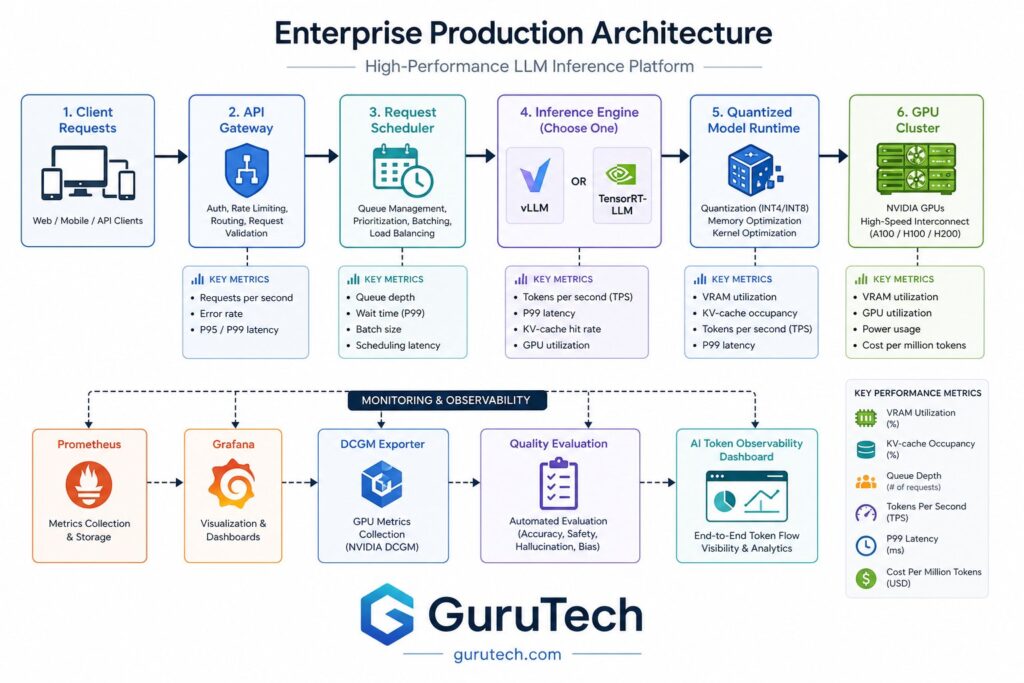
A production quantization strategy extends beyond the checkpoint. Client requests pass through an API gateway and scheduler before reaching the serving engine, which determines batch formation, sequence admission, model execution, and KV-cache placement.
The core path typically follows: Client Requests → API Gateway → Request Scheduler → vLLM or TensorRT-LLM → Quantized Model Runtime → GPU Cluster → Telemetry and Quality Monitoring. The compressed checkpoint changes how much model memory each replica consumes, while the scheduler determines whether that headroom becomes useful concurrency.
For NVIDIA-focused deployments, the official TensorRT-LLM documentation provides current guidance on supported quantization methods, optimized kernels, parallel execution, and production serving configurations.
Continuous batching can use freed VRAM to keep more sequences active at the same time. This often improves tokens per GPU-hour even when the latency of an isolated request changes only modestly.
Long-context workloads may consume most of the reclaimed capacity through KV cache. Teams should therefore model weight memory and KV-cache memory separately rather than assuming that a smaller checkpoint automatically guarantees a fixed concurrency improvement.
Tensor parallelism remains important when a quantized model still exceeds single-device capacity or when throughput targets require multiple devices. Quantization reduces the data stored per device, but NCCL communication, synchronization, and interconnect topology continue to affect end-to-end performance.
For a broader production topology, see the Local LLM Deployment Infrastructure guide. Quantization should be treated as one layer within the serving platform rather than as a replacement for scheduling, autoscaling, monitoring, or deployment governance.
Hardware Compatibility and Capacity Planning
Quantization decisions must be grounded in the accelerator generation that will execute the model. The same checkpoint can exhibit different latency, throughput, and memory behavior across consumer GPUs, Ampere data-center devices, Hopper systems, and Blackwell-class infrastructure because kernel availability and native precision support differ.
Older accelerators may benefit from 4-bit weight compression primarily because the model fits in fewer devices or leaves more space for KV cache. However, they may not expose the same native low-precision tensor-core path available on newer hardware, so runtime unpacking and memory movement can dominate the realized performance.
Modern Hopper and Blackwell platforms make FP8 more attractive because the hardware, compiler stack, and inference frameworks are designed to execute low-precision floating-point operations directly. This does not remove the need for calibration or validation, but it reduces the gap between nominal format support and practical execution.
Capacity planning should begin with a memory budget rather than a model-size estimate alone. The budget must include packed weights, scales, zero-points, unquantized layers, KV cache, activations, CUDA graphs, temporary workspaces, NCCL buffers, adapter memory, and a safety margin for workload variation.
For a tensor-parallel deployment, divide persistent model memory across devices but do not assume every runtime allocation partitions evenly. Some buffers may be replicated, and communication workspaces can grow with parallel degree and backend configuration.
Context length has a different scaling law from model weights. Weight memory remains mostly fixed per replica, while KV-cache memory grows with active tokens, layer count, hidden dimensions, precision, and concurrent sequences.
This distinction explains why a compressed model can fit comfortably during startup and still fail under production load. The scheduler may admit enough long sequences to exhaust the remaining memory even though the checkpoint itself occupies far less VRAM than the BF16 baseline.
Engineers should create at least three load profiles: short interactive prompts, mixed enterprise traffic, and long-context stress. Each profile should measure stable concurrency, queue growth, preemption, tokens per second, and out-of-memory behavior.
Interconnect topology also matters. Reducing weight memory can allow a model to move from four GPUs to two, which may lower communication overhead and simplify placement, but a two-device tensor-parallel layout can still underperform if the devices communicate over a weak PCIe topology rather than a high-bandwidth fabric.
Replica density should be evaluated alongside tensor parallelism. A more aggressively quantized model may permit multiple replicas per node, improving fault isolation and request scheduling, while a higher-precision model may require one large multi-GPU replica with less flexible scaling.
Capacity models should therefore report both maximum theoretical fit and maximum stable production fit. The latter includes operational headroom, burst traffic, monitoring agents, model reloads, rolling upgrades, and temporary memory spikes during graph capture or kernel initialization.
| Capacity Planning Variable | Why It Matters | Validation Method |
|---|---|---|
| Persistent Weight Memory | Determines baseline replica footprint and minimum device count. | Measure after model load using the exact checkpoint and backend. |
| KV-Cache Growth | Drives memory use as context length and active sequences increase. | Run representative and worst-case prompt distributions. |
| Runtime Workspace | Includes CUDA graphs, temporary tensors, and kernel-specific buffers. | Observe peak allocated and reserved memory under sustained load. |
| Parallel Communication | Can offset compute gains when tensor parallelism introduces synchronization overhead. | Measure collective time, link utilization, and scaling efficiency. |
| Operational Headroom | Prevents transient memory spikes from causing instability. | Maintain a defined reserve and test rolling reloads under traffic. |
Finally, teams should record capacity results as versioned infrastructure artifacts rather than informal benchmark notes. A model-format change, driver update, kernel revision, or scheduler configuration can materially change the safe concurrency envelope.
Production approval should therefore bind the quantized checkpoint to a tested deployment manifest containing GPU type, framework version, quantization backend, tensor-parallel degree, context limit, memory-utilization setting, and accepted quality thresholds. This makes later regressions easier to isolate and prevents an apparently identical model from being deployed through an unvalidated execution path.
Combining Quantization with FlashAttention and Speculative Decoding
Quantization, FlashAttention, and speculative decoding address different bottlenecks. Quantization reduces model-weight storage and memory traffic, FlashAttention improves attention-kernel execution, and speculative decoding reduces the number of expensive target-model decoding steps.
These techniques can be complementary, but their gains should not be multiplied mechanically. Once weight traffic is reduced, the system may become more sensitive to KV-cache bandwidth, attention performance, draft-model acceptance rate, scheduler efficiency, or tensor-parallel communication.
Benchmark combined configurations with identical prompt distributions, output lengths, batch sizes, concurrency levels, and generation parameters. Compare the result against both the full-precision baseline and each optimization applied independently.
The Speculative Decoding Architecture guide explains how a smaller draft model can reduce target-model decoding work. The FlashAttention article explains how attention-specific kernel improvements can complement a compressed weight layout.
Benchmarking Accuracy, Throughput, and Per-Token Cost
A quantized model should be evaluated against the original FP16 or BF16 deployment, not against an unrelated model or different serving configuration. Use the same tokenizer, prompts, sampling settings, context limits, hardware topology, and scheduler configuration.
For reproducible benchmark coverage, the LM Evaluation Harness provides a widely used framework for testing language models across standardized academic and task-oriented evaluations. Its results should complement, not replace, domain-specific production tests.
Model Quality Metrics
- Perplexity: useful as a broad distribution-level indicator, but insufficient for approving business-critical workloads.
- Domain-specific accuracy: measures performance on the actual legal, financial, coding, support, or technical tasks the model serves.
- Structured-output validity: tracks JSON schema compliance, field completeness, and parse failures.
- Tool-call success rate: measures correct tool selection, argument generation, and execution completion.
- Hallucination and regression rates: identify quality changes that may not appear in aggregate language-model benchmarks.
Runtime Metrics
- Time to first token: captures prefill, queueing, model loading, and scheduling effects.
- Inter-token latency: isolates decode responsiveness for streaming applications.
- Tokens per second: should be measured per request and across the full server.
- Maximum stable concurrency: determines how many active requests can run without unacceptable tail latency or memory failures.
- VRAM and KV-cache occupancy: shows whether compressed weights are actually creating usable runtime headroom.
Cost Metrics
- Requests per GPU: measures replica density and active-sequence capacity.
- Tokens per GPU-hour: normalizes throughput against accelerator time.
- Cost per million tokens: translates infrastructure consumption into a comparable financial metric.
- Cost per successful task: accounts for retries, malformed outputs, human review, and quality failures.
A model that uses less memory but produces lower throughput or more failed outputs may not reduce total platform cost. Production telemetry should therefore combine infrastructure metrics with model-quality outcomes through an AI Token Observability Dashboard.
When Quantization Hurts
Quantization error is capability-dependent. Mathematical reasoning, code generation, long-context recall, structured output, multilingual generation, and rare domain terminology can regress more than general conversational quality.
Calibration-dataset mismatch is a major source of failure. A model calibrated on short general conversations may behave differently on long legal clauses, financial disclosures, source code, retrieval-augmented prompts, or deeply nested JSON schemas.
Agentic workflows amplify small probability changes because a different tool name, argument, or branch decision can alter the entire execution path. Validate quantized models with end-to-end task tests rather than relying solely on perplexity or a single public benchmark.
Teams using low-bit fine-tuning should also distinguish inference quantization from the training architecture described in LoRA Fine-Tuning Architectures. QLoRA reduces training memory by combining a quantized base model with trainable adapters, but it does not remove the need to validate the final serving format.

Monitoring Quantized Models in Production
Quantization validation does not end when the compressed checkpoint passes an offline benchmark. Production traffic can expose regressions that appear only at long context lengths, high concurrency, uncommon prompt categories, or specific combinations of model format and GPU type.
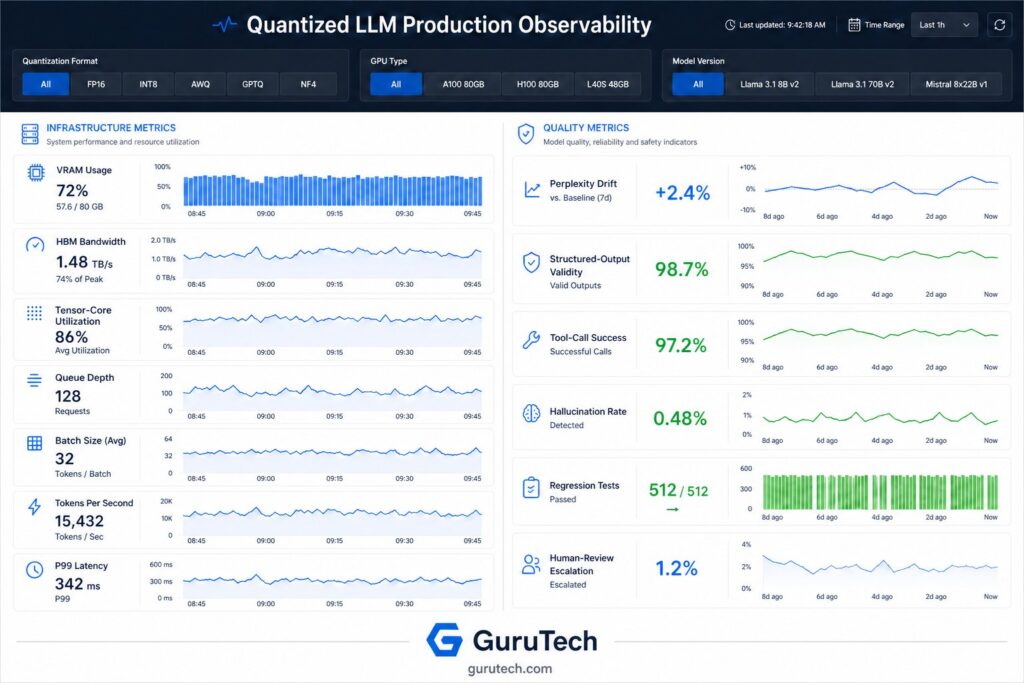
Infrastructure telemetry should track GPU memory consumption, memory-bandwidth utilization, tensor-core activity, queue depth, active sequence count, batch size, tokens per second, and P50, P95, and P99 latency. Out-of-memory events and scheduler preemption rates are especially important because they reveal whether the expected VRAM headroom is actually available under load.
Quality telemetry should include structured-output validity, tool-call success, hallucination indicators, policy failures, human-review escalation, and domain-specific regression tests. A quantized model can retain general perplexity while becoming less reliable on a narrow but business-critical task.
Metrics should be segmented by model version, quantization format, serving backend, GPU generation, prompt category, context length, and output length. Without this segmentation, an aggregate dashboard may hide that one hardware pool or one quantized checkpoint is responsible for most failures.
The AI Token Observability Dashboard can serve as the operational telemetry layer for tokens per second, queue depth, latency, utilization, and cost. Quantization-specific quality checks should be added alongside those infrastructure metrics rather than tracked in a separate, disconnected evaluation process.
Canary deployment is the safest rollout pattern. Route a small share of production traffic to the quantized model, compare outputs against the full-precision baseline where feasible, and expand traffic only after both quality and infrastructure thresholds remain stable.
Rollback criteria should be explicit. Examples include a rise in invalid JSON, a drop in tool-call completion, an increase in human escalation, sustained latency regression, or cost per successful task that exceeds the baseline despite lower nominal memory use.
Common Enterprise Quantization Mistakes
Assuming 4-bit weights deliver exact fourfold end-to-end VRAM savings. Raw weight storage may approach that ratio, but scales, zero-points, unquantized layers, embeddings, activations, KV cache, CUDA graphs, and temporary buffers reduce the effective saving.
Using a generic calibration dataset. Calibration should represent the prompts, languages, structured schemas, context lengths, and domain terminology seen in production. A mismatched dataset can protect the wrong activation patterns.
Selecting INT4 for every workload. Maximum compression is not always the best economic choice. FP8 or INT8 may produce better throughput and lower cost per successful task when compatible native hardware is available.
Ignoring kernel compatibility. A packed checkpoint can load successfully while using a fallback path that performs poorly. Benchmark the exact model, framework, CUDA version, driver, and accelerator combination.
Benchmarking only one request at a time. Quantization often creates the most value through higher batch capacity and serving density. Single-request latency alone cannot reveal those benefits.
Ignoring the KV cache. Weight compression may free substantial VRAM, but long-context or highly concurrent workloads can immediately consume that headroom through KV-cache growth.
Comparing inconsistent workloads. Prompt length, output length, batch size, sampling parameters, and concurrency must remain consistent across the full-precision and quantized tests.
Monitoring infrastructure without monitoring output quality. High tokens-per-second results are not useful when schema validity, tool-use reliability, or domain accuracy declines.
Assuming quantization error is uniform. Mathematical reasoning, code generation, rare terminology, multilingual output, and long-context retrieval can degrade at different rates.
Confusing semantic caching with KV-cache quantization. Semantic caching reuses previous responses or retrieval results for similar requests. KV-cache quantization reduces the memory used by attention state during active generation; the two techniques belong to different architectural layers.
Ecosystem Traffic Control: While compressing your local foundation models drastically lowers your VRAM overhead, scaling these savings across an entire business demands a centralized traffic routing layer. Deploying an enterprise-grade llm gateway orchestration proxy allows you to dynamically evaluate incoming application queries, sending routine data arrays to your quantized local nodes while safely isolating high-risk edge cases to cloud-based fallbacks.
Frequently Asked Questions
What are model quantization architectures?
Model quantization architectures are structured methods for reducing the precision used to store weights, represent activations, or execute model operations. They combine numerical formats, calibration policies, scaling granularity, kernel support, and serving-engine behavior into a complete deployment design.
How much VRAM can 4-bit quantization save?
A 4-bit weight representation is theoretically one-quarter the raw size of a 16-bit weight representation. Actual end-to-end savings are smaller because scales, metadata, unquantized layers, KV cache, activations, temporary tensors, and framework allocations remain.
Is AWQ better than FP8?
Neither is universally better. AWQ is usually the stronger option when maximum weight compression and model fit are the primary constraints, while FP8 is often better suited to newer accelerators where native low-precision throughput is the priority.
Does quantization reduce model accuracy?
It can. The effect depends on the model, bit depth, quantization algorithm, calibration data, group size, workload, and runtime implementation. Domain-specific evaluation is required because aggregate benchmarks may hide regressions in structured output, tool use, reasoning, or rare terminology.
Can quantized models use FlashAttention?
Yes, when the model architecture, serving engine, GPU, and kernel implementations are compatible. Quantization reduces model-weight memory, while FlashAttention optimizes attention execution, so the two techniques can address different bottlenecks in the same deployment.
Model Quantization Architectures: Auditing Per-Token Cost Reductions
The correct quantization decision balances VRAM capacity, memory bandwidth, native hardware support, runtime unpacking, accuracy retention, context requirements, concurrency targets, and per-token cost. Nominal bit depth is only the starting point.
A compressed model can reduce the number of GPUs required per replica or allow each replica to serve more active sequences. The financial benefit appears only when the serving stack converts that headroom into stable throughput without producing unacceptable quality regressions.
Use the following operational sequence:
- Establish an FP16 or BF16 baseline using production-like prompts and serving settings.
- Select candidate AWQ, GPTQ, INT8, and FP8 configurations supported by the target hardware and runtime.
- Calibrate with representative domain data, including high-risk and long-context cases.
- Benchmark time to first token, inter-token latency, tokens per second, VRAM, KV-cache occupancy, and maximum stable concurrency.
- Measure domain-specific quality, structured-output validity, tool-call success, hallucination rate, and regression-test performance.
- Deploy through a staged rollout segmented by model version, quantization format, GPU type, prompt class, and context length.
- Monitor infrastructure and output quality through the same observability layer.
- Calculate cost per million tokens and cost per successful task before declaring the deployment more efficient.
Selecting the correct mathematical compression layout is one of the most effective ways to scale enterprise model serving sustainably. The winning architecture is the configuration that meets quality thresholds while maximizing useful work per GPU, not simply the format with the smallest checkpoint.