
Giving an AI agent access to tools, APIs, databases, code execution, and enterprise systems changes the reliability problem. A weak answer is no longer only a bad answer: it can become a malformed API request, an incorrect database mutation, a failed deployment, an unnecessary escalation, or an action that violates policy. Advanced tool ingestion engineering expands what agents can do, but it also expands the blast radius of an incorrect model decision.
LLM reflection architectures address part of this problem by inserting structured evaluation and revision into an agent workflow. Instead of accepting the first generation as final, the system can inspect the candidate output, identify defects, produce corrective feedback, revise the candidate, and then submit the revision to an independent validation layer before anything consequential is committed.
The important engineering distinction is that reflection is not proof of correctness. A model can criticize itself and still be wrong. Production systems therefore need to combine model-driven reflection with deterministic validators, external evidence, policy controls, bounded execution budgets, observability, and—where risk warrants it—human approval. This article develops that architecture from the control loop outward and shows how to implement, operate, measure, and troubleshoot it.
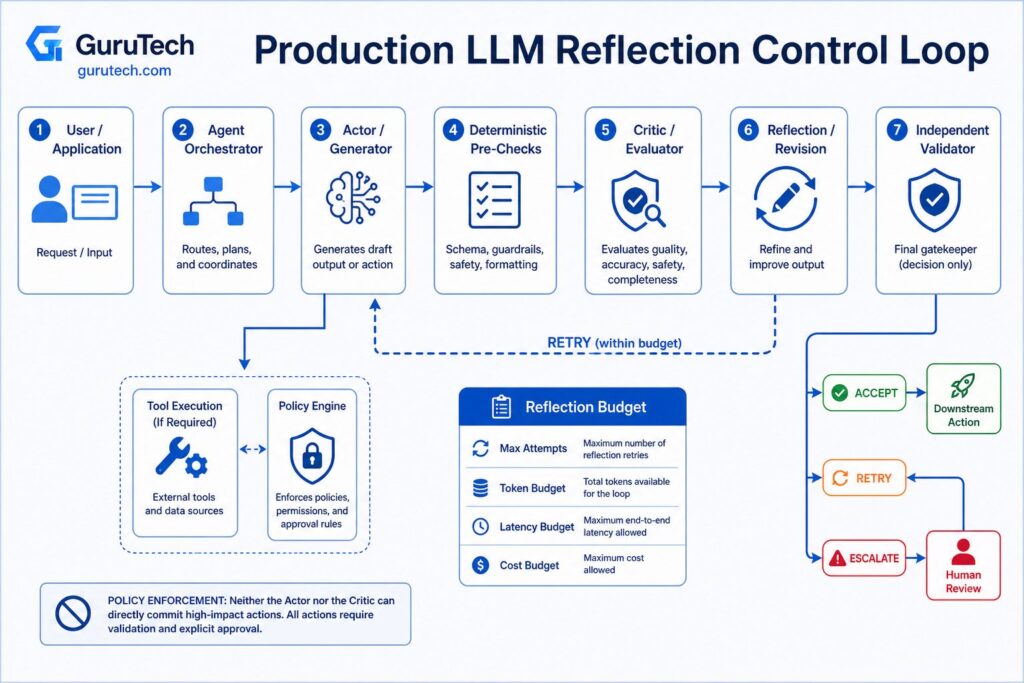
From Single-Pass Generation to Bounded Reflection
A single-pass LLM workflow is simple: receive a task, construct context, call the model, parse the response, and return or execute it. That design is appropriate for many low-risk workloads. Reflection becomes valuable when the output can be evaluated against meaningful criteria and the expected improvement justifies the additional latency, tokens, infrastructure, and operational complexity.
The core production loop is better expressed as Generate → Check → Evaluate → Reflect → Revise → Validate → Accept / Retry / Escalate. Each stage has a different responsibility. The actor proposes an answer or action. Cheap deterministic checks reject obvious structural failures. A critic identifies semantic or task-level deficiencies. Reflection converts those deficiencies into actionable feedback. The actor revises the candidate. An independent validator then determines whether the result is safe and correct enough to proceed.
Research and practitioner material on reflection-based reasoning/action architectures, deliberation and self-reflection patterns, and LLM self-evaluation provides useful conceptual grounding. The production challenge is converting those concepts into a bounded control system whose behavior can be measured and governed.
When Reflection Is Worth Adding
Reflection is most useful when three conditions are present: the system can recognize meaningful defects, a revision has a reasonable chance of correcting them, and the cost of a bad first-pass result is materially higher than the cost of another inference cycle. Code generation, tool planning, structured document generation, policy-constrained workflows, and complex research tasks often satisfy these conditions. A simple classification request with a deterministic schema may not.
| Workload | Primary Control | Reflection Value | Recommended Final Gate |
|---|---|---|---|
| JSON/tool arguments | Schema validation | Useful for repairing invalid fields | Schema + tool policy |
| Generated code | Parser, tests, sandbox | High when test feedback can guide repair | Tests + security checks + approval for deployment |
| Content drafting | Editorial rubric | Useful for completeness and style | Human review when publication risk is material |
| Database mutation | Authorization and transaction rules | Secondary; useful for repairing a proposed action | Policy engine + transaction validation |
| Infrastructure change | Policy-as-code, plan/diff, tests | Useful for diagnosing failed plans | Deterministic controls + risk-based human approval |
| Low-risk summarization | Grounding/citation checks | Optional | Source verification when accuracy matters |
The Core Mechanics of Programmatic Self-Correction Loops
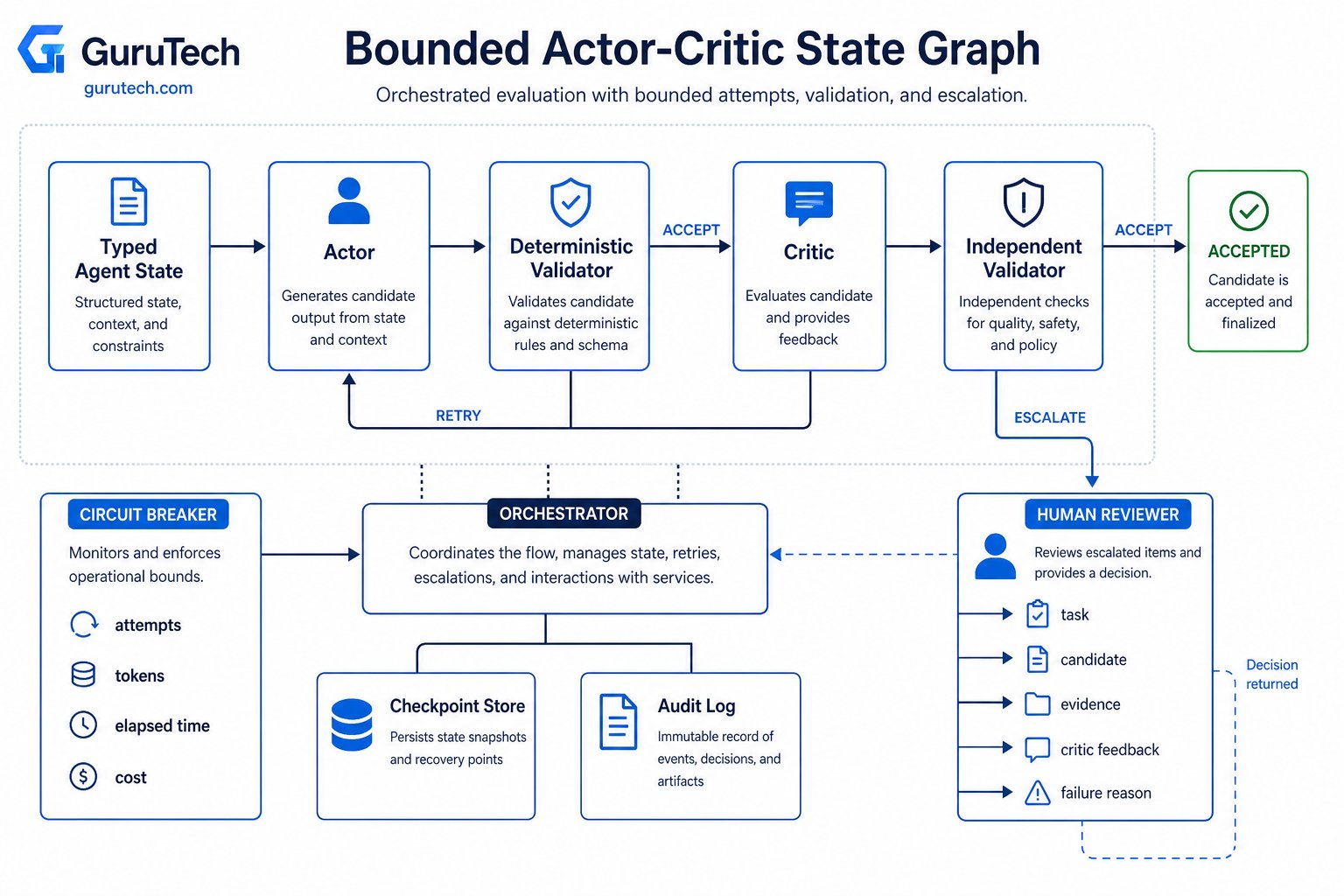
A reflection workflow normally stores the actor’s candidate in shared state rather than immediately exposing it to a downstream action. This fits naturally with stateful agentic AI systems: the graph runtime owns state transitions, validators own acceptance criteria, and model output remains a proposal until the control plane accepts it.
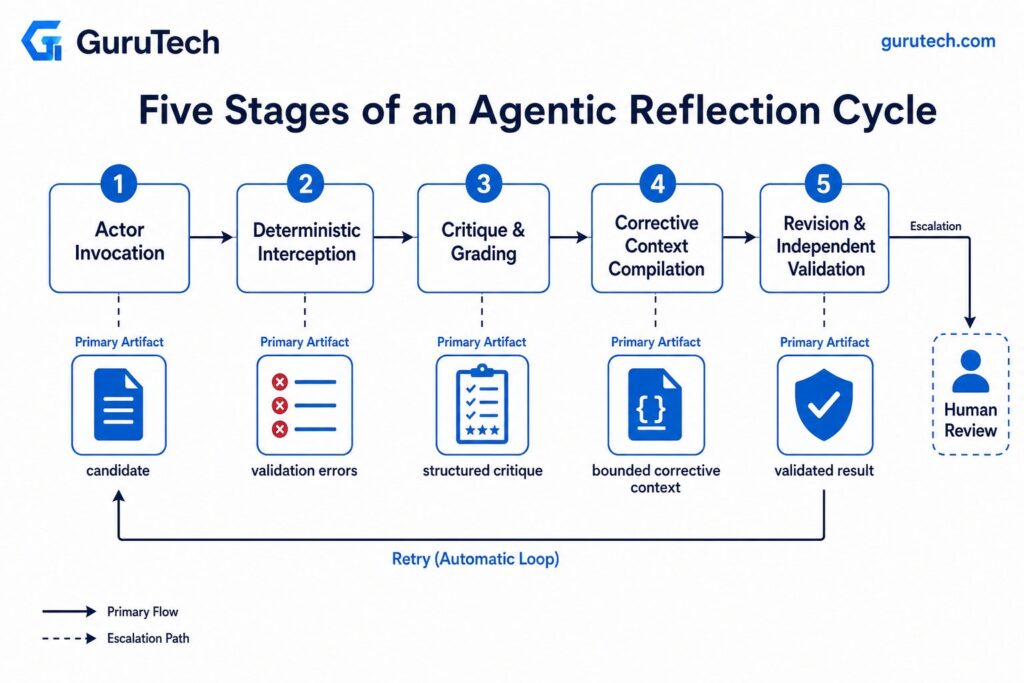
Step-by-Step Anatomy of an Agentic Reflection Cycle
1. Actor invocation. The actor receives the task, bounded context, relevant tool results, and any prior corrective feedback. It generates a candidate response or action. The candidate is written to working state; high-impact actions should not be committed directly from this node.
2. Deterministic interception. Before spending another model call, the system checks what code can check cheaply and reliably: JSON validity, required fields, enum membership, Pydantic models, syntax, authorization constraints, file size, tool signatures, or unit tests. Structural failures become machine-readable error evidence for the next attempt.
3. Critique and grading. If semantic evaluation is required, a critic assesses the candidate against an explicit rubric. The critic may be the same model with a separate prompt, a dedicated evaluator model, multiple evaluators, or a domain-specific service. The output should be structured—for example, defect codes, severity, evidence, and recommended correction—rather than an unconstrained essay. This is where the broader GenAI evaluation framework becomes part of the runtime architecture.
4. Corrective context compilation. The orchestrator—not the critic—decides what feedback enters the next actor call. It should preserve the original task, authoritative evidence, the current candidate, and the most useful failure signal without endlessly appending every previous attempt.
5. Revision and independent validation. The actor generates a new candidate. A validator then checks whether the candidate actually satisfies the acceptance conditions. If it passes, the workflow can continue. If it fails and budget remains, the graph retries. If the budget is exhausted or the failure is high-risk, the task transitions to a fallback or human-review state.
Reflection Is Not Validation: Establishing an Independent Source of Truth
This is the most important boundary in the architecture. A critic can detect inconsistencies, omissions, weak reasoning, or instruction violations, but the critic remains a probabilistic model. If the actor and critic share training biases, context, or the same incorrect assumption, repeated reflection can make an incorrect result sound more convincing without making it more correct.
Validation should therefore move toward the strongest available source of truth. For structured output, that may be a JSON Schema or Pydantic model. For code, it may be parsing, static analysis, unit tests, integration tests, and sandbox execution. For factual claims, it may be authoritative retrieval or a system of record. For access decisions, it is the identity and policy layer. For consequential business decisions, a qualified human may remain the final authority.
| Verification Layer | Best At | Core Failure Mode | Engineering Recommendation |
|---|---|---|---|
| Deterministic parser/schema | Hard formats and constraints | Cannot judge fluid semantic quality | Run first; reject cheap structural failures before semantic critique. |
| Unit/integration tests | Executable behavior | Incomplete test coverage | Treat tests as evidence, not universal proof; preserve failing test output for repair. |
| LLM critic/judge | Semantic quality and rubric-based review | Bias, inconsistency, correlated errors | Use structured rubrics, controlled sampling, calibration, and independent validation. |
| External tool/system of record | Authoritative facts and state | Stale data, tool errors, permissions | Validate provenance, freshness, authorization, and tool status. |
| Human reviewer | Ambiguity, accountability, high-impact judgment | Queueing and inconsistent review | Escalate selectively with complete evidence and clear decision options. |
Rule-Based Evaluation vs. LLM-as-a-Judge Refinement
The production recommendation is not to choose deterministic validation or model-driven critique universally; it is to layer them. Deterministic checks should handle constraints that can be expressed deterministically. Model-based evaluation should be reserved for dimensions that genuinely require semantic judgment.
A Pydantic validator can immediately reject a missing field without another inference call. A unit-test runner can prove that a generated function fails a known case. By contrast, whether an incident summary adequately distinguishes observed evidence from inference may require a semantic rubric. Resources on LLM-as-a-Judge evaluation patterns and reference-based quality criteria illustrate model-evaluator approaches, but production teams still need to calibrate them against domain data.
Judge temperature, model size, and quantization are workload decisions rather than universal rules. A smaller or quantized model may reduce cost, but only if evaluation quality remains acceptable. Increasing sampling randomness is not inherently desirable for grading; repeatability is often valuable when the critic is part of a control system.
Scripted Error Catching vs. Dynamic LLM Reflection Architectures
Traditional exception handling and reflection solve different layers of the problem. A try/except block should still catch known runtime failures deterministically. Reflection becomes useful above that layer when the system needs to interpret the failure and propose a new candidate action.
| Architectural Feature | Scripted Error Handling | Dynamic LLM Reflection Architectures |
|---|---|---|
| Error detection | Exceptions, status codes, explicit conditions | Semantic interpretation of error evidence |
| Recovery | Predetermined retry/fallback path | Model proposes a revised plan, code artifact, prompt input, or tool arguments |
| State | Can be stateless or stateful; persistence is an application choice | Usually benefits from typed shared state containing attempts, evidence, budgets, and critique |
| Strength | Fast, predictable, testable | Can adapt to failures not fully enumerated in advance |
| Risk | Cannot repair unmodeled semantic failures | May hallucinate a repair or repeatedly make the same mistake |
Dynamic reflection patterns should complement, not replace, normal software controls. If a tool returns HTTP 403, the system should not ask the model to creatively bypass authorization. The policy layer should classify the error as non-repairable by reflection and route it to an authorized recovery path. Conventional circuit breakers and retry logic remain part of the design.
Code-Level Implementation: Engineering a Bounded Actor-Critic Self-Correction Graph
Building self-correcting AI agent architectures requires explicit state management and programmatic evaluation nodes. A useful implementation needs more than checking whether generated text contains def or try:. Shared state should represent acceptance status, structured feedback, retry budgets, token/cost accounting, and escalation.
1. Define Typed Shared State
from enum import Enum
from typing import List, Optional
from pydantic import BaseModel, Field

class Status(str, Enum):
    RUNNING = "running"
    ACCEPTED = "accepted"
    RETRY = "retry"
    ESCALATED = "escalated"

class Critique(BaseModel):
    passed: bool
    defect_codes: List[str] = Field(default_factory=list)
    feedback: List[str] = Field(default_factory=list)

class AgentState(BaseModel):
    task: str
    current_output: Optional[str] = None
    critique: Optional[Critique] = None

    attempt: int = 0
    reflection_tokens: int = 0
    estimated_cost_usd: float = 0.0
    elapsed_ms: int = 0

    max_attempts: int = 3
    max_reflection_tokens: int = 8000
    max_elapsed_ms: int = 12000
    max_cost_usd: float = 0.25

    status: Status = Status.RUNNING
    audit_events: List[str] = Field(default_factory=list)
The values above are illustrative engineering limits, not universal recommendations. A low-latency customer interaction might allow only one repair attempt, while an asynchronous code-generation workflow might permit several. Limits should come from measured quality gain, service-level objectives, risk, and unit economics.
2. Separate Generation, Deterministic Validation, and Critique
import ast

def actor_node(state: AgentState) -> AgentState:
    feedback = state.critique.feedback if state.critique else []
    prompt = {
        "task": state.task,
        "previous_candidate": state.current_output,
        "corrective_feedback": feedback,
    }

    result = call_actor_model(prompt)  # Return text plus usage/cost metadata.
    state.current_output = result.text
    state.attempt += 1
    state.reflection_tokens += result.total_tokens
    state.estimated_cost_usd += result.estimated_cost_usd
    state.audit_events.append(f"actor_attempt:{state.attempt}")
    return state


def deterministic_validator(state: AgentState) -> AgentState:
    """Example: candidate must be syntactically valid Python."""
    try:
        ast.parse(state.current_output or "")
        state.audit_events.append("syntax_validation:passed")
    except SyntaxError as exc:
        state.critique = Critique(
            passed=False,
            defect_codes=["PYTHON_SYNTAX_ERROR"],
            feedback=[f"Python parser rejected the candidate: {exc.msg}"],
        )
        state.status = Status.RETRY
        state.audit_events.append("syntax_validation:failed")
    return state


def critic_node(state: AgentState) -> AgentState:
    result = call_critic_model(
        task=state.task,
        candidate=state.current_output,
        output_schema=Critique,
    )
    state.critique = result.parsed
    state.reflection_tokens += result.total_tokens
    state.estimated_cost_usd += result.estimated_cost_usd
    state.audit_events.append("semantic_critique:complete")
    return state
For real code generation, syntax parsing should be followed by isolated tests, static analysis, dependency controls, and a sandbox. The key pattern is that validator output becomes structured evidence. The actor may use that evidence to repair the candidate, but it cannot declare its own repair successful.
3. Add a Multi-Dimensional Circuit Breaker
def budget_exhausted(state: AgentState) -> Optional[str]:
    if state.attempt >= state.max_attempts:
        return "max_attempts"
    if state.reflection_tokens >= state.max_reflection_tokens:
        return "token_budget"
    if state.elapsed_ms >= state.max_elapsed_ms:
        return "latency_budget"
    if state.estimated_cost_usd >= state.max_cost_usd:
        return "cost_budget"
    return None


def route_after_validation(state: AgentState) -> str:
    if state.critique and state.critique.passed:
        state.status = Status.ACCEPTED
        return "accept"

    reason = budget_exhausted(state)
    if reason:
        state.status = Status.ESCALATED
        state.audit_events.append(f"reflection_budget_exhausted:{reason}")
        return "escalate"

    state.status = Status.RETRY
    return "actor"
A production circuit breaker should consider more than iteration count. A single very large retry can violate a token or latency budget even when the attempt count remains below its limit. Conversely, a cheap asynchronous task may tolerate more iterations.
4. Assemble the Graph
from langgraph.graph import StateGraph, END

graph = StateGraph(AgentState)

graph.add_node("actor", actor_node)
graph.add_node("deterministic_validate", deterministic_validator)
graph.add_node("critic", critic_node)
graph.add_node("human_escalation", enqueue_human_review)

graph.set_entry_point("actor")
graph.add_edge("actor", "deterministic_validate")

# A complete implementation should use a conditional edge here:
# structural failure -> retry/escalate; structural pass -> critic.
graph.add_edge("deterministic_validate", "critic")

graph.add_conditional_edges(
    "critic",
    route_after_validation,
    {
        "actor": "actor",
        "accept": END,
        "escalate": "human_escalation",
    },
)

graph.add_edge("human_escalation", END)
app = graph.compile()
The LangChain reflection-agent discussion and community LangGraph self-correction example are useful starting points. Production implementations should additionally handle persistence, authorization, telemetry, idempotency, timeouts, and failure recovery.
Stateful and Memory-Backed Reflection
Reflection becomes more powerful—and more dangerous—when lessons persist across attempts or episodes. Working state may need the current candidate, latest validator evidence, retry count, and budget counters. Longer-lived memory may store recurring failure patterns or successful repair strategies. Those are different data classes and should not be mixed indiscriminately.
The active reflection context should usually be compact. Replaying every failed generation can cause context inflation and make stale mistakes more salient. A better hydration policy preserves the original task, authoritative constraints, the current candidate, the latest high-value error evidence, and only historical lessons relevant to the current node. This is closely related to context hydration and working-memory design in Stateful Agentic AI Systems.
Long-term reflection memory needs lifecycle controls. A lesson learned from temporary API behavior can become harmful after the API changes. Memory entries should carry provenance, timestamps, scope, confidence, and invalidation rules. Enterprise systems of record remain authoritative business data; reflection memory should never silently override them.
Tool-Assisted and Grounded Reflection
The strongest reflection loops often use tools to obtain evidence rather than asking the model to introspect harder. A code agent can execute tests. A research agent can retrieve a primary source. A database agent can run a read-only query to verify current state. A deployment agent can inspect a plan or dry-run result before proposing a change.
This turns reflection into evidence-guided repair: candidate → tool check → structured evidence → revised candidate. The model interprets evidence, but the evidence is produced outside the model. Tool access should still pass through the permissions and policy controls described in Tool Ingestion Engineering for LLMs and the broader multi-agent orchestration layer.
A critical rule is that reflection must not increase privileges. If an action fails because the actor lacks authorization, the reflection loop should not search for alternative ways around the control. Authorization errors, policy denials, and protected-resource boundaries should be terminal to reflection unless an explicitly authorized recovery workflow exists.
When LLM Reflection Makes the Output Worse
Reflection is not monotonically beneficial. A correct first answer can be rewritten into a worse one. A critic can reward verbosity instead of correctness. An actor and critic can share the same false premise. Repeated retries can accumulate misleading context until the original task is obscured. A system can even learn to satisfy the evaluator’s rubric without improving the real business outcome.
Correlated Actor-Critic Errors
Using the same model family for generation and critique is operationally convenient, but independence should not be assumed. For high-value workloads, compare same-model self-critique against a separate evaluator, deterministic evidence, or human-labeled evaluation set before concluding that the additional model call improves reliability.
Over-Correction
A critic should be allowed to say “no material defect found.” If every reflection pass is instructed to find something wrong, the architecture creates pressure to modify correct outputs. Track the rate at which revisions convert previously correct outputs into failures. That metric is as important as the rate at which reflection repairs bad outputs.
Evaluator Gaming
When the actor repeatedly sees the same rubric, it may optimize toward superficial grader signals. Mitigations include hidden evaluation cases, deterministic validators, multiple evaluation dimensions, periodic human calibration, and measuring downstream task success rather than only critic scores.
Repeated-Failure Loops
A loop that produces nearly identical failures should terminate before the nominal retry limit. Compare defect codes and validator outcomes across attempts. If the same failure signature repeats without meaningful progress, route to a different strategy, fallback model, tool, or human reviewer instead of paying for another equivalent retry.
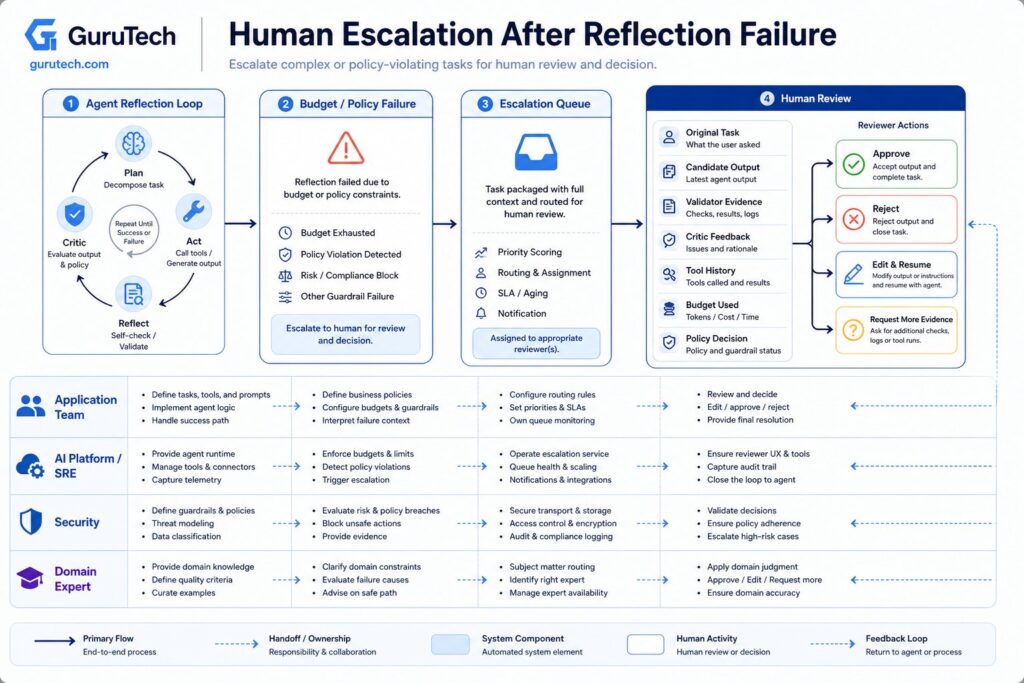
The Human Decision Layer: What Happens When Reflection Fails?
Production architecture becomes real at the point where automation stops. Consider an infrastructure agent asked to generate a configuration change. The actor produces a candidate, deterministic validation passes, the critic identifies a policy concern, and two revisions still fail policy-as-code. The correct outcome is not an infinite conversation between models. The task should enter an explicit human-review state.
The reviewer needs more than “agent failed.” A useful escalation package contains the original request, actor identity and permissions, current candidate, previous material changes, validator evidence, critic findings, tools invoked, budget consumed, policy rule that blocked execution, and a clear set of allowed actions such as approve, reject, edit-and-resume, or return to the requester.
Ownership should be defined before deployment. Application teams may own content-quality failures; platform teams may own model gateway or orchestration failures; security teams may own policy violations; domain experts may own ambiguous business decisions. Human-in-the-loop AI workflows should be designed as part of the state machine rather than bolted on after an incident.
Production Scenario: A Reflection Loop for an Infrastructure Change
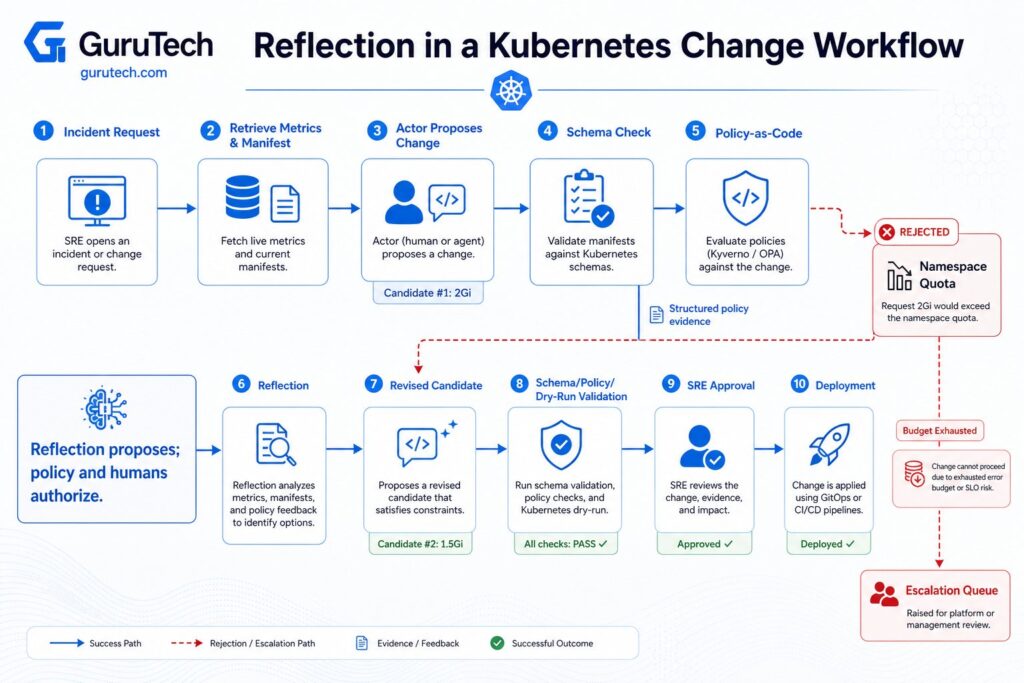
Consider an internal platform agent asked to update a Kubernetes deployment after an application team reports repeated out-of-memory restarts. The agent can read telemetry and manifests, but it should not convert a plausible diagnosis directly into a production mutation.
Stage 1: Generate a Candidate Change
The actor retrieves the current manifest, recent memory metrics, restart events, and deployment policy. It proposes a structured resource change rather than immediately invoking the deployment API.
Stage 2: Deterministic and Policy Validation
The orchestrator validates the schema, verifies the resource, checks identity, and submits the proposed manifest to policy-as-code. If a proposed 2 GiB limit exceeds namespace quota, the policy engine returns machine-readable evidence instead of a generic failure.
Stage 3: Reflect Using Failure Evidence
The reflection context contains the original task, current metrics, candidate change, and specific quota violation. The actor can propose a smaller limit or a different remediation without changing quotas or bypassing policy.
Stage 4: Validate the Revision Independently
The revised manifest is schema-validated, evaluated against quota and deployment policies, and rendered as a dry-run. The critic’s opinion is not the acceptance signal; policy and deployment validation determine whether the candidate is admissible.
Stage 5: Decide Whether a Human Must Approve
If policy requires an SRE to approve production resource changes, the reviewer receives the incident context, metrics, proposed diff, failed attempt, policy evidence, revised candidate, and estimated resource impact. If the revision fails again or exhausts its budget, the state becomes ESCALATED and remains resumable.
Choosing the Right Reflection Pattern
| Pattern | Use It When | Limit It When | Primary Acceptance Signal |
|---|---|---|---|
| Same-model self-critique | Low-to-moderate-risk drafting or repair | Correlated errors create unacceptable risk | External validator or user review |
| Separate critic model | Semantic rubrics benefit from a dedicated evaluator | Extra model cost produces little measured gain | Calibrated validator result |
| Deterministic repair loop | Errors have precise evidence such as schemas or tests | The defect is subjective | Parser, tests, policy engine, or tool result |
| Tool-grounded reflection | External systems can verify facts or behavior | Tools are stale, untrusted, or too privileged | Validated external evidence |
| Human-in-the-loop | Ambiguity, accountability, policy, or impact requires judgment | High-volume low-risk cases can be safely automated | Authorized human decision |
Start with deterministic evidence whenever possible, add semantic critique only for criteria code cannot reliably express, and add humans where accountability or ambiguity exceeds the automation boundary. More reflection components do not automatically create a more reliable system.
Cost, Latency, and Capacity Engineering
Reflection converts one logical task into multiple inference and validation operations. The cost increase is not inherently exponential; it depends on actor attempts, critic calls, context size, output length, tool operations, and branching. Capacity planning should therefore use cost per validated task, not cost per model call.
Likewise, time-to-first-token is not the best end-to-end metric for reflection. The user or downstream service cares about time to validated result. Instrument actor inference time, critic time, deterministic validation time, tool latency, queue time, retry depth, and human escalation separately.
For API-hosted models, rate limits, concurrency, token throughput, and spend dominate. For self-hosted models, reflection also affects GPU residency, KV-cache usage, batching efficiency, queue depth, HBM/VRAM pressure, and inference scheduling. Techniques from reducing AI API costs, enterprise semantic caching, and model quantization architectures can reduce parts of this overhead, but cached decisions must remain scoped to the exact task, evidence, model/prompt version, and policy context.
A Practical Reflection Budget
reflection_policy:
  profile: "code-review-standard"
  limits:
    actor_attempts: 3        # Example only; calibrate from production data
    evaluator_calls: 3
    total_tokens: 8000
    elapsed_ms: 12000
    estimated_cost_usd: 0.25
    repeated_failure_signature: 2
  on_exhaustion: "human_review"
  on_policy_denial: "stop"
  on_authorization_failure: "stop"
The specific values are examples. The useful design pattern is multidimensional budgeting: attempt count alone cannot express all the ways a reflection loop can become operationally uneconomic.
Observability: Proving That Reflection Adds Value
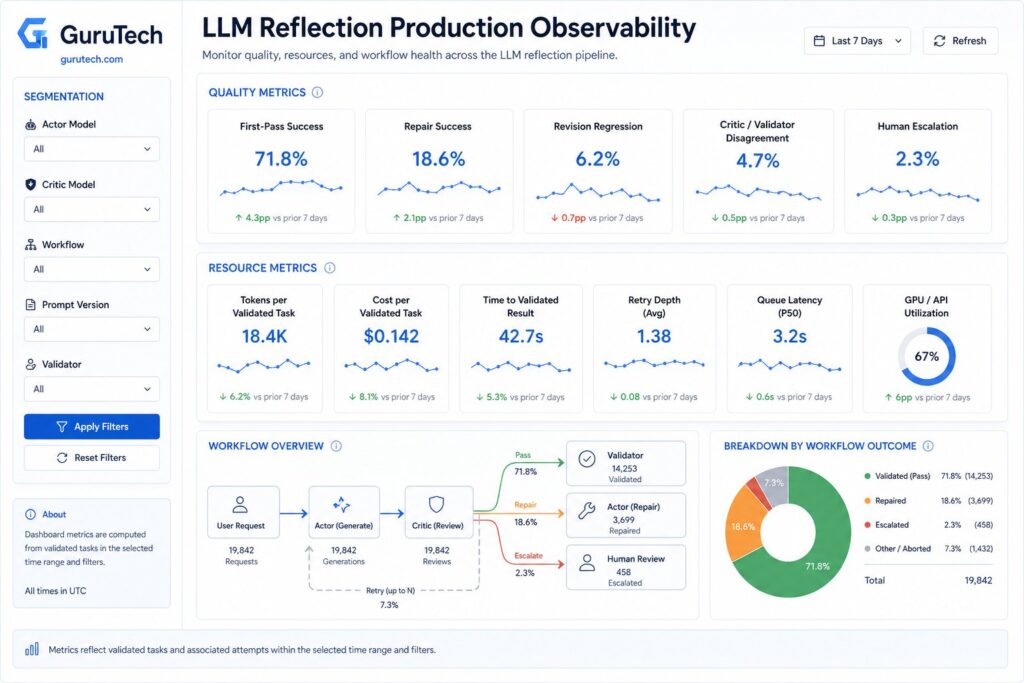
Reflection should be treated as a measurable reliability feature. The AI Token Observability Dashboard should correlate inference consumption with actual quality outcomes so teams can answer a simple question: did the additional reflection cycle improve the task enough to justify its cost?
| Metric | What It Reveals |
|---|---|
first_pass_success_rate | How often reflection was unnecessary |
reflection_attempts | Retry-depth distribution by workflow/model/version |
repair_success_rate | How often a failed candidate becomes valid after reflection |
revision_regression_rate | How often reflection makes a previously acceptable output worse |
validator_rejection_rate | Gap between critic approval and independent validation |
repeated_failure_rate | Loops that are not making progress |
human_escalation_rate | Operational load transferred to reviewers |
tokens_per_validated_task | True token economics of the control loop |
cost_per_validated_task | Business-relevant inference cost |
time_to_validated_result | User-visible or workflow-visible latency |
Segment these metrics by model, prompt version, critic version, workflow, validator type, tool, customer tier, and failure category. A global average can hide a reflection policy that works extremely well for code repair but wastes tokens on simple structured extraction.
Security and Governance Boundaries
Reflection expands the amount of model-generated text circulating inside the system, including critiques, revised prompts, tool errors, and retrieved evidence. Every one of those artifacts can carry untrusted content. Treat reflected instructions as data until the orchestrator validates them against policy.
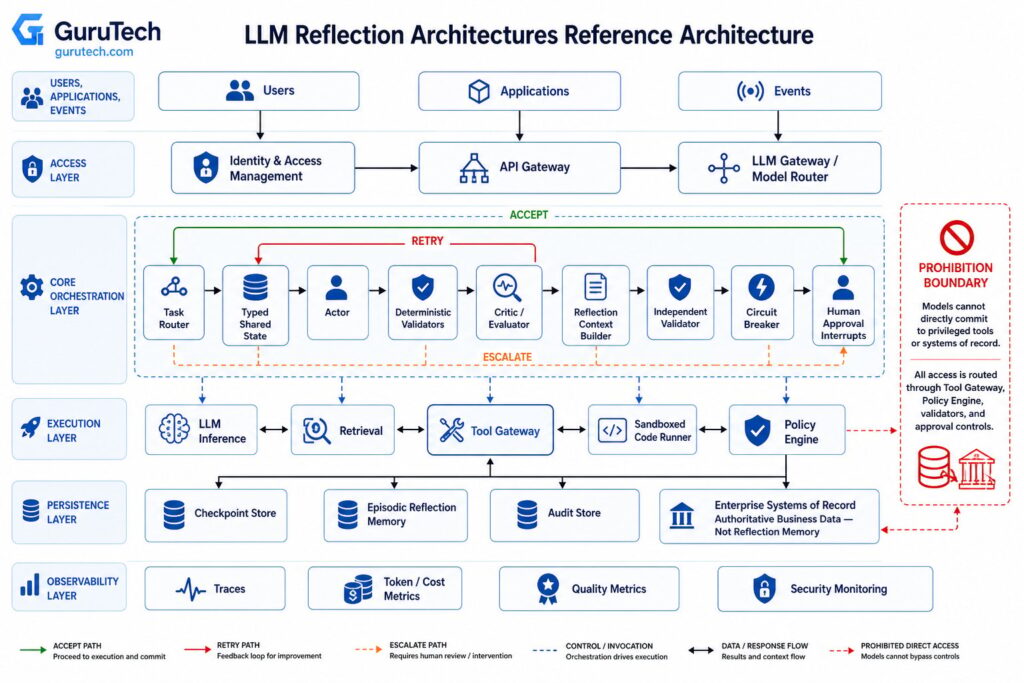
The actor and critic should not directly write to checkpoint databases, policy stores, enterprise systems of record, or privileged tools. Tool execution should pass through an identity-aware gateway that validates arguments, authorization, policy, and idempotency. Reflection can propose a corrected action; it cannot grant itself permission to execute it.
Audit records should capture model and prompt versions, tool calls, validation results, state transitions, policy decisions, and human overrides without indiscriminately logging sensitive prompt contents. Retention and redaction policies should reflect the data classification of the workload.
Troubleshooting Common Reflection Failures
| Symptom | Likely Cause | What to Inspect | Corrective Action |
|---|---|---|---|
| Same error repeats every attempt | Feedback is not actionable or actor lacks capability | Defect codes, prompt diff, tool evidence | Stop repeated signature; change strategy/model or escalate |
| Critic passes, validator fails | Judge rubric does not match source of truth | False-positive critic cases | Recalibrate rubric; increase deterministic/tool validation |
| Latency spikes | Long contexts, sequential critics, slow tools | Per-node traces and queue time | Prune context, parallelize independent checks, tighten budget |
| Token cost rises over time | History accumulation or higher retry depth | Tokens by attempt and hydration source | Prune intermediate attempts; investigate first-pass regression |
| Correct outputs are rewritten | Critic forced to find defects | Revision regression set | Allow PASS/no-material-defect; calibrate critic |
| Human queue grows | Overly strict thresholds or poor automated repair | Escalation reasons and reviewer outcomes | Automate recurring safe resolutions; fix upstream validator/actor |
How to Evaluate Reflection Before Production
Before enabling reflection on live traffic, build an evaluation set that distinguishes four outcomes: the first pass was already correct, the first pass was wrong and reflection repaired it, the first pass was wrong and reflection failed to repair it, and the first pass was correct but reflection degraded it. Without the fourth category, teams can overestimate reflection because they measure repairs but ignore regressions.
Run the same tasks through a single-pass baseline and the proposed reflection policy. Record independent validator results rather than relying only on critic scores. Compare the improvement in validated success against additional tokens, latency, cost, and escalation load.
| Evaluation Outcome | What It Means | Engineering Response |
|---|---|---|
| First pass valid; reflection unnecessary | Reflection adds cost without repair value | Gate reflection to failed or uncertain cases |
| Invalid → valid | Successful repair | Measure which evidence and attempt produced the correction |
| Invalid → still invalid | Reflection did not solve the failure | Improve feedback, change strategy, or escalate earlier |
| Valid → invalid | Revision regression | Adjust critic rubric and allow no-change/PASS outcomes |
| Critic passes; validator rejects | Evaluator is misaligned with acceptance criteria | Recalibrate or reduce critic authority |
The deployment decision should be based on the delta in validated outcomes. Reflection may justify several additional calls for difficult asynchronous code repair while being inappropriate for a latency-sensitive request whose first-pass validity is already high. Enable, gate, or disable reflection per workflow rather than globally.
Production Deployment Pattern
A production deployment should place reflection inside the agent orchestration layer, behind identity and model gateways and ahead of privileged side effects. The actor, critic, validators, tools, checkpoint store, and human-review queue should be independently observable components. This makes it possible to change an evaluator without changing the actor, tighten a policy without retraining a model, or disable reflection for a degraded dependency.
Before rollout, create an offline evaluation set containing first-pass successes, repairable failures, unrepairable failures, adversarial cases, and cases where reflection historically makes the result worse. Compare the single-pass baseline against each reflection policy. Then canary the workflow with strict budgets and monitor both quality and operational cost. This is part of the broader discipline of deploying agentic AI systems in production.
Production Readiness Checklist
- Define exactly which failure classes reflection is allowed to repair.
- Run deterministic checks before semantic model evaluation where possible.
- Use typed state for candidate outputs, critique, validator evidence, budgets, and status.
- Keep authorization and policy decisions outside the model.
- Define independent acceptance criteria for consequential actions.
- Set workload-specific attempt, token, latency, cost, and tool-call budgets.
- Terminate repeated failure signatures that show no progress.
- Test cases where reflection makes correct outputs worse.
- Measure first-pass success, repair success, regression, validator rejection, and escalation.
- Provide a resumable human-review state with complete evidence.
- Version actor prompts, critic rubrics, validators, models, and reflection policies.
- Canary changes and compare against a single-pass baseline.
- Protect logs and reflection memory according to data classification and retention policy.
- Have a fallback mode that can disable reflection without disabling the entire service.
Implementing LLM Reflection Architectures Safely in Enterprise CI/CD
Reflection policy should be versioned and tested like application code. CI should run representative evaluation sets against actor prompts, critic rubrics, structured output schemas, deterministic validators, and routing logic. A model or prompt update should not reach production merely because average critic scores increased; it should demonstrate acceptable downstream validation, regression, latency, and cost behavior.
Deployment can proceed through staged environments and canary traffic. Centralized AI Token Observability Dashboard logging should track the new version’s reflection depth, token use, cost per validated task, repair rate, and human escalation rate alongside conventional infrastructure metrics. If quality gains disappear or operational cost exceeds the workload’s budget, the reflection policy can be rolled back independently of the rest of the agent.
Frequently Asked Questions
What are LLM reflection architectures?
LLM reflection architectures are orchestrated workflows that evaluate an LLM-generated candidate, produce structured feedback, revise the candidate when appropriate, and route the result through explicit validation before acceptance, retry, fallback, or escalation. Production implementations usually combine model-based critique with deterministic controls and bounded execution.
Is self-reflection the same as validation?
No. Self-reflection is another model inference and can reproduce the same error. Validation uses the strongest available source of truth: schemas, tests, tools, authoritative data, policy engines, or qualified human review.
Should the actor and critic use different models?
Not always. A separate critic can provide operational and sometimes behavioral diversity, but different models are not automatically independent or more accurate. Evaluate same-model and separate-model configurations against a labeled workload and compare repair success, regression, latency, and cost.
How many reflection attempts should an agent make?
There is no universal number. Set limits from production measurements and workload risk. The circuit breaker should usually include more than attempt count: tokens, elapsed time, cost, tool calls, and repeated failure signatures can all be termination conditions.
When should reflection escalate to a human?
Escalate when the reflection budget is exhausted, the failure requires judgment or authorization the model does not possess, validators repeatedly disagree with the critic, policy requires approval, or the expected cost of another automated attempt exceeds the expected benefit. The reviewer should receive the task, candidate, evidence, critique, policy decision, and audit trail needed to act efficiently.
How do you know whether reflection is actually helping?
Compare it against a single-pass baseline. Measure repair success, revision regression, independent validator acceptance, cost per validated task, time to validated result, and human escalation. Reflection is valuable only when the quality or risk reduction justifies the additional operational cost.
Conclusion: Reflection as a Measured Control Loop
LLM reflection architectures can make agentic systems more resilient, but only when reflection is treated as one component of a larger control plane. The production pattern is not “let the model keep trying until it feels confident.” It is a bounded state machine that separates generation, deterministic checks, semantic critique, revision, independent validation, policy enforcement, and escalation.
The practical objective is measurable: increase the percentage of tasks that reach a valid outcome without allowing latency, token consumption, operational complexity, or risk to grow without control. That requires typed state, explicit budgets, trustworthy validation, observability, security boundaries, and a human path for cases automation should not decide alone.
For teams already building production systems, reflection should be introduced selectively and evaluated against a single-pass baseline. Start where failures are observable and repairable, instrument the complete loop, and expand only when the data shows that reflection improves the validated business outcome.