
Most enterprise LLM applications begin as linear request-response pipelines. A user submits input, the application retrieves supporting context, the model generates a response, and the execution environment discards the active working context when the request completes.
This pattern works well for classification, extraction, summarization, search augmentation, and other bounded inference tasks. It becomes structurally inadequate when an application must coordinate a sequence of dependent actions, preserve intermediate results, recover from partial failure, or continue execution across multiple user interactions and infrastructure events.
Stateful agentic AI systems introduce a persistent execution layer around model inference. Rather than treating each model invocation as an isolated transaction, the surrounding software maintains a durable representation of the active thread, workflow position, tool outputs, validation status, resource budgets, and other state required to continue execution safely.
This architectural shift enables autonomous task completion across workflows that may span multiple model calls, tools, processes, or human approval steps. The model remains fundamentally request-driven; continuity is provided by the orchestration and persistence layers surrounding it.
Moving from Linear RAG to Cyclic, Stateful Autonomy
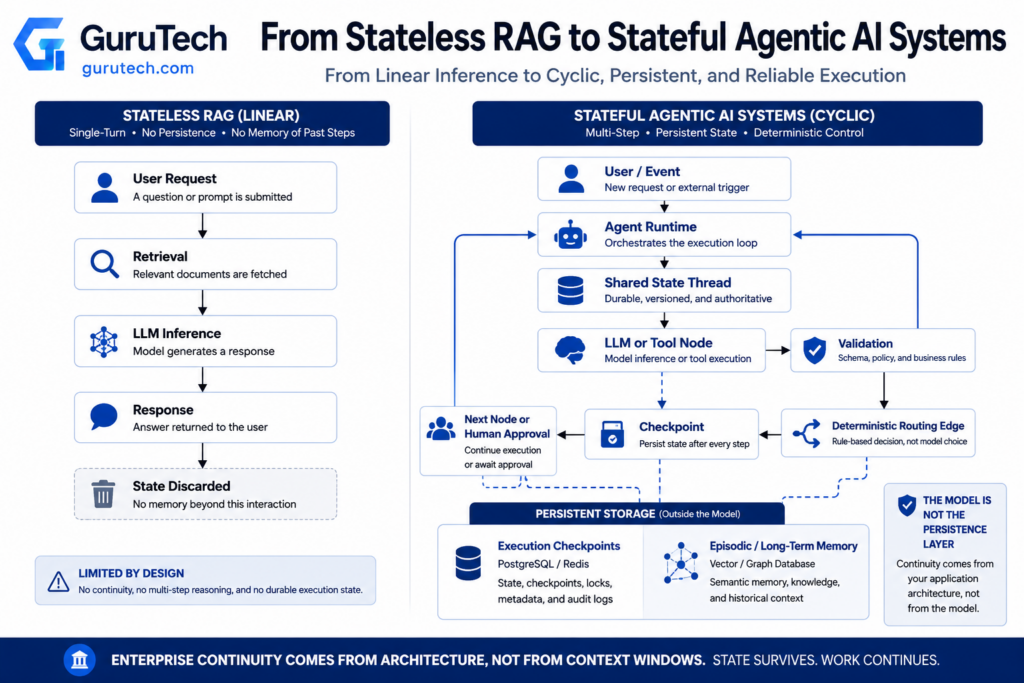
A conventional retrieval-augmented generation pipeline is primarily linear. An application resolves an input, retrieves relevant documents, constructs a prompt, invokes a model, and returns the generated result.
Any continuity between calls must be reconstructed explicitly by the application. Without an external state layer, the model provider does not inherently preserve the operational position of a regulatory review, deployment workflow, financial reconciliation process, or software engineering task after the inference request terminates.
Long-horizon enterprise workflows are fundamentally different because later operations depend on earlier state mutations. A compliance agent may need to know which controls have already been evaluated, which accounting records were modified, which evidence remains unresolved, which exceptions require human review, and whether a previous external transaction actually committed.
A software engineering agent faces the same requirement. Repository state, test results, generated patches, failed builds, dependency changes, approval status, and rollback points must survive independently of any particular LLM call or worker process.
This is where cyclic execution graphs replace simple linear chains. A workflow can move from generation to validation, branch into a tool operation, return to an earlier node after failure, suspend for external approval, resume from a persisted checkpoint, and terminate only when deterministic completion criteria are satisfied.
Designing stateful agentic loops therefore requires more than maintaining a conversation transcript. The runtime must manage execution status, state transitions, external side effects, recovery boundaries, and the conditions under which another model invocation is permitted.
The architectural distinction is important. An LLM may generate an action proposal, structured tool request, or routing signal, but the surrounding control plane should determine whether that proposed transition is valid before mutating enterprise systems.
This separation becomes especially important when workflows use deterministic routing edges. Explicit routing predicates, policy gates, iteration limits, typed state schemas, and validation nodes constrain otherwise probabilistic model outputs within a controlled execution topology.
The result is not simply an LLM with a longer memory. It is a distributed application in which model inference operates as one component inside a larger state machine.
State Is External to the Model
The central design principle is that durable agent state should remain decoupled from the model provider. Conversation history, execution metadata, tool outputs, checkpoint identifiers, approval flags, and workflow variables belong in application-controlled persistence layers rather than being implicitly entrusted to a model session.
This makes the execution thread portable across model endpoints and runtime instances. A failed worker can be replaced, a different model can process the next graph node, or a human operator can inspect and modify the workflow without losing the authoritative state of the task.
The distinction also supports memory consolidation strategies. Recent operational state can remain available in low-latency storage while older interactions are compressed, indexed, or transferred into semantic memory systems that are retrieved only when relevant.
Persistent memory is therefore not one storage mechanism. Production systems typically separate transactional execution state from conversational history, episodic memory, semantic retrieval indexes, and authoritative enterprise records.
Why Enterprise Workflows Require Persistence
Consider a multi-day regulatory compliance audit. The system may ingest financial records, retrieve applicable policies, calculate control deviations, call internal accounting services, request supporting evidence, route exceptions to reviewers, and resume execution after human approval.
A stateless loop can recreate portions of that context by repeatedly injecting previous messages into a prompt. It cannot reliably establish whether an external accounting adjustment committed, whether a reviewer approved a particular exception, or which graph transition should execute after a worker crashes.
Those are application-state problems rather than language-model problems.
Production implementations therefore require mechanisms familiar to distributed systems engineering: state serialization, checkpoint persistence, schema versioning, idempotent tool execution, concurrency control, deterministic recovery, memory lifecycle management, and end-to-end execution tracing.
Stateful architectures are useful precisely because they move these responsibilities into explicit infrastructure components instead of hiding continuity inside prompt construction.
The same principle applies to observability. A long-running agent cannot be evaluated solely by measuring individual model latency or token consumption. Operators need visibility into the complete execution thread, including node transitions, retries, checkpoint operations, external tool calls, retrieval events, and accumulated cost.
This is why stateful execution belongs within the broader infrastructure model described throughout the GuruTech enterprise architecture stack, including LLM gateway orchestration, GraphRAG architectures, and the AI Token Observability Dashboard.
The Production Engineering Problem
Agent memory and state management ultimately reduce to a systems question: what information must survive an execution boundary, where should that information be stored, how should it be validated, and under what conditions may subsequent nodes mutate it?
As execution graphs become longer, storing every previous interaction becomes increasingly inefficient. Context windows fill with obsolete tool outputs, superseded plans, duplicated instructions, and historical messages that may no longer be relevant to the next inference step.
At the same time, aggressive summarization can destroy information required for deterministic recovery or auditability. A production architecture must therefore distinguish between information needed for immediate inference, information needed to resume execution, information required for long-term semantic recall, and information that must remain in authoritative enterprise systems.
The architectural difference between stateless and stateful agents becomes increasingly consequential as workflow duration, branching complexity, external side effects, and recovery requirements increase.
Key Takeaways
- Model inference is stateless by default from the application’s perspective. Durable continuity must be implemented in the orchestration, persistence, and memory layers surrounding the model.
- Stateful agentic AI systems are execution architectures, not simply chat systems with longer history. They persist workflow position, tool results, validation flags, resource constraints, and recovery metadata across execution boundaries.
- Cyclic workflows require explicit control. Typed state schemas, deterministic routing edges, checkpoints, iteration limits, and validation nodes prevent probabilistic model outputs from becoming unrestricted workflow control.
- Persistent state and semantic memory are different engineering concerns. Transactional execution state should not be conflated with vector retrieval, conversation history, or authoritative business data.
- Long-running autonomy introduces distributed-systems problems. Failure recovery, idempotency, concurrency, schema evolution, state corruption, observability, and governance become first-class production requirements.
The Core Mechanics of Agentic State Retention: The Shared State Thread
The foundational abstraction in a stateful agent architecture is not the conversation transcript. It is the shared state thread: an application-controlled state object that represents the current execution position, accumulated evidence, tool results, validation status, and other variables required to continue a workflow across model calls and infrastructure boundaries.
Multi-agent shared state management extends this principle across multiple workers or specialized agents. Instead of allowing each execution component to maintain an independent interpretation of workflow history, the runtime coordinates access to a persistent state representation identified by a stable thread identifier.
The critical architectural property is decoupling. The state belongs to the application runtime and persistence layer—not to the LLM process, model provider, or individual worker executing the current graph node.
A model endpoint can therefore fail, change, scale horizontally, or be replaced without destroying the authoritative execution state. The next eligible worker hydrates the thread from persistent storage and continues from a validated checkpoint.
The State Object as an Execution Contract
A production state object should be treated as a typed execution contract between graph nodes. Each node receives an authorized view of the current state and returns a defined mutation rather than arbitrarily rewriting the entire workflow history.
The schema can contain conversational data, but conversation history is only one component. A more complete state representation typically includes:
- Execution history: completed nodes, tool invocations, model calls, validation events, retry counters, and checkpoint identifiers
- Planning and workflow metadata: active objective, current execution node, completed sub-tasks, pending operations, and terminal-state conditions
- Validation state: schema-validation results, policy checks, approval flags, confidence thresholds, and verification outcomes
- Resource state: remaining token budget, tool-call limits, retry allowance, execution deadline, and other bounded-autonomy controls
- Runtime context: current user request, recent messages, retrieved documents, relevant memory records, and structured tool outputs
- Business payload: structured domain data required by the workflow, preferably represented through typed fields rather than embedded exclusively inside natural-language messages
The state schema should not become a dumping ground for every artifact produced during execution. Large documents, source files, binary objects, database exports, and other heavyweight artifacts are generally better stored externally with immutable references recorded in state.
This separation keeps checkpoints compact and makes state transitions easier to validate, serialize, inspect, and migrate.
Step 1: Resolve a Stable Thread Identifier
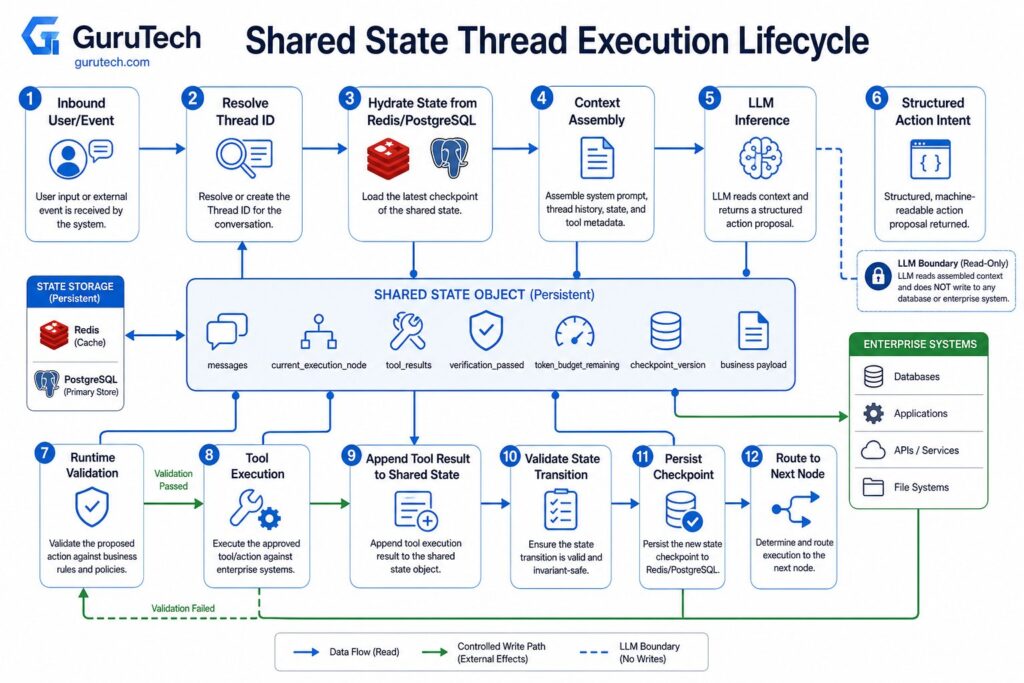
Every persistent workflow begins with an identifier that separates one execution history from another. An inbound user event, scheduled process, API request, or enterprise message resolves to a unique Thread ID that becomes the primary lookup key for the workflow’s persistent state.
The Thread ID should remain stable across model invocations and worker processes. It may represent a conversation, compliance case, software change request, incident, financial reconciliation task, or another durable unit of enterprise work.
The identifier should not be confused with an individual model request ID. A single thread can contain dozens or hundreds of model calls, tool executions, checkpoints, retries, and human interventions while preserving one continuous workflow identity.
Step 2: Hydrate the Current State
Before executing the next graph node, the runtime retrieves the latest valid state version from persistent storage. A transactional store such as PostgreSQL or a low-latency state service such as Redis can provide this operational persistence depending on durability, latency, and consistency requirements.
Hydration reconstructs the active runtime representation from the persisted checkpoint. The runtime can then validate schema version, checkpoint version, workflow status, ownership, authorization, expiration conditions, and other invariants before allowing execution to continue.
This validation step is important because persisted state may have been created by an earlier application version or modified by another worker. Loading bytes successfully does not establish that the state remains valid for the currently deployed graph.
Step 3: Assemble the Inference Context
The complete persisted state should not automatically be inserted into every model prompt. Instead, a context assembly layer selects the subset required by the current node.
That subset may include the system instructions, recent messages, current business payload, selected historical events, relevant retrieved memory, unresolved validation errors, and tool results required for the next inference operation.
This separation between authoritative workflow state and model-visible context is fundamental. The persistence layer may contain considerably more information than the model should receive during a particular node execution.
Selective context assembly reduces token consumption and prevents obsolete or irrelevant state from competing with the information required for the current operation.
Step 4: Request a Structured Action Intent
The assembled context is forwarded through the model layer. The model should return a constrained output such as a structured action request, tool invocation, candidate classification, proposed state update, or another schema-validated response appropriate to the node.
The model output is a proposal. It should not be treated as an authoritative state mutation merely because it was generated successfully.
The runtime intercepts the output and verifies that the requested action is permitted at the current graph position. Tool name, argument schema, authorization scope, resource limits, policy requirements, and routing conditions can all be evaluated before execution.
Step 5: Execute the Tool Outside the Model Boundary
Once validated, the runtime invokes the corresponding programmatic function or enterprise service. The model itself should not own database credentials, directly mutate persistent state, or independently determine whether an external side effect committed.
This boundary is particularly important for operations involving payments, infrastructure changes, identity systems, financial records, source repositories, or regulated datasets. The tool execution layer can enforce authentication, authorization, idempotency, timeout policies, retry behavior, and audit logging independently of model behavior.
The raw tool result then returns to the orchestration runtime rather than being trusted as implicit conversational memory.
Step 6: Mutate the Shared State
The runtime converts the validated tool result into an explicit state mutation. New evidence may be appended to an execution log, a verification flag may change from false to true, an extracted business object may be updated, or the current execution node may advance.
Append-oriented reducers are useful for historical fields because they preserve previous events rather than allowing a later node to overwrite them. Replacement semantics are more appropriate for scalar fields such as current status, remaining resource budget, or active graph position.
The distinction matters under parallel execution. If two branches return updates simultaneously, the state layer needs deterministic merge semantics for each field rather than relying on arbitrary last-write-wins behavior.
Step 7: Validate and Persist the Checkpoint
A successful tool call does not automatically imply a valid workflow transition. The mutated state should pass schema validation, business invariants, policy checks, and any node-specific verification requirements before the new checkpoint becomes authoritative.
After validation, the runtime serializes and persists the new state version. Stateful architectures use these checkpoints to establish recovery boundaries that survive process termination, model-provider failure, deployment changes, or infrastructure interruption.
The persisted checkpoint should include sufficient metadata to determine which state version produced the next operation. Depending on the workflow, this may include Thread ID, checkpoint version, graph version, timestamp, current node, execution status, and references to external side effects.
State deltas can reduce storage duplication when histories become large, while periodic full snapshots can limit replay depth. The appropriate design depends on recovery objectives, audit requirements, workflow duration, and the cost of reconstructing state.
Step 8: Route the Next Graph Transition
Only after the checkpoint is valid should the control plane determine the next eligible node. The routing decision may be deterministic, model-assisted, human-gated, or a combination of these mechanisms.
For example, a verification flag can deterministically route execution to completion when all required evidence is present. A failed validation can return the workflow to an evidence-gathering node, while a high-risk state transition can suspend execution until a human reviewer approves it.
This creates the cyclic behavior that distinguishes a graph-based agent runtime from a simple sequential prompt loop. The state object provides continuity while the graph defines which transitions are legal.
Enterprise Example: Multi-Day Corporate Asset Tax Audit
Consider a financial compliance system auditing a multi-million-dollar corporate asset ledger across several subsidiaries. The workflow cannot be represented safely as a sequence of prompts because individual accounting adjustments, supporting documents, tax classifications, validation results, and reviewer decisions may arrive over several days.
An inbound audit request creates a Thread ID tied to the audit case. The initial state records the reporting entity, accounting period, applicable jurisdiction, ledger references, workflow status, verification requirements, and resource limits.
The first graph node may retrieve asset records and applicable compliance documentation. Those results are stored as structured references in state and, where appropriate, supporting material is retrieved through enterprise retrieval infrastructure.
A subsequent model node analyzes a bounded subset of that information and proposes classifications requiring verification. The runtime validates the structured output before invoking accounting or tax-rule services.
Suppose the tool layer discovers that a capital asset was assigned an inconsistent tax classification. The raw tool response is appended to the execution history, while the affected asset record is represented as a structured exception in the business payload.
The workflow then checkpoints before routing to a validation node. If the proposed adjustment exceeds an enterprise approval threshold, deterministic routing sends the thread to human review rather than allowing another model call to authorize the change.
The thread may remain suspended overnight. When the reviewer responds the following day, the new event resolves to the same Thread ID, hydrates the last valid checkpoint, appends the approval or rejection result, and resumes execution from the appropriate graph edge.
No model instance needs to remain alive during the suspension. Continuity exists because the authoritative workflow state survives independently of the inference process.
State Growth Is a Memory-Management Problem
As a thread grows, durable execution history must remain separate from the subset exposed to the model. Historical state can stay available for recovery and audit while the inference layer receives only the information required by the current node; this leads directly to distinct storage tiers for working context, persistent checkpoints, and long-term episodic memory.
Deep Dive: Short-Term Working Memory vs. Long-Term Episodic Memory Tiers
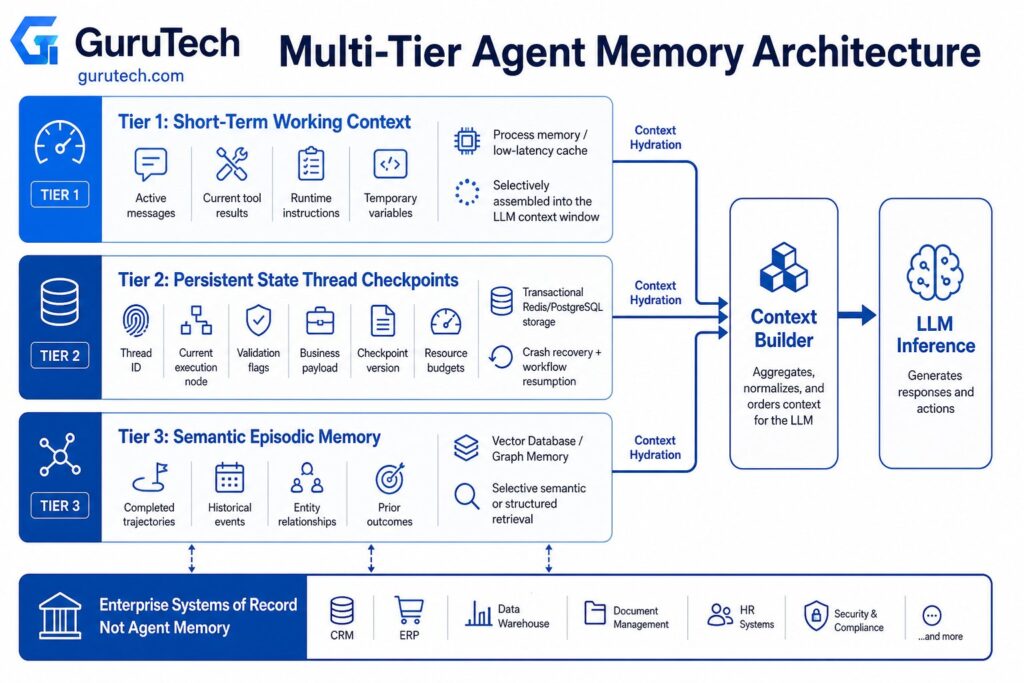
Persistent agent memory is not a single database or an indefinitely growing conversation transcript. Production stateful agentic AI systems separate memory according to durability, retrieval pattern, consistency requirements, latency sensitivity, and whether the stored information is authoritative or merely useful as inference context.
The most important boundary is between working context and persistent state. Working context contains the information assembled for the current inference operation, while persistent state contains the durable information required to reconstruct or continue the execution thread after the active process disappears.
A third tier, semantic episodic memory, serves a different purpose. It allows historical interactions, completed task trajectories, entities, outcomes, and other prior experiences to be retrieved selectively when they are relevant to a future execution.
These tiers should not be collapsed into one generalized “agent memory” abstraction. Their infrastructure characteristics and failure modes are fundamentally different.
Why Raw Conversation History Does Not Scale as Memory
Short-term memory is commonly implemented as a conversation buffer containing recent messages, tool outputs, and intermediate execution context. This works for bounded interactions because the runtime can reconstruct the immediate dialogue by inserting the recent history into the next model request.
The problem emerges when persistent multi-turn workflows continue accumulating state. Every additional message, retrieved document, tool result, validation response, and instruction competes for a finite context budget.
A naive implementation repeatedly serializes the entire conversation history into each subsequent model request. The prompt therefore grows with the thread, increasing inference input size while progressively introducing information that may have little relevance to the current graph node.
The original history can also contain superseded plans, corrected facts, failed tool results, stale retrievals, and instructions that applied only to earlier execution stages. Preserving these records for auditability does not mean they should remain continuously visible to the model.
Agent memory architectures therefore require an explicit distinction between what the system stores and what the model sees.
Three Distinct Memory and State Tiers
A practical enterprise agent memory architecture separates active inference context, durable operational state, and associative long-term memory. Each tier solves a different systems problem and should be selected according to its access and consistency characteristics.
| Agent Memory Storage Vector | Data Schema & Persistence Mechanics | Hardware Execution Layer | Enterprise Engineering Recommendation |
|---|---|---|---|
| Short-Term Context In-Memory Buffers | Recent messages, current node inputs, selected tool outputs, active instructions, temporary variables, and retrieved evidence assembled for the current inference operation. Data is ephemeral or reconstructable and is typically bounded by message count, token budget, node relevance, or time. | Application process memory, distributed cache, or low-latency stores such as Redis when active context must survive worker replacement or support distributed runtimes. | Use only for information required by the current or immediately adjacent graph nodes. Do not treat the complete conversation buffer as durable workflow state, and do not automatically inject the entire buffer into every model call. |
| Persistent State Thread Checkpoints | Structured state keyed by Thread ID and checkpoint version. Typical fields include current execution node, validation flags, tool execution status, structured business payloads, retry counters, token budgets, approval state, schema version, and references to external artifacts. State is serialized and written to durable storage at defined recovery boundaries. | Low-latency key-value infrastructure such as Redis for appropriate operational workloads, or transactional relational storage such as PostgreSQL where durability, relational integrity, auditability, and stronger transaction semantics are required. Storage design should follow the persistence and retrieval principles discussed in the Vector Databases for AI architecture while recognizing that transactional state is not itself vector memory. | Treat this tier as the authoritative operational state of the agent workflow. Use explicit schemas, versioned checkpoints, atomic mutations where required, lifecycle policies, and deterministic recovery procedures. Do not rely on semantic retrieval to reconstruct critical execution state. |
| Semantic Episodic Storage | Historical task trajectories, prior interactions, completed workflow outcomes, extracted entities, observations, and selected execution events transformed into embeddings or graph representations. Retrieval occurs through semantic similarity, metadata filtering, graph traversal, structured search, or hybrid retrieval rather than sequential replay. | Persistent vector databases, pgvector-backed relational infrastructure, search indexes, or graph-oriented memory systems depending on retrieval requirements. Existing GraphRAG architecture can provide relationship-aware retrieval when memory requires entity and dependency traversal rather than similarity search alone. | Use episodic memory to provide relevant historical context, not as the source of truth for transactional workflow position. Apply provenance, tenant isolation, retention policies, retrieval filters, and memory-quality evaluation because retrieved memories are candidate inference context rather than authoritative facts. |
Tier 1: Short-Term Working Context
Short-term working context exists to support the model invocation currently being executed. It can contain the active user request, system instructions, the immediately relevant conversation turns, structured state fields, current tool results, and selected evidence retrieved from longer-term stores.
Working memory should therefore be assembled according to the current execution node rather than copied blindly from a global message history. A validation node may require the proposed output and governing policy but not the exploratory messages that produced the proposal.
Similarly, a tool-routing node may need a structured intent, current authorization context, and resource limits without requiring every document retrieved earlier in the workflow.
This node-specific approach turns context construction into an explicit infrastructure operation. The runtime decides what information is eligible for model exposure before the request reaches the inference layer.
In-memory structures can provide the lowest-latency representation when execution remains on one worker. Redis or another low-latency distributed store becomes useful when active state must survive process termination, move between workers, or be shared across horizontally scaled runtime instances.
Time-to-live policies can remove inactive working buffers after the durable state has been checkpointed. The persistence requirement is therefore determined by whether the information can be reconstructed from authoritative state rather than by whether it happened to appear in a conversation.
Tier 2: Persistent State Thread Checkpoints
Persistent checkpoints solve a different problem: execution continuity. If a worker crashes after node 17 of a multi-stage workflow, the system needs to determine what completed, which external side effects occurred, what validation state existed, and which node may execute next.
That information should be represented structurally rather than reconstructed from embeddings or inferred from natural-language conversation history.
A checkpoint can contain the Thread ID, graph version, checkpoint sequence, current node, completion status, retry state, approval flags, tool execution references, resource budget, structured business payload, and other fields required for deterministic resumption.
Relational databases such as PostgreSQL are well suited when checkpoint mutations require transactions, relational constraints, audit queries, or integration with existing enterprise persistence infrastructure. Redis can support low-latency operational state where its durability and consistency configuration matches the workflow’s recovery requirements.
The important architectural rule is that the state backend should be selected according to the workflow’s durability and consistency requirements—not because a particular database is commonly associated with AI applications.
A vector database, for example, may be highly effective for associative retrieval but is generally the wrong abstraction for determining whether a financial transaction committed or whether a particular graph node completed successfully.
Tier 3: Semantic Episodic Memory
Long-term episodic memory exists to make selected historical experience retrievable without replaying an entire execution history. Episodic memory can represent previous task trajectories, tool outcomes, user interactions, incident resolutions, or other historical events that may improve a later execution.
Instead of loading all historical episodes, the system indexes selected records and retrieves a small relevant subset. Vector databases can support semantic similarity retrieval, while metadata filters restrict results by tenant, user, workflow type, date range, outcome, authority level, or other structured attributes.
Graph-oriented retrieval becomes useful when historical relevance depends on relationships rather than semantic proximity. An enterprise agent investigating a recurring infrastructure incident, for example, may need to traverse relationships among a service, deployment, dependency, previous incident, remediation action, and affected environment.
That is a different retrieval problem from finding text fragments with similar embeddings.
Memory architecture determines which historical information becomes available to an agent, but retrieval does not make the returned information authoritative. Episodic memory should enter the runtime as evidence carrying provenance and confidence, not as an unquestioned replacement for current enterprise data.
Authoritative Enterprise Data Is a Separate Layer
One of the most important production boundaries is the distinction between agent memory and systems of record. An accounting ledger, customer master record, identity directory, source repository, ticketing platform, or configuration database remains authoritative even when an agent maintains a memory representation derived from it.
An episodic memory may record that a customer requested a configuration change. The authoritative configuration service determines whether that change actually exists.
A checkpoint may record that an accounting adjustment was proposed. The financial system of record determines whether the transaction was committed.
This separation prevents stale or hallucinated memory from silently becoming enterprise truth. When authoritative state can change outside the agent workflow, the runtime should revalidate critical facts against the source system before executing consequential actions.
Programmatic State Condensation
Memory growth cannot be solved simply by periodically asking an LLM to “summarize the conversation.” Free-form summaries are lossy representations and can remove distinctions required for later validation, recovery, or audit.
A stronger pattern is programmatic state condensation. Background processes analyze older execution segments and extract durable structured changes while preserving the original records separately.
For example, a completed audit sequence might contain dozens of messages, retrieval results, and tool calls. Rather than injecting that entire sequence into future requests, a condensation process can extract structured entities such as:
- asset identifier and jurisdiction
- validated classification
- evidence references
- exception status
- reviewer approval identifier
- effective date
- source-system transaction reference
- provenance linking the condensed record to the original execution events
The condensed representation can then be indexed for semantic or structured retrieval while the original checkpoint and audit history remain intact.
This pattern is materially different from replacing history with a prose summary. The objective is to reduce inference-context pressure without destroying the structured facts needed for subsequent processing.
Asynchronous Memory Consolidation
Condensation does not always need to execute synchronously inside the user-facing agent loop. Background workers can process completed or inactive thread segments after the critical workflow checkpoint has already committed.
An asynchronous consolidation pipeline can identify entities, normalize relationships, generate embeddings, update semantic indexes, detect superseded memories, and construct graph relationships without increasing the latency of the foreground inference path.
This also creates an opportunity to validate memory writes before they enter long-term retrieval. Sensitive fields can be removed, provenance can be attached, tenant boundaries can be verified, and low-confidence extractions can be withheld or routed for additional validation.
The durable checkpoint remains authoritative during this process. If the asynchronous memory job fails, the workflow should not lose its ability to resume.
Memory Retrieval Requires a Context Budget
Long-term memory only solves context pressure if retrieval itself is bounded. Returning dozens of semantically similar episodes and inserting them into every model request recreates the same context inflation problem in a different storage layer.
The context builder should allocate explicit budgets among system instructions, active thread state, recent conversation turns, retrieved enterprise evidence, episodic memory, and expected model output.
Retrieval can then optimize within those constraints rather than treating the model’s maximum context window as a target to fill.
This is also where semantic caching and memory retrieval must remain conceptually separate. A semantic cache attempts to reuse a prior computational result for sufficiently similar input, whereas episodic memory retrieves historical information that may inform a new execution.
The two mechanisms may use similar embedding infrastructure while serving different correctness and lifecycle requirements.
Memory Degradation Begins at the Tier Boundaries
Long-running memory systems eventually accumulate stale, duplicated, contradictory, or low-value information. The failure mode is not simply storage growth; it is deterioration in the quality of the context selected for future inference.
Old episodic records may conflict with current system-of-record data. Multiple condensed representations may describe the same entity differently. Changes to embedding models can alter retrieval behavior, while poorly scoped metadata filters can expose memories from the wrong workflow or tenant.
These risks mean memory systems require lifecycle management: retention, deduplication, provenance, invalidation, versioning, re-indexing, access control, and retrieval-quality evaluation.
Stateful architecture therefore does not mean retaining everything forever. It means retaining the right information in the right storage tier with explicit semantics for recovery, retrieval, authority, and deletion.
Once these memory boundaries are established, the next architectural question is how execution itself should be controlled. A local Python loop can append messages and call tools, but it does not automatically provide typed state transitions, deterministic recovery paths, bounded cycles, or durable graph execution. Those differences separate stateless scripted wrappers from formal stateful agent architectures.
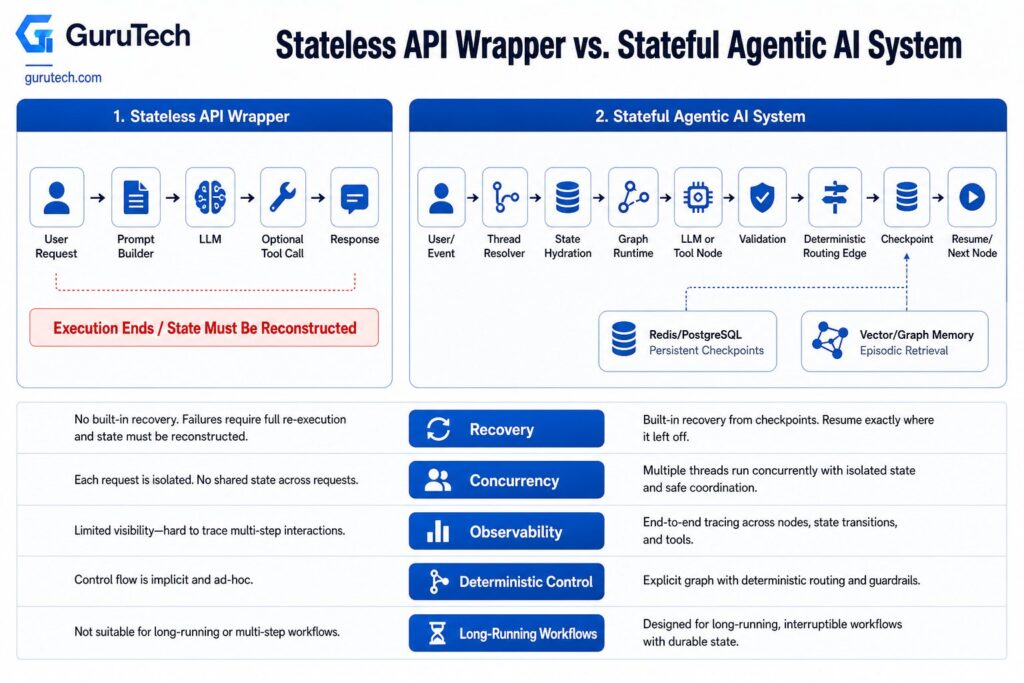
Stateless API Wrappers vs. Stateful Agentic AI Systems
Many systems labeled as “AI agents” are still structurally simple API wrappers. They accept input, append context to a prompt, invoke a model, optionally call a tool, and return the result without maintaining a durable execution model.
That pattern is useful for bounded tasks. It is not equivalent to a persistent state machine capable of recovering from partial failure, coordinating concurrent work, enforcing graph invariants, or resuming execution after a process or model-provider boundary.
Stateless API wrappers can scale efficiently because each request is self-contained. Their architectural weakness appears when future execution depends on prior state mutations that must remain authoritative across multiple calls.
A stateful agentic architecture introduces an explicit control plane around model inference. That control plane manages state schemas, checkpointing, routing predicates, recovery boundaries, tool execution status, and thread identity independently of the model itself.
Downstream Actor Integration: Once your system stabilizes its internal state schemas across cyclical execution nodes, these graphs must actively manipulate external environments. Read our complete companion manual on engineering robust tool ingestion engineering llm workflows to safely map and sandbox complex read/write enterprise function boundaries.
Where Stateless Scripted Loops Work
A stateless wrapper is appropriate when each request can be evaluated independently and the complete task context fits within one bounded execution window.
Examples include extraction, classification, summarization, deterministic enrichment, single-turn retrieval, schema conversion, and other operations where failure can be handled by retrying the request from the beginning.
The implementation can be as simple as a Python service that constructs a prompt, invokes a model endpoint, parses the result, and returns the response.
The distinction between stateless and stateful AI agents becomes relevant only when future behavior depends on information that cannot be reconstructed safely from the current request.
Why Appending Strings to a Local List Is Not State Management
A common intermediate implementation uses a local array to preserve messages across a loop:
messages.append(model_output)
This creates continuity inside one running process, but it does not create durable state. If the process terminates, the array disappears unless it has been serialized externally.
It also mixes multiple concerns into one sequence. User messages, system instructions, tool results, validation failures, retries, and workflow position become indistinguishable conversational artifacts rather than explicitly typed state variables.
The result is an execution loop that can appear agentic while lacking the mechanisms required for deterministic recovery or formal workflow control.
Instruction Drift in Long Prompt Loops
Stateless scripted loops often maintain continuity by repeatedly appending earlier outputs back into the next model prompt. As the thread grows, the model receives increasingly heterogeneous context containing current instructions, historical instructions, obsolete tool results, failed plans, corrections, and natural-language descriptions of workflow status.
This creates instruction drift because the runtime has no explicit representation of which directives remain active. The model must infer priority from the prompt itself.
Typed state solves a different problem. Instead of asking the model to infer whether a task has completed or whether a validation flag changed, the orchestration layer can represent those conditions as explicit fields that deterministic code evaluates outside the prompt.
Unhandled Tool Failures and Infinite Loop Traps
Basic scripted loops frequently allow the model to determine what should happen after a tool failure. A tool throws an exception, the exception text is appended to the message history, and another model call is asked to decide what to do next.
This can create uncontrolled retry cycles when the underlying failure is not recoverable. Authentication failures, invalid schemas, unavailable dependencies, or malformed requests may repeatedly trigger the same tool operation.
Stateful graph architectures provide a stronger mechanism. The runtime can classify the failure, increment a retry counter, inspect the current policy, and route the thread through a deterministic error edge.
A transient rate limit might move to a retry node with backoff. A schema violation might route to repair. An authorization failure may terminate execution immediately or escalate to a human reviewer.
The LLM does not need to control those transitions.
Deterministic Routing Edges Change the Control Model
Deterministic routing edges establish explicit legal transitions between graph nodes. A node can produce a probabilistic output, but code evaluates whether that output satisfies the conditions required to reach the next state.
For example, a validation node may return structured fields such as:
verification_passedmissing_evidence_countrisk_classificationrequires_human_approval
The router can then evaluate those fields with deterministic predicates rather than asking the model where the workflow should go next.
This changes the trust boundary. The model generates candidate content or action intent, while the orchestration layer retains authority over workflow progression.
Graph Nodes Create Execution Isolation
Formal state-machine frameworks represent workflows as directed graphs composed of isolated nodes. Each node performs one bounded operation against a known state schema and returns only the mutation it is authorized to produce.
A retrieval node should not implicitly mutate approval state. A tool node should not rewrite conversation policy. A validation node should not silently execute an external transaction.
This isolation improves testability because each node can be evaluated independently against known state fixtures. It also reduces the amount of context exposed to the model because each node receives only the information required for its responsibility.
Stateful agent architectures are therefore less about making the model more autonomous and more about constraining probabilistic inference inside explicit software boundaries.
Formalized State Schemas Prevent Implicit Workflow Logic
In a scripted loop, workflow status is often represented implicitly in natural-language messages such as “the verification step failed” or “the user approved the transaction.”
Formal state machines encode those conditions structurally. A state schema can expose fields such as:
current_execution_nodeverification_passedretry_countapproval_statusallocated_token_budget_remainingcheckpoint_version
The routing layer evaluates these fields directly. This removes workflow-critical conditions from the ambiguity of prompt interpretation.
LangGraph, CrewAI, and Custom Enterprise Graph Layers
Frameworks such as LangGraph and CrewAI can provide abstractions for orchestrating multi-step workflows, while custom enterprise runtimes may implement similar patterns directly on top of workflow engines, queues, transactional stores, and internal policy services.
The important architectural distinction is not the framework name. It is whether the runtime provides explicit state, graph transitions, recovery semantics, bounded execution, and infrastructure-level controls.
LangGraph emphasizes typed shared state and graph-oriented execution. CrewAI emphasizes role-oriented collaboration patterns. Custom systems may integrate agent logic into existing orchestration platforms where enterprise transaction and governance requirements take precedence over framework-specific abstractions.
No framework removes the need to design state semantics correctly.
Architectural Comparison
| Architectural Feature Set | Stateless Scripted Loop Wrapper | Stateful Agentic System Architecture |
|---|---|---|
| Execution Flow Control | Sequential prompt and tool logic typically encoded directly in application code or model-generated next-step instructions. | Explicit graph topology with isolated nodes, conditional transitions, terminal states, and bounded cycles. |
| State Representation | Conversation arrays, local variables, or client-provided context. | Typed shared state schema persisted independently of individual model calls or worker processes. |
| Persistence | Optional and usually external to the execution loop. | Thread state and checkpoints are first-class runtime components with defined serialization and recovery semantics. |
| Error Recovery Pathways | Retry request from the beginning or append exception details and ask the model to continue. | Route failures through explicit recovery nodes, retry policies, compensation logic, checkpoint restoration, or human escalation. |
| Infinite Loop Protection | Application-specific counters or prompt instructions; often inconsistently enforced. | Iteration limits, recursion limits, resource budgets, deterministic terminal conditions, and graph-level guards. |
| Tool Execution Control | Tool calls may be executed directly after parsing model output. | Model-generated action intent is validated against schemas, policy, authorization, and graph position before execution. |
| Deterministic Routing | Limited; routing frequently delegated to another model call or hardcoded inside sequential logic. | Conditional edges evaluate typed state values through deterministic predicates outside model inference. |
| Checkpoint Recovery | Usually unavailable; recovery requires reconstructing the request or replaying earlier steps. | Resume from persisted state at a known checkpoint or graph boundary. |
| Concurrency Tracing | Difficult because execution history is often represented as one linear message sequence. | Parallel branches can retain node identity, state versions, causal metadata, merge behavior, and trace relationships. |
| State Conflict Resolution | Typically undefined or handled through last-write-wins application behavior. | Reducers, optimistic concurrency, transactional writes, version checks, or domain-specific merge semantics. |
| Data Storage Decoupling | Model context, conversational history, and application variables are frequently mixed together. | Execution state, short-term context, episodic memory, artifacts, and authoritative enterprise data are separate persistence concerns. |
| Observability | Primarily request-level latency, errors, and token usage. | Thread-level traces across node transitions, checkpoints, memory retrievals, tool calls, retries, and state mutations. |
| Schema Evolution | Minimal concern when each request is independent. | Requires versioned state schemas, migration strategies, and backward-compatible checkpoint hydration. |
| Long-Running Workflows | Process must remain active or external code must reconstruct execution context. | Thread can suspend, persist, and resume across processes, machines, model providers, or human approval intervals. |
| Operational Complexity | Low; appropriate for bounded request-response workloads. | Higher due to persistence, recovery, concurrency, lifecycle management, governance, and distributed state. |
Data Storage Decoupling Is a Major Architectural Boundary
One of the most important differences between the two patterns is where state lives.
A scripted wrapper often reconstructs operational context by reusing model-facing messages. A stateful runtime separates model context from durable workflow state, long-term memory, tool artifacts, and authoritative enterprise records.
This separation allows the model context to remain compact while the workflow remains fully recoverable.
It also permits infrastructure components to evolve independently. A team can change vector stores without changing the transactional checkpoint model, replace an LLM provider without migrating thread identity, or rework the prompt strategy without destroying the audit history.
Concurrency Exposes the Limits of Local Loops
The architectural difference becomes more pronounced when multiple branches execute in parallel. A simple message array assumes one linear history, but real enterprise workflows may perform retrieval, validation, policy evaluation, or tool operations concurrently.
Parallel branches can generate independent mutations that must eventually merge into one authoritative thread state.
A formal state architecture can define reducers for append-only evidence, replacement semantics for scalar status fields, and conflict checks for mutually exclusive business mutations.
A local scripted loop has no equivalent semantics unless the engineer manually builds them—which effectively means reimplementing a state machine.
Stateful Does Not Automatically Mean Better
Stateful systems introduce significant operational overhead. Schema evolution, checkpoint storage, distributed coordination, state corruption, migration logic, garbage collection, recovery testing, and observability all become production responsibilities.
Those costs are unnecessary when the workload is naturally stateless.
Workflows requiring context retention across multiple invocations, external side effects, approvals, branching, failure recovery, or long execution horizons are the cases where stateful architecture provides a structural advantage.
A one-shot extraction endpoint does not need LangGraph. A multi-day audit, infrastructure remediation process, or software engineering workflow probably needs more than a local message array.
The Decision Boundary
The correct question is not whether an application contains an LLM loop. The correct question is whether the system needs a durable execution model whose future behavior depends on validated state mutations from previous operations.
If the answer is no, a stateless wrapper is often the simpler and more reliable architecture.
If the answer is yes, the system needs explicit mechanisms for state identity, persistence, transition validation, checkpoint recovery, resource bounds, and observability.
That is the point where a prompt loop becomes a distributed state-management problem—and where formal state graph design becomes justified.
The next section moves from architecture to implementation by defining the typed shared schema that carries execution state across nodes and determines how concurrent updates are merged.
Code-Level Implementation: Declaring a Production-Grade State Graph Schema
A production agent graph needs a shared schema that is explicit enough to support deterministic routing, checkpoint persistence, failure recovery, concurrency control, and observability. The state object should function as a typed contract between graph nodes rather than as an unstructured container for arbitrary model outputs.
In LangGraph production deployments, the state schema defines which fields are available across node transitions and how updates are merged into the shared graph state. The same design principle applies to custom orchestration layers even when LangGraph itself is not used.
The schema below models an enterprise systems-operations workflow. It separates conversational messages from execution metadata, verification state, resource controls, structured business payloads, and append-only tool logs.
from __future__ import annotations

from datetime import datetime, timezone
from typing import Annotated, Any, Literal, TypedDict


class ToolExecutionLog(TypedDict):
    tool_name: str
    execution_id: str
    status: Literal["started", "completed", "failed"]
    timestamp_utc: str
    input_reference: str | None
    output_reference: str | None
    error_code: str | None


class CheckpointMetadata(TypedDict):
    thread_id: str
    checkpoint_id: str
    checkpoint_version: int
    graph_version: str
    state_schema_version: str
    persisted_at_utc: str


def append_tool_logs(
    existing: list[ToolExecutionLog],
    incoming: list[ToolExecutionLog],
) -> list[ToolExecutionLog]:
    """
    Append new immutable tool execution events without overwriting prior history.

    The reducer preserves causal execution order while suppressing duplicate
    records that may be replayed after retries or checkpoint restoration.
    """
    merged = list(existing)
    known_execution_ids = {
        entry["execution_id"]
        for entry in existing
    }

    for entry in incoming:
        if entry["execution_id"] not in known_execution_ids:
            merged.append(entry)
            known_execution_ids.add(entry["execution_id"])

    return merged


class EnterpriseAgentState(TypedDict):
    # Model-visible conversational state should remain distinct from
    # authoritative execution metadata and business state.
    messages: list[dict[str, Any]]

    # Graph execution control.
    current_execution_node: str
    previous_execution_node: str | None
    execution_status: Literal[
        "running",
        "waiting_for_tool",
        "waiting_for_approval",
        "retry_pending",
        "completed",
        "failed",
    ]

    # Validation and bounded-autonomy controls.
    verification_passed: bool
    retry_count: int
    max_retry_count: int
    allocated_token_budget_remaining: int
    requires_human_approval: bool

    # Structured business-domain state.
    extracted_json_payload: dict[str, Any]

    # Append-only operational history.
    tool_execution_logs: Annotated[
        list[ToolExecutionLog],
        append_tool_logs,
    ]

    # Checkpoint and replay metadata.
    checkpoint: CheckpointMetadata

    # Concurrency and idempotency controls.
    state_version: int
    idempotency_key: str


def initialize_agent_state(
    *,
    thread_id: str,
    checkpoint_id: str,
    graph_version: str,
    state_schema_version: str,
    initial_payload: dict[str, Any],
    token_budget: int,
) -> EnterpriseAgentState:
    now = datetime.now(timezone.utc).isoformat()

    return EnterpriseAgentState(
        messages=[],
        current_execution_node="ingest_request",
        previous_execution_node=None,
        execution_status="running",
        verification_passed=False,
        retry_count=0,
        max_retry_count=3,
        allocated_token_budget_remaining=token_budget,
        requires_human_approval=False,
        extracted_json_payload=initial_payload,
        tool_execution_logs=[],
        checkpoint=CheckpointMetadata(
            thread_id=thread_id,
            checkpoint_id=checkpoint_id,
            checkpoint_version=1,
            graph_version=graph_version,
            state_schema_version=state_schema_version,
            persisted_at_utc=now,
        ),
        state_version=1,
        idempotency_key=f"{thread_id}:{checkpoint_id}:1",
    )
Why the Schema Separates Messages from Execution State
The messages field exists because some graph nodes need conversational context. It should not become the authoritative representation of workflow progress.
Fields such as current_execution_node, verification_passed, execution_status, and requires_human_approval encode workflow-critical conditions explicitly. Deterministic routing code can evaluate those fields directly without asking the model to infer state from natural-language history.
This separation also improves checkpoint recovery. The runtime can determine exactly where execution stopped even if the most recent model response is malformed, incomplete, or unavailable.
Custom Reducers Preserve Historical State
The tool_execution_logs field uses a custom reducer rather than simple replacement semantics. Each graph node can return a new tool event, and the reducer appends that event to the existing history without discarding previous entries.
The reducer also suppresses duplicate execution_id values. That becomes important when a node is replayed after a checkpoint restore or when delivery semantics allow the same event to be observed more than once.
Append-only event fields and mutable scalar fields should not share the same merge strategy. A retry counter should usually be replaced with the latest validated value, while an execution log should preserve prior events for auditability and causal tracing.
Checkpoint Metadata Belongs Inside the State Contract
The checkpoint structure records which persisted version of the workflow the runtime is operating against. It includes a stable Thread ID, checkpoint ID, graph version, schema version, and persistence timestamp.
These fields provide the minimum metadata required to reason about state compatibility during recovery and deployment changes.
If a workflow created under graph version 2026.08.1 is hydrated by a runtime executing 2026.09.0, the orchestration layer can inspect the checkpoint metadata before attempting to run the next node. That makes schema migration an explicit engineering decision rather than an accidental deserialization failure.
State Versioning Supports Optimistic Concurrency
The state_version field provides a simple foundation for optimistic concurrency control. A worker hydrates version 17, performs its node execution, and attempts to persist version 18.
If another worker has already committed version 18, the stale write can be rejected rather than silently overwriting newer state.
This is particularly important when parallel branches converge on a shared state thread. Without version checks or transactional merge semantics, concurrent workers can erase valid mutations produced by other branches.
Idempotency Must Be Explicit
The idempotency_key field helps separate state replay from external side-effect replay. Restoring a checkpoint should not automatically cause a payment, infrastructure change, ticket creation, or database mutation to execute twice.
A tool execution layer can combine the thread identifier, checkpoint version, node identifier, and operation identity into an idempotency key that external services or internal middleware use to suppress duplicate side effects.
This becomes critical in persistent multi-turn workflows where retries are expected rather than exceptional.
Business Payloads Should Be Structured
The extracted_json_payload field represents workflow-specific business state in machine-readable form. A financial audit agent might store normalized asset records, tax classifications, evidence references, and exception status here.
A software-operations agent might instead track repository identifiers, deployment environment, test status, incident severity, and remediation metadata.
Keeping these fields structured makes them easier to validate, diff, persist, query, and route on than embedding the same information inside prose messages.
Large Artifacts Should Remain External
The shared state object should not contain large binaries, full documents, source archives, or large tool-response payloads when an immutable external reference is sufficient.
Instead, state can store object-store URIs, content hashes, database record identifiers, or signed internal references. This keeps checkpoint serialization bounded and reduces the cost of repeatedly loading and persisting the graph state.
It also allows artifact retention and access control to evolve independently from the agent-state schema.
Schema Mutation Requires Deployment Discipline
The architecture requires schema evolution as a production concern, but the stronger rule is that persisted state must be treated as long-lived application data rather than as an ephemeral Python object.
Adding, renaming, or changing the type of a field can affect every thread whose checkpoint was created under an earlier schema version.
Production systems should therefore use explicit state_schema_version metadata and define migration logic for older checkpoints. Depending on operational requirements, this can be handled through backward-compatible readers, migration jobs, graph-version pinning, or controlled blue-green deployment strategies.
Observability Should Reference State, Not Pollute It
Execution traces, model latency, token usage, database timing, and infrastructure metrics should generally flow through dedicated observability channels rather than being copied wholesale into the shared state object.
The state should contain only the identifiers or bounded counters required for workflow control, such as remaining token budget, retry count, or trace correlation ID.
The full telemetry stream belongs in systems such as the AI Token Observability Dashboard, where node-level model usage can be correlated with thread execution without inflating every persisted checkpoint.
Example State Mutation Across a Tool Node
Assume the current graph node validates a configuration record and invokes an internal compliance service. The tool returns a structured exception indicating that the configuration violates policy.
The node should not rewrite the entire state. It returns only the fields it is authorized to mutate:
def apply_compliance_result(
    state: EnterpriseAgentState,
    *,
    tool_result: dict[str, Any],
    execution_id: str,
) -> dict[str, Any]:
    now = datetime.now(timezone.utc).isoformat()

    updated_payload = {
        **state["extracted_json_payload"],
        "compliance_exception": tool_result,
    }

    return {
        "previous_execution_node": state["current_execution_node"],
        "current_execution_node": "validate_exception",
        "verification_passed": False,
        "extracted_json_payload": updated_payload,
        "tool_execution_logs": [
            ToolExecutionLog(
                tool_name="compliance_policy_check",
                execution_id=execution_id,
                status="completed",
                timestamp_utc=now,
                input_reference=None,
                output_reference=tool_result.get("result_reference"),
                error_code=None,
            )
        ],
        "state_version": state["state_version"] + 1,
    }
The runtime merges this partial update according to the schema rules, validates the resulting state, persists a checkpoint, and only then evaluates the next routing edge.
This is the core advantage of formal state graphs: each node produces a bounded, inspectable state transition rather than mutating a hidden execution context through side effects.
The next section builds on this schema by examining how LangGraph-style runtimes use shared state, nodes, conditional edges, cycles, interrupts, and checkpoints to implement persistent agent state machines.
LangGraph State Management and Cyclic Agent State Machines
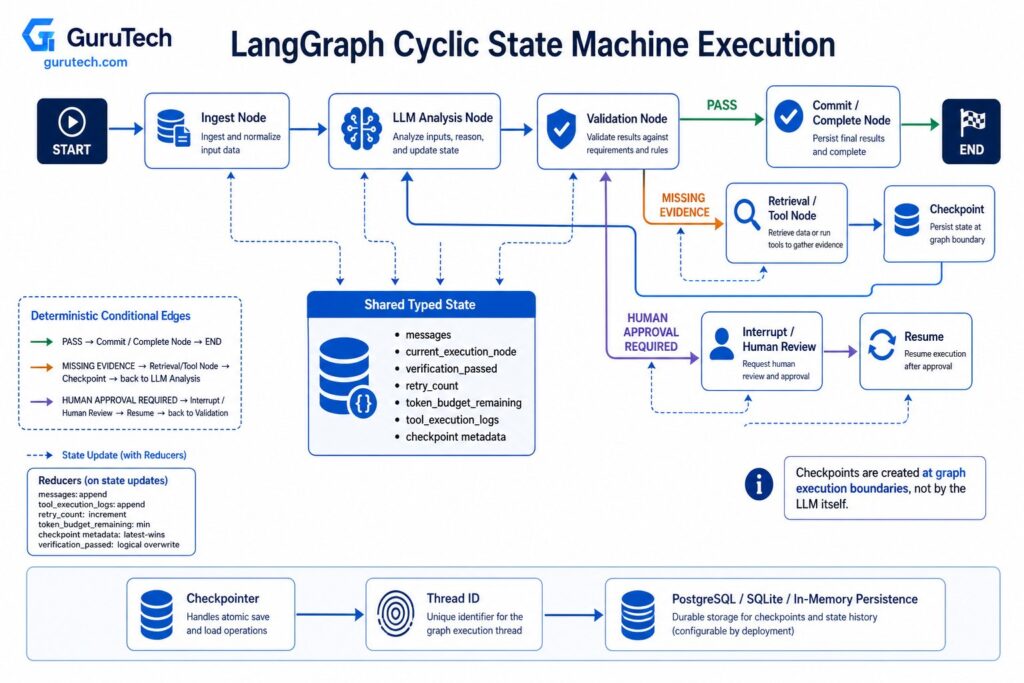
LangGraph state management provides a concrete implementation of the broader architecture described throughout this article: a shared state object moves through a directed execution graph, nodes return bounded state updates, reducers determine how those updates merge, and a persistence layer can checkpoint the graph so execution survives beyond a single process invocation.
LangGraph is useful here because it makes state, routing, cycles, interruptions, and persistence explicit software primitives rather than conventions embedded inside prompt strings. It should not, however, be treated as synonymous with stateful agent architecture. The same architectural principles can be implemented through custom workflow engines, durable queues, relational databases, event-driven runtimes, or other orchestration frameworks.
Each LangGraph node receives the current graph state, performs a bounded operation such as validation, retrieval, tool execution, or an LLM call, and returns a partial update. Reducer semantics determine how that update is applied to the accumulated state rather than requiring every node to reconstruct or overwrite the entire state object.
State Is Shared, but Updates Are Node-Scoped
The graph state represents the accumulated execution context available to the workflow. Nodes do not need to return the complete state after every operation; they can return only the keys they intend to modify.
The runtime then applies the configured reducer for each updated key. LangGraph’s reducer model is significant because different state fields require different mutation semantics.
A scalar field such as current_execution_node may use replacement semantics. An append-only tool history may use a reducer that combines previous and incoming events. A more complex domain field may require a custom merge function that rejects invalid concurrent changes.
This is materially different from passing one mutable Python dictionary through a sequence of arbitrary functions. The schema and reducer behavior define how state changes accumulate across graph execution.
Reducers Define State Mutation Semantics
The custom reducer introduced in the previous section maps directly to this design. LangGraph allows individual state keys to define their own reducer functions; where no custom reducer is supplied, an incoming update can replace the prior value for that key.
This means reducer selection is part of the architecture rather than a convenience feature.
Consider two graph branches that independently retrieve compliance evidence. Both may safely append records into an evidence collection. Two branches that independently modify the same approved financial adjustment require a different rule because combining both updates may violate the domain model.
Reducers should therefore reflect business-state semantics rather than automatically concatenating everything produced by parallel nodes.
Cyclic Agent State Machines
Cyclic agent state machines are valuable when a workflow cannot be represented as a one-way sequence from input to output. A validation result may require the system to return to retrieval, retry a tool operation, request additional evidence, invoke another model, or suspend for human review.
A directed graph makes these transitions explicit.
For example:
START
  ↓
Analyze
  ↓
Validate
  ├── PASS ───────────────→ Complete → END
  ├── MISSING_EVIDENCE ──→ Retrieve Evidence ──→ Analyze
  └── NEEDS_APPROVAL ────→ Human Review ───────→ Validate
The graph contains a cycle because Retrieve Evidence returns execution to Analyze. The presence of a cycle does not itself create autonomy; it creates a legal execution path that can be traversed repeatedly while state changes.
This distinction matters. A production graph should encode why the cycle exists, what state must change before another iteration occurs, and which conditions force termination.
Conditional Edges Should Evaluate Typed State
Conditional routing is strongest when it evaluates explicit state fields rather than free-form model prose.
A validation node might return:
{
    "verification_passed": False,
    "missing_evidence_count": 2,
    "requires_human_approval": False,
}
The routing function can then evaluate those fields through ordinary deterministic code:
from typing import Literal


def route_after_validation(
    state: EnterpriseAgentState,
) -> Literal[
    "complete",
    "retrieve_evidence",
    "human_review",
    "terminate",
]:
    if state["verification_passed"]:
        return "complete"

    if state["requires_human_approval"]:
        return "human_review"

    if state["allocated_token_budget_remaining"] <= 0:
        return "terminate"

    return "retrieve_evidence"
The model may have contributed to the validation result, but the graph transition remains visible, testable, and enforceable outside model inference.
This pattern also supports quality thresholds and other deterministic validation controls where only explicitly accepted state may advance toward completion.
Cycles Require Explicit Termination Conditions
Cyclic workflows introduce the possibility that execution repeatedly traverses the same nodes without converging. Prompt instructions such as “do not loop forever” are not sufficient production controls.
LangGraph provides a recursion limit that bounds the number of graph super-steps executed during a run. If the configured limit is exhausted, the runtime raises a graph recursion error rather than allowing execution to continue indefinitely.
Infrastructure-level limits should be combined with domain-specific termination conditions such as:
- maximum retry count
- remaining token budget
- tool-call quota
- elapsed execution deadline
- maximum evidence-retrieval cycles
- unchanged state across successive iterations
- terminal policy violation
- mandatory human escalation threshold
The objective is not merely to stop infinite recursion. It is to determine when continued autonomous execution no longer has a justified path toward a valid terminal state.
Thread IDs Establish Persistent Workflow Identity
When LangGraph is compiled with a checkpointer, persisted state is associated with a thread. The thread_id identifies the sequence of checkpoints belonging to that execution history, while a checkpoint identifier can address a particular persisted state within the thread.
This corresponds directly to the shared-state thread architecture introduced earlier.
A single Thread ID may survive many graph runs. A user can initiate a workflow, the runtime can checkpoint it, execution can suspend, and a later invocation can continue against the persisted state associated with the same thread.
The Thread ID should therefore represent a durable business execution boundary rather than a transient HTTP request.
Checkpointers Provide Durable Execution State
LangGraph supports checkpointer implementations that persist graph state. Current reference documentation includes in-memory, SQLite, and PostgreSQL checkpoint savers, as well as a base checkpoint interface that can support additional persistence implementations.
State persistence is closely linked to several possible storage technologies. That broader enterprise pattern remains valid, but the framework-specific implementation should follow the persistence adapters and interfaces actually supported by the deployed LangGraph version.
In-memory persistence is useful where process durability is unnecessary. SQLite can support local or constrained environments. PostgreSQL is more appropriate when durable state must survive worker termination and participate in production infrastructure with established backup, access-control, and operational practices.
The persistence backend should still be selected according to recovery objectives, concurrency characteristics, deployment topology, state volume, and governance requirements rather than simply because an adapter exists.
LangGraph Checkpoints Occur at Execution Boundaries
A particularly important implementation detail is that LangGraph does not checkpoint arbitrary lines inside a node function. With a checkpointer enabled, graph state is saved at graph execution or super-step boundaries.
This affects how engineers should design node responsibilities.
If one node performs five external side effects and fails after the fourth, resuming the graph does not automatically mean execution restarts at the fifth line of that Python function. Depending on the execution pattern, the node may run again.
External operations inside resumable nodes must therefore be designed for idempotency or separated into appropriately bounded execution tasks.
This is one reason the earlier state schema included an idempotency_key. Durable graph execution without idempotent external actions can still produce duplicate business transactions.
Pending Writes Reduce Unnecessary Re-Execution
Checkpointing becomes more subtle when multiple nodes operate within the same execution step. LangGraph’s checkpointing model can preserve writes from nodes that completed successfully when another node in the same super-step fails, allowing the runtime to avoid unnecessarily repeating work that has already completed.
This is important for parallel graph execution because failure recovery should preserve successful independent work whenever the runtime can prove that the result remains valid.
It does not remove the need for application-level transaction design. External tool side effects still require idempotency and consistency controls outside the graph-state checkpoint itself.
Interrupts Turn Human Approval into a Persistent Graph State
Long-running enterprise workflows frequently need to suspend execution rather than terminate it. A financial exception, infrastructure change, security escalation, or regulated action may require approval before the graph is permitted to continue.
LangGraph supports interrupt-and-resume patterns where execution pauses and later continues using the persisted thread state. The resume input is supplied back into the interrupted execution rather than forcing the workflow to reconstruct its prior history from scratch.
This maps naturally to human-in-the-loop AI workflows.
The state might transition from:
execution_status = "running"
to:
execution_status = "waiting_for_approval"
requires_human_approval = True
The worker process can then disappear entirely. The authoritative thread state remains persisted until an approval event resolves the same Thread ID and resumes execution.
Human Approval Is an Edge, Not a Chat Message
This distinction is architecturally important. A production system should not represent approval solely as a user message saying “yes.”
The runtime should validate the identity and authorization of the reviewer, associate the approval with the correct checkpoint and requested action, record provenance, mutate structured approval state, and only then enable the next legal graph edge.
The LLM should not interpret whether the reviewer was authorized to approve the operation.
Graph State and Runtime Context Are Different Concerns
Not every value required by a node belongs in persistent graph state. Framework runtime configuration can carry dependencies or invocation-specific context that should not become durable thread data.
Examples include model provider selection, database connection handles, service clients, tracing infrastructure, deployment environment, and other runtime dependencies.
Separating durable state from runtime dependencies keeps checkpoints portable and prevents environment-specific objects from leaking into serialization boundaries.
Schema Evolution Requires More Nuance Than “Locking the Graph”
A common claim is that graph compilation effectively locks the state schema and that runtime changes force blue-green migration. That is too absolute.
Current LangGraph documentation describes support for graph migrations, including adding or removing state keys in many cases. Renaming keys can cause previously persisted values to be lost for existing threads, while incompatible type changes can create problems when hydrating older state. Graph topology changes also need additional care for threads currently paused at interrupts.
The enterprise recommendation remains the same even though the framework is more flexible: version persistent state deliberately.
A production system should know which graph version and state-schema version produced a checkpoint. Compatibility should be tested explicitly rather than assumed because deserialization happens to succeed.
Concurrency Is Not Solved by the Graph Abstraction Alone
State graphs make parallel execution visible, but they do not eliminate distributed-systems consistency problems.
Multiple runtime instances may operate against the same underlying business resources. Graph branches may independently modify shared data. External systems can change while an agent thread remains suspended.
The orchestration layer therefore still needs transactional database semantics, optimistic concurrency, idempotency keys, domain-specific conflict resolution, or other coordination controls where required.
Managing complex agent task flows becomes considerably easier when graph state is explicit, but state-machine structure does not replace the consistency model of the systems being modified.
LangGraph Should Remain an Orchestration Layer
A useful enterprise boundary is to treat LangGraph as the durable orchestration layer rather than as the database of record for the entire application.
The graph can hold execution state, references to artifacts, validation flags, resource counters, and enough context to determine what should happen next.
Authoritative business data should remain in the enterprise systems designed to own it. Long-term semantic memory should remain in its dedicated retrieval layer. Full telemetry should remain in the observability stack.
This prevents the graph state from becoming an unbounded monolithic application database.
What Cyclic State Machines Actually Provide
The architectural value of cyclic state machines is not that they make an LLM inherently more capable. They provide a controlled environment in which uncertain model operations can participate in longer execution processes.
The graph determines:
- which operations are legal
- which state each operation may inspect
- how state mutations merge
- when validation occurs
- where checkpoints establish recovery boundaries
- which conditions permit another cycle
- when human intervention is required
- what constitutes a terminal state
The LLM supplies inference inside those boundaries.
That separation is the production engineering principle behind cyclic agent state machines: probabilistic inference remains bounded by deterministic execution topology and durable state.
The next section goes below the graph abstraction into the persistence layer itself: how state is serialized, how database checkpoints are stored, where transaction boundaries belong, and how a failed thread is reconstructed safely from durable storage.
State Serialization and Database Checkpoints
Persistent execution requires an agent’s in-memory state to survive process termination, worker replacement, deployment changes, and long periods of inactivity. State serialization is the boundary that converts the active runtime representation into a durable form that can be written to storage and reconstructed later.
For stateful agentic AI systems, serialization is not simply a convenience for saving conversation history. The serialized checkpoint may represent the authoritative recovery position of a multi-step enterprise workflow.
A valid checkpoint therefore needs enough information to answer four questions after failure: which thread was executing, which state version committed, which operations completed, and which graph transition is legally allowed next?
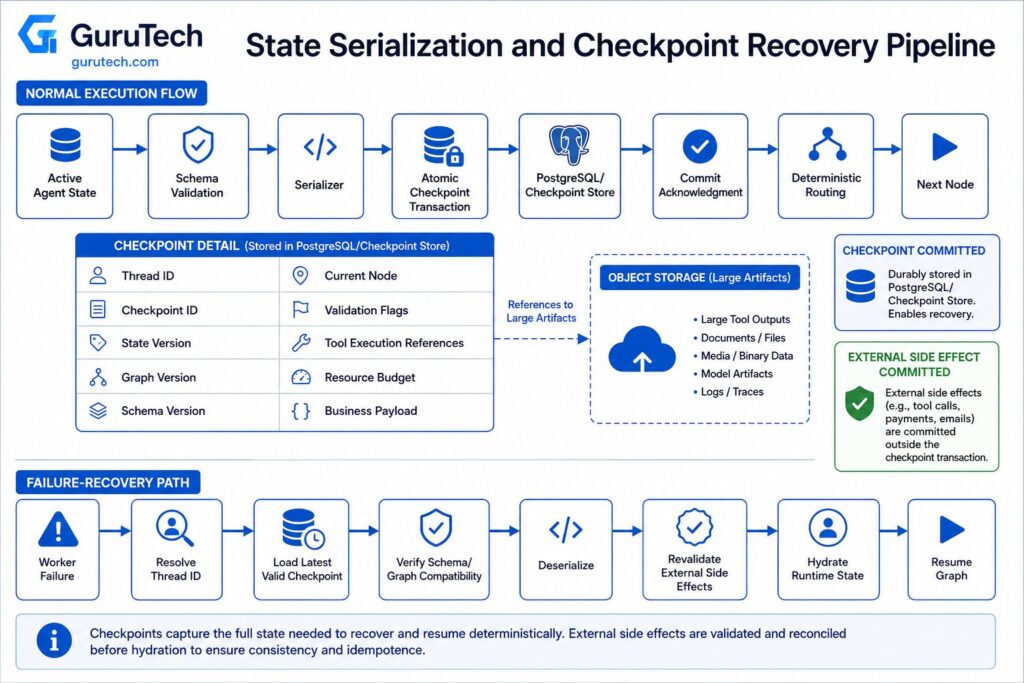
What a Production Checkpoint Actually Contains
A checkpoint is a versioned representation of operational state at a known execution boundary. It should contain enough structured information to resume the graph without reconstructing workflow position from natural-language messages.
Typical checkpoint metadata includes:
- Thread ID — durable identity of the workflow
- Checkpoint ID — identity of the specific persisted state
- State version — monotonic version used for concurrency and stale-write detection
- Graph version — orchestration topology expected by the checkpoint
- State-schema version — serialization contract used by the persisted data
- Current execution node — graph position represented by the checkpoint
- Execution status — running, suspended, retry pending, failed, or completed
- Validation state — verification flags, policy results, and approval status
- Tool execution references — identifiers and status for external operations
- Resource state — remaining token, retry, time, or tool-call budgets
- Business payload — structured domain state required to continue execution
Large source documents, binary artifacts, repository snapshots, model outputs, and tool payloads should generally remain outside the checkpoint. The serialized state can retain immutable identifiers, object-store references, hashes, or database keys pointing to those artifacts.
This keeps checkpoint size bounded while preserving traceability.
The Serialization Boundary
Serialization converts the typed application state into a representation that the persistence backend can store reliably. JSON is useful when human readability, interoperability, and schema inspection are priorities. Binary formats can reduce representation overhead when compactness or richer type support is required.
The correct format depends on the runtime and persistence implementation. The architectural requirement is more important than the encoding choice: serialized state must be deterministic enough to validate, version, migrate, and reconstruct safely.
Runtime-only objects should not cross this boundary.
Database connections, HTTP clients, model clients, file handles, locks, secrets managers, and other process-specific dependencies belong in runtime configuration rather than persistent graph state. A checkpoint should describe what the workflow knows and where it is, not serialize the infrastructure process currently executing it.
Checkpoint Persistence Is a Transaction Boundary
State checkpointing should establish an explicit recovery boundary. The runtime validates the proposed state mutation, serializes the new state, and commits the checkpoint according to the durability guarantees required by the workflow.
For workflows where the checkpoint is authoritative, partial persistence is unacceptable. The system should not expose a state version as committed if only some of its required fields or associated metadata were written successfully.
Transactional databases are useful here because related state mutations can be committed atomically. A failed transaction leaves the previous valid checkpoint available rather than exposing a partially updated workflow state.
Checkpoint Committed Is Not the Same as Tool Committed
The hardest checkpointing problem appears when a graph node also causes an external side effect.
Consider this sequence:
1. Agent requests accounting adjustment
2. Accounting API commits adjustment
3. Worker crashes
4. Agent checkpoint has not yet recorded success
When the thread resumes, the checkpoint indicates that the tool operation is incomplete even though the accounting system has already committed it.
Blindly replaying the node can execute the adjustment twice.
The inverse ordering has a different failure mode:
1. Agent checkpoint records operation as completed
2. Accounting API call begins
3. API fails before committing adjustment
Now the workflow state claims that an operation occurred when the authoritative external system says otherwise.
This is why checkpoint persistence and external side effects must be designed together.
Idempotency Protects Replayable Tool Operations
A common pattern is to assign every consequential external operation a stable idempotency key. The key identifies the business operation independently of how many times the orchestration runtime attempts to execute it.
thread_id
+ graph_node
+ business_operation_id
+ checkpoint_version
→ idempotency_key
If a worker crashes after the external service commits but before the graph persists the corresponding checkpoint, the resumed node can safely submit the same idempotency key. A correctly designed downstream service returns the result of the existing operation instead of creating a duplicate side effect.
Where downstream systems do not support idempotency natively, an enterprise tool gateway can maintain an operation ledger that records request identity, execution status, and authoritative result references.
Retry safety therefore belongs primarily at the tool boundary rather than inside prompt instructions.
Checkpoint Strategies Should Follow Recovery Requirements
Checkpointing can be divided into synchronous, asynchronous, and conditional patterns. That distinction is useful, but the correct choice depends on what state the organization is prepared to lose after failure.
| Checkpoint Strategy | Persistence Boundary | Primary Advantage | Primary Engineering Risk | Recommended Use |
|---|---|---|---|---|
| Transition-Aligned Durable Checkpoint | Persist after validated graph transitions or other defined recovery boundaries. | Recovery position closely tracks completed workflow progress. | Additional persistence operations can increase database load and execution latency. | Long-running or consequential enterprise workflows where replay cost or duplicate side effects are significant. |
| Periodic / Asynchronous Snapshot | Persist accumulated state after an interval or background trigger. | Reduces synchronous writes on the foreground execution path. | Failure can lose state accumulated after the last durable snapshot. | Low-risk workflows where recent operations are inexpensive and safe to reconstruct or replay. |
| Conditional Checkpoint | Persist only after high-value transitions, tool operations, approval events, or expensive computation. | Balances write volume against recovery value. | Requires precise classification of which state transitions are safe to lose. | Mixed workflows where some nodes are ephemeral and others establish critical business state. |
| Event Log + Periodic Snapshot | Persist state-changing events continuously and create full snapshots periodically. | Supports auditability and point-in-time reconstruction without storing a complete state copy after every mutation. | Replay logic, event compatibility, and compaction increase implementation complexity. | Highly regulated or long-lived workflows requiring detailed historical reconstruction. |
Full Snapshots vs. State Deltas
Persisting the complete state after every transition simplifies recovery because each checkpoint can be hydrated independently. The tradeoff is write amplification when state objects become large.
Delta-based persistence stores only changes between versions. This can substantially reduce duplicated data, but recovery may require replaying a sequence of deltas from a known base snapshot.
A hybrid architecture periodically creates full snapshots while recording intermediate state mutations as deltas or events.
The appropriate balance depends on thread duration, state size, recovery-time objectives, audit requirements, and the probability that historical versions will actually need to be reconstructed.
Choosing the Persistence Layer
Persistence technology should follow the semantics of the data being stored. PostgreSQL or another transactional database is a natural fit for durable checkpoints that require version checks, audit queries, tenant isolation, and atomic updates, while Redis can support low-latency operational state when its configured durability and recovery model matches the workload.
Semantic memory belongs in separate vector database infrastructure or graph-oriented retrieval systems because approximate retrieval and exact workflow recovery have different correctness requirements. Large immutable artifacts such as reports, datasets, source archives, and raw tool outputs should remain in object storage, with the checkpoint retaining identifiers, hashes, and provenance references rather than the artifact itself.
Recovery Begins with the Latest Valid Checkpoint
After a worker failure, the recovery path should be deterministic:
- Resolve the Thread ID associated with the interrupted workflow.
- Locate the latest committed checkpoint permitted by the recovery policy.
- Validate checkpoint integrity and state-schema version.
- Verify compatibility with the deployed graph version.
- Deserialize the persisted state.
- Reconcile any external operations whose commit status is uncertain.
- Reconstruct only the runtime dependencies required by the next node.
- Resume execution from the legal graph transition represented by the checkpoint.
The system should not simply deserialize the state and immediately call the model.
Recovery is a validation operation because the world outside the checkpoint may have changed while the workflow was inactive.
External State Must Be Revalidated During Recovery
A thread can remain suspended for hours or days while enterprise systems continue changing. Inventory can move, identities can be revoked, source repositories can advance, policies can change, and financial records can be modified by other processes.
The checkpoint accurately describes what the workflow knew when it was persisted. It does not guarantee that every external fact remains current.
Consequential workflows should therefore distinguish between immutable historical evidence and external state that requires freshness validation before execution resumes.
This is especially important after human approval intervals, long retry delays, disaster recovery, or deployment outages.
Rollback, Replay, and Compensation
The checkpoint and rollback mechanism allows engineers to reconstruct or restore historical agent state, but restoring a checkpoint does not reverse external side effects that already committed. Database transactions, deployments, payments, emails, and source-code changes require domain-specific recovery.
Where a distributed transaction cannot be made atomic, compensation provides the recovery path: a created resource may be deleted, a reservation released, or a financial correction offset through a new transaction. The checkpoint records where orchestration stands; compensation logic manages consequences already committed outside the graph.
Schema Migration Is Part of Checkpoint Operations
Persistent state outlives application releases, which means checkpoint schemas need lifecycle management.
A production deployment should maintain migration rules for supported historical state versions. Migration may occur when a checkpoint is read, through an offline migration process, or by pinning older threads to compatible graph versions until they terminate.
The appropriate strategy depends on workflow duration and change frequency.
A system processing five-minute tasks may tolerate aggressive deployment migration. A regulatory workflow that remains open for months needs much stricter backward-compatibility discipline.
Checkpoint Retention and Garbage Collection
Durability does not mean every checkpoint should remain online indefinitely.
Completed, abandoned, failed, and expired threads require explicit lifecycle policies. Organizations may retain final checkpoints and audit events while compacting intermediate versions after the operational recovery window closes.
Retention should account for regulatory obligations, incident investigation, customer deletion requests, storage cost, and the possibility that episodic memory contains derived representations of the same thread.
Deleting a thread from the checkpoint database while leaving its semantic-memory embeddings indefinitely accessible does not constitute complete lifecycle management.
Checkpointing Establishes the Recovery Contract
The core purpose of state serialization and database checkpoints is not to preserve every intermediate byte. It is to establish a reliable contract between execution before failure and execution after recovery.
That contract specifies what state became authoritative, which external operations are known to have completed, what information must be revalidated, and where the graph is permitted to continue.
Once this recovery boundary is reliable, the next architectural problem is controlling what the agent is allowed to do after hydration. That requires separating probabilistic model-generated action intent from deterministic routing edges and bounded autonomy.
Deterministic Routing Edges and Bounded Agent Autonomy
Stateful agent execution becomes operationally reliable only when probabilistic model outputs are separated from deterministic workflow control. An LLM can propose an action, classify a condition, or generate a structured intent, but the control plane should decide whether that proposal is allowed to mutate state or trigger an external operation.
Deterministic routing moves workflow progression out of free-form model interpretation and into explicit predicates evaluated against typed state. This creates verifiable execution paths that can be tested, traced, audited, and constrained independently of model behavior.
The architectural pattern is straightforward:
LLM Output
   ↓
Structured Action Intent
   ↓
Schema Validation
   ↓
Policy / Authorization Evaluation
   ↓
Deterministic Routing Edge
   ↓
Allowed Node or Terminal State
The model influences the candidate action. The orchestration layer retains authority over whether that action becomes an execution transition.
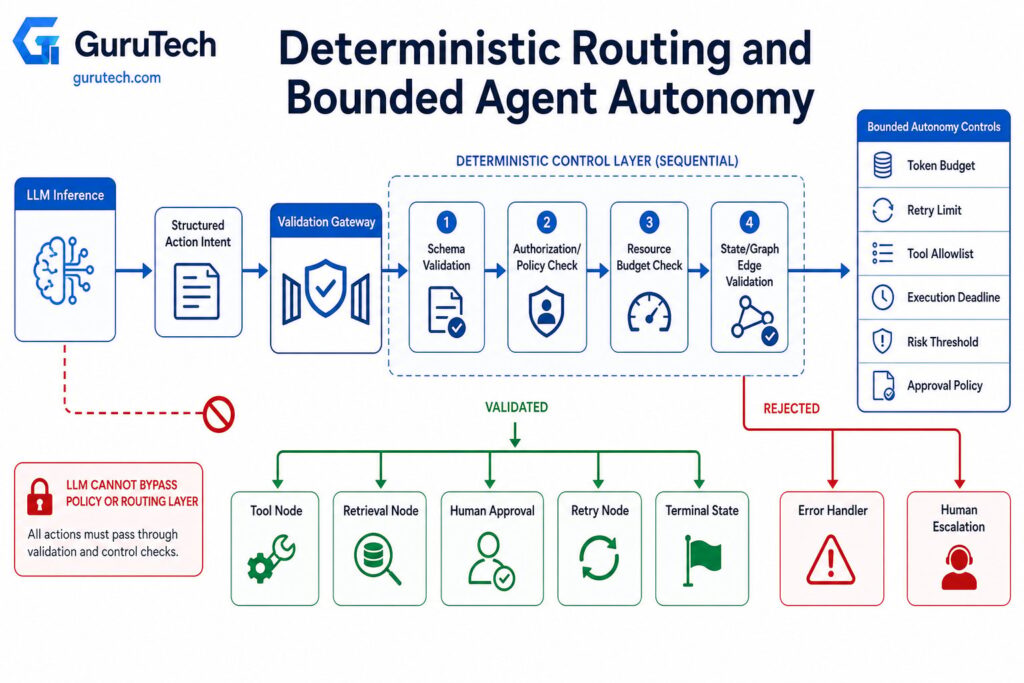
Probabilistic Inference and Deterministic Control Are Different Layers
An LLM is useful when the next operation depends on ambiguous language, incomplete evidence, classification, planning, or semantic interpretation. It is less appropriate for conditions that can be evaluated exactly.
Whether a retry counter exceeded its maximum does not require model reasoning. Whether a user possesses an approval role should not be delegated to the model. Whether a token budget has reached zero should be enforced by code.
The control plane should therefore reserve deterministic logic for rules that are objective, security-sensitive, cost-sensitive, or required for workflow correctness.
The execution plane can invoke LLM agents where probabilistic inference genuinely adds value.
The LLM Should Produce Structured Intent
Bounded autonomy begins with constraining the interface between inference and execution. Instead of returning prose such as “I think we should update the accounting record,” the model should produce a machine-readable action proposal.
For example:
{
  "action": "update_asset_classification",
  "asset_id": "AST-42817",
  "proposed_classification": "capital_equipment",
  "confidence": 0.94,
  "requires_approval": true
}
The runtime can validate the structure before considering the action itself.
Malformed outputs can be rejected immediately. Unsupported action names can be blocked. Missing required fields can route the thread to repair without invoking the target enterprise system.
Schema Validation Is the First Execution Gate
A valid JSON payload is not necessarily a valid action, but structural validation should occur before any downstream decision.
The runtime should verify:
- required fields are present
- field types are correct
- enumerated values are allowed
- identifiers conform to expected formats
- numeric values remain within syntactic ranges
- unexpected fields are rejected when the contract requires strictness
This reduces the number of malformed model outputs that propagate deeper into the workflow.
Schema validation should remain deterministic and independent of the model that generated the payload.
Policy and Authorization Determine Whether the Action Is Allowed
A structurally valid action may still violate enterprise policy or exceed the requesting principal’s authority. A request to delete a production resource, post a financial adjustment, or retrieve customer data should therefore pass policy and authorization checks outside the model before execution.
Defense-in-depth approaches for autonomous agents reinforce this separation: identity, permissions, and security controls should be enforced by runtime infrastructure rather than prompt instructions. Because long-running workflows can remain suspended for hours or days, consequential actions should revalidate current authorization immediately before execution.
Resource Governance Creates Hard Execution Boundaries
Autonomous loops require explicit resource ceilings. Prompt instructions asking a model to “be efficient” do not enforce an operational budget.
The state schema should carry or reference hard limits such as:
- remaining token budget
- maximum model invocations
- maximum external tool calls
- retry allowance
- maximum graph depth or cycle count
- execution deadline
- cost ceiling
- maximum parallel branches
Formal resource governance is particularly important in delegated or multi-agent execution because one parent task can generate multiple child workflows that consume resources independently.
The control plane should decrement and evaluate resource state after each material operation.
If a hard budget reaches its terminal condition, the graph should route to a defined stop, degradation, or escalation state even if the model proposes further work.
Deterministic Routing Edges Encode Legal State Transitions
A routing edge is best understood as a predicate over validated state.
For example:
def route_execution(state: EnterpriseAgentState) -> str:
    if state["allocated_token_budget_remaining"] <= 0:
        return "budget_exhausted"

    if state["requires_human_approval"]:
        return "human_review"

    if not state["verification_passed"]:
        return "verification"

    return "execute_tool"
The routing function is intentionally simple. The complexity belongs in state generation and validation, while the edge itself remains understandable and testable.
This is preferable to asking the model a second question such as “what should happen next?” when the answer can be derived directly from structured state.
Deterministic Does Not Mean Hardcoded Everywhere
Deterministic routing does not require every enterprise workflow to become a rigid tree of static if statements.
Routing rules can be data-driven through policy tables, feature flags, configuration services, entitlement systems, risk engines, or workflow metadata.
The important property is that the same validated state and policy version produce the same routing decision.
This preserves reproducibility even when business rules change over time.
Known Conditions Should Avoid Unnecessary LLM Calls
Some operations are fully resolvable through deterministic systems.
If a request maps exactly to a known identifier, the application should perform the lookup directly. If a validation field already indicates that evidence is missing, another inference call is not required merely to discover that the workflow should retrieve evidence.
Production search architectures often benefit from a similar distinction between deterministic routing and model-assisted retrieval. Known conditions should take the cheapest and most predictable path that satisfies the task.
The objective is not to maximize agent involvement. It is to use inference only where inference is needed.
Routing Decision Matrix
| Execution Condition | Recommended Route | Control Type | Engineering Rationale |
|---|---|---|---|
| Output schema invalid | Repair node or deterministic error handler | Deterministic | The runtime already knows the contract was violated; no policy interpretation is required. |
| Required evidence missing | Retrieval or evidence-acquisition node | Deterministic after validation | Structured state explicitly identifies an unresolved dependency. |
| Known identifier or exact lookup | Direct database/index query | Deterministic | A model call adds uncertainty and cost without improving resolution. |
| Ambiguous natural-language intent | LLM classification or planning node | Probabilistic inference | Semantic interpretation is required before the graph can select a bounded action. |
| Tool not present in allowlist | Reject or escalate | Deterministic policy | The model cannot grant itself new execution capabilities. |
| Authorization check fails | Terminate or human escalation | Deterministic security control | Authorization must be enforced outside model inference. |
| High-risk action requires approval | Human-review interrupt | Deterministic policy edge | The action cannot execute autonomously regardless of model confidence. |
| Retry budget exhausted | Terminal failure or escalation | Deterministic resource control | Prevents unbounded retry loops. |
| Token or cost budget exhausted | Terminate, degrade, or escalate | Deterministic resource control | Economic boundaries should be enforced in the runtime rather than through prompts. |
| Validation passes and action is authorized | Execute permitted tool or next graph node | Deterministic transition | All required execution gates have been satisfied. |
Tool Allowlists and Semantic Validation Bound the Action Surface
An agent should see only the tools permitted for the current workflow, identity, environment, graph node, and risk level. A development remediation workflow might restart staging workloads while production actions remain unavailable without a separate approved path.
Schema-valid arguments can still be unsafe: a request may satisfy its JSON contract while violating environment restrictions, business thresholds, or change-control policy. The execution gateway should therefore validate semantic constraints before invoking the tool. Model confidence can influence review routing, but it must never substitute for authorization or policy.
Human Approval Is a Deterministic Edge
Human-in-the-loop control should be represented explicitly in the graph rather than implemented as an informal conversational exchange.
When state satisfies an approval condition, the routing layer transitions the workflow to a suspended approval node. Execution stops until the appropriate external event resolves the approval.
The resume operation should validate reviewer identity, approval scope, checkpoint identity, target operation, expiration state, and any relevant policy version before the graph proceeds.
A human response therefore becomes an authenticated state transition rather than merely another message.
Validation Nodes Bound Model-Generated State
A useful graph pattern separates generation from validation:
Generate Candidate
      ↓
Validate Candidate
      ↓
 ┌────┼─────────────┐
PASS  REPAIR     ESCALATE
 ↓      ↓            ↓
NEXT  GENERATE    HUMAN
The generation node can remain probabilistic. The validation node produces structured findings. The deterministic edge decides which transition is legal.
This separation allows different validation mechanisms to coexist: schema checks, business-rule engines, static analyzers, policy services, deterministic calculations, retrieval verification, or another independently configured model where semantic review is necessary.
Bounded Autonomy Requires Terminal States
A graph that can always find another node to execute is not bounded.
Every production workflow should define explicit terminal conditions such as:
- successful completion
- policy rejection
- authorization failure
- budget exhaustion
- maximum retry exhaustion
- irrecoverable tool failure
- human escalation required
- workflow expiration
- state corruption detected
The control plane should be able to reach these states without requiring model agreement.
Bounded Autonomy Is an Architectural Property
Agent autonomy should not be measured by how many decisions the LLM is allowed to make. A stronger definition is how much useful work the system can complete independently while remaining inside explicit execution, policy, security, and resource boundaries.
A production agent can still perform complex planning and adaptive execution while deterministic code controls the boundaries that matter most. Deterministic governance approaches apply the same principle by keeping critical controls outside natural-language model behavior.
The resulting architecture is:
Probabilistic reasoning
        inside
Deterministic workflow constraints
        inside
Enterprise security and transaction boundaries
This hierarchy is what allows agentic systems to scale beyond demonstrations without giving probabilistic inference unrestricted authority over production environments.
The next section examines what happens when these bounded workflows execute over long periods and inevitably encounter network failures, model timeouts, partial tool execution, retries, and interrupted multi-turn loops.
Persistent Multi-Turn LLM Loops and Failure Recovery
Persistent multi-turn LLM loops introduce failure modes that do not exist in simple request-response inference. A workflow may execute dozens of model calls, retrieval operations, validation nodes, external API requests, and human approval steps before reaching a terminal state.
If execution fails after significant progress, restarting from the beginning may be expensive, operationally incorrect, or actively dangerous when earlier tool calls already modified external systems.
Multi-turn agentic systems therefore require explicit recovery semantics around each material execution boundary. The runtime needs to know what failed, what completed, which state became authoritative, which external effects may already exist, and whether another attempt can execute safely.
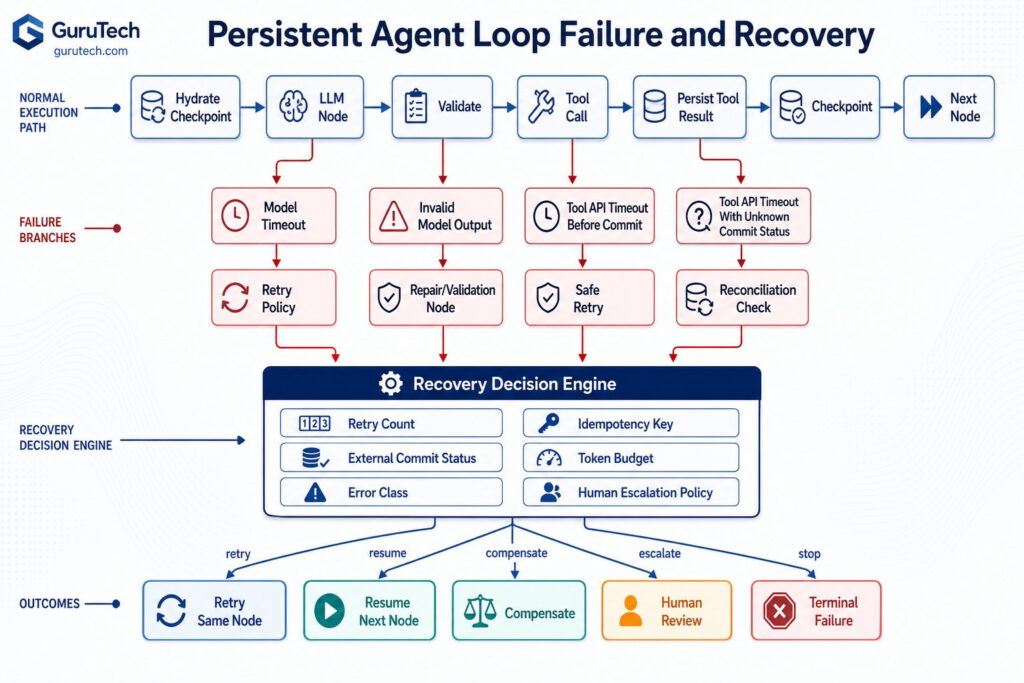
Failure Recovery Starts with Error Classification
Not every failure should trigger the same response.
A model-provider timeout, malformed structured output, authentication error, rate limit, database deadlock, tool-schema rejection, and uncertain payment result represent fundamentally different recovery conditions.
The runtime should classify failures before deciding whether to retry, reroute, reconcile, compensate, escalate, or terminate.
A useful high-level classification is:
- Transient infrastructure failure — temporary network, model-provider, database, or service availability issue
- Recoverable application failure — malformed model output, schema violation, incomplete evidence, or retryable tool response
- Policy or authorization failure — execution is structurally prohibited rather than temporarily unavailable
- External side-effect uncertainty — the runtime cannot determine whether a consequential operation committed
- Terminal domain failure — the workflow cannot satisfy its completion conditions without intervention or changed input
These classes should map to explicit graph transitions rather than to a generic “try again” instruction sent back to the model.
Model Invocation Failures Are Usually Easier to Retry
A model call that times out before returning a usable response is generally simpler to recover than an external business transaction because model inference typically has no authoritative side effect outside the orchestration state.
If the checkpoint preceding the model node remains valid, the runtime can retry the inference using the same structured inputs, subject to retry policy, budget constraints, and provider routing rules.
The output may not be identical because model generation can be nondeterministic. Recovery should therefore depend on schema and downstream validation rather than expecting byte-for-byte reproduction.
LLM gateway orchestration can also route retries to an alternate model endpoint when provider availability, quota, or latency policy permits, while preserving the same thread state.
Malformed Model Output Should Route to Repair, Not Blind Replay
A structurally invalid model response represents an application-level failure rather than an infrastructure outage.
If a node expects a typed tool request and receives malformed output, the runtime can route the result to a repair path that supplies validation errors back into a constrained generation step.
This should remain bounded.
Repeated schema failures should increment a retry counter and eventually route to a terminal or human-review state instead of generating an unbounded correction loop.
Tool Failures Are More Complicated Because Side Effects Exist
External tools operate against systems that may retain state independently of the agent runtime. A CRM update, infrastructure deployment, accounting adjustment, ticket creation, repository write, or payment request may commit even if the orchestration layer never receives a successful response.
This creates the central recovery ambiguity:
Did the operation fail,
or did only the response fail?
The runtime must resolve this question before replaying a consequential tool call.
Recovering External Tool Calls
If the runtime can establish that a request never left the tool gateway, retry is usually safe from a side-effect perspective. The workflow can retain the same operation identity and retry according to policy.
If the request may have reached the external service but the response was lost, the runtime should record an uncertain state such as tool_status = "unknown" and route to reconciliation. The authoritative service should be queried using the transaction identifier, idempotency key, or domain-specific lookup before the workflow decides to continue, retry, compensate, or escalate.
Retries Must Be Policy-Driven
Retry logic should not be encoded primarily through natural-language instructions such as “try again if the tool fails.”
The runtime should determine whether an error class is retryable and how many attempts remain.
A retry policy can evaluate:
- error category
- current retry count
- time elapsed since initial failure
- remaining execution deadline
- remaining token and cost budget
- external service health
- whether the operation is idempotent
- whether another attempt could create a duplicate side effect
The resulting routing decision remains deterministic even when the original operation was model-generated.
Backoff Prevents Failure Amplification
Immediate repeated retries can amplify an outage.
A failing external service may receive additional load from hundreds of suspended agent threads simultaneously retrying the same operation.
Backoff policies introduce increasing delays between attempts, while jitter reduces synchronization across workers.
The workflow state can remain checkpointed during the delay rather than holding a worker process open.
Circuit Breakers Protect Shared Dependencies
A circuit breaker operates above the individual thread level.
If a dependency is experiencing a known outage or sustained failure rate, the runtime can stop new tool invocations temporarily and route affected workflows to a waiting, degraded, alternate-provider, or escalation state.
This prevents every agent thread from independently discovering the same system failure through repeated expensive attempts.
The circuit-breaker state should remain an infrastructure concern rather than being embedded in each model prompt.
Persistent Loops Need Explicit Run Status
A long-running graph should expose structured execution status so operators and external systems can determine whether a thread is active, suspended, retrying, blocked, failed, or complete.
Typical states include:
running
waiting_for_tool
waiting_for_retry
waiting_for_approval
reconciliation_required
compensation_required
completed
failed
Agentic-loop designs similarly benefit from explicit run-status handling because orchestration needs a machine-readable lifecycle rather than relying on the semantic interpretation of conversation text.
Run status becomes particularly important when execution is asynchronous and no user-facing HTTP request remains open.
Resume from the Last Valid State
Conversation history is insufficient for deterministic recovery because the latest visible message may not reflect whether a checkpoint or external operation actually committed. Recovery should begin with the latest valid checkpoint, reconcile uncertain external state, and then reconstruct the next node’s context. This follows the same state snapshotting and persistent recovery principle used to avoid recomputing validated work after interruption.
Completed work that remains valid should not be repeated. If retrieval, validation, or human approval was already checkpointed, the runtime can resume from that boundary and replay only the operations required after it.
Nondeterministic Outputs Complicate Replay
Model generation may produce different outputs when a node is rerun with the same visible context.
This does not make recovery impossible, but it means replay semantics should focus on validated state rather than reproducibility of every token generated previously.
If a prior model output passed validation and was already checkpointed, the system should generally reuse the persisted result rather than regenerating it unnecessarily.
If the output was never committed to authoritative state, a retry can generate a new candidate that must pass the same validation gates before becoming authoritative.
Detecting Non-Convergent Loops
A persistent workflow can repeatedly traverse valid nodes without moving toward completion. Recursive agent delegation or retry logic illustrates why bounded execution requires more than exception handling.
The runtime can detect stagnation by comparing selected state deltas across cycles. If retries consume resources without adding evidence, changing validation state, or advancing the business payload, deterministic policy should route the thread to re-planning, escalation, or a terminal state.
Human Escalation Is a Recovery Path
Not every failed autonomous workflow should end in a generic error.
Some failure conditions are better represented as:
execution_status = "waiting_for_approval"
or:
execution_status = "reconciliation_required"
A human operator can inspect the thread state, tool ledger, checkpoints, and external-system status before authorizing the appropriate recovery action.
This creates a much stronger human-in-the-loop workflow than simply asking a reviewer to read the latest agent response.
Failure Recovery Requires Causal Observability
Engineers investigating a failed thread need to reconstruct the causal sequence across model invocations, graph edges, checkpoints, tool calls, and external side effects.
A request-level application log is insufficient.
The trace should make it possible to answer:
- which checkpoint was hydrated
- which node executed
- which model and prompt configuration were used
- which structured output was generated
- which routing predicate selected the next edge
- which tool operation was attempted
- which idempotency key identified that operation
- whether the external service confirmed commit
- which checkpoint persisted afterward
- why a retry or escalation occurred
Thread-level observability can then correlate reliability failures with token usage, latency, tool cost, and repeated execution paths.
Transport Efficiency Is Secondary to Correct Recovery
Stateful continuation can reduce redundant context movement in tool-heavy execution architectures, but transport efficiency should remain secondary to correctness.
An optimization that avoids re-serializing context is useful only if the runtime still preserves durable state identity, replay safety, and recovery semantics.
Persistent connections, provider-managed conversations, and session APIs can simplify portions of context handling, but they should not replace application-controlled checkpoints for workflows that require enterprise-grade recovery.
The Recovery Decision Matrix
| Failure Condition | Safe Default Response | Required State Check | Primary Risk |
|---|---|---|---|
| Model timeout before usable output | Retry or alternate provider | Confirm retry budget and last valid checkpoint | Repeated cost or divergent output |
| Malformed structured model output | Repair node | Increment bounded schema-repair counter | Infinite correction loop |
| Tool request rejected before execution | Repair, reroute, or terminate | Verify no external side effect occurred | Repeated invalid requests |
| Tool timeout with known non-commit | Retry according to policy | Reuse idempotency identity | Outage amplification |
| Tool timeout with unknown commit status | Reconciliation node | Query authoritative external system | Duplicate side effect |
| Authorization failure | Terminate or escalate | Re-evaluate current identity and policy | Security bypass through retries |
| Retry budget exhausted | Terminal failure or human escalation | Confirm no unresolved external transactions | Runaway execution |
| Workflow state shows no progression | Terminate, re-plan, or escalate | Compare validated state deltas across cycles | Infinite agent loop |
| Checkpoint restored after long suspension | Revalidate mutable external state | Check freshness, authorization, and system-of-record state | Executing against stale assumptions |
Reliable Recovery Is a State-Machine Property
Failure recovery cannot be bolted onto an agent after the workflow has already been designed as an unstructured prompt loop.
Safe recovery depends on explicit execution boundaries, structured state, checkpoint identity, deterministic routing, idempotent tools, retry classification, compensation paths, and terminal conditions.
The result is a workflow that can survive partial failure without confusing “retry the model” with “repeat the business operation.”
That distinction becomes even more important as execution histories grow. Persistent systems eventually accumulate stale, conflicting, duplicated, and low-value memory, creating a different class of failure: autonomous agent memory degradation.
Agent Memory Degradation and Conversational Context Hydration
Persistent memory creates a problem that stateless applications largely avoid: stored context can become less reliable as the execution history grows. Autonomous agent memory degradation occurs when stale, duplicated, contradictory, low-value, or incorrectly prioritized information begins influencing later model decisions.
The underlying storage system may be functioning correctly. The failure occurs because the runtime retrieves or hydrates the wrong information into the active inference context.
Long-term agent memory therefore requires lifecycle management rather than indefinite accumulation. Persistence determines what the system can retain; context management determines what the model should see now.
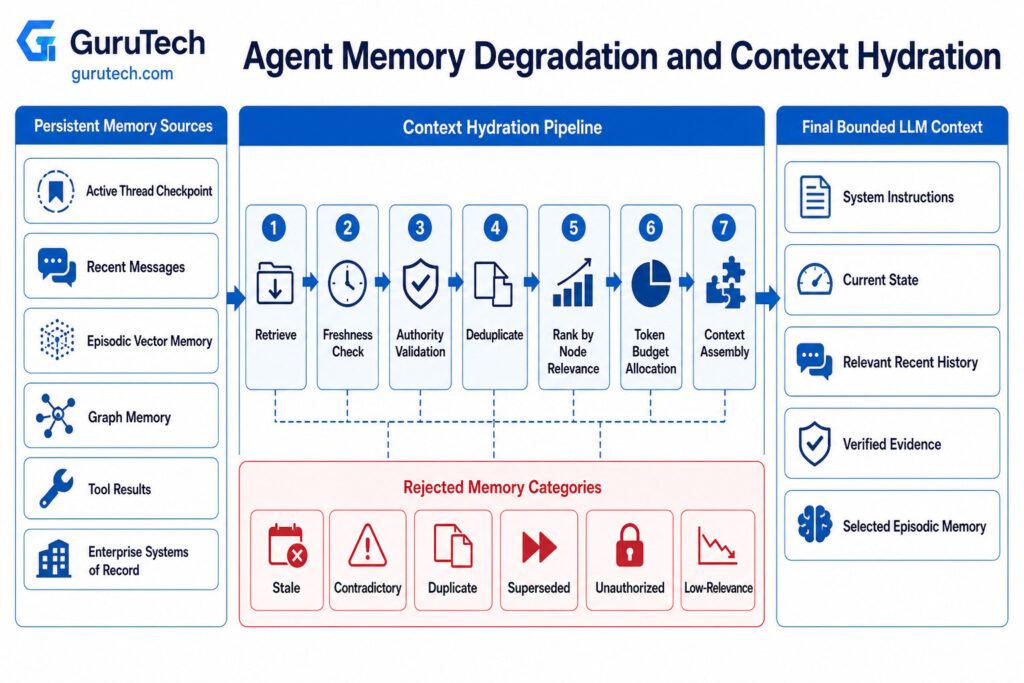
Memory Degradation Is Primarily a Selection Problem
A long-running thread can accumulate valid historical information that is no longer valid operational context. Previous plans may have been abandoned, tool results superseded, policies updated, approvals revoked, or business records modified outside the agent workflow.
Injecting all of this material into subsequent prompts forces the model to distinguish current state from historical state probabilistically.
Production systems should make that distinction before inference.
Memory retrieval and update strategies therefore need to account for more than semantic similarity. Recency, authority, provenance, workflow position, tenant boundaries, and whether a memory has been superseded can all affect whether it belongs in the current context.
Four Common Forms of Memory Degradation
| Degradation Mode | Failure Mechanism | Engineering Control |
|---|---|---|
| Stale Memory | Historical information remains retrievable after the authoritative enterprise state has changed. | Freshness metadata, source-of-truth revalidation, expiration policies, and invalidation events. |
| Contradictory Memory | Multiple stored observations describe the same entity or condition differently. | Provenance tracking, versioning, authority ranking, temporal metadata, and conflict detection. |
| Duplicate Memory | Repeated interactions or condensation jobs create semantically equivalent records that dominate retrieval. | Deduplication, canonical entity identifiers, content hashing, and consolidation. |
| Low-Value Memory Accumulation | Routine execution artifacts compete with information relevant to the current node. | Retention classes, retrieval thresholds, node-specific filtering, and selective promotion into long-term memory. |
Memory Should Carry Provenance
A retrieved memory should identify where it came from and why the runtime considers it relevant.
Useful metadata can include source Thread ID, originating node, creation time, source-system identifier, tenant, memory type, validation status, embedding version, and references to the original evidence.
This allows the context builder to distinguish an unverified model-generated observation from a fact retrieved directly from an authoritative system.
Without provenance, semantically similar records can appear equally trustworthy even when their authority differs substantially.
Conversational Context Hydration
Conversational context hydration is the process of reconstructing the bounded model-visible context required for the next graph node. It occurs after durable state has been loaded but before the next model invocation.
The runtime should not simply deserialize a checkpoint and insert every field into the prompt.
Instead, hydration combines selected information from several sources:
- current graph state
- active system and node instructions
- relevant recent conversation turns
- validated tool outputs
- selected episodic memories
- retrieved enterprise evidence
- current data from authoritative systems where freshness matters
The result is a temporary inference context assembled for one bounded operation.
Hydration Should Be Node-Specific
Different graph nodes require different views of the same thread.
A retrieval node may need the current objective, entity identifiers, and unresolved evidence requirements. A compliance-validation node may need the proposed adjustment, governing policy, and supporting evidence. A tool-execution node may need only the validated structured arguments and authorization context.
Node-specific hydration prevents the complete workflow history from being repeatedly exposed to every model call.
It also reduces accidental cross-contamination between stages. Exploratory reasoning used to generate a proposal does not necessarily belong in the context used to validate that proposal.
Hydration Requires a Token Budget
The model context window is a constrained execution resource rather than long-term storage.
A context builder should allocate space deliberately among competing categories:
System / Policy Instructions
        ↓
Current Structured State
        ↓
Immediate Conversation Context
        ↓
Verified Enterprise Evidence
        ↓
Selected Episodic Memory
        ↓
Reserved Model Output Budget
The exact allocation can vary by node, model, and workload. The important architectural principle is that retrieval should operate within an explicit budget rather than filling whatever context capacity remains available.
Memory systems become more useful when historical context is selected according to task relevance instead of retained indiscriminately in the active prompt.
Authority Should Override Semantic Similarity
A vector search may retrieve an old memory because it is semantically close to the current request. That does not mean it should outrank newer information from an authoritative enterprise system.
For consequential decisions, context assembly should apply an authority hierarchy such as:
Current System of Record
        ↓
Validated Current Thread State
        ↓
Verified Historical Evidence
        ↓
Condensed Episodic Memory
        ↓
Unverified Historical Model Output
This hierarchy prevents long-term memory from silently overriding current business truth.
Structured Condensation Is Preferable to Endless Summarization
When historical execution paths become too large for direct reuse, the system can condense them into structured records containing durable entities, decisions, outcomes, and provenance.
The original execution history remains available for audit and recovery, while the condensed representation becomes eligible for future retrieval.
This is stronger than repeatedly summarizing summaries. Successive free-form summarization can progressively remove identifiers, exceptions, causal relationships, and uncertainty that later workflows may need.
Where relationship structure matters, GraphRAG architectures can preserve links among entities, events, decisions, and evidence rather than flattening the history into prose.
Memory Invalidation Is as Important as Memory Creation
Persistent memory needs a mechanism for becoming obsolete.
If a policy changes, an employee leaves the organization, a configuration is replaced, or a previously recorded business fact is corrected, related memories may need to be invalidated or marked as superseded.
Deletion is not always necessary. Temporal validity fields can preserve historical evidence while preventing obsolete records from being treated as current context.
This distinction is especially useful for audit workflows where the organization needs to know what was believed at a particular point in time without treating that information as current truth.
Context Hydration Is an Observable Operation
The hydration layer should produce telemetry describing what information entered the model context and why.
Useful signals include retrieved memory identifiers, source types, token contribution by context category, rejected stale memories, retrieval latency, and the checkpoint version used to construct the request.
These signals can feed the AI Token Observability Dashboard so engineers can determine whether high token consumption originates from recent conversation history, retrieval evidence, episodic memory, or oversized system instructions.
This also improves incident analysis. When a model produces an incorrect action proposal, engineers can inspect the context that was actually hydrated rather than attempting to reconstruct it from multiple databases afterward.
The Core Memory Rule
Stateful systems should retain enough information to recover execution without assuming that all retained information belongs in the next inference request.
The architecture therefore separates three operations:
Persist what must survive
        ↓
Retrieve what may be relevant
        ↓
Hydrate only what this node needs
That separation limits memory degradation while preserving the durability required by long-running workflows.
Once multiple workers and specialized agents begin operating against the same persistent thread, however, memory quality is no longer the only concern. The system must also control concurrent state mutation, authorization boundaries, and thread-level observability across distributed execution.
Concurrency, Security, and Observability in Stateful Agent Execution
Once multiple workers, graph branches, or specialized agents operate against the same persistent thread, state management becomes a distributed-systems problem. The architecture must prevent conflicting mutations, enforce authorization at every execution boundary, and preserve enough telemetry to reconstruct exactly how the thread changed.
These requirements are interconnected. Concurrency controls determine which state mutation becomes authoritative, security controls determine which component is permitted to make that mutation, and observability records the causal path that produced it.
Parallel Execution Creates State Conflicts
Multi-agent orchestration frequently introduces parallel execution. Separate branches may retrieve evidence, evaluate policies, query external systems, or perform independent analysis before converging on shared state.
Parallelism is safe when mutations are independent. It becomes dangerous when multiple workers attempt to update the same authoritative field from different versions of the thread.
Consider two workers hydrating state version 41:
Worker A → reads version 41 → approves validation
Worker B → reads version 41 → records validation failure
If both writes are accepted without concurrency control, whichever operation persists last can silently erase the other mutation.
Optimistic Concurrency Protects Thread Integrity
For many agent workflows, optimistic concurrency is preferable to holding database locks across long-running model or tool calls.
Each worker reads a state version and submits its mutation conditionally:
UPDATE thread_state
SET state = :new_state,
    state_version = 42
WHERE thread_id = :thread_id
  AND state_version = 41;
If another worker has already advanced the thread, the update affects no row and the stale worker must reload the current state before continuing.
This avoids holding a transaction open while an LLM or external service executes.
Reducers Must Reflect Domain Semantics
Some concurrent updates can be merged safely. Two retrieval branches may append independent evidence records, while parallel observability events can usually accumulate without conflict.
Other mutations are mutually exclusive.
Two workers proposing different values for the same approved accounting classification should not be resolved through generic list concatenation or last-write-wins behavior.
The state schema therefore needs field-specific conflict semantics:
| State Type | Typical Merge Strategy | Example |
|---|---|---|
| Append-Only Events | Reducer with deduplication | Tool logs, evidence records, trace events |
| Independent Keyed Data | Merge by stable identifier | Results from separate asset records |
| Authoritative Scalar | Version check or single-writer ownership | Approval status, current execution node |
| Conflicting Business Mutation | Reject and reconcile | Two different proposed values for the same financial adjustment |
Single-Writer Patterns Simplify Critical State
Not every field needs concurrent mutation.
For high-value state, the architecture can designate one node or service as the authoritative writer while parallel agents produce candidate results. A coordinator then validates those results and commits the final mutation.
This pattern trades some parallelism for simpler consistency semantics and is often appropriate for approval status, financial mutations, workflow completion, and other state that must have one authoritative value.
Persistent Memory Expands the Security Boundary
Persistent agent systems retain execution history, business context, tool results, and memory across sessions, making the state layer a security-sensitive data store. Thread IDs must not implicitly authorize access; checkpoint and memory queries should remain scoped by tenant, authenticated principal, data classification, and permitted operation.
Persistent agent memory introduces risks including cross-thread leakage, unauthorized retrieval, malicious memory insertion, stale permissions, and retention of sensitive information. Semantic similarity must never override isolation or authorization filters.
Memory Writes Need Trust Controls
Long-term memory is a persistent input channel into future model executions. Memory poisoning should therefore be treated as a persistence-layer threat, and promoted memories should carry provenance, ownership, validation status, timestamps, memory type, and invalidation state.
Credentials, API keys, access tokens, and database passwords should remain in dedicated secret-management systems. Agent state may carry an opaque runtime reference when needed, but checkpoints and semantic memory should not become alternative secret stores.
Authorization Must Be Revalidated After Suspension
A thread may remain checkpointed while the identity and permissions that initiated it change.
When execution resumes, consequential operations should verify current authorization rather than assuming that permissions captured days earlier remain valid.
This is particularly important for human approval workflows, infrastructure administration, financial operations, and access to regulated data.
State Encryption and Retention Are Governance Requirements
Persistent state may contain sensitive business information even when the model itself is externally hosted.
Checkpoint databases, object stores, memory indexes, backups, and replicas should follow the organization’s encryption, access-control, residency, retention, and deletion policies.
Lifecycle management must extend across derived memory as well. Deleting the primary thread while retaining embeddings or condensed episodic records can leave information accessible through another retrieval path.
Stateful Agents Require Thread-Level Observability
Traditional request monitoring is insufficient for a workflow that can execute over many minutes, hours, or days.
Agent observability needs to reconstruct the complete execution thread across model calls, graph transitions, state mutations, retrieval operations, checkpoints, retries, and tools.
The Thread ID becomes the primary correlation key connecting these distributed events.
Trace the Graph, Not Just the Model
A production trace should make the causal execution path visible:
Thread
  ↓
Checkpoint Hydrated
  ↓
Node Started
  ↓
Context Hydrated
  ↓
Model / Tool Executed
  ↓
Validation Result
  ↓
State Mutation
  ↓
Routing Edge Selected
  ↓
Checkpoint Persisted
If execution fails, engineers should be able to identify the exact state version and transition that preceded the failure.
This is more useful than a collection of disconnected model-provider request IDs.
State Transitions Need Structured Telemetry
Useful thread-level signals include:
- Thread ID and checkpoint version
- graph and state-schema version
- current and previous node
- routing-edge selection
- node execution duration
- model and provider used
- input and output token consumption
- retrieved memory count and token contribution
- tool name and execution status
- retry and repair count
- checkpoint persistence duration
- remaining execution budget
- human-intervention events
These signals can be correlated through the AI Token Observability Dashboard to expose the operational cost of an entire agent thread rather than only the cost of individual model requests.
OpenTelemetry Fits the Distributed Execution Model
OpenTelemetry’s GenAI semantic conventions provide a useful foundation for tracing agent and model operations using standard distributed-observability concepts.
A graph node can be represented as a span, with model calls, retrieval operations, tool executions, and checkpoint writes represented as child spans or correlated operations.
The exact instrumentation model depends on the runtime, but the architectural objective is consistent: preserve causal relationships across components and execution boundaries.
Cost Should Be Attributed to the Thread
A single model call may appear inexpensive while the overall workflow is not.
A thread can repeatedly hydrate large contexts, execute several models, retrieve memory, call external tools, retry failed nodes, and remain active through multiple approval cycles.
Thread-level cost attribution should therefore aggregate:
Total Thread Cost =
    Model Inference
  + Retrieval
  + Tool Execution
  + State Persistence
  + Supporting Infrastructure
This provides a more useful basis for capacity planning and workflow optimization than request-level token cost alone.
Concurrency, Security, and Observability Form One Control Plane
Production state management ultimately needs to answer three questions for every mutation:
Can this worker commit the change?
Is this worker authorized to commit the change?
Can we prove how the change occurred?
Concurrency control answers the first question. Security and governance answer the second. Observability answers the third.
Treating these concerns as one control plane prevents the state layer from becoming an opaque shared database surrounded by independent agents.
With these operational controls established, the architecture can now be assembled into a complete enterprise deployment model showing how gateways, graph runtimes, models, tools, checkpoint databases, memory systems, policy enforcement, and observability interact as one stateful agentic AI system.
Enterprise Stateful Agent Reference Architecture
A production stateful agentic AI system is not a single agent framework connected directly to an LLM. It is a layered distributed system in which model inference, graph execution, persistent state, memory retrieval, enterprise tools, security controls, and observability remain separate architectural responsibilities.
The central design principle is that the orchestration runtime owns execution continuity while authoritative enterprise systems continue to own business truth. Models generate bounded inference outputs; deterministic infrastructure controls whether those outputs can advance the workflow or mutate external systems.
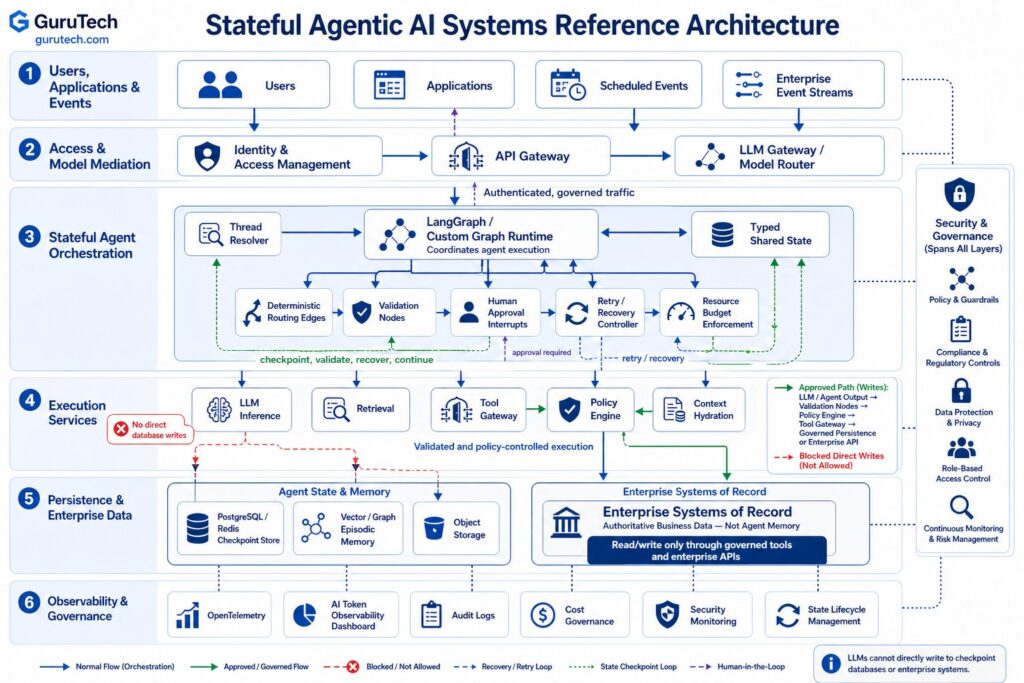
Layer 1: Enterprise Entry Points
Agent execution can originate from more than a conversational interface. User requests, application APIs, scheduled jobs, message queues, monitoring alerts, and enterprise event streams can all instantiate or resume a stateful thread.
The entry layer resolves the request into an authenticated execution context before it reaches the agent runtime. Existing threads should resolve to their durable Thread IDs rather than creating new workflow identities for every event.
Layer 2: Identity, API, and Model Access
Identity and API controls remain outside the agent graph. Authentication establishes who or what initiated the operation, while authorization determines which resources and workflow capabilities that principal may access.
An API gateway can enforce request-level security, quotas, and traffic policy. Behind it, LLM gateway orchestration provides a separate abstraction for model-provider routing, fallback, rate limits, model policy, and inference telemetry.
The graph runtime should not need to embed provider-specific connection logic into every node. It requests an inference capability through the model layer while retaining the thread state independently.
Layer 3: Stateful Agent Orchestration
The orchestration layer is the architectural center of the system.
Its responsibilities include:
- resolving Thread IDs
- hydrating the latest valid checkpoint
- executing graph nodes
- applying state reducers
- evaluating deterministic routing edges
- enforcing retry and execution budgets
- suspending workflows for human approval
- validating state transitions
- persisting new checkpoints
- resuming interrupted execution
Frameworks such as LangGraph can implement this graph-oriented execution model, while organizations with different requirements may build equivalent control planes using durable workflow infrastructure or custom orchestration services.
The architectural requirement is explicit state and transition control, not dependence on a particular framework.
Layer 4: Context Hydration and Execution Services
Before a model node executes, the context-hydration layer constructs the bounded inference context from current state, relevant conversation history, verified enterprise evidence, and selected episodic memory.
The resulting context passes to the appropriate inference endpoint through the model gateway.
Other graph nodes can bypass the LLM entirely. Deterministic validation, database retrieval, policy evaluation, calculations, and known tool operations should execute directly when probabilistic inference adds no value.
This prevents the architecture from turning every workflow transition into an unnecessary model call.
The Tool Gateway Is the Side-Effect Boundary
Model-generated tool requests should terminate at a controlled execution gateway rather than directly at enterprise APIs.
The tool layer validates:
- tool identity
- argument schema
- authorization
- environment restrictions
- business policy
- idempotency identity
- resource limits
- approval requirements
Only validated requests reach the underlying enterprise service.
This boundary also provides one location for audit logging, retry classification, timeout handling, and reconciliation of uncertain external commits.
Human Approval Is Part of the Execution Graph
High-risk workflows should route to human-in-the-loop approval through an explicit graph state.
The thread checkpoint persists while execution is suspended. No model or worker process needs to remain active.
When the reviewer responds, the runtime validates reviewer identity, authorization, approval scope, and checkpoint identity before enabling the next transition.
This makes human intervention a controlled state mutation rather than an informal message interpreted by the model.
Layer 5: Persistence Is Deliberately Split
A production architecture should avoid placing every form of memory and business data into one database.
| Persistence Component | Primary Responsibility | Authority Model |
|---|---|---|
| Checkpoint Store | Thread state, graph position, validation status, resource state, and recovery metadata | Authoritative for agent execution position |
| Vector / Graph Memory | Semantic and relationship-based retrieval of historical episodes | Contextual evidence; not authoritative transactional state |
| Object Storage | Large documents, generated artifacts, datasets, logs, and binary outputs | Authoritative for stored artifact content according to application policy |
| Enterprise Systems of Record | Financial records, identities, configurations, tickets, customer records, repositories, and operational business data | Authoritative business truth |
This separation is fundamental. A memory saying that an asset classification changed does not prove that the accounting platform committed the change.
The runtime should query the authoritative system when current business truth matters.
Enterprise Systems Remain Authoritative
This boundary prevents one of the most dangerous agent architecture mistakes: allowing model-generated or memory-derived state to become enterprise truth merely because it exists inside the agent thread.
The agent may propose a deployment, accounting adjustment, account modification, or support action. The corresponding enterprise platform determines whether that operation actually committed.
The checkpoint stores the execution consequence and reference needed to continue the workflow.
Layer 6: Observability and Governance
The observability layer correlates execution across the entire architecture using Thread ID, checkpoint version, graph node, model request, tool execution, and trace identifiers.
OpenTelemetry GenAI conventions can provide standardized distributed tracing primitives, while the AI Token Observability Dashboard can correlate model usage with thread-level execution behavior and cost.
Governance controls operate across the same architecture: audit logging, state retention, encryption, access policy, memory invalidation, tenant isolation, model policy, and cost ceilings.
End-to-End Execution Flow
A complete production request follows a controlled sequence:
- An authenticated user, application, or event initiates or resumes a workflow.
- The runtime resolves the Thread ID.
- The latest valid checkpoint is loaded and validated.
- The graph determines the current execution node.
- The context builder hydrates only the information required by that node.
- The node executes through an LLM, deterministic service, retrieval layer, or tool gateway.
- The result is structurally and semantically validated.
- Authorized state mutations are applied through defined reducer semantics.
- External side effects are reconciled where necessary.
- The new checkpoint is persisted.
- A deterministic routing edge selects the next legal node.
- The thread continues, suspends, escalates, or reaches a terminal state.
The loop can span multiple processes and long periods of inactivity because continuity resides in durable state rather than in a continuously running model session.
Production Deployment Topology and High Availability
At enterprise scale, orchestration workers should remain horizontally scalable and operationally disposable. A worker hydrates thread state, executes a bounded graph operation, persists the result, and releases compute capacity while durable continuity remains in external persistence systems.
This allows failed workers to be replaced without losing the workflow and supports heterogeneous inference across local LLM infrastructure, hosted models, specialized models, and deterministic services while preserving one continuous state thread.
The Architecture Scales by Separating Responsibilities
The resulting system has clear authority boundaries:
LLM
→ proposes structured inference outputs

Graph Runtime
→ controls execution and state transitions

Policy / Identity Layer
→ determines what is permitted

Tool Gateway
→ controls external side effects

Checkpoint Store
→ preserves execution continuity

Memory Layer
→ retrieves relevant historical context

Enterprise Systems
→ own authoritative business data

Observability Layer
→ records execution, reliability, and cost
No single component is expected to provide autonomy, memory, persistence, security, and correctness simultaneously.
Stateful Agentic AI Systems in Enterprise Production
Stateful agentic AI systems become justified when an enterprise workflow must preserve execution state across multiple reasoning cycles, recover after interruption, coordinate tools or agents, suspend for external events, and resume without reconstructing the task from scratch.
They should not become the default architecture for every generative AI application. A deterministic request-response workflow, conventional RAG pipeline, or standard application service remains simpler to operate when the task can be completed within a bounded execution path.
When Stateful Agent Architecture Is Actually Required
The architectural decision should follow workflow requirements rather than the desire to deploy an agent framework.
| Workload Characteristic | Stateless Pipeline | Stateful Agent Architecture |
|---|---|---|
| Single-turn retrieval or generation | Recommended | Usually unnecessary |
| Short deterministic workflow | Recommended | Usually unnecessary |
| Multiple dependent reasoning cycles | Difficult to maintain reliably | Strong fit |
| Execution spanning minutes, hours, or days | Requires external orchestration | Strong fit |
| Human approval and later resume | Possible but increasingly complex | Strong fit |
| Recovery after worker or provider failure | Usually application-specific | Checkpoint-driven recovery |
| Cyclic validation and repair | Becomes difficult to control | Explicit graph transitions |
| Parallel agent or tool branches | Requires custom coordination | Shared-state coordination |
| Persistent cross-session memory | External memory logic required | Natural architectural extension |
| Consequential enterprise actions | Appropriate when workflow remains deterministic | Appropriate only with strong policy, validation, and recovery controls |
The more a workflow depends on continuity, branching, interruption, recovery, and changing state, the stronger the case for formal state-machine architecture.
Keep Execution State, Memory, Authority, and Observability Separate
Conversation history and long context windows are model inputs, not durable execution state. The checkpoint store should represent workflow position explicitly, while enterprise systems of record remain authoritative for business data and deterministic policy controls what the model is allowed to execute.
The same separation applies to measurement: the AI Token Observability Dashboard should attribute model usage, retrieval, retries, tools, and persistence to the full Thread ID so teams can measure the cost and reliability of completing a business objective rather than a single API call.
Production Readiness Checklist
Before a stateful agent workflow receives consequential enterprise authority, the architecture should be able to answer yes to the following questions:
- Is workflow state represented through an explicit typed schema?
- Can execution survive worker termination?
- Are checkpoints versioned and recoverable?
- Are consequential tool operations idempotent or reconcilable?
- Are cyclic paths bounded by deterministic termination conditions?
- Can stale or conflicting writes be detected?
- Are authorization and policy evaluated outside the LLM?
- Can human approval suspend and safely resume the thread?
- Are long-term memories isolated by tenant and authorization scope?
- Can stale or superseded memories be invalidated?
- Is model context hydrated selectively rather than reconstructed from unlimited history?
- Can operators trace every important state transition?
- Can token and infrastructure costs be attributed to individual threads?
- Can old checkpoint schemas be migrated or safely supported?
- Are terminal failure and escalation states explicitly defined?
If these controls are missing, adding more autonomous reasoning generally increases operational uncertainty rather than system capability.
Persistent State
        +
Selective Memory
        +
Cyclic Graph Execution
        +
Deterministic Routing
        +
Checkpoint Recovery
        +
Bounded Tool Authority
        +
Thread-Level Observability
        =
Production Stateful Agent System
The Engineering Baseline for Enterprise Autonomy
These stateful execution controls sit above the platform services described in the Enterprise AI Systems Engineering Blueprint, where model serving, gateways, retrieval, security, observability, and platform operations provide the underlying infrastructure.
State retention alone does not create reliable autonomy. The system becomes operationally useful when state can be trusted across time, failures, workers, model calls, and external business operations.
That requires explicit ownership boundaries. The model reasons. The graph coordinates. The checkpoint store preserves execution continuity. Memory provides selected historical context. Policy determines what is permitted. Enterprise applications remain authoritative for business data. Observability records what actually happened.
Mastering those boundaries is the engineering baseline for deploying autonomous systems that can perform complex work without turning probabilistic model behavior into uncontrolled application state.
For systems engineers, machine learning leads, and solutions architects already deploying persistent agents, the most useful next question is where the architecture is failing under real production pressure. Drop a comment below with the specific challenge you are seeing around agent memory degradation, state drift, cyclic execution, checkpoint recovery, or thread serialization and how you are currently addressing it.
Master Framework Architecture: This technical implementation is a core architectural component of our overarching, end-to-end lifecycle guide. Review the complete enterprise ai systems engineering blueprint to see how this deployment layer integrates directly with secure corporate data pipelines and low-level hardware serving infrastructure.