
An AI agent processes a customer refund request, validates the claim against your internal policy, and prepares to write a $47,000 credit directly to your production database. The system flags 91% confidence.
But the AI misinterpreted a clause in your return policy and the refund should have been $4,700. Without human oversight, that hallucination becomes a financial loss, a compliance incident, and a breakdown in customer trust.
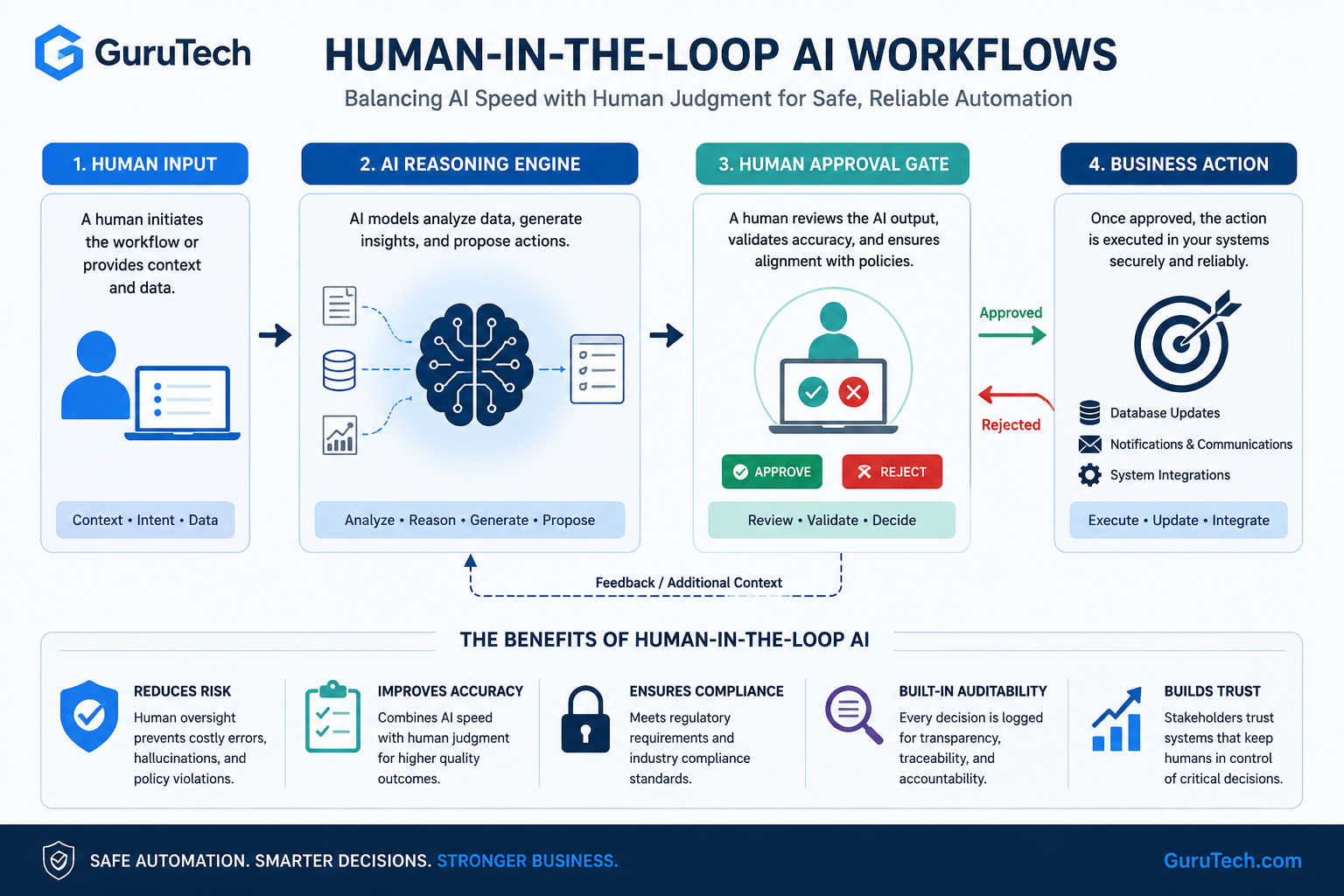
Human-in-the-loop AI workflows insert approval checkpoints into automated processes, allowing you to capture AI efficiency while preventing costly errors before they reach production systems. Human-in-the-loop refers to the intentional integration of human oversight into autonomous AI workflows at critical decision points.
Instead of letting agents execute tasks end-to-end, you add user approval, rejection, or feedback gates before the workflow continues.
As AI adoption accelerates across enterprise operations, the gap between what AI can do and what it should do without supervision has become a strategic risk. HITL systems pause at critical decision points, allowing a doctor, manager, or human reviewer to approve, reject, or adjust the output before the agent continues.
This governance layer enables you to scale automation safely while maintaining accountability, auditability, and control over high-stakes business processes.
Defining the HITL Approach
Human-in-the-loop (HITL) refers to a system design where humans actively participate in AI workflows at critical decision points. Rather than letting AI agents execute tasks autonomously from start to finish, HITL workflows insert checkpoints where you approve, reject, or modify outputs before the system continues.
In human-in-the-loop machine learning, humans contribute to training data collection, model evaluation, and decision-making processes.
This creates a feedback loop where your input continuously improves system accuracy.
Core Components of HITL Workflows:
- Decision checkpoints where AI pauses for approval
- Human review interfaces displaying context and recommendations
- Approval routing logic directing requests to appropriate reviewers
- Feedback mechanisms capturing human decisions to improve models
- Audit trails documenting who approved what and when
HITL workflows differ fundamentally from fully autonomous systems. You maintain control over high-stakes decisions while automating routine processing.
The AI handles data analysis, pattern recognition, and recommendation generation. You provide judgment, contextual understanding, and accountability.
Human-AI collaboration works particularly well when AI confidence varies by task. Your procurement agent might auto-approve vendor invoices under $500 but route larger purchases for manager review.
Customer service agents could handle common questions autonomously while escalating complex complaints to human specialists.
The HITL approach integrates human oversight into automated systems without sacrificing efficiency. You preserve human judgment where it matters most while gaining speed and consistency through automation.
Business Risks of Unsupervised Automation
When you deploy AI automation without adequate oversight, you expose your organization to several critical business risks. These risks become particularly acute as agentic AI systems gain autonomy and begin making decisions that directly impact your operations.
Financial errors represent the most immediate concern. An AI agent processing invoices or approving purchase orders can execute thousands of transactions before you detect a systematic error.
A single misconfigured confidence threshold in your procurement automation could approve unauthorized purchases worth millions.
Compliance violations carry equally serious consequences. When AI systems process documents that feed into your ERP systems or financial reporting without human verification, you risk regulatory non-compliance and audit failures.
Your finance and logistics teams need traceability and predictable behavior for business-critical workflows.
Reputational damage escalates quickly when automated systems make visible mistakes. An AI customer service agent sending inappropriate responses or a document generation system producing inaccurate contracts can harm client relationships faster than you can intervene.
The operational risks include:
- Data integrity issues when AI writes incorrect information to production databases
- Cascading failures where one automated decision triggers downstream errors across multiple systems
- Loss of institutional knowledge as your team stops understanding the logic behind automated decisions
- Audit trail gaps that prevent you from explaining how decisions were made
Your organization faces increased legal liability when automated systems make consequential decisions without documented human review.
This becomes critical in regulated industries where you must demonstrate oversight and accountability for every business action.
Workflow Design: Synchronous and Asynchronous Models
Human-in-the-loop AI workflows operate in two fundamental execution modes that shape how your organization balances speed against control.
Understanding when to use each model determines whether your AI workflow maintains operational velocity or creates unnecessary delays.
Synchronous workflows require immediate human response before the AI agent proceeds.
The workflow pauses at the approval gate and waits for your decision in real time.
This model works for high-stakes decisions where the business cannot tolerate autonomous execution—think contract approvals, significant budget allocations, or customer communications that carry legal weight.
The trade-off is latency.
Your workflow runs only as fast as your reviewers respond.
Asynchronous workflows decouple the AI processing from human review timing.
The agent completes its analysis, stores the output, and notifies the relevant reviewer.
You approve on your schedule, and the workflow resumes when you confirm.
This approach supports human-in-the-loop automation that spans hours or days without blocking other system operations.
Modern AI orchestration platforms combine both models within the same enterprise architecture.
Your procurement agent might use synchronous approval for contracts above $50,000 while processing routine purchase orders asynchronously with next-day batch review.
| Model | Best For | Latency | Complexity |
|---|---|---|---|
| Synchronous | Time-sensitive, high-risk decisions | Seconds to minutes | Low—simple approval gates |
| Asynchronous | Batch operations, distributed teams | Hours to days | High—requires state management |
| Hybrid | Enterprise workflow automation | Variable by task | Medium—risk-based routing |
Your architecture choice impacts both user experience and infrastructure requirements.
Synchronous patterns need real-time notification systems.
Asynchronous patterns demand durable state storage so workflows resume correctly after approval arrives.
HITL in Next-Generation Agentic Systems
Agentic AI systems raise the stakes because AI agents take independent actions like booking flights, moving money, or modifying infrastructure.
Unlike traditional automation scripts that follow predetermined paths, modern AI agents powered by large language models make dynamic decisions based on context and reasoning.
This fundamental shift means you’re no longer just running deterministic workflows.
You’re orchestrating autonomous agents that learn and act in dynamic environments, which requires robust oversight mechanisms.
Frameworks like LangChain and LangGraph enable you to build agentic workflows where multiple AI agents collaborate on complex tasks.
An agent might retrieve customer data, analyze purchasing patterns, draft personalized communications, and recommend specific actions.
Each step involves probabilistic reasoning rather than rigid if-then logic.
Human-in-the-loop agentic systems integrate advanced AI architectures with structured human oversight through demonstration, intervention, and evaluation.
You maintain decision authority over high-risk actions while allowing agents to handle routine operations autonomously.
Agent orchestration platforms let you define exactly when human input becomes mandatory.
Your procurement agent might automatically approve purchases under $500 but route larger requests through approval gates.
Your database assistant can execute read queries freely but requires human confirmation before any write operations.
Key differences in agentic HITL:
- Multi-step reasoning chains require intervention points between agent actions
- Tool-calling capabilities demand permission controls for external API access
- Memory and context enable agents to learn from human feedback over time
- Confidence scoring allows dynamic routing based on agent certainty levels
Comparing HITL, Human-on-the-Loop, and Full Autonomy
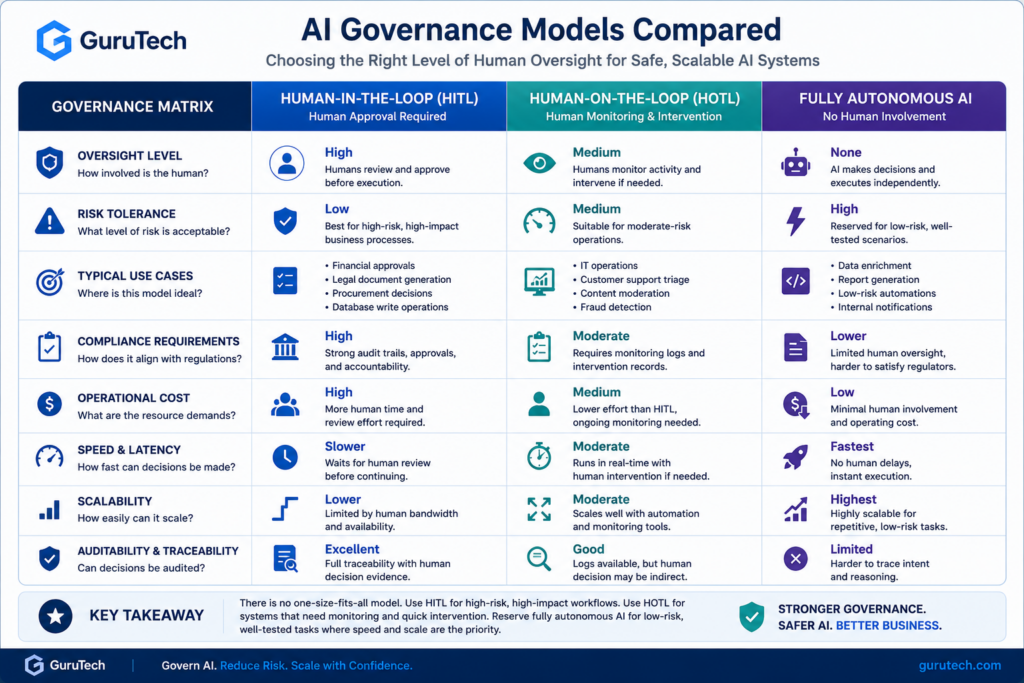
The spectrum of autonomy levels determines where control sits in your AI workflows.
Each model addresses different operational requirements and risk profiles.
Human-in-the-Loop (HITL) requires your team to approve decisions before execution.
The AI generates recommendations, but humans retain final authority.
You see this in procurement systems where AI suggests vendor selections but purchasing managers must approve each transaction.
Human-on-the-Loop (HOTL) allows autonomous systems to execute decisions independently while humans monitor for exceptions.
Your team supervises rather than participates in every action.
Customer service agents might operate autonomously for routine inquiries while escalating complex cases.
Full Autonomy eliminates real-time human oversight within defined boundaries.
The system handles perception, decision-making, and execution without intervention.
| Model | Decision Authority | Human Role | Execution Speed | Risk Profile |
|---|---|---|---|---|
| Human-in-the-Loop | Human approves each action | Active participant | Slower (approval required) | Lowest risk |
| Human-on-the-Loop | AI decides, human supervises | Exception handler | Fast (no approval gate) | Medium risk |
| Full Autonomy | AI decides independently | System designer | Fastest | Highest risk |
Your choice depends on criticality and operational maturity.
High-stakes financial decisions typically require HITL controls.
Routine data entry tasks can operate with full autonomy.
Many AI-driven workflows use hybrid approaches, applying different models based on confidence scores and business impact.
Human oversight remains essential even in highly autonomous systems for edge-case handling, ethical judgment, and recovery actions during system failures.
Interactive Approval Gateway Design
An interactive approval gateway acts as a controlled checkpoint where AI agent workflows pause execution and wait for explicit human authorization before proceeding.
You design these gateways by identifying which actions require human review based on risk, compliance requirements, and confidence thresholds.
The gateway architecture consists of three core components: the interception layer that catches flagged actions, the review interface where humans make decisions, and the resumption mechanism that continues workflow execution after approval.
Your design must account for asynchronous decision-making since reviewers may not be immediately available.
Key design elements include:
- Action queuing – pending decisions stored with full context
- Reviewer assignment – routing rules based on action type and user role
- Decision interface – clear presentation of what the AI intends to do
- Timeout handling – automatic escalation or cancellation after defined periods
- Audit capture – complete record of who approved what and when
You should implement confidence-threshold escalation architectures that automatically route uncertain agent decisions to appropriate reviewers.
Actions above 95% confidence might execute automatically, while those between 80-95% require standard approval, and anything below 80% escalates to supervisors.
Your gateway design must preserve workflow state during the approval wait period.
This means capturing all relevant context—the AI’s reasoning, data sources consulted, proposed action parameters, and potential business impact.
Without this context, human checkpoints become bottlenecks where reviewers lack information needed for informed decisions.
Manual review interfaces should present information hierarchically: critical action details first, supporting context second, and full audit trail available on demand.
You want reviewers to make confident decisions in 30 seconds, not spend five minutes hunting for relevant details.
Confidence Scoring and Adaptive Approval Routing
Confidence scoring enables your AI system to evaluate its own certainty before taking action.
When you implement confidence-threshold escalation architectures, your workflow can automatically route decisions based on how certain the model is about its output.
Model accuracy improves when you set appropriate confidence thresholds that determine routing logic.
Your system calculates a confidence score for each AI decision, typically expressed as a percentage between 0 and 100.
Setting up confidence thresholds for automated AI approvals requires you to establish tiered routing rules:
| Confidence Level | Routing Action | Use Case |
|---|---|---|
| 95%+ | Automatic execution | Routine approvals, standard requests |
| 80-95% | Human approval required | Medium-risk decisions, non-standard cases |
| 60-80% | Supervisor review | Complex decisions, policy exceptions |
| Below 60% | Regenerate or escalate | Ambiguous inputs, missing context |
You should adjust these thresholds based on your risk tolerance and domain requirements.
Financial transactions may need higher thresholds than content categorization tasks.
Human-in-the-loop approvals with confidence scoring let you automate routine work while preserving human judgment for uncertain cases.
Your approval queue only fills with items that genuinely need review, reducing approval fatigue.
Dynamic routing evaluates multiple factors beyond raw confidence scores.
You can incorporate business rules, transaction value, regulatory requirements, and historical model accuracy for specific input types.
This creates adaptive approval workflows that balance automation efficiency with appropriate oversight.
Implementing HITL Gates in n8n
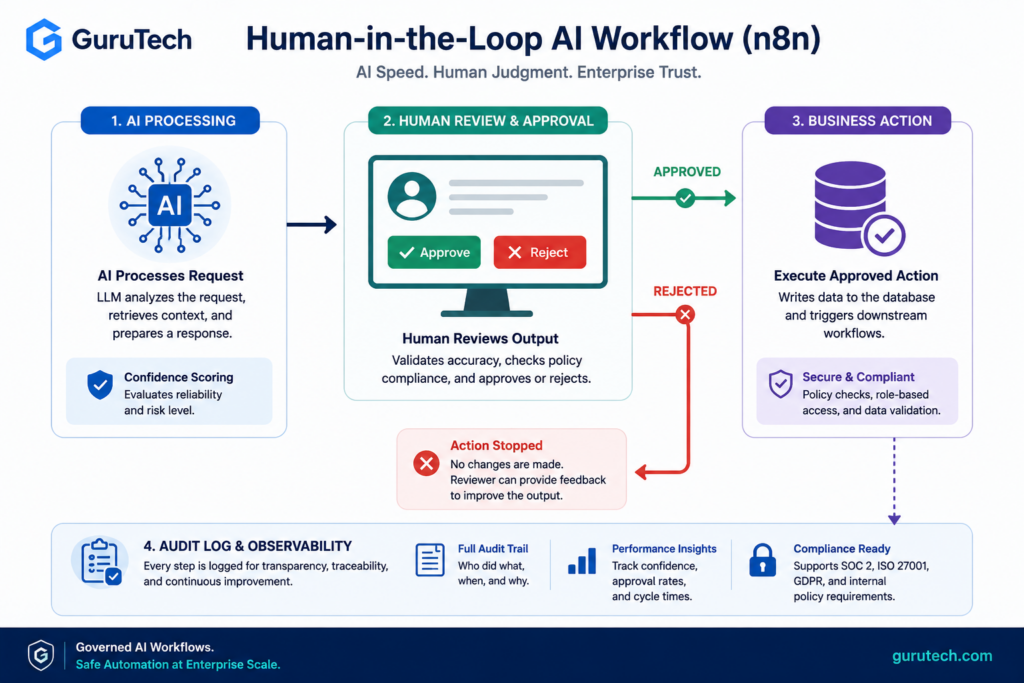
n8n provides built-in human review capabilities for AI tool calls as a first-class feature in its visual workflow builder.
You can configure approval gates directly on individual tools connected to AI Agent nodes, giving you granular control over which actions require human oversight.
The implementation begins by opening the Tools Panel on your AI Agent node and navigating to the Human review section.
From there, you select an approval channel that fits your operational workflow.
n8n supports multiple channels including Slack, Discord, Telegram, Microsoft Teams, and the built-in Chat interface.
Available Approval Channels
| Channel | Use Case |
|---|---|
| Slack | Team-based approvals in dedicated channels |
| Discord | Community or support team workflows |
| Telegram | Mobile-first approval routing |
| Microsoft Teams | Enterprise environments with existing Teams infrastructure |
| Gmail | Email-based approval for asynchronous review |
| n8n Chat | Embedded approval interface for custom applications |
Once you configure your approval channel, you connect the tools that require human review to the review step’s tool connector.
The AI Agent automatically pauses execution when it attempts to use a gated tool, sending an approval request with full context to your designated reviewer.
You can customize approval messages using the $tool variable, which exposes $tool.name and $tool.parameters.
This allows reviewers to see exactly what action the AI wants to perform and with what inputs before making a decision.
n8n’s visual workflow builder makes it straightforward to implement these gates without custom code.
You simply drag tools into the human review step, configure your approval routing, and update your system prompt to inform the AI about which tools require approval and how to handle denials gracefully.
Human Approval Interfaces
The interface where humans review and approve AI decisions determines whether your approval workflow becomes a governance asset or an operational bottleneck.
Effective approval interfaces deliver decision context, allow quick action, integrate with existing collaboration tools, and create verifiable audit trails without requiring users to learn new systems.
Slack
Slack serves as a natural approval interface for human-in-the-loop AI workflows because your team already works there.
When an AI agent reaches a decision point requiring approval, it posts a message to a designated channel with interactive buttons for approve, reject, or request changes.
The approval message should include the AI’s recommendation, confidence score, relevant data excerpts, and a link to full context.
You can route different approval types to different channels based on risk level or business function.
Slack’s Block Kit enables rich formatting that presents decision context clearly.
You can display tables, highlight key figures, and embed relevant screenshots directly in the approval request.
This eliminates context switching and speeds up decision-making.
The interactive components let reviewers approve or reject with a single click.
Their response triggers a webhook back to your workflow orchestration platform, which then continues or halts the AI process accordingly.
Every approval action automatically creates a timestamped record showing who approved what and when.
For enterprise deployments, Slack Enterprise Grid provides the audit logging and data retention policies required for regulated environments.
You maintain complete records of all approval decisions without building custom tracking systems.
Microsoft Teams
Microsoft Teams functions as the approval interface of choice for enterprises standardized on Microsoft 365.
Power Automate includes native human-in-the-loop approval workflows that integrate directly with Teams channels and adaptive cards.
Adaptive cards in Teams support complex layouts with multiple approval options, data tables, and conditional fields.
Your AI agent can present structured information that matches corporate design standards while maintaining consistent approval experiences across different workflow types.
Teams approvals support sequential routing where decisions move through multiple reviewers based on predefined rules.
You can configure escalation paths that automatically notify supervisors if approvals sit idle beyond threshold timeframes.
The Approvals app in Teams provides a centralized view of all pending requests across workflows.
Reviewers access a unified queue rather than hunting through channel messages, which reduces approval latency and prevents requests from being overlooked.
Microsoft’s compliance infrastructure means Teams approvals inherit your organization’s existing security policies, retention schedules, and eDiscovery capabilities.
You don’t need separate systems to meet regulatory requirements.
Email remains viable for human-in-the-loop AI workflows when approvers don’t actively use collaboration platforms or when you need to reach external stakeholders.
Your workflow system sends formatted emails with approval links that route back to a secure decision endpoint.
The email should include complete decision context in the message body so reviewers understand what they’re approving without clicking through.
Use clear subject lines that indicate priority level and decision type for efficient inbox management.
Approval links must be tokenized with expiration times and single-use enforcement to prevent unauthorized access or replay attacks.
When someone clicks approve or reject, the link validates the token, records the decision, and redirects to a confirmation page.
Email lacks the real-time feedback and rich formatting of modern collaboration tools.
It works best for lower-frequency approvals where immediate response isn’t critical and where you need flexibility in reaching approvers outside your primary systems.
Track email open rates and response times to identify bottlenecks.
If certain approvers consistently delay decisions via email, consider routing their approvals through channels they monitor more actively.
Retool Dashboards
Retool enables you to build custom approval dashboards that display AI decisions alongside relevant business data from multiple sources.
This approach suits scenarios where approvers need comprehensive context that spans databases, APIs, and internal tools.
You create approval queues that show pending decisions in table format with filtering, sorting, and search capabilities.
Each row represents one approval request with key attributes visible at a glance and drill-down options for detailed review.
The dashboard pulls live data to supplement AI recommendations.
For example, a procurement approval might show the vendor’s historical performance metrics, current inventory levels, and budget remaining alongside the AI’s purchase recommendation and confidence score.
Retool’s component library lets you design approval interfaces that match your specific workflow needs.
You can include comparison views, trend charts, document previews, and custom validation logic that prevents approvals when business rules aren’t met.
Building in Retool requires development effort but delivers approval experiences tailored to complex enterprise workflows.
You control exactly what information appears, how decisions route, and what validation happens before approvals commit.
Internal Web Portals
Custom-built internal web portals provide maximum control over approval interfaces for human-in-the-loop AI workflows.
You design the exact user experience, integrate with proprietary systems, and implement governance requirements that off-the-shelf tools can’t accommodate.
Your portal serves as a dedicated approval center where different user roles access queues matched to their responsibilities.
Executives see high-value decisions requiring senior approval while operational staff handle routine AI recommendations within their authority limits.
The interface presents decision context through custom layouts optimized for each workflow type.
A contract approval shows redlined documents with AI-flagged clauses highlighted, while a data access request displays the requestor’s role, data classification, and compliance implications.
Role-based access controls ensure approvers only see requests within their purview.
You enforce separation of duties by preventing the same person from initiating and approving certain actions, which satisfies audit requirements in regulated industries.
Custom portals integrate directly with your identity provider, logging systems, and business intelligence platforms.
This creates unified audit trails that connect AI decisions, human approvals, and downstream business outcomes for comprehensive governance reporting.
Audit Logging, Governance, and Regulatory Compliance
An auditable logging system provides the immutable evidence trail you need for compliance, debugging, and continuous improvement of your human-in-the-loop AI workflows.
Every approval decision, override action, and system output must be captured with timestamps, user identifiers, and contextual metadata.
Your audit logs should record the AI’s initial recommendation, the confidence score that triggered human review, the assigned reviewer, approval or rejection timestamps, and any modification notes.
This creates a complete chain of custody for regulatory compliance and internal governance reviews.
Critical elements of audit trails include:
- Input data captured at the time of AI processing
- Model outputs with confidence scores and reasoning
- Human decisions including approver identity and timestamp
- Override justifications when reviewers modify AI recommendations
- Escalation paths documenting supervisor involvement
- System actions executed after approval
The EU AI Act mandates human oversight for high-risk AI systems, making your audit trail a compliance requirement rather than a best practice.
You must demonstrate that qualified personnel reviewed critical decisions and that your system preserves evidence of this oversight.
AI governance policies should define retention periods, access controls, and review schedules for audit logs.
Most enterprises retain approval logs for 3-7 years depending on industry regulations.
Your governance framework must also specify who can access audit trails and under what circumstances, protecting both accountability and privacy.
Case Studies of HITL Guardrails
Organizations deploying AI agents in production environments are implementing human-in-the-loop guardrails to maintain control over high-stakes decisions while preserving automation benefits.
The following cases demonstrate how approval gates, exception escalation, and audit trails function across legal contract review, financial transaction approval, procurement purchasing, customer support escalation, and database operations.
Legal
Law firms and corporate legal departments use HITL guardrails when AI agents draft contracts, review clauses, or generate legal memoranda.
The AI processes incoming requests and generates draft documents, but a licensed attorney must review and approve before any document is finalized or sent to clients.
A mid-sized corporate legal team implemented an AI contract review system with mandatory attorney approval for all redlines.
The AI flags potentially problematic clauses in vendor agreements and suggests alternative language.
The system routes flagged contracts to the appropriate attorney based on contract type and dollar value.
Confidence-based routing determines review priority:
| Confidence Level | Routing Action | Review Timeframe |
|---|---|---|
| 95%+ | Attorney review recommended | 24 hours |
| 80-94% | Senior attorney approval required | 12 hours |
| 60-79% | Department head escalation | 4 hours |
| Below 60% | Manual drafting required | Immediate |
The approval gate prevents unauthorized practice of law concerns and maintains professional liability coverage.
Each attorney review is logged with timestamp, reviewer identity, changes made, and approval decision.
The audit trail satisfies bar association ethics requirements for AI-assisted legal work.
Finance
Financial institutions deploy HITL workflows for credit decisions, transaction approvals, and fraud detection. AI agents analyze applications and flag exceptions, but human officers retain final authority over consequential financial decisions.
A regional bank implemented AI-assisted credit scoring with mandatory human review for all declined applications. The AI evaluates creditworthiness using traditional metrics plus alternative data sources.
Applications scoring above the approval threshold receive automatic approval for amounts under $25,000. Applications in the middle range trigger review by a loan officer.
All declines require senior underwriter sign-off before any adverse action notice is sent to the applicant. This design satisfies Equal Credit Opportunity Act requirements for human review of adverse credit actions.
The bank maintains complete audit logs showing AI recommendation, human reviewer, override rationale, and final decision. Override rates are monitored weekly to detect automation bias or rubber-stamping patterns.
Transaction approval routing:
- Routine transactions: AI processes autonomously with real-time monitoring
- Large transactions ($50,000+): Manager approval required before execution
- High-risk transactions: Fraud team review plus dual authorization
- Blocked transactions: Customer service escalation with compliance review
The system reduces processing time for standard approvals while maintaining control over high-risk decisions. Approval fatigue is managed through intelligent routing that sends only genuinely ambiguous cases to human reviewers.
Procurement
Procurement teams use AI agents to automate purchase requisitions, vendor selection, and order placement. HITL guardrails ensure spending authority policies are enforced and unusual purchases receive appropriate oversight.
A manufacturing company deployed an AI procurement agent that monitors inventory levels, identifies restocking needs, and generates purchase orders. The agent operates autonomously for routine purchases from approved vendors within established price ranges.
Purchases exceeding departmental thresholds or involving new vendors trigger approval workflows.
Approval matrix by purchase type:
| Purchase Scenario | AI Action | Human Checkpoint |
|---|---|---|
| Approved vendor, in-budget, routine item | Auto-execute | None (monitoring only) |
| Approved vendor, over $10,000 | Generate PO | Department manager approval |
| New vendor, any amount | Research and recommend | Procurement director approval |
| Emergency purchase | Flag and escalate | VP approval required |
The system maintains audit trails showing AI rationale, approval chain, and execution timestamps. Monthly reports track auto-approval rates, override frequency, and cost savings from automation.
The procurement team reviews override patterns to refine approval thresholds and train the AI on edge cases. Exception escalation prevents the AI from making purchasing commitments beyond its authorization while eliminating manual work for 70% of routine orders.
Buyers focus on vendor negotiations and strategic sourcing rather than processing standard replenishment orders.
Customer Support
Customer service teams implement HITL workflows to balance automation efficiency with service quality for complex or sensitive issues. AI agents handle routine inquiries autonomously while escalating cases requiring human judgment to qualified agents.
An e-commerce company deployed an AI customer service agent that resolves common questions about order status, returns, and product information. The agent monitors its own confidence levels and escalates to human agents when it cannot provide a satisfactory answer or when customer frustration indicators appear.
Escalation triggers include:
- AI confidence below 80% on customer intent
- Customer explicitly requests human agent
- Sentiment analysis detects frustration or anger
- Refund request exceeds $200
- Account security or fraud concerns
- Three-turn conversation without resolution
Human agents receive full conversation context including AI responses, confidence scores, and customer history. Agents can approve AI-suggested resolutions, modify responses, or take over the conversation entirely.
Each interaction is logged for quality assurance and AI training. The parallel review pattern allows supervisors to monitor AI conversations in real time and intervene before service failures occur.
Supervisors review a random sample of autonomous AI resolutions daily to identify gaps in AI training or policy guidance. Customer satisfaction scores improved because frustrated customers reach human agents faster rather than cycling through ineffective automated responses.
Database Operations
Database administrators use AI agents to generate and execute queries, optimize performance, and troubleshoot issues. HITL guardrails prevent destructive operations and ensure data integrity in production environments.
A SaaS company deployed an AI database assistant that helps developers query their Postgres databases using natural language. The assistant translates requests into SQL, explains query plans, and suggests optimizations.
Different guardrail levels apply based on query type and target environment.
Query execution policy:
| Query Type | Development DB | Staging DB | Production DB |
|---|---|---|---|
| SELECT (read-only) | Auto-execute | Auto-execute | Auto-execute with logging |
| INSERT/UPDATE (under 100 rows) | Auto-execute | Auto-execute | DBA approval required |
| DELETE (any rows) | Auto-execute | Approval required | Senior DBA approval required |
| Schema changes | Approval required | Senior DBA approval required | Change advisory board approval required |
Failure Modes in Practice
Human-in-the-loop AI workflows introduce structural vulnerabilities that can compromise system reliability even when individual components function correctly. Understanding these failure modes is essential for enterprise architects designing production systems.
Approval fatigue represents one of the most common failure patterns. When reviewers face high-volume approval queues, they develop pattern-matching heuristics rather than conducting thorough evaluations of each request.
Research on human-in-the-loop failure modes found that human reviewers approved approximately 78% of AI-generated plans that had been subtly subverted through instruction hierarchy attacks.
The business impact is immediate. The oversight layer becomes ineffective under operational load.
Mitigation requires throughput constraints that match cognitive capacity for sustained analytical review rather than surface-level validation.
Missing review context occurs when approval interfaces fail to surface the information reviewers need to make informed decisions. Teams may see a formatted output but lack visibility into the AI’s reasoning process, confidence scores, or relevant historical patterns.
This creates conditions where format recognition substitutes for genuine content evaluation. The impact manifests as approved actions that fail downstream validation or produce unexpected results.
Mitigation strategies should include parameter-level displays of key values, deviation flagging relative to previously approved actions, and explicit confirmation requirements for irreversible operations.
Delayed approvals create bottlenecks that undermine the economic value proposition of automation. When approval queues grow faster than reviewers can process requests, the system either stalls or pressures reviewers to accelerate decisions beyond safe thresholds.
Automated routing logic should escalate time-sensitive requests while batching routine approvals for periodic review. Designing resilient agentic AI pipelines requires fallback logic and circuit breakers that prevent queue overflow.
Lack of audit history creates compliance exposure and prevents learning from past decisions. Systems may route approvals effectively but fail to capture who approved what, when, and under what conditions.
This becomes critical during incident investigations or regulatory audits. Human error compounds these structural issues.
Reviewers make mistakes under time pressure, misinterpret formatted outputs, or apply inconsistent standards across similar requests. Algorithmic bias can also persist through human oversight when reviewers systematically approve biased outputs because the bias aligns with organizational norms or appears operationally plausible.
Mitigation approaches must address both human error and systemic vulnerabilities through interface design, workload management, and explicit validation requirements for high-consequence decisions.
Operational Best Practices
Successful human-in-the-loop AI workflows require disciplined operational practices that balance automation speed with quality control. Clear protocols are necessary for routing decisions, capturing human feedback, and maintaining system performance over time.
Define explicit escalation paths based on confidence thresholds and task complexity. Systems should automatically route high-confidence predictions for execution while flagging uncertain cases for human review.
Building scalable workflows requires routing logic that prevents bottlenecks while maintaining oversight.
Establish regular calibration sessions where reviewers align on edge cases and ambiguous scenarios. Document these decisions to create consistent standards across the team.
This practice reduces reviewer drift and ensures that human feedback remains reliable as training data for model improvement. Implement structured feedback loops that capture both approvals and rejections with contextual reasoning.
Workflow platforms need to record why humans overrode AI decisions, not just that they did. This metadata becomes valuable training data for refining model behavior and reducing future errors.
Create tiered review queues based on risk levels and business impact. Route financial transactions over certain thresholds to senior reviewers while allowing junior team members to handle routine cases.
Effective oversight strategies include role-based routing that matches reviewer expertise with task requirements. Monitor key metrics including approval rates, review times, and escalation frequency.
Track how often humans agree with AI recommendations and identify patterns in overrides. Sharp increases in rejection rates signal model drift or changing business requirements that need attention.
Invest in data annotation quality by providing reviewers with sufficient context and clear labeling guidelines. Annotation interfaces should display relevant information without overwhelming users with unnecessary details.
Well-designed review screens reduce cognitive load and improve decision accuracy.
Measuring HITL Performance and Approval Efficiency
Human-in-the-loop AI workflows should be measured like any other production system. The goal is not to maximize manual review. The goal is to place human judgment where it prevents meaningful risk while gradually reducing unnecessary friction.
Track approval turnaround time, reviewer workload, escalation rate, override rate, false approvals, false rejections, and the percentage of AI actions that move from manual review into safe automation over time.
| Metric | What It Shows | Why It Matters |
|---|---|---|
| Approval turnaround time | How long humans take to approve or reject requests | Identifies workflow bottlenecks |
| Override rate | How often reviewers change AI recommendations | Signals model quality or policy mismatch |
| Escalation rate | How often requests require senior review | Shows whether thresholds are too strict or too loose |
| Approval fatigue indicators | Rapid approvals, skipped notes, repeated rubber-stamping | Protects the integrity of the oversight layer |
| Automation graduation rate | How many tasks become safe for auto-execution | Measures long-term efficiency gains |
These metrics help you tune approval thresholds with evidence instead of guesswork. If reviewers approve 98% of low-risk requests without edits, that workflow may be ready for automated execution with audit logging. If reviewers frequently override an AI recommendation, the workflow needs better prompts, stronger validation rules, or more reliable source data.
Criteria for Removing Human Oversight
Not every AI decision requires human oversight to AI systems. Clear criteria are needed to determine when automation can proceed without approval gates.
Start by evaluating task repeatability and predictability. Processes with well-defined inputs, stable business rules, and consistent outputs are candidates for autonomous execution.
Invoice data extraction that matches existing vendor records presents lower risk than contract negotiations with new partners. Risk tolerance defines your threshold.
High-consequence decisions like financial disbursements or legal commitments require tighter controls than internal data categorization or draft content generation. Organizational appetite for error determines where approval gates are placed.
Consider the confidence score your AI system generates. When models produce predictions above 95% confidence on historical validation data and those predictions align with business outcomes, those decisions can be routed to automatic execution.
Lower confidence triggers human review.
| Decision Factor | Keep Human Oversight | Remove Human Oversight |
|---|---|---|
| Financial impact | >$10,000 | <$1,000 |
| Model confidence | <80% | >95% |
| Regulatory exposure | High (healthcare, finance) | Low (internal tools) |
| Task complexity | Novel scenarios | Repetitive patterns |
| Error reversibility | Permanent changes | Easily undone |
Volume matters. Human-in-the-loop workflows cannot scale when processing thousands of decisions hourly.
Calculate the review burden against available capacity. Test autonomous operation in shadow mode first.
Run the AI system without human approval but compare its decisions against what humans would choose. Track accuracy over weeks before removing oversight entirely.
Document removal criteria in writing. Include the data that justified the change, performance metrics that triggered it, and rollback procedures if accuracy degrades.
Emerging Trends in Human-Governed AI
Human-governed AI is evolving rapidly as organizations recognize the limitations of fully autonomous systems in high-stakes environments.
The emphasis has shifted from replacing human judgment to augmenting it through structured oversight frameworks.
Regulatory-Driven Adoption
The EU AI Act explicitly requires human oversight for high-risk AI systems affecting employment, creditworthiness, essential services, or legal rights.
Similar requirements are emerging in financial services regulations and state-level AI governance laws across the United States.
These regulatory pressures are transforming human oversight from an optional best practice into a legal requirement for enterprise deployments.
Key Trends Shaping Human-Governed AI:
- Active Learning Integration – AI systems now continuously improve through human feedback loops, where corrections and approvals train models in production.
- HITL by Design – Human oversight must be architected into systems from the beginning rather than added as an afterthought.
- Responsible AI Frameworks – Governance models increasingly emphasize accountability, transparency, and documented decision rationale.
- Hybrid Decision Models – AI is leveraged for speed and scale while preserving human authority over sensitive decisions.
The integration of human judgment into AI systems has become essential for trustworthy AI deployment.
This approach maintains ethical AI standards while capturing efficiency gains.
The trend toward human-centered frameworks for AI integration reflects growing recognition that sustainable automation requires human expertise embedded at critical decision points.
This paradigm represents sophisticated collaboration, where systems are designed to leverage complementary strengths of both humans and machines.
Frequently Asked Questions
Teams implementing human-in-the-loop AI workflows face practical questions about system design, governance requirements, and how human oversight integrates with autonomous AI capabilities.
The answers below address real-world implementation decisions, compliance frameworks, and technical distinctions between oversight models.
What are common real-world examples of combining human review with automated model outputs in production systems?
Human-in-the-loop AI workflows are deployed across high-stakes enterprise domains where automated decisions require verification before execution.
Financial institutions route loan approvals through human reviewers when AI confidence scores fall between 60-80%, allowing immediate approval for high-confidence cases while protecting against costly errors.
Healthcare systems implement human-in-the-loop workflows for diagnostic support where radiologists review AI-flagged anomalies before finalizing reports.
The AI processes thousands of images but pauses execution when detecting potential issues, presenting findings to specialists who provide final diagnostic judgment.
Customer service deployments use approval gates for refund requests exceeding threshold amounts.
An AI agent analyzes the customer inquiry, proposes a resolution, but requires manager approval before issuing credits above $500.
Procurement agents process vendor quotes autonomously for purchases under $10,000 but route higher-value contracts to purchasing managers.
The AI compares pricing, checks vendor compliance, and prepares recommendations that humans approve or modify before committing company resources.
Document generation systems in legal and compliance contexts create draft contracts, policies, or regulatory filings that subject matter experts review before publication.
AI accelerates creation but humans verify accuracy, tone, and regulatory alignment before documents become official.
Database assistants handling schema changes or bulk data operations pause before executing potentially destructive actions.
The system generates SQL statements and shows predicted impact, but requires administrator approval before running ALTER TABLE commands or mass deletions that could affect production data.
Content moderation platforms combine automated classification with human review queues where borderline cases receive specialist review.
AI flags potentially violating content, auto-removes clear violations, but routes ambiguous cases to trained moderators who apply nuanced judgment.
How should teams decide which decisions require human approval versus fully automated execution?
Evaluate four key factors when determining appropriate automation levels: decision reversibility, financial impact, regulatory requirements, and confidence reliability.
Decisions that are easily reversible, low-cost, unregulated, and have proven high confidence scores become candidates for full automation.
Start by mapping your decision landscape using a risk matrix that considers both consequence severity and frequency.
Low-consequence, high-frequency decisions like email categorization or routine data formatting warrant full automation.
High-consequence, low-frequency decisions like contract terminations or major expenditures require human approval regardless of AI confidence.
| Decision Type | Financial Impact | Reversibility | Regulatory Risk | Recommended Approach |
|---|---|---|---|---|
| Routine data entry | Under $100 | Easily reversed | None | Fully automated |
| Standard customer replies | $100-$1,000 | Reversible with effort | Low | Confidence gating |
| Pricing adjustments | $1,000-$10,000 | Difficult to reverse | Medium | Human approval required |
| Contract modifications | Above $10,000 | Legal complexity | High | Specialist review + audit |
| Regulatory filings | Variable | High stakes | Very high | Multi-level approval |
Confidence thresholds should align with business risk tolerance.
A working model routes decisions based on AI certainty:
| Confidence Range | Routing Decision | Rationale |
|---|---|---|
| 95%+ | Automatic execution | Proven accuracy justifies autonomy |
| 80-95% | Human approval gate | Moderate confidence requires verification |
| 60-80% | Supervisor review | Uncertainty demands specialist judgment |
| Below 60% | Regenerate or escalate | Insufficient reliability for execution |
Measure actual performance against these thresholds continuously.
If 95%+ confidence decisions show error rates above acceptable limits, raise the threshold or add validation rules before automation.
Consider domain-specific regulations that mandate human oversight.
HIPAA requirements for healthcare, SOC 2 controls for data handling, and financial services regulations often specify human accountability that cannot be delegated to automated systems regardless of accuracy.
Customer tier influences automation decisions even when confidence remains identical.
You might auto-approve a $500 refund for a standard customer but route the same decision to account management when involving enterprise clients where relationship preservation outweighs process efficiency.
Build in temporal factors where time-sensitive decisions receive different treatment.
The system might auto-execute inventory reorders during business hours when staff can monitor results but route identical decisions to approval queues during off-hours when immediate intervention becomes difficult.
What is the difference between a human-in-the-loop approach and agentic AI systems with autonomous tool use?
Human-in-the-loop systems pause at defined checkpoints and wait for explicit approval before continuing. Agentic AI systems can make plans, call tools, and complete multi-step tasks within defined boundaries.
The strongest production architecture usually combines both. An AI agent may collect context, compare options, draft a response, and prepare an action autonomously, but the workflow should pause before high-risk steps such as sending a legal document, changing a production database, issuing a large refund, or committing company funds.
| Aspect | Human-in-the-Loop | Human-on-the-Loop | Autonomous Agentic AI |
|---|---|---|---|
| Decision authority | Human approves before execution | AI acts while humans monitor | AI acts within predefined limits |
| Best use case | High-risk or regulated actions | Moderate-risk operations with exception handling | Low-risk, reversible, repetitive tasks |
| Main benefit | Maximum control and accountability | Balanced speed and supervision | Maximum speed and scale |
| Main risk | Approval bottlenecks | Missed exceptions | Unsupervised errors or tool misuse |
How does n8n support human-in-the-loop AI workflows?
n8n supports HITL workflows through approval gates, webhook callbacks, messaging integrations, and wait-style execution patterns. In practice, an AI workflow can generate a recommendation, send the proposed action to Slack, Microsoft Teams, email, or another approval interface, then resume only after the reviewer approves or rejects the request.
This is especially useful for database writes, customer communications, invoice approvals, procurement requests, and document generation workflows where you want automation speed without giving the AI unrestricted execution authority.
Are human-in-the-loop AI workflows required for compliance?
They are not required for every AI use case, but they are increasingly important for regulated, high-risk, or auditable processes. Finance, healthcare, legal, security, HR, procurement, and enterprise data operations often require traceability, access controls, and evidence that a qualified person reviewed sensitive actions.
Even when regulations do not explicitly require HITL approval, audit logs and approval records help prove that your organization maintained reasonable controls over AI-assisted decisions.
What are the best metrics for monitoring HITL systems?
The most useful metrics are approval turnaround time, override rate, rejection rate, escalation rate, reviewer workload, queue backlog, model confidence distribution, and downstream error rate after approval. These metrics show whether the workflow is improving safety or simply creating manual friction.
A mature HITL system should gradually reduce unnecessary approvals while preserving human review for decisions that are costly, irreversible, sensitive, or uncertain.
When should a business avoid human-in-the-loop automation?
A business should avoid manual approval gates when the task is low-risk, highly repetitive, reversible, and already validated through strong testing. Adding humans to every minor action can create approval fatigue, slow operations, and reduce the value of automation.
For low-risk tasks, human-on-the-loop monitoring, sampling, alerting, and audit logs may be more efficient than requiring approval for every action.
Conclusion: Human Oversight Is the Scaling Layer for Enterprise AI
The goal of production AI is not to remove humans from every business process. The goal is to place human judgment where it matters most.
Human-in-the-loop AI workflows give organizations a practical governance layer between AI recommendations and business execution. They allow teams to automate routine work, accelerate document and data operations, and deploy agentic systems while maintaining accountability, compliance, and trust.
As AI agents gain more autonomy, the winners will not be the organizations that blindly automate everything. The winners will be the teams that design clear approval gates, audit trails, escalation paths, and confidence thresholds from the beginning.
Safe automation scales when humans and AI work together: machines handle speed, pattern recognition, and repetitive processing, while people provide judgment, accountability, and final authority over consequential decisions.