
Enterprise AI systems rarely become difficult because an organization cannot access a capable model. The difficult engineering begins after the first successful applications reach production.
A proof of concept may require little more than an application, a model API, a prompt, and a small collection of enterprise data. A production platform must solve a much larger problem. It must authenticate users, authorize access to proprietary information, retrieve context, route requests between models, control inference costs, validate outputs, trace failures, evaluate quality, protect sensitive data, manage compute capacity, and preserve an auditable record of how AI-assisted decisions were produced.
Those responsibilities do not belong to a single model. They belong to the architecture surrounding it.
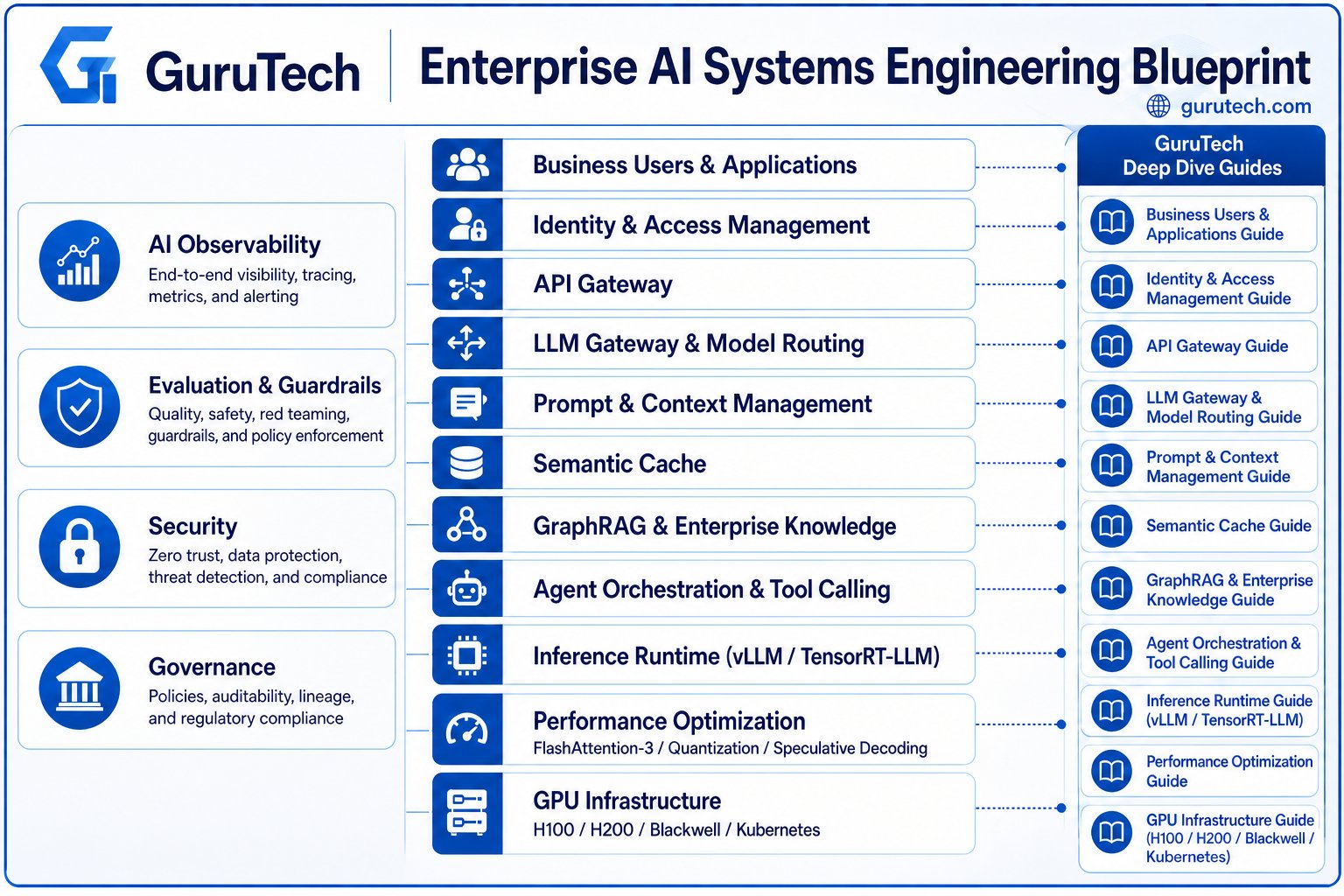
The enterprise AI systems engineering blueprint presented here is a master architecture for that surrounding infrastructure. It maps the progression from initial workflow automation through secure enterprise integration, retrieval and knowledge systems, model gateways, local inference, GPU optimization, model alignment, observability, governance, and ongoing platform operations.
The objective is not to prescribe one vendor, one model, or one deployment topology. A financial institution operating privately hosted models has different constraints from a software company consuming managed APIs. A regulated healthcare environment will make different data and governance decisions from an internal engineering copilot. The implementation changes, but the underlying systems engineering responsibilities remain remarkably consistent.
This is therefore a reference architecture rather than a product stack. It explains what each layer is responsible for, why that layer appears as AI deployments mature, which components depend on it, and where specialized technologies belong within the complete production system. Those technologies include GraphRAG architecture for enterprise AI, enterprise semantic caching, LLM gateway orchestration, local LLM deployment infrastructure, and the AI token observability architecture. Later layers extend into hardware-aware inference, quantization, speculative decoding, model alignment, and autonomous orchestration.
Part I — Enterprise AI Systems Engineering Fundamentals
The first generation of corporate generative AI adoption has largely been application-led. Teams identify a problem, select a model or AI service, connect a data source, and build an application around it. This approach is appropriate for experimentation because it minimizes the distance between an idea and a working prototype.
It becomes increasingly inefficient at enterprise scale.
Consider five independent applications: a legal contract assistant, an HR policy assistant, an engineering knowledge agent, a finance document processor, and a customer-support copilot. Their business functions differ, but their infrastructure requirements overlap substantially.
- Each application needs enterprise identity and access control.
- Each needs a mechanism for constructing, versioning, and governing prompts.
- Each may require controlled access to proprietary enterprise knowledge.
- Each must communicate with one or more foundation models.
- Each requires logging, tracing, evaluation, and cost attribution.
- Each needs controls governing what information can enter or leave the inference pipeline.
- Each eventually needs resilience against model outages, quota restrictions, latency spikes, or provider changes.
If every application implements those capabilities independently, the enterprise does not have five AI applications. From an infrastructure perspective, it has five partially duplicated AI platforms.
That distinction becomes critical as adoption expands from five applications to fifty or five hundred.
The systems engineering response is to extract repeated capabilities from individual applications and turn them into shared platform services. Identity remains an enterprise service. Model access moves behind a routing and policy layer. Enterprise knowledge is exposed through governed retrieval services. Repeated semantic requests can be intercepted before unnecessary inference occurs. Model execution is abstracted from application logic. Observability spans the entire request path. Evaluation becomes part of the deployment lifecycle. Governance is enforced across architectural boundaries instead of being implemented independently inside every application.
Engineering Insight: The transition from AI experimentation to AI infrastructure occurs when repeated application-level capabilities are extracted into reusable enterprise services.
This is the same architectural pressure that has repeatedly shaped enterprise computing. Applications once implemented their own authentication, deployment procedures, logging, storage, and infrastructure provisioning. Over time, those responsibilities moved into reusable enterprise platforms because duplicating them across every application was expensive, inconsistent, and difficult to govern.
AI is now undergoing that consolidation.
The resulting platform is not a single piece of software. It is a set of coordinated architectural layers extending from business workflows at the top of the stack to compute infrastructure at the bottom. Some responsibilities operate directly in the inference path; others—including security, evaluation, governance, and observability—must span the architecture horizontally.
A mature request path can therefore look substantially different from the simple application-to-model API call used during experimentation. A request may pass through enterprise identity, an API gateway, an LLM gateway and model-routing layer, policy enforcement, a semantic cache, retrieval and knowledge services, prompt construction, agent orchestration, tool execution, inference, output validation, and telemetry collection before the final response reaches the user.
At sufficient scale, inference itself becomes an infrastructure discipline. Hosted model APIs can remain appropriate where their capabilities, economics, or operational simplicity justify them. Other workloads may require greater data control, predictable capacity, specialized models, or lower marginal inference costs and therefore migrate toward privately managed local LLM infrastructure. That transition introduces GPU scheduling, model placement, VRAM constraints, batching, KV-cache management, throughput optimization, quantization, hardware-aware kernels, and capacity planning.
These layers should not be introduced simply because the technologies exist. They should appear when a workload creates the engineering requirement for them. A semantic cache is justified when semantically repetitive requests produce avoidable latency and cost. GraphRAG becomes relevant when relationships among enterprise entities cannot be represented adequately by independent retrieved chunks. Quantization becomes important when model weights, KV cache, activations, and runtime overhead compete for finite accelerator memory. Speculative decoding becomes valuable when token-generation latency is a material constraint and the workload can benefit from draft-and-verify execution.
This dependency-driven approach is central to the blueprint. It prevents the architecture from becoming a checklist of fashionable AI technologies and instead ties each component to a production requirement.
The Production Gap in Enterprise AI
The production gap begins with a contradiction: the easier AI experimentation becomes, the easier it becomes to create architectural fragmentation.
A team can obtain access to a hosted model, build a prompt workflow, index a collection of documents, and demonstrate a useful application without waiting for a centralized AI platform. That autonomy is valuable during discovery. Requiring every experiment to pass through a fully engineered enterprise platform would slow learning and encourage infrastructure investment before teams understand which use cases deserve production resources.
The problem appears when experimental architecture quietly becomes production architecture.
The legal prototype receives more users. Its temporary vector database becomes permanent. Customer support builds a similar retrieval system using a different embedding model. Engineering creates another because source-code retrieval has different requirements. Finance integrates another model provider because its workload performs better there. Each decision can be rational when viewed independently. Collectively, the organization begins accumulating architectural debt.
Architectural debt differs from ordinary application technical debt because the duplication exists across systems rather than primarily inside one codebase. Replacing a poorly designed module may affect one application. Standardizing model access across forty independently developed AI applications can require coordinated changes across forty teams, multiple security policies, vendor contracts, data pipelines, and operational dashboards.
This is why the production gap often remains hidden during early adoption. The first application does not expose it. Neither does the second. The cost becomes visible when the organization attempts to standardize, secure, observe, audit, or optimize the portfolio as a whole.
Local Success Can Create Enterprise-Level Failure
Individual engineering teams are usually incentivized to solve the workload in front of them. If directly integrating a model API allows a team to ship in two weeks instead of waiting for a shared routing service, the direct integration may be rational. If another team can deploy a dedicated vector database faster than coordinating access to a common retrieval platform, it may make the same decision.
The architecture problem is therefore not necessarily caused by poor engineering. It is often the predictable outcome of optimizing delivery independently at the project level.
Enterprise architecture must optimize a different variable: the total cost, risk, interoperability, and controllability of the system across its lifecycle.
That means identifying the point at which repeated capabilities should move out of individual applications and into the platform. Move them too early and the organization creates abstractions for requirements it does not yet understand. Move them too late and dozens of production applications become coupled to inconsistent implementations that are expensive to unwind.
Architect’s Note: Standardization should follow validated repetition. The goal is not to centralize every experimental capability immediately. The goal is to recognize when the same production responsibility is being solved repeatedly and establish a governed platform boundary before duplication becomes structural.
Model access provides a useful example. One experimental application may not justify an enterprise gateway. Multiple production applications using different providers, API credentials, rate limits, fallback policies, data-handling requirements, and cost centers create a much stronger case. At that point, centralized routing becomes an architectural control point rather than an unnecessary abstraction.
The same pattern applies to enterprise retrieval, evaluation, observability, prompt management, and inference infrastructure. The blueprint therefore does not assume that every organization needs every component on day one. It provides the architecture needed to recognize when each component becomes justified and how to introduce it without destabilizing the layers already in production.
Governance Must Span the Architecture
Production AI also changes the scope of enterprise risk management. Access control around the application is not sufficient when a model can retrieve proprietary documents, invoke external tools, generate executable actions, or return information derived from multiple internal systems. Governance has to follow the request through the complete AI lifecycle: identity, data access, retrieval, prompt construction, model execution, tool use, output handling, evaluation, logging, and retention.
The NIST AI Risk Management Framework provides a useful external reference for this lifecycle-oriented approach. Its core functions—Govern, Map, Measure, and Manage—are intended to help organizations incorporate trustworthiness and risk management throughout the design, development, deployment, use, and evaluation of AI systems rather than treating governance as a final compliance checkpoint.
For systems architects, the practical implication is architectural: governance cannot exist only in a policy document. Controls need technical enforcement points. Identity determines who can initiate a request. Authorization determines which enterprise knowledge can be retrieved. Gateway policy can restrict models or providers. Human oversight can interrupt high-risk workflows. Evaluation can detect regressions. Observability provides the evidence required to reconstruct what occurred. Audit logging preserves that evidence for later review.
The architecture therefore has to make governance observable and enforceable. This is one reason an AI token observability and monitoring layer becomes more than a performance dashboard. In a mature platform, telemetry links model behavior, token consumption, latency, routing decisions, and application activity to the operational controls surrounding the workload.
This combination of shared infrastructure and cross-cutting controls is what closes the production gap. The enterprise moves away from asking whether individual AI applications work and begins asking whether the complete platform can be secured, measured, governed, scaled, optimized, and changed without requiring every application team to solve the same problem independently.
Why Enterprise AI Is Fundamentally Different from Traditional Software
Closing the production gap requires recognizing that enterprise AI cannot be operated exactly like conventional application infrastructure. Many of the engineering disciplines remain familiar—identity, APIs, networking, databases, containers, monitoring, CI/CD, and access control still matter—but generative AI introduces a probabilistic execution layer whose behavior depends on models, prompts, retrieved context, runtime configuration, and sometimes external tools.
A conventional application typically executes explicitly defined logic. Given the same inputs and application state, engineers generally expect the software to follow the same execution path and produce a predictable result. Failures can often be traced to code, infrastructure, configuration, dependencies, or data.
An AI application introduces another variable: inference.
The application may be functioning exactly as designed while the generated answer is incomplete, poorly grounded, incorrectly formatted, inconsistent with policy, or simply wrong. A retrieval pipeline can return technically relevant documents while omitting the evidence needed to answer the question. A model upgrade can improve aggregate benchmark performance while degrading one critical enterprise workflow. A prompt modification can fix one class of responses while creating regressions elsewhere.
Production reliability therefore cannot be defined only as uptime.
Engineering Insight: In traditional infrastructure, a service can often be considered healthy when it is available and responding within its latency objective. An AI service can be available, fast, and technically error-free while still producing unacceptable results.
This changes what must be observed. CPU utilization, memory consumption, request latency, HTTP error rates, and service availability remain important, but they describe only the infrastructure envelope. Enterprise AI requires another layer of telemetry covering model selection, token consumption, time to first token, generation latency, retrieval behavior, tool execution, structured-output validity, evaluation results, and application-level quality indicators.
This is the reason AI-specific monitoring becomes a first-class architectural component rather than an extension of ordinary application logging. The AI token observability dashboard architecture provides a deeper implementation model for tracking the inference-specific signals that conventional infrastructure monitoring does not capture.
Deterministic Execution Becomes Probabilistic Inference
Traditional business software attempts to encode expected behavior directly. Validation rules define acceptable input. Business logic determines which operations execute. Database constraints protect data integrity. Tests verify known behavior. Engineers can inspect the source code and trace how a result was produced.
Large language models do not replace those mechanisms. They introduce a probabilistic component between them.
This distinction is especially important when architects decide where AI belongs inside a workflow. Deterministic operations should generally remain deterministic. Authorization checks should not depend on a model deciding whether a user appears authorized. Financial calculations should not be delegated to free-form generation when established software can compute them exactly. Database integrity should remain enforced by database controls. Compliance rules that can be expressed explicitly should not become optional suggestions inside a system prompt.
The model is most valuable where the problem itself contains ambiguity: interpreting natural language, extracting meaning from unstructured documents, synthesizing information, classifying uncertain inputs, generating content, translating between human intent and machine operations, or reasoning over retrieved context.
This creates a hybrid architecture. Deterministic software establishes the operational boundaries. AI operates inside those boundaries where probabilistic reasoning provides value.
That principle becomes increasingly important as systems gain the ability to invoke tools. An AI agent may determine that a customer request requires looking up an account, retrieving an invoice, querying inventory, or opening a support case. The model can participate in deciding which action is appropriate, but the actual operation should still pass through authenticated, authorized, observable application services.
The separation protects the enterprise from an architectural mistake that becomes more dangerous as AI systems become more autonomous: confusing model reasoning with system authority.
Enterprise Knowledge Becomes Part of the Runtime
Most useful enterprise AI applications require information that was never contained in the model’s training data. Internal policies change. Product documentation evolves. Customer records are private. Contracts contain organization-specific obligations. Engineering systems contain proprietary code and operational knowledge. Financial data may change every hour.
Enterprise knowledge therefore has to enter the inference path dynamically.
This requirement creates an architectural boundary between the foundation model and the organization’s knowledge systems. Retrieval-augmented generation is one common implementation: enterprise content is indexed, relevant information is retrieved at request time, and that context is supplied to the model. More complex environments can introduce graph-based retrieval when relationships between entities carry information that independent document chunks cannot adequately represent.
The GraphRAG architecture for enterprise AI explores this transition from basic retrieval toward graph-aware knowledge systems in greater depth. The important point at the blueprint level is that retrieval is not merely a model enhancement. It becomes part of the production data architecture.
Once retrieval enters the runtime, familiar enterprise data concerns immediately follow. Which repositories can be indexed? Which users can retrieve which documents? How quickly must source changes propagate into the index? How is stale content removed? Which version of a document supported a generated answer? Can retrieved evidence be traced during an audit? What happens when two repositories contain conflicting information?
These are systems engineering questions, not prompt-engineering questions.
Retrieval architecture also introduces its own performance profile. Embedding generation, vector search, graph traversal, reranking, document loading, and prompt construction can all contribute to end-to-end latency. Improving model generation speed while ignoring a slow retrieval pipeline may produce little visible improvement for users.
This is one reason performance optimization must be considered across the complete request path rather than exclusively at the GPU layer.
Semantic Reuse Changes the Economics of Inference
Traditional application caching usually depends on deterministic keys. If a request maps to an identical object or query, the application can often reuse a previously computed result.
Natural-language requests make reuse less obvious. Two users may ask semantically equivalent questions using completely different words. Sending both requests through retrieval and model inference can repeat expensive work even when an acceptable answer already exists.
This creates a role for enterprise semantic caching, where similarity rather than exact string identity can determine whether prior work is reusable. Properly implemented, semantic caching can reduce inference traffic, retrieval load, token consumption, and response latency for workloads containing substantial semantic repetition.
But semantic caching also illustrates why AI infrastructure cannot be reduced to familiar distributed-systems patterns with new terminology. A conventional cache hit is usually exact. A semantic cache hit involves a similarity decision. The architecture must determine how similar two requests must be, whether cached responses remain valid after source data changes, which workloads are safe to cache, and when user or authorization context makes reuse inappropriate.
The optimization layer therefore inherits governance responsibilities. A faster response is not an improvement if it returns information that the current user was never authorized to retrieve.
Models Must Be Treated as Replaceable Infrastructure
One of the most consequential architectural decisions is whether business applications communicate directly with individual model providers or through an abstraction layer.
Direct integration is attractive during experimentation. It is simple, transparent, and fast to implement. At enterprise scale, however, tight coupling between applications and individual models can make provider changes expensive. Authentication methods, request formats, context limits, structured-output behavior, pricing, rate limits, tool interfaces, safety controls, and response semantics differ across providers and model families.
A model that is optimal today may not be optimal six months from now. Another model may become cheaper, faster, better at a particular task, available in a preferred deployment region, or suitable for private deployment. Different workloads may also require different models simultaneously.
An LLM gateway orchestration layer can separate application intent from model-provider mechanics. The gateway becomes a control point for routing, authentication, quotas, retries, fallback, cost attribution, policy enforcement, and provider abstraction.
The goal is not abstraction for its own sake. It is to prevent business applications from becoming unnecessarily coupled to infrastructure decisions that are likely to change faster than the applications themselves.
Architect’s Note: A model should be treated more like a runtime dependency than a permanent application boundary. Applications should express the capability they require while the platform retains as much freedom as practical to determine where and how that capability executes.
Human Oversight Is an Architectural Control
Probabilistic execution also changes where human review belongs in the system. A human-in-the-loop process is sometimes treated as a temporary compromise that will disappear when models improve. In enterprise architecture, that assumption is too simplistic.
Human approval can be a deliberate control boundary for workflows where the consequence of an incorrect action exceeds the value of complete automation. Contract changes, financial approvals, regulatory decisions, high-impact customer actions, security responses, and other sensitive operations may require escalation regardless of average model quality.
The architecture should therefore determine where human intervention occurs, what evidence reviewers receive, how decisions are recorded, how rejected outputs feed evaluation systems, and whether different risk categories require different approval thresholds. Human oversight is most useful when designed into the workflow rather than added after a system has already been automated end to end.
Evaluation Becomes Part of Software Delivery
Traditional automated testing asks whether software behaves according to explicit expectations. AI evaluation must additionally determine whether probabilistic outputs remain acceptable across a representative workload.
This requires more than a generic benchmark score. Enterprise evaluation should reflect the task the system actually performs. A support assistant may need measures for answer correctness, grounding, escalation behavior, policy compliance, and citation quality. A structured extraction system may care more about field accuracy and schema validity. An agent may require tool-selection accuracy, task-completion rate, and failure recovery.
The evaluation frameworks for GenAI production layer becomes particularly important when models, prompts, retrieval configurations, quantization formats, or orchestration logic change. A technically successful deployment should not be considered safe simply because the service starts and health checks pass. The new configuration has to demonstrate that it has not degraded the business behavior the application depends upon.
Evaluation therefore belongs inside the engineering lifecycle alongside testing, deployment, monitoring, and rollback.
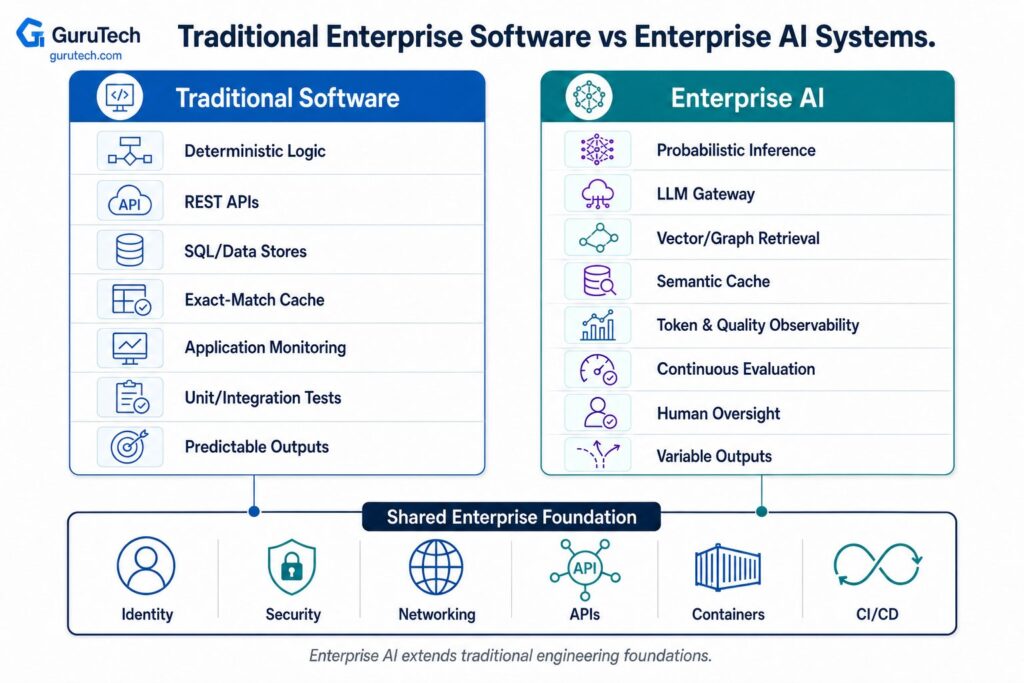
Traditional Software and Enterprise AI Require Different Operational Signals
| Engineering Concern | Traditional Enterprise Software | Enterprise AI Platform |
|---|---|---|
| Primary execution model | Deterministic application logic | Deterministic controls surrounding probabilistic inference |
| Knowledge access | Databases and application APIs | Databases, APIs, vector retrieval, graph retrieval, and dynamic context |
| Service abstraction | API gateway and service mesh | API gateway plus model-routing and LLM gateway layers |
| Caching | Exact keys and deterministic objects | Exact caching plus semantic similarity and context-aware reuse |
| Testing | Unit, integration, regression, and end-to-end tests | Traditional tests plus task evaluation, grounding checks, model comparison, and output validation |
| Observability | Logs, metrics, traces, availability, latency | Traditional telemetry plus tokens, model routing, retrieval behavior, generation latency, evaluation, and quality signals |
| Scaling constraint | CPU, memory, storage, network, service capacity | Traditional resources plus accelerator memory, model size, KV cache, batching, and inference throughput |
| Change management | Code and configuration releases | Code, prompts, models, retrieval configuration, evaluation sets, inference runtimes, and policies |
| Failure definition | Incorrect execution or unavailable service | Infrastructure failure or technically successful execution producing an unacceptable result |
None of this means enterprise AI requires abandoning established software engineering practices. The opposite is true. Reliable AI systems depend on mature application engineering, security, data architecture, platform engineering, and site reliability practices. AI adds new operational dimensions on top of those foundations.
The NIST AI Risk Management Framework reinforces this lifecycle view by treating AI risk as something organizations must govern, map, measure, and manage rather than assess only at deployment. At the infrastructure level, the same principle applies: model behavior, data access, evaluation, monitoring, and governance must remain connected throughout the system lifecycle.
This leads to the next architectural shift. Once AI-specific capabilities such as retrieval, model routing, evaluation, observability, and inference become reusable services, AI stops behaving like a feature embedded independently inside applications. It begins behaving like an enterprise platform.
AI as the Next Enterprise Platform
Enterprise computing repeatedly follows the same architectural pattern. New capabilities first appear inside individual applications. As adoption grows, organizations identify repeated requirements, centralize them into reusable services, and eventually operate those services as a platform.
Mainframe environments centralized compute because hardware was scarce and expensive. Client-server systems distributed application logic while retaining shared databases and enterprise identity. Web architectures introduced HTTP, web servers, application servers, content delivery networks, and API layers. Cloud computing transformed infrastructure provisioning into programmable services. Kubernetes standardized orchestration for containerized workloads. Each generation changed where infrastructure responsibilities lived, but the underlying objective remained consistent: separate reusable platform capabilities from application-specific business logic.
Enterprise AI is now producing a similar transition.
The first AI applications commonly embed model access, prompt construction, retrieval, and monitoring directly into application code. This is appropriate while teams are learning what works. Once those capabilities begin repeating across applications, however, they become candidates for platform services.
Model routing becomes a shared capability. Retrieval becomes a governed enterprise knowledge service. Evaluation moves into the delivery pipeline. Observability spans applications and models. Local inference becomes shared accelerator infrastructure. Fine-tuned adapters become managed artifacts. Semantic caching becomes a reusable optimization layer. Agent tooling becomes a controlled interface to enterprise systems.
The architecture gradually stops resembling a collection of independent AI features and begins resembling a distributed enterprise platform.
Engineering Insight: The defining characteristic of an enterprise AI platform is not that it runs large language models. It is that applications can consume AI capabilities without independently rebuilding the infrastructure required to secure, route, retrieve, evaluate, observe, and operate those capabilities.
The Platform Boundary
One of the most important architectural decisions is determining what belongs inside the AI platform and what remains the responsibility of individual applications.
The platform should generally own capabilities that are reused across workloads, require centralized governance, depend on specialized infrastructure, or benefit significantly from scale. Applications should retain business-specific workflow logic, user experience, domain-specific validation, and task-specific behavior.
For example, an enterprise model gateway may handle provider authentication, routing, fallback, quotas, and cost attribution. The customer-support application still decides when a model should be invoked and how the generated response fits into the support workflow.
A shared GraphRAG or retrieval platform can govern document ingestion, indexing, access filtering, graph construction, and retrieval APIs. The legal application still determines which contract-analysis workflow to execute and which retrieved evidence is required for a particular task.
A shared observability system can record tokens, latency, routing behavior, and quality indicators across the enterprise. The application still defines what business success means for its own workload.
The objective is not to make all AI applications identical. It is to ensure that they do not repeatedly solve the same infrastructure problems.
Platformization Reduces Architectural Coupling
A mature platform also creates useful abstraction boundaries between components that evolve at different speeds.
Business workflows may remain stable for years. Foundation models can change within months. Inference engines can improve even faster. GPU generations evolve independently of application release schedules. Retrieval technologies and embedding models may change without altering the business purpose of the application.
If applications are tightly coupled to all of those decisions, every infrastructure change risks becoming an application migration.
Platform boundaries reduce that coupling. An application can continue requesting a summarization or extraction capability while the gateway routes the request differently. A retrieval API can preserve its interface while the implementation migrates from basic vector search toward a richer graph-based architecture. An inference endpoint can remain stable while the runtime adopts FlashAttention-3 hardware acceleration, model quantization architectures, or speculative decoding underneath it.
This separation is particularly valuable because AI infrastructure is currently evolving faster than most enterprise application portfolios. Architectures that assume the present model, provider, inference engine, or accelerator will remain permanent are likely to accumulate unnecessary migration cost.
Core Principles of Enterprise AI Systems Engineering
The complete blueprint rests on a small set of architectural principles. These principles determine when components should be centralized, where control points belong, and how organizations can avoid building infrastructure that becomes obsolete as models and hardware evolve.
1. Build Platforms, Not Collections of Projects
Individual AI projects should be allowed to experiment, but successful patterns should converge toward reusable infrastructure. Authentication, model access, retrieval, observability, evaluation, governance, and deployment should not remain permanently duplicated across departmental applications.
The transition does not require building a massive centralized platform before the first use case exists. It requires recognizing repeated requirements early enough that architectural duplication does not become permanent.
2. Treat Models as Replaceable Components
Models should not become permanent application boundaries unless a workload truly depends on unique provider-specific behavior. The application should ideally depend on a capability contract while the platform retains flexibility over routing, provider selection, deployment location, and model version.
This principle is the architectural foundation for LLM gateway orchestration. Routing and fallback become platform concerns rather than application rewrites.
3. Treat Enterprise Knowledge as a Strategic Runtime Asset
Models provide generalized capability. Enterprise knowledge provides business relevance.
Documents, databases, graphs, customer records, product information, procedures, policies, and operational history should therefore be treated as governed runtime assets rather than as arbitrary context copied into prompts.
This leads naturally toward managed retrieval systems, document lineage, authorization-aware search, metadata policies, freshness controls, and eventually graph-based knowledge architectures such as GraphRAG where relationships between entities are operationally important.
4. Design Observability Before Optimization
Organizations cannot reliably optimize what they cannot measure. AI infrastructure decisions should therefore be driven by telemetry rather than assumptions.
Before introducing semantic caching, teams should understand request repetition and inference cost. Before adopting quantization, they should understand memory pressure and throughput. Before using speculative decoding, they should measure generation latency and determine whether draft-model acceptance can improve the workload. Before changing retrieval architecture, they should understand retrieval quality and end-to-end latency.
This is why AI token observability sits across the architecture rather than at the end of it. Telemetry provides the evidence required to decide which optimization actually solves the production bottleneck.
5. Optimize the System Before Optimizing the Model
Poor AI performance is frequently attributed to the model even when the actual bottleneck exists elsewhere.
A slow knowledge retrieval step can dominate response time. Oversized prompts can increase cost and latency. Poor batching can leave GPUs underutilized. Unnecessary repeated queries can waste inference capacity. Inefficient model placement can create memory pressure. A weak routing policy can send simple tasks to an unnecessarily expensive model.
Model replacement may help some workloads, but architecture-level improvements often provide greater and more durable gains.
This principle becomes increasingly important in the infrastructure layer, where quantization, optimized attention kernels, speculative decoding, and local inference engines can improve different parts of the execution path.
6. Governance Must Be Enforced by Architecture
Governance cannot depend exclusively on documentation or user training. Policies should be translated into technical controls wherever possible.
Identity systems establish who is making the request. Retrieval filters determine which information can enter context. Gateway policies restrict model and provider access. Tool interfaces constrain which actions an agent can perform. Evaluation detects behavioral regressions. Observability provides evidence. Human approval gates interrupt workflows when risk exceeds the organization’s automation threshold.
The NIST AI Risk Management Framework offers a useful external model for thinking about this lifecycle. From an architecture perspective, the key lesson is that governance, measurement, and risk management must remain active throughout deployment and operation rather than being completed once before launch.
7. Prefer Shared Services Over Repeated Implementations
Shared infrastructure does not automatically mean one centralized monolith. The important distinction is whether repeated responsibilities are exposed through stable services and standards rather than independently reinvented.
Different business units may require isolated data stores or dedicated inference clusters for security, residency, or performance reasons. They can still consume common routing standards, evaluation frameworks, observability schemas, identity controls, and deployment practices.
Platform consistency therefore matters more than physical centralization.
8. Infrastructure Will Change Faster Than Business Capabilities
Models will improve. Accelerator architectures will change. Context windows will expand. Inference runtimes will introduce new scheduling strategies. Retrieval techniques will evolve. New alignment approaches will replace current ones.
The business capability—summarizing contracts, answering support questions, generating software, identifying anomalies, or automating an operational workflow—may remain largely unchanged.
Good architecture protects that business capability from unnecessary infrastructure churn.
Architect’s Note: The more rapidly a technology layer evolves, the stronger the case for preventing business applications from depending directly on its implementation details.
The Enterprise AI Maturity Model
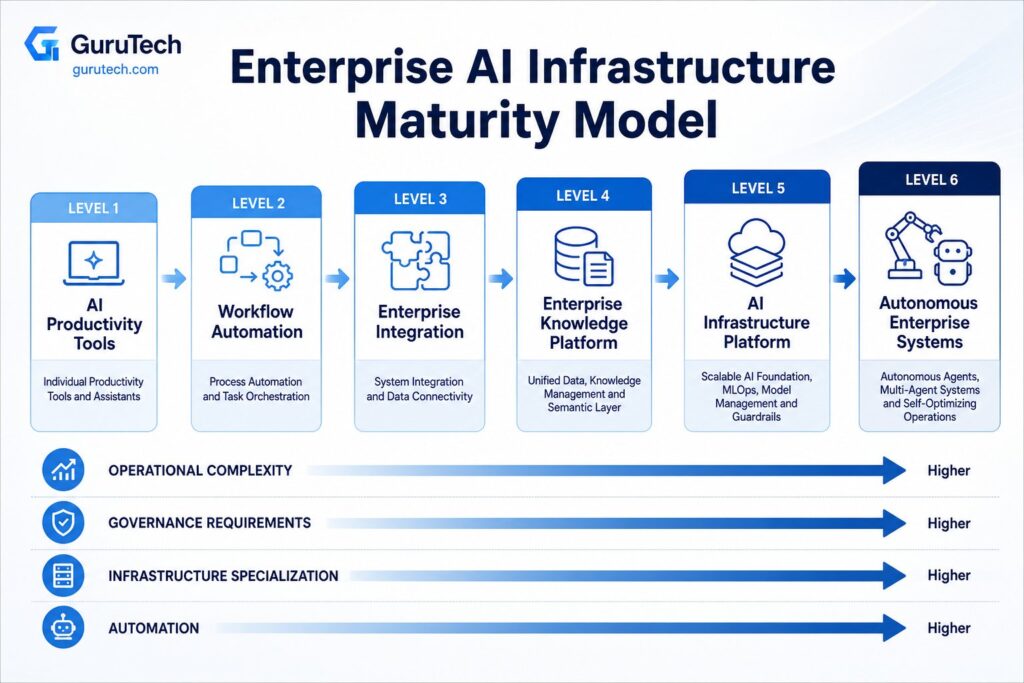
Not every organization requires the complete architecture immediately. Enterprise AI infrastructure typically develops in stages as the number, complexity, and operational importance of AI workloads increases.
The maturity model below should not be interpreted as a rigid certification framework. Organizations may operate at different levels simultaneously. A customer-support environment may have mature retrieval and observability while an HR team remains at the productivity-tool stage. The model is useful because it shows which architectural pressures usually appear as adoption expands.
Level 1: AI Productivity Tools
At the first level, employees use general-purpose AI tools to improve individual productivity. Common activities include writing, summarization, brainstorming, research assistance, coding support, and document transformation.
Infrastructure requirements are limited because the organization is primarily consuming finished SaaS products. The dominant concerns are approved-tool lists, acceptable-use policies, identity, data handling, and preventing sensitive enterprise information from entering uncontrolled systems.
Level 2: Workflow Automation
AI begins participating in repeatable business processes. Applications classify tickets, extract information, summarize documents, generate structured content, or assist employees inside established workflows.
This is where prompt management, task-specific evaluation, human review, structured outputs, and application integration begin to matter. The organization is no longer simply consuming AI software; it is engineering AI behavior into business processes.
Level 3: Enterprise Integration
AI applications connect to internal APIs, databases, document systems, and operational platforms. Identity and authorization become more complex because model responses are now influenced by proprietary enterprise information and may trigger actions in downstream systems.
Secure integration, tool permissions, auditability, secrets management, data classification, and application observability become architectural requirements rather than optional improvements.
Level 4: Enterprise Knowledge Platform
Multiple applications begin requiring access to the same organizational knowledge. Instead of building independent retrieval systems, the enterprise starts operating reusable ingestion, indexing, metadata, authorization, vector search, and graph-based retrieval capabilities.
This is where architectures such as GraphRAG and enterprise semantic caching become platform-level considerations rather than isolated application features.
Level 5: AI Infrastructure Platform
At this stage, the organization operates shared model access, routing, observability, evaluation, deployment, and potentially private inference infrastructure. Hosted models, local models, and specialized fine-tuned models can coexist behind common interfaces.
Infrastructure engineering expands into GPU capacity, batching, model placement, inference runtimes, memory optimization, quantization, latency reduction, and cost governance. The local LLM deployment infrastructure and LLM gateway layers become especially important as model execution is treated as shared platform capacity.
Level 6: Autonomous Enterprise Systems
The most advanced stage introduces AI systems capable of coordinating multi-step workflows, calling tools, delegating work between specialized models or agents, maintaining contextual state, evaluating intermediate results, and escalating selectively to humans.
This level does not eliminate the architecture beneath it. It depends on it.
Autonomous systems require stronger identity, retrieval, tool controls, evaluation, observability, governance, and failure recovery than simpler AI applications because they can make more decisions and interact with more enterprise systems. Multi-agent orchestration therefore belongs near the top of the maturity curve rather than at the beginning of AI adoption.
| Maturity Level | Primary Capability | Architecture Pressure | Typical Platform Requirement |
|---|---|---|---|
| 1 | AI Productivity Tools | Data leakage and uncontrolled usage | Identity, policy, approved tools |
| 2 | Workflow Automation | Quality and repeatability | Prompt management, evaluation, human review |
| 3 | Enterprise Integration | Secure access to business systems | APIs, authorization, secrets, auditability |
| 4 | Knowledge Platform | Repeated enterprise retrieval | RAG, GraphRAG, indexing, semantic cache |
| 5 | AI Infrastructure Platform | Scale, cost, routing, and compute efficiency | LLM gateway, local inference, GPU infrastructure, observability |
| 6 | Autonomous Systems | Multi-step decision and action execution | Agent orchestration, tool governance, continuous evaluation, human escalation |
How the Blueprint Is Organized
The remainder of this guide follows the architecture from the business problem downward rather than beginning with infrastructure technologies.
The Foundation Layer examines where AI should be applied, how workflows should be selected, how human oversight fits into automation, and how evaluation and governance begin before infrastructure decisions are made.
The Integration Layer connects AI systems to enterprise data, APIs, knowledge repositories, retrieval services, semantic caches, and observability systems.
The Infrastructure Layer examines model serving, local LLM deployment, GPU architecture, inference runtimes, FlashAttention-3, quantization, speculative decoding, model routing, and the systems required to operate inference at scale.
The Model Optimization and Alignment Layer covers LoRA, DPO, synthetic data, evaluation, and the feedback loops that allow enterprise models and adapters to improve without repeatedly retraining complete foundation models.
The Enterprise Reference Architecture then connects these components into one production system, mapping dependencies, implementation choices, maturity stages, and technology decisions.
Finally, the AI Platform Operations layer addresses the responsibilities that remain after deployment: versioning, CI/CD, model and prompt registries, canary releases, capacity planning, incident response, cost governance, and long-term operation of AI as enterprise infrastructure.
Engineering Insight: The purpose of the blueprint is not to deploy every technology shown in the architecture. It is to understand where each capability belongs, which production problem justifies it, and what must already exist before it becomes useful.
With those architectural principles established, the blueprint can move to the first implementation layer: identifying where AI creates measurable business value before introducing unnecessary infrastructure.
Part II — Foundation Layer: Building Business Value Before Infrastructure
The strongest enterprise AI programs do not begin with GPUs, vector databases, fine-tuning pipelines, or agent frameworks. They begin with a business process.
This distinction matters because infrastructure can easily become a distraction. New models, inference engines, retrieval techniques, and orchestration frameworks appear continuously. An organization that starts with technology selection instead of workflow selection risks building sophisticated infrastructure around problems that do not justify the operational complexity.
The foundation layer therefore answers a more basic question before any architectural commitment is made:
Which business processes are valuable enough, repeatable enough, and controllable enough to justify AI automation?
This is where enterprise AI architecture begins. The infrastructure exists to support a workflow. If the workflow is poorly selected, no amount of model optimization will rescue the economics.
Workflow Discovery Comes Before Model Selection
Organizations frequently approach AI adoption by asking which model, platform, or tool they should deploy. The more useful starting point is to examine where knowledge work is repetitive, slow, expensive, inconsistent, or dependent on large volumes of unstructured information.
Good AI candidates tend to exhibit several characteristics at once. The task appears frequently enough that automation creates cumulative value. Inputs are available in digital form. The desired outcome can be evaluated. Errors can be detected or contained. Human review can be inserted where necessary. The process does not depend entirely on tacit judgment that cannot be represented or measured.
Examples include document classification, case summarization, information extraction, internal knowledge retrieval, support triage, policy lookup, software assistance, report generation, data transformation, and structured drafting.
By contrast, a task may be a poor initial candidate if it occurs rarely, has no reliable data source, produces outcomes that cannot be evaluated, carries severe downside risk, or requires unrestricted autonomous action across sensitive systems.
Engineering Insight: The best first AI workloads are not necessarily the most impressive. They are the ones where value is measurable, failure is containable, and the workflow can be improved incrementally.
Map the Workflow Before Automating It
Once a candidate process is identified, the next step is to decompose it into stages.
A seemingly simple workflow such as contract review may actually include document ingestion, entity extraction, clause identification, comparison against policy, risk classification, escalation, reviewer approval, and audit logging. A customer-support assistant may include ticket classification, account lookup, retrieval of product information, suggested response generation, approval, and case closure.
These stages should be mapped explicitly because AI may be appropriate for only some of them.
Classification may benefit from a model. Authorization should remain deterministic. Retrieval may require enterprise search or GraphRAG. A financial calculation should use a deterministic service. Response generation may be probabilistic. High-risk actions may require human approval.
This decomposition prevents one of the most common architectural mistakes in enterprise AI: attempting to turn an entire business process into a single prompt.
A production workflow should instead separate reasoning, retrieval, deterministic logic, system actions, and human control into explicit components.
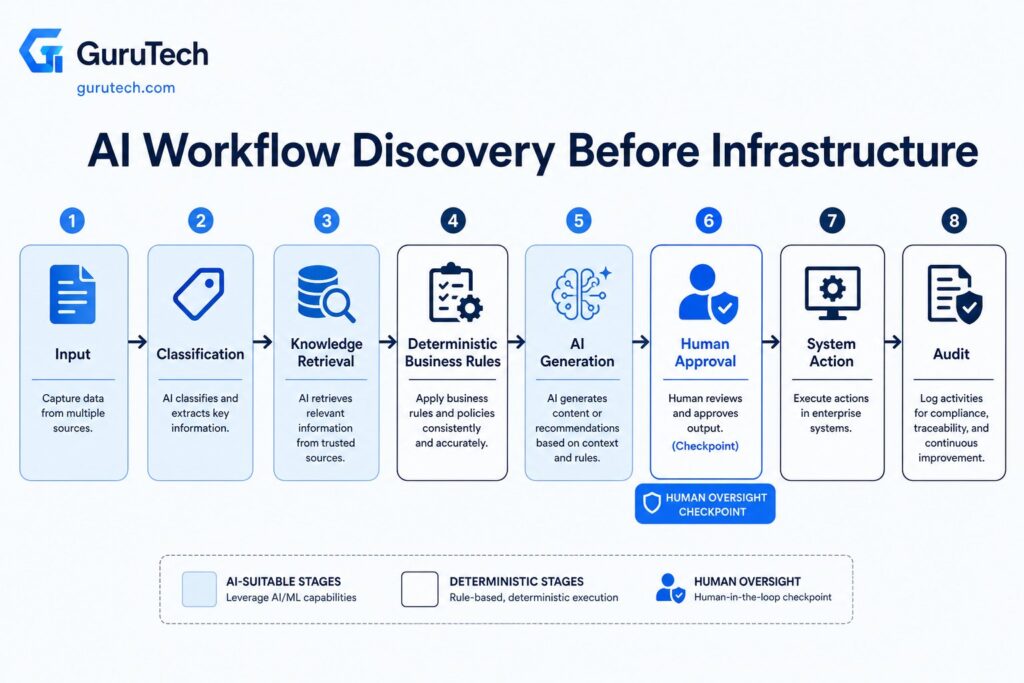
AI Opportunity Assessment
After the workflow is decomposed, organizations need a consistent way to decide which opportunities should move forward.
A useful assessment combines business value, implementation feasibility, data availability, operational risk, and evaluation difficulty.
| Dimension | Questions to Ask |
|---|---|
| Business Value | How much time, cost, revenue, or service quality can improve? |
| Frequency | How often does the workflow occur? |
| Data Availability | Are the documents, records, APIs, or knowledge sources available and usable? |
| Evaluation | Can success or failure be measured objectively enough to support testing? |
| Risk | What happens if the AI produces an incorrect or incomplete result? |
| Human Oversight | Can risky outputs be reviewed before consequential action occurs? |
| Integration Complexity | How many enterprise systems must participate? |
| Scale | Does the workload justify shared infrastructure or can it remain application-specific? |
The highest-priority opportunities generally combine meaningful business value with moderate implementation difficulty and controllable risk.
This assessment also helps prevent premature investment in advanced infrastructure. A small internal summarization workflow may not need a model gateway, local inference cluster, GraphRAG, or fine-tuning. A large enterprise knowledge assistant serving thousands of employees may justify all of them eventually, but only after the workload demonstrates the requirement.
When Not to Use AI
A credible AI architecture blueprint must include situations where AI should not be introduced.
If a deterministic rule solves the problem reliably, it is usually preferable. If a database query can return the exact answer, generating that answer probabilistically adds unnecessary complexity. If a calculation has a defined formula, the formula should remain authoritative. If authorization can be enforced by policy, a model should not infer whether access seems appropriate.
AI should also be avoided when the downside of an incorrect output is unacceptable and no effective review or containment mechanism exists.
The strongest enterprise systems combine deterministic controls with probabilistic capability rather than replacing deterministic engineering wherever a model can technically be inserted.
Prompt Engineering Becomes a Software Lifecycle
Once a workflow is selected, prompts often become the first behavioral layer teams build around a model. During experimentation, a prompt may exist as text inside a notebook or application source file. In production, that approach quickly becomes difficult to manage.
Prompts influence application behavior and should therefore be treated as controlled artifacts. They require versioning, testing, documentation, ownership, and rollback.
A prompt change can alter response style, tool selection, output format, reasoning behavior, refusal patterns, and retrieval usage without any corresponding code change. From an operational perspective, that makes prompts configuration with behavioral consequences.
Production prompt management should therefore answer several questions:
- Which prompt version is currently deployed?
- Which model was it evaluated against?
- Which application or workflow owns it?
- What changed between versions?
- Which evaluation results justified deployment?
- Can the previous version be restored quickly?
The same principle applies to system instructions, templates, few-shot examples, retrieval formatting, and structured-output schemas.
Architect’s Note: If changing an artifact can change production AI behavior, that artifact belongs in the software lifecycle even if it is not traditional source code.
Human-in-the-Loop as a Foundation Control
Human review should be designed according to risk rather than added uniformly to every AI task.
Low-risk internal summarization may require no approval. A customer-facing answer may require confidence thresholds or selective escalation. A financial or legal action may require mandatory human authorization before execution.
The objective is not to maximize human involvement. It is to position human judgment where the expected cost of an AI error exceeds the cost of review.
A well-designed human-in-the-loop AI workflow also produces valuable operational data. Reviewer corrections reveal failure modes. Rejected outputs become evaluation examples. Escalation patterns can identify domains where the model lacks sufficient knowledge or confidence.
Human oversight therefore contributes not only to safety but also to continuous system improvement.
Governance Starts Before Deployment
Governance becomes significantly harder when introduced after an application has already accumulated users, data integrations, prompts, and model dependencies.
The foundation layer should establish basic rules before production deployment: which data classifications may be processed, which models are approved, which workloads require human oversight, how outputs are retained, how users are authenticated, and who owns evaluation and incident response.
The NIST AI Risk Management Framework is useful here because it treats governance as a continuous organizational function rather than a one-time release gate. Its Govern, Map, Measure, and Manage functions reinforce the idea that AI risk controls should exist throughout the lifecycle.
For architects, the practical requirement is to make those policies implementable. A rule stating that confidential documents may be accessed only by authorized employees eventually needs identity integration, retrieval filtering, logging, and auditability in later architectural layers.
The foundation layer defines the requirement. The integration and infrastructure layers provide the enforcement mechanisms.
Evaluation Must Exist Before Optimization
Organizations often attempt to improve an AI system before establishing a reliable way to determine whether the change actually helped.
This is backwards.
Before model changes, retrieval modifications, prompt rewrites, quantization, fine-tuning, or orchestration changes are introduced, the team should define a representative evaluation set and the metrics that matter to the workflow.
Those metrics vary by application. A document extraction workflow may focus on field-level precision and recall. A knowledge assistant may measure answer correctness, retrieval relevance, grounding, and citation quality. A support assistant may measure resolution rate, escalation accuracy, policy compliance, and customer satisfaction.
The evaluation frameworks for GenAI production guide expands this into a full production methodology. At the foundation level, the rule is simpler: if a team cannot define what better means, it is not ready to optimize the system.
Foundation Readiness Checklist
- The business workflow has been mapped before infrastructure selection.
- AI is applied only where probabilistic reasoning provides value.
- Deterministic operations remain deterministic where practical.
- The expected business outcome is measurable.
- Failure modes and consequences are understood.
- Human review points are defined for higher-risk actions.
- Prompt and behavioral artifacts are version controlled.
- A representative evaluation set exists before production optimization begins.
- Data classification and acceptable-use policies are defined.
- Ownership is clear for application behavior, evaluation, governance, and incident response.
If these conditions are not satisfied, additional infrastructure usually increases complexity faster than it increases value.
Once they are satisfied, the next challenge becomes connecting the AI workflow to the systems and knowledge it needs to operate. That transition moves the architecture into the Integration Layer: secure enterprise APIs, databases, retrieval systems, GraphRAG, semantic caching, and end-to-end observability.
Part III — Integration Layer: Connecting AI to the Enterprise
An AI system becomes enterprise software when it can securely interact with enterprise data, knowledge, applications, and operational systems.
This is the purpose of the integration layer.
The foundation layer determines which workflows deserve automation and where probabilistic reasoning belongs. The integration layer turns those workflows into production systems by connecting them to the information and services required to perform useful work.
For most organizations, this layer becomes more important than the model itself. A general-purpose model may understand how contracts are structured, but it does not know which agreements the company signed last quarter. It may understand software troubleshooting, but it cannot see the organization’s current incidents, internal documentation, source repositories, or service topology unless those systems are connected deliberately.
Enterprise value emerges when model capability is combined with proprietary context and controlled action.
Engineering Insight: A foundation model provides generalized intelligence. The integration layer determines whether that intelligence can operate safely and usefully inside the enterprise.
Enterprise Data Architecture for AI Systems
Enterprise information rarely exists in one system or one format. AI applications may need to work across relational databases, document repositories, data lakes, CRM platforms, ticketing systems, source-control repositories, wikis, object storage, email archives, knowledge graphs, and real-time APIs.
The integration challenge is therefore not simply connecting a model to “the data.” It is creating governed interfaces between the AI platform and multiple categories of enterprise information.
- Structured operational data includes customer records, orders, financial transactions, inventory, service tickets, and application state.
- Unstructured knowledge includes contracts, policies, manuals, reports, presentations, support documentation, and internal research.
- Semi-structured information includes JSON records, logs, event streams, configuration, metadata, and API responses.
- Relationship-oriented knowledge includes entities and dependencies that may be better represented through graph structures than independent records.
Each category creates different integration requirements. Structured operational data is often best accessed through application APIs or controlled database services. Large document collections may require ingestion, chunking, embedding, indexing, and retrieval. Relationship-heavy domains may justify graph-based architectures. Real-time operational information may need tool calls rather than periodic indexing.
The architecture should preserve these distinctions instead of forcing every information source into one retrieval mechanism.
Do Not Turn the Model Into the Database Layer
One of the simplest ways to weaken enterprise architecture is to give a model unnecessary responsibility for data access.
A model should not be responsible for deciding whether a user is authorized to view a database record. It should not construct unrestricted SQL against production systems unless the surrounding architecture imposes strict controls. It should not infer which fields are sensitive or decide independently whether a confidential document belongs in context.
Those responsibilities belong to deterministic services and policy enforcement.
A stronger architecture exposes approved operations through controlled interfaces. The model can determine that it needs customer status, but a trusted service determines whether that user is allowed to access the account and which fields may be returned.
This pattern maintains the separation introduced in the foundation layer: the model can participate in reasoning while enterprise systems retain authority.
Secure Database Connectivity
Direct database access is sometimes appropriate for narrowly scoped internal systems, but production AI should generally avoid giving models or application agents broad database credentials.
A secure database integration should apply the same principles used elsewhere in enterprise architecture: least privilege, authentication, authorization, network isolation, encryption, secrets management, logging, and auditable access.
The secure database connection architecture provides a deeper implementation model for connecting applications and AI services to enterprise databases without embedding privileged credentials or exposing unrestricted access paths.
For AI workloads, the risk is amplified because natural-language interfaces can make broad capabilities appear deceptively simple. A user asking an agent to “show me all customers with overdue balances and send them a reminder” may translate into multiple system operations: querying financial records, retrieving contact information, generating individualized messages, and triggering outbound communication.
Each operation should cross an explicit authorization boundary.
Architect’s Note: Natural-language convenience must never collapse security boundaries. A single user instruction may correspond to several privileged enterprise operations, each of which still requires explicit controls.
Enterprise APIs Become the Preferred Action Boundary
APIs are often the safest and most maintainable interface between AI systems and operational applications because they expose defined capabilities rather than raw implementation details.
An account service can expose a controlled operation such as retrieving an account summary. A ticketing system can expose an API for creating or updating a case. An inventory system can provide an availability check. A finance platform can expose an approved calculation or reporting function.
The AI system may decide which tool or operation it needs, but the enterprise API determines what is actually possible.
This approach creates several advantages:
- Authentication and authorization remain centralized.
- Business rules continue to execute in trusted application services.
- Input and output schemas constrain model-generated parameters.
- Actions are easier to audit.
- Rate limits and operational safeguards can be enforced outside the model.
- Applications remain insulated from internal database structure.
In agentic architectures, APIs effectively become the vocabulary of allowable enterprise actions.
Tool Calling Requires Capability Control
Modern models can generate structured tool calls, allowing an application to translate natural-language intent into operations against external systems. This capability is powerful because it moves AI beyond passive generation and into active workflow execution.
It also changes the risk model.
A model that generates an incorrect paragraph creates a content-quality problem. A model that selects the wrong tool or supplies incorrect parameters may create an operational incident.
Tool access should therefore be explicit, constrained, observable, and revocable. High-impact tools may require approval. Parameters should be validated independently of the model. Sensitive tools should be exposed only to workflows and identities that require them.
As agent systems mature, tool governance becomes as important as model governance because the practical impact of the system increasingly depends on what the model is permitted to do.
The Model Context Protocol is one emerging standard for connecting AI applications with external tools and data sources through structured interfaces. Whether an organization uses MCP or conventional application APIs, the architectural principle remains the same: capabilities should be exposed through controlled contracts rather than unrestricted infrastructure access.
Retrieval-Augmented Generation as an Enterprise Knowledge Interface
Operational APIs are appropriate when the model needs current system state or needs to perform an action. Enterprise documents create a different problem.
Policies, manuals, contracts, product documentation, research, meeting records, engineering documentation, and institutional knowledge are usually too large and too dynamic to place directly into a prompt. Retrieval-augmented generation solves this by selecting relevant information at request time.
A typical retrieval pipeline includes document ingestion, preprocessing, chunking, embedding generation, indexing, candidate retrieval, optional reranking, and context assembly before the final model invocation.
This architecture separates two responsibilities:
- The model contributes generalized language and reasoning capability.
- The retrieval system supplies enterprise-specific evidence.
This separation is valuable because the organization’s knowledge can change without retraining the foundation model.
But production retrieval requires more than semantic similarity. The system must also consider access control, metadata, freshness, source quality, document lineage, jurisdiction, department, and sometimes the authority of one source over another.
A retrieved chunk can be semantically relevant and still be operationally inappropriate.
Authorization-Aware Retrieval
Enterprise retrieval should preserve the security boundaries of the source systems.
If an employee cannot open a confidential document in the original repository, an AI assistant should not reveal that document simply because its embedding was placed in a shared vector index.
Authorization therefore needs to participate in retrieval itself. This can involve security metadata attached during ingestion, query-time filtering based on identity and group membership, repository-specific permissions, or retrieval through source systems that already enforce access control.
This is one of the strongest arguments for treating enterprise retrieval as platform infrastructure rather than allowing every application team to build a separate vector database. A centralized or standardized retrieval architecture can preserve identity, metadata, lineage, and access-control requirements consistently across applications.
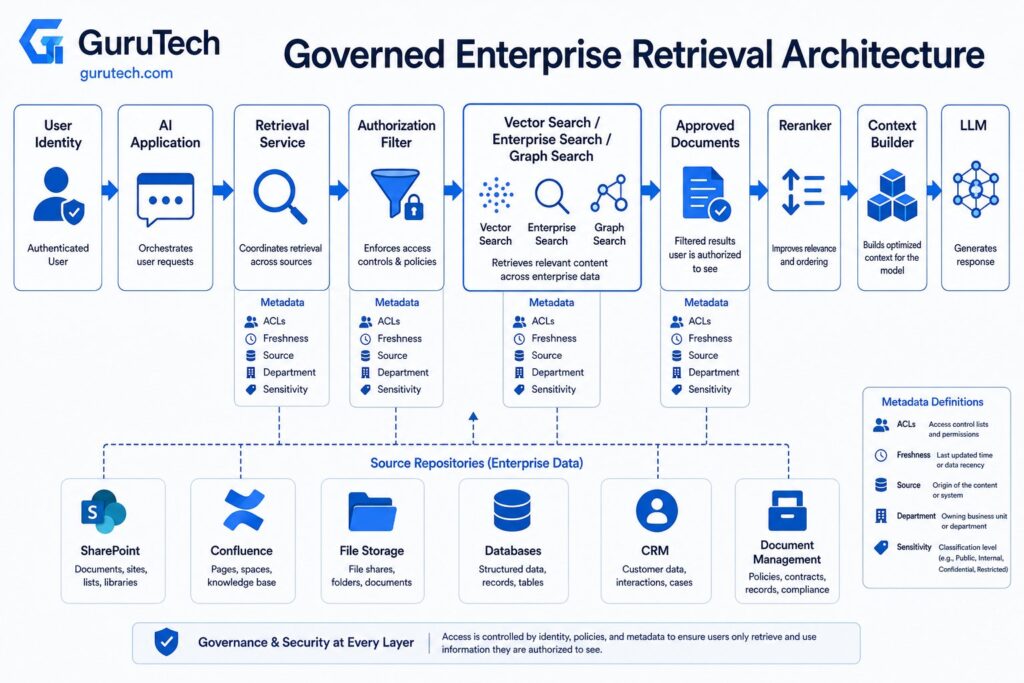
When Basic RAG Is Not Enough
Basic vector retrieval works well when the information needed to answer a question is contained within a small number of semantically similar passages.
It becomes less effective when the answer depends on relationships distributed across documents.
Consider an enterprise asking which products are affected by a supplier issue. The required answer may depend on the relationship between suppliers, components, product assemblies, manufacturing locations, customer contracts, and active incidents. No single document chunk necessarily contains the complete answer.
This is where GraphRAG architecture becomes useful. Instead of treating knowledge entirely as independent chunks, GraphRAG can represent entities and their relationships explicitly, allowing retrieval to follow connections across the enterprise knowledge domain.
GraphRAG should not replace conventional retrieval automatically. It introduces additional ingestion, entity extraction, graph construction, maintenance, query planning, and governance complexity. It is most justified when relationship structure contributes materially to the answer.
Engineering Insight: Use vector retrieval when the problem is primarily finding relevant information. Introduce graph-aware retrieval when the problem requires understanding how information is connected.
Semantic Caching Reduces Repeated AI Work
Once enterprise applications begin serving significant traffic, another pattern often appears: different users repeatedly ask variations of the same questions.
A conventional exact-match cache will miss many of these opportunities because natural-language phrasing changes even when intent does not. Enterprise semantic caching addresses this by comparing the semantic meaning of a new request against previous requests and determining whether a prior response can be reused safely.
The potential benefits extend beyond model cost. A cache hit can avoid embedding generation, retrieval, reranking, prompt construction, and inference. In high-volume workloads, semantic reuse can therefore reduce load across multiple infrastructure layers simultaneously.
However, semantic caching requires careful invalidation and authorization design.
A cached answer derived from last month’s policy may no longer be valid. A response generated for an executive may contain information that another employee cannot access. A question that appears semantically similar may contain a subtle difference that changes the correct answer.
Semantic caching is therefore an optimization layer, not a bypass around retrieval governance.
Observability Must Follow the Entire Request Path
Once a request can pass through identity, APIs, retrieval, reranking, caching, model routing, tool execution, and inference, application-level latency becomes the sum of many independent operations.
A user reporting that “the AI is slow” does not identify the bottleneck.
The delay might occur in document retrieval. A graph query may be expensive. The semantic cache may produce a low hit rate. A gateway may wait for a provider retry. Tool execution may be slow. The inference queue may be saturated. Generation itself may represent only a fraction of total latency.
This makes distributed tracing especially important for enterprise AI. The platform should be able to follow an individual request across the components that contributed to the final answer.
The OpenTelemetry project provides an industry-standard framework for collecting traces, metrics, and logs across distributed systems. AI-specific observability can build on that foundation by adding model, token, retrieval, and evaluation metadata to the request trace.
The AI token observability dashboard becomes particularly valuable here because infrastructure telemetry needs to be correlated with model behavior. Tokens per request, model selection, time to first token, generation throughput, retrieval latency, cache behavior, and application-level outcomes should not live in disconnected monitoring systems.
Observability Is Also a Cost-Control System
AI infrastructure introduces costs that can be difficult to allocate through conventional application monitoring.
Two requests reaching the same endpoint may consume dramatically different amounts of compute. One may use a short prompt and produce a concise answer. Another may retrieve several documents, generate thousands of tokens, invoke multiple tools, and route through a premium model.
Cost attribution therefore needs workload-level context.
A mature platform should be able to answer questions such as:
- Which applications consume the most inference capacity?
- Which departments generate the largest token volume?
- Which models have the highest cost per successful task?
- Which queries repeatedly bypass the semantic cache?
- Which retrieval workflows add significant latency without improving quality?
- Which applications could move to smaller or locally hosted models?
These signals become the input to optimization decisions in the infrastructure layer.
Integration Layer Readiness Checklist
- Enterprise data sources are classified by access method and sensitivity.
- Operational systems are exposed through controlled APIs where practical.
- Database access follows least-privilege principles.
- Model-generated tool calls are validated before execution.
- High-impact actions have explicit authorization or approval controls.
- Enterprise retrieval preserves source-system permissions.
- Document lineage, metadata, and freshness can be tracked.
- Vector retrieval is used where semantic similarity is sufficient.
- Graph-based retrieval is introduced only where relationship structure provides measurable value.
- Semantic caching includes authorization and invalidation controls.
- Requests can be traced across retrieval, routing, tools, and inference.
- Token consumption and infrastructure cost can be attributed to workloads.
At this point, the AI platform can securely reach the enterprise systems and knowledge required to perform useful work. The next challenge is operating model inference efficiently at production scale.
That moves the blueprint into the Infrastructure Layer, where application architecture meets model serving, GPU capacity, inference runtimes, model routing, quantization, FlashAttention-3, speculative decoding, and high-performance AI compute.
Part IV — Infrastructure Layer: High-Performance Enterprise AI Infrastructure
Once enterprise AI workloads are connected to production data, knowledge systems, APIs, and observability, a new engineering problem emerges: inference itself becomes infrastructure.
During early adoption, model execution is often almost invisible to application teams. A request is sent to a hosted API, a response returns, and the provider manages accelerator allocation, batching, model loading, kernel execution, and hardware failures.
At enterprise scale, that abstraction remains useful—but it may no longer be sufficient for every workload.
Organizations may operate millions of requests, require predictable latency, process sensitive information, deploy specialized open-source models, maintain workloads in private environments, or discover that inference has become a significant operating expense. Different applications may also require different combinations of model capability, context length, latency, throughput, privacy, and cost.
The infrastructure layer exists to manage those tradeoffs without forcing every application to understand the hardware and runtime mechanics underneath them.
Engineering Insight: The objective of AI infrastructure is not simply to run a model. It is to convert finite compute, memory bandwidth, accelerator capacity, and model capability into predictable application-level service.
Hosted APIs and Private Inference Are Not Mutually Exclusive
Enterprise architecture should avoid treating hosted and self-hosted inference as opposing strategies.
Managed APIs can provide rapid access to highly capable models without requiring the organization to operate GPU infrastructure. They can be an excellent fit for low-volume workloads, rapidly changing model requirements, experimentation, or applications where the provider’s model quality outweighs infrastructure-control requirements.
Private inference becomes more attractive when requirements shift toward data sovereignty, predictable capacity, specialized open-source models, workload isolation, lower marginal cost at sustained utilization, or deeper control over inference behavior.
Many mature enterprises will therefore operate a hybrid model estate rather than choosing one approach universally.
One application may use a frontier hosted model for complex reasoning. Another may use a smaller privately deployed model for classification. A high-volume retrieval assistant may run an open model on dedicated accelerators. A sensitive workflow may be restricted to private infrastructure regardless of cost.
The architecture should make those execution decisions as independent from application code as practical.
The LLM Gateway Becomes the Inference Control Plane
As the number of models and providers increases, applications need a stable interface to the inference layer. Without one, provider-specific integration spreads throughout the application portfolio.
An enterprise LLM gateway orchestration layer provides a control point between applications and model execution.
The gateway can centralize responsibilities such as:
- model and provider routing;
- authentication and credential isolation;
- request quotas and rate limits;
- fallback and retry policies;
- cost attribution;
- model-specific request transformation;
- policy enforcement;
- load balancing;
- latency-aware routing;
- and routing between hosted and privately operated models.
This layer becomes particularly valuable when routing decisions are dynamic.
A simple extraction task may not justify an expensive reasoning model. A long-context analysis may require a model with a larger context window. A confidential workload may be restricted to a private cluster. A latency-sensitive request may need the model with the shortest current queue. A provider outage may require automatic failover.
The gateway converts those requirements into infrastructure policy.
Architect’s Note: The gateway should not determine business intent. Applications define what capability they need. The gateway determines which approved inference resource can satisfy that requirement under current policy, availability, performance, and cost constraints.
Local LLM Deployment Changes the Infrastructure Boundary
When an organization begins operating models directly, responsibilities previously hidden behind an API become visible.
Models must be loaded onto accelerators. Requests need scheduling. GPU memory must be allocated. Concurrent sequences compete for capacity. KV caches grow with active context. Batching affects throughput. Long requests can interfere with short requests. Model replicas need scaling and placement. Failed nodes need recovery.
The local LLM deployment infrastructure therefore includes much more than downloading model weights and attaching a GPU.
A production architecture may include an API gateway, model router, inference runtime, Kubernetes or another scheduler, GPU nodes, model storage, autoscaling, metrics collection, and centralized logging. Depending on scale, different models may occupy dedicated pools while smaller models share accelerator capacity.
The inference runtime becomes especially important because it determines how efficiently application requests are converted into accelerator work.
Inference Runtimes Are Resource Schedulers
A production inference engine does substantially more than execute a model’s forward pass. It manages contention between multiple sequences and attempts to keep expensive accelerators productive.
Frameworks such as vLLM focus on high-throughput LLM serving and include mechanisms for efficient KV-cache management and continuous batching. Other environments may use NVIDIA TensorRT-LLM or managed inference runtimes depending on model, hardware, and operational requirements.
The choice of runtime matters because utilization directly affects inference economics. An accelerator that spends substantial time waiting for work still incurs infrastructure cost. A system that can combine requests efficiently, manage memory effectively, and sustain higher token throughput extracts more useful inference from the same hardware.
This is why application demand, scheduler behavior, batch formation, memory allocation, and GPU execution cannot be analyzed independently.
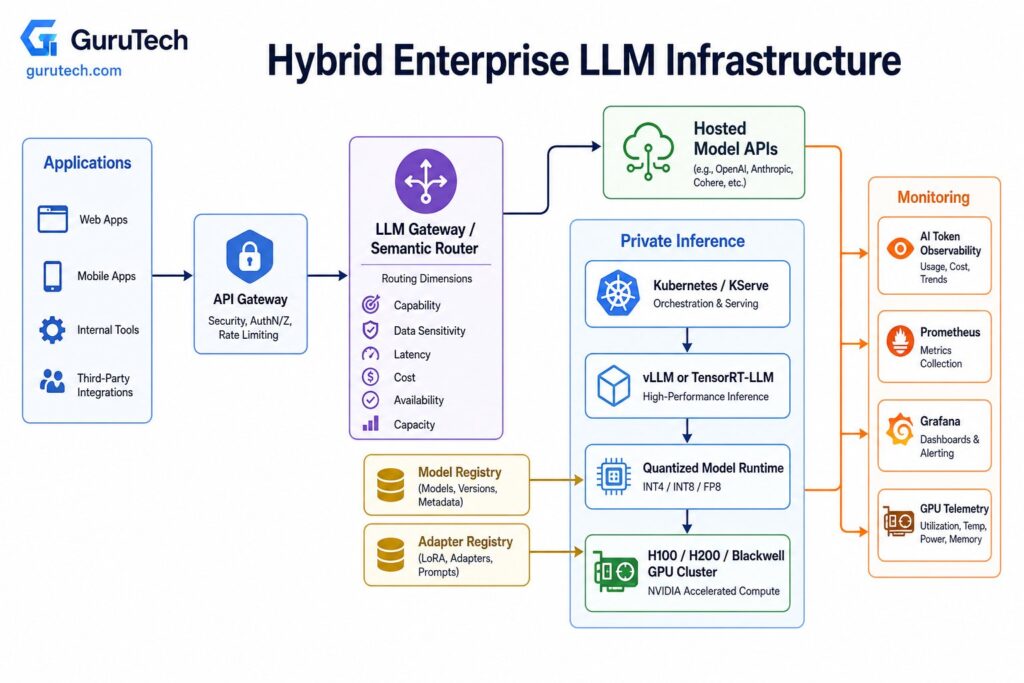
GPU Memory Is an Architectural Constraint
Self-hosted inference forces architects to confront a constraint that hosted APIs largely conceal: accelerator memory is finite.
Model weights consume memory before a request is processed. Active sequences require KV-cache capacity. Runtime buffers, activations, adapters, and framework overhead consume additional space. Longer contexts and higher concurrency increase memory pressure further.
The result is that a model fitting onto a GPU does not necessarily mean the model can serve the intended production workload efficiently.
An architecture that consumes nearly all available memory for weights may leave insufficient headroom for useful concurrency. Conversely, reducing model memory can create capacity for larger batches, longer contexts, or additional model replicas.
This is the engineering motivation behind model quantization architectures.
Quantization Converts Precision Into Capacity
Quantization reduces the numerical precision used to represent some or all model parameters and computations. In infrastructure terms, its most immediate benefit is often memory reduction.
A lower-precision representation can allow a model to fit on fewer accelerators or leave more memory available for runtime state. Depending on the format and hardware, it can also improve inference throughput.
But quantization is not a universal compression switch. Different approaches make different tradeoffs among model quality, hardware compatibility, throughput, memory reduction, and deployment complexity.
Formats and techniques such as INT8, FP8, GPTQ, and AWQ belong to different deployment paths. The correct choice depends on accelerator generation, inference runtime, model architecture, quality requirements, and whether the optimization targets memory capacity, execution speed, or both.
The architectural sequence matters:
- Measure the workload.
- Identify the actual memory or throughput constraint.
- Select a quantization approach compatible with the runtime and hardware.
- Evaluate task-specific quality after conversion.
- Measure the resulting capacity and throughput improvement.
Skipping the evaluation step is particularly dangerous. Infrastructure efficiency has little value if the compressed model no longer meets the application’s quality requirements.
Memory Bandwidth Shapes LLM Performance
Large-model inference is not governed only by theoretical compute capability. Moving model data through the memory hierarchy is frequently a critical part of the execution cost.
This is why accelerator selection cannot be reduced to comparing headline compute numbers. HBM capacity, memory bandwidth, tensor-core capabilities, interconnect topology, precision support, and kernel compatibility all influence practical inference performance.
The infrastructure team must therefore understand how the model, runtime, and accelerator interact rather than selecting each independently.
FlashAttention-3 Optimizes the Attention Execution Path
Attention is a central operation in transformer execution, and naïve implementations can create substantial memory traffic by materializing large intermediate results.
FlashAttention-3 hardware acceleration represents the type of optimization that becomes relevant once an organization is operating sufficiently advanced inference infrastructure to care about kernel-level efficiency.
The important architectural lesson is not that every enterprise should deploy FlashAttention-3. It is that high-performance inference eventually extends below the model-serving framework into hardware-aware kernel execution.
At that level, performance depends on how work is tiled, how data moves between HBM and on-chip memory, how Tensor Cores are scheduled, and how the implementation exploits capabilities of the accelerator architecture.
This is far removed from the initial AI proof of concept—and exactly why the blueprint separates application adoption from advanced infrastructure engineering.
Engineering Insight: Optimization should move downward through the stack only when measurement justifies it. First optimize unnecessary requests and routing. Then optimize serving and batching. Then memory representation. Only after those layers are understood should kernel-level optimization become a priority.
Speculative Decoding Targets Token-Generation Latency
Quantization and optimized attention address particular compute and memory constraints. Speculative decoding architecture approaches inference performance from another direction: reducing the cost of sequential token generation.
Autoregressive generation normally requires the target model to produce tokens sequentially. Speculative decoding introduces a smaller or otherwise faster draft mechanism that proposes multiple future tokens. The target model then verifies those candidates, accepting a valid prefix and rejecting incorrect speculation.
The optimization is effective only when the additional draft work is outweighed by the reduction in expensive sequential target-model steps.
This means acceptance rate becomes an infrastructure metric. A poorly matched draft model can consume additional compute without delivering useful latency improvement. A well-matched configuration can reduce inter-token latency while preserving the target model’s output distribution.
Again, the decision should be workload-driven rather than technology-driven.
Optimization Techniques Solve Different Bottlenecks
| Infrastructure Technique | Primary Problem | Primary Resource Affected | Architectural Trigger |
|---|---|---|---|
| LLM Gateway | Fragmented model access | Providers and inference endpoints | Multiple models, providers, policies, or fallback requirements |
| Semantic Cache | Repeated inference | Tokens, retrieval, inference capacity | High semantic repetition across requests |
| Continuous Batching | Low accelerator utilization | GPU compute and throughput | Concurrent production request volume |
| Quantization | Model memory footprint | VRAM and potentially throughput | Weights constrain capacity, placement, or concurrency |
| FlashAttention-3 | Attention memory traffic and execution efficiency | HBM bandwidth and accelerator execution | Hardware-aware transformer optimization is justified |
| Speculative Decoding | Sequential generation latency | Target-model decoding steps | Inter-token latency is material and draft acceptance is strong |
The table highlights why these technologies should not be treated as interchangeable “LLM performance optimizations.” They operate at different architectural layers and attack different bottlenecks.
A system suffering from excessive repeated requests may benefit more from semantic caching than from faster GPUs. A system constrained by model weight memory may benefit from quantization. A system with poor GPU utilization may require better batching. A latency-sensitive generation workload may justify speculative decoding. A heterogeneous model estate may need gateway routing before any hardware optimization occurs.
Performance engineering begins by identifying the bottleneck correctly.
Observability Connects Application Demand to GPU Behavior
At this layer, observability must extend from the original application request all the way into the inference runtime and accelerator.
Application teams care about time to first token, end-to-end latency, successful task completion, and cost. Platform teams need queue depth, batch size, requests per second, tokens per second, model occupancy, and cache utilization. Infrastructure teams need accelerator utilization, memory consumption, HBM bandwidth, thermal behavior, hardware errors, and interconnect performance.
Those views should describe the same system rather than exist as independent dashboards.
A latency spike may originate from application demand creating a queue, a routing policy overloading one model pool, KV-cache pressure reducing effective concurrency, or GPU execution becoming inefficient. The AI token observability architecture provides the bridge between request-level AI telemetry and the infrastructure signals needed to diagnose these conditions.
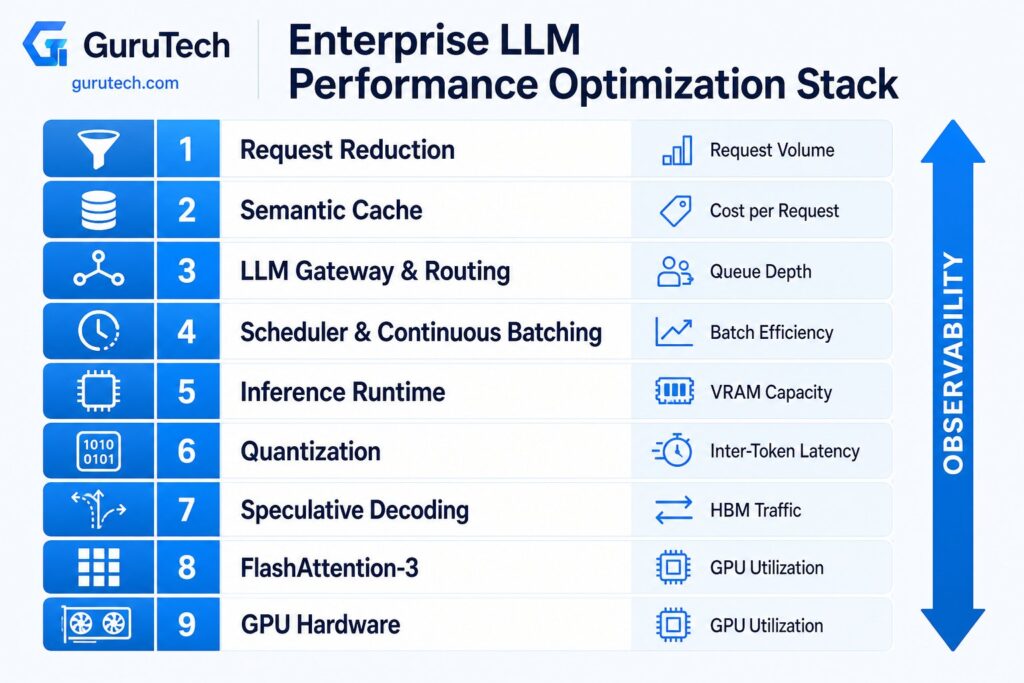
Infrastructure Should Scale by Workload Class
Not every model workload should share identical infrastructure.
Interactive assistants prioritize latency. Offline document processing may prioritize throughput. Long-context analysis consumes substantially more memory than short classification tasks. Agentic workloads may generate bursts of model and tool activity. Embedding models have different execution characteristics from autoregressive language models.
A mature platform can therefore separate workload classes into pools with different models, accelerator types, scaling policies, queue priorities, and service-level objectives.
The gateway and scheduler become the connection between workload intent and infrastructure placement.
This is the point where enterprise AI infrastructure begins resembling a specialized compute platform rather than a collection of model servers.
Infrastructure Layer Readiness Checklist
- Applications are not unnecessarily coupled to individual model providers.
- A routing layer exists when multiple models or providers justify it.
- Hosted and private inference are selected according to workload requirements rather than ideology.
- Private inference has explicit capacity and availability objectives.
- Model weights, KV cache, runtime overhead, and concurrency are included in VRAM planning.
- The inference runtime supports the production concurrency pattern.
- Quantization is introduced only after measuring memory or throughput constraints.
- Task-specific evaluation verifies quality after model optimization.
- Speculative decoding is measured using acceptance rate and end-to-end latency.
- Kernel-level optimizations are introduced only when lower layers justify the engineering complexity.
- Application latency can be correlated with scheduler and GPU telemetry.
- Different workload classes can receive different infrastructure policies.
At this stage, the enterprise has moved from consuming models to operating a genuine inference platform. Applications can reach enterprise knowledge, requests can be routed across model resources, and the underlying infrastructure can be optimized according to measured workload behavior.
But infrastructure efficiency does not determine whether a model behaves correctly for a specialized enterprise task. The next layer addresses that problem through parameter-efficient adaptation, preference alignment, synthetic data, and continuous evaluation.
That moves the blueprint into Part V — Model Optimization and Alignment.
Part V — Model Optimization and Alignment
Efficient infrastructure does not guarantee that a model behaves correctly for a specific enterprise task.
A well-routed, highly optimized inference stack can still produce outputs that are inconsistent with internal terminology, workflow expectations, compliance requirements, structured output formats, or domain-specific reasoning patterns. At that point, the problem is no longer primarily infrastructure efficiency. It is model behavior.
The model optimization and alignment layer addresses this gap.
It includes parameter-efficient fine-tuning, preference optimization, synthetic data generation, domain-specific evaluation, and the feedback loops required to improve model behavior over time.
Engineering Insight: Infrastructure optimization makes inference cheaper and faster. Alignment optimization makes the model more useful for the enterprise workload. The two problems are related, but they are not interchangeable.
When Prompt Engineering Stops Being Enough
Prompt engineering is usually the first behavioral control applied to a foundation model because it is fast, flexible, and inexpensive compared with training. Many workflows can be solved entirely through better instructions, retrieval, structured outputs, and tool design.
There is a point, however, where repeated prompt complexity becomes a signal that the model itself may need adaptation.
A team may find itself maintaining long system prompts filled with domain terminology, formatting rules, exception handling, examples, style instructions, and corrective language. The prompt grows larger while behavior remains inconsistent. Additional examples increase token cost. Small prompt changes create regressions elsewhere.
At that stage, model adaptation can move some of the desired behavior from runtime instructions into learned parameters.
The correct escalation path is generally:
- Improve the workflow design.
- Improve deterministic controls.
- Improve retrieval and context.
- Improve prompt structure and examples.
- Evaluate whether model adaptation is justified.
Fine-tuning should not compensate for weak retrieval, unclear evaluation, or poorly designed business logic.
LoRA Makes Model Specialization Operationally Practical
Full model fine-tuning modifies a large portion of the model parameters and can require substantial compute, storage, training infrastructure, and model lifecycle management.
Parameter-efficient techniques such as LoRA fine-tuning architectures change this equation by training a comparatively small set of additional parameters while keeping the base model frozen.
From an enterprise systems perspective, this is important because it changes specialization from a model-copying problem into an adapter-management problem.
Instead of storing and operating a separate full model for Legal, Finance, HR, Engineering, and Customer Support, an organization can maintain one shared base model and multiple lightweight adapters representing specialized behavior.
This creates a new architecture:
Shared Base Model → Adapter Registry → Dynamic Adapter Loading → Department-Specific Behavior
The storage savings can be significant, but the deeper architectural advantage is lifecycle separation. The base model and the enterprise specialization layer can evolve independently.
A common model can be patched or upgraded while specialized adapters remain separately versioned, evaluated, approved, and deployed.
Architect’s Note: LoRA is most valuable architecturally when multiple enterprise specializations share the same underlying model. The efficiency comes not only from training fewer parameters, but from avoiding a separate full model lifecycle for every domain.
Adapter Isolation Becomes a Governance Requirement
Once adapters represent business-specific behavior, they must be managed like production artifacts.
An enterprise adapter registry should track:
- base model compatibility;
- training dataset version;
- training configuration;
- evaluation results;
- department or workload ownership;
- approval status;
- deployment history;
- rollback version;
- and production usage.
This registry becomes the model-adaptation equivalent of an application artifact repository.
The inference platform also needs to know which adapter is authorized for which workload. A Legal adapter should not be loaded simply because an application provides its identifier. Routing policy, application identity, or deployment configuration should determine which specialization can execute.
Dynamic adapter loading therefore creates operational flexibility but also introduces another policy boundary.
DPO Aligns Models Through Preference Data
Fine-tuning can teach a model domain patterns, output formats, and specialized behavior. Some enterprise requirements are better expressed as preferences between alternative responses.
For example, an organization may prefer answers that are concise, citation-heavy, conservative about uncertainty, aligned with policy language, or structured according to internal communication standards.
Direct Preference Optimization provides one mechanism for learning those preferences from paired examples of preferred and rejected outputs.
DPO is architecturally interesting because it can fit into a relatively direct training pipeline:
Production Examples → Preference Collection → Dataset Validation → DPO Training → Evaluation → Model Registry → Deployment
The quality of this pipeline depends heavily on the preference data.
If preferences are inconsistent, poorly labeled, or dominated by superficial style choices, the resulting model may optimize the wrong behavior. Preference datasets therefore require the same discipline as other production data assets: schema validation, provenance, versioning, review, and quality control.
LoRA and DPO Solve Different Problems
LoRA and DPO should not be treated as competing technologies.
LoRA is a parameter-efficient adaptation mechanism. DPO is an alignment objective based on preference data. The two can be used together.
An enterprise may apply LoRA to specialize a base model using domain examples and then use DPO to further align the adapter or model toward preferred response behavior.
| Technique | Primary Objective | Typical Input | Enterprise Use |
|---|---|---|---|
| Prompt Engineering | Runtime behavioral guidance | Instructions and examples | Fastest way to shape behavior without training |
| RAG / GraphRAG | Provide current enterprise knowledge | Documents, data, graph relationships | Grounding and proprietary context |
| LoRA | Parameter-efficient specialization | Training examples | Domain, task, department, or output specialization |
| DPO | Preference alignment | Preferred and rejected response pairs | Style, policy, safety, quality, and behavioral alignment |
The sequence matters. Retrieval should not be replaced by fine-tuning when the required information changes frequently. Fine-tuning should not be used to memorize enterprise facts that belong in governed knowledge systems.
Knowledge and behavior should remain separate wherever practical.
Engineering Insight: Use retrieval to teach the model what the enterprise currently knows. Use model adaptation to teach the model how the enterprise wants the task performed.
Synthetic Data Expands the Training and Evaluation Supply
Enterprise model improvement is frequently constrained by data rather than training infrastructure.
Organizations may have thousands of production interactions but relatively few carefully labeled examples suitable for training or evaluation. Sensitive workloads may also limit how raw production data can be reused.
Synthetic data curation pipelines provide one way to expand the available dataset by generating examples that are subsequently validated, filtered, scored, and governed before use.
The word curation is critical.
Generating synthetic examples is easy. Generating synthetic data that improves a production model without amplifying errors or narrowing diversity is much harder.
A mature synthetic-data architecture can include:
- seed data selection;
- scenario generation;
- multi-model generation;
- schema validation;
- deduplication;
- quality scoring;
- policy filtering;
- human review;
- dataset versioning;
- and downstream evaluation.
The pipeline itself becomes an enterprise data product.
Synthetic Data Should Target Coverage Gaps
The strongest synthetic datasets are usually not created by asking a model to produce more examples of everything.
They target gaps revealed by evaluation and production telemetry.
If the model performs poorly on unusually long contracts, the synthetic pipeline can generate or transform examples that exercise long-document behavior. If structured output fails when fields are missing, training data can emphasize incomplete-input scenarios. If the model struggles with a rare policy exception, synthetic examples can expand coverage of that case.
This connects data generation directly to observed failure modes.
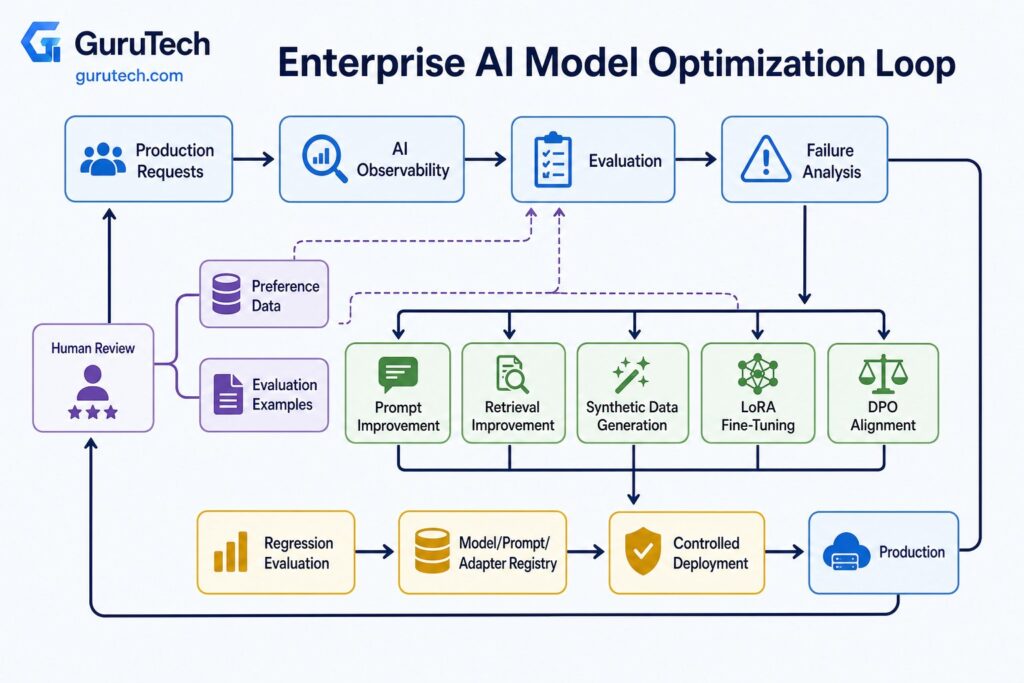
Evaluation Is the Control Plane for Model Change
Every optimization path described in this section introduces the possibility of regression.
A new prompt may improve one task while degrading another. A LoRA adapter may learn domain terminology but reduce general reasoning quality. DPO may strengthen policy adherence while making responses excessively conservative. Synthetic data may improve rare cases while creating distribution bias.
This is why production GenAI evaluation must sit between experimentation and deployment.
Evaluation should include multiple layers:
- Task evaluation — Did the model complete the intended task correctly?
- Grounding evaluation — Is the response supported by approved sources?
- Structured output validation — Does the result satisfy the required schema?
- Policy evaluation — Does the response follow enterprise constraints?
- Regression evaluation — Did previously working cases remain stable?
- Operational evaluation — Did latency, token usage, and infrastructure cost remain acceptable?
- Human evaluation — Does expert review confirm that automated metrics reflect real quality?
The model should not move into production because its average benchmark score improved. It should move because the enterprise workload it serves improved without creating unacceptable regressions elsewhere.
Offline Evaluation and Production Evaluation Serve Different Purposes
Offline evaluation occurs before deployment against controlled datasets. It enables reproducibility and direct comparison between candidate configurations.
Production evaluation captures what happens after the system encounters real users, real documents, changing data, unusual phrasing, tool failures, and operational conditions that were not represented perfectly in the offline dataset.
Both are required.
Offline evaluation reduces deployment risk. Production telemetry reveals the gap between the test environment and actual use.
The two should form a feedback loop rather than separate processes.
Production failures become new evaluation cases. Evaluation failures generate data-curation priorities. Validated data feeds prompt improvement, retrieval changes, LoRA training, or DPO. The new candidate returns to evaluation before another controlled deployment.
Human Feedback Becomes Training Infrastructure
Human review introduced in the foundation layer becomes increasingly valuable once the organization operates an optimization pipeline.
A reviewer correcting an AI-generated answer produces more than an operational decision. The correction may become a supervised training example. A choice between two outputs may become preference data. A rejected tool call may become an agent evaluation case. An escalation may reveal a missing policy or knowledge source.
Human interaction therefore creates a stream of improvement signals.
The architecture should capture those signals intentionally rather than allowing them to disappear inside application logs.
Model Registries Become More Complex Than Version Numbers
Traditional machine learning registries already track model versions and artifacts. Enterprise generative AI expands the number of components that can influence production behavior.
A deployment may depend on:
- a foundation model version;
- a quantization format;
- a LoRA adapter;
- a tokenizer;
- a system prompt;
- a retrieval configuration;
- an embedding model;
- a reranker;
- a tool schema;
- an evaluation dataset;
- and a gateway routing policy.
Two deployments using the same nominal model can therefore behave differently because other components changed.
Reproducibility requires versioning the complete behavioral configuration, not only the model weights.
Continuous Optimization Is a Closed-Loop System
The most mature enterprise architecture converts AI improvement into a closed loop:
Production → Observability → Evaluation → Failure Analysis → Data / Prompt / Retrieval / Model Improvement → Regression Testing → Controlled Deployment → Production
This loop prevents optimization from becoming a sequence of disconnected experiments.
Each change begins with evidence, targets a measured problem, passes through evaluation, and produces telemetry after deployment.
The cycle also clarifies which intervention is appropriate.
- If knowledge is missing, improve retrieval.
- If instructions are unclear, improve prompts.
- If a behavior must become consistent across requests, consider model adaptation.
- If preference or policy alignment is weak, consider DPO.
- If examples are insufficient, expand the curated dataset.
- If latency is the problem, return to infrastructure optimization.
Every failure should not lead automatically to fine-tuning.
Engineering Insight: Mature AI engineering is less about finding one perfect model and more about operating a measurable system that can identify the source of failure and apply the least expensive intervention capable of correcting it.
Model Optimization and Alignment Readiness Checklist
- Prompt, retrieval, and workflow problems are addressed before fine-tuning is introduced.
- Fine-tuning has a clearly defined behavioral objective.
- LoRA adapters are versioned and associated with a specific base model.
- Adapter ownership and authorization are defined.
- Preference data used for DPO is reviewed and version controlled.
- Synthetic data targets measured coverage gaps rather than expanding datasets indiscriminately.
- Training data provenance is available.
- Offline evaluation exists before candidate models or adapters are deployed.
- Production telemetry feeds new regression and evaluation cases.
- Human feedback can be converted into structured improvement signals.
- Model, prompt, retrieval, adapter, and routing configurations can be reproduced.
- Changes can be rolled back when production quality deteriorates.
The architecture has now progressed from business workflow selection through enterprise integration, model serving, infrastructure optimization, and model alignment.
The remaining challenge is to assemble those capabilities into one coherent reference architecture and understand the dependencies between them.
That is the purpose of Part VI — Enterprise AI Reference Architecture: Putting the Complete System Together.
Part VI — Enterprise AI Reference Architecture: Putting the Complete System Together
The previous sections examined enterprise AI as a sequence of architectural layers: business workflow selection, integration, knowledge access, inference, optimization, alignment, evaluation, and governance. The reference architecture brings those layers together into one production system.
The objective is not to create a mandatory stack that every organization must deploy. It is to show where each capability belongs, which problems justify it, and how the layers depend on one another.
A mature enterprise AI platform can be understood as a set of vertical execution layers combined with horizontal control planes.
The vertical path moves a request from the user through identity, application logic, model routing, retrieval, orchestration, inference, and response generation.
The horizontal control planes—security, governance, observability, evaluation, and lifecycle management—span that execution path rather than existing as isolated components.
Engineering Insight: The architecture is complete only when the request path and the control path are designed together. Inference without governance is risky. Governance without observability is difficult to enforce. Observability without evaluation cannot determine whether the system is actually useful.
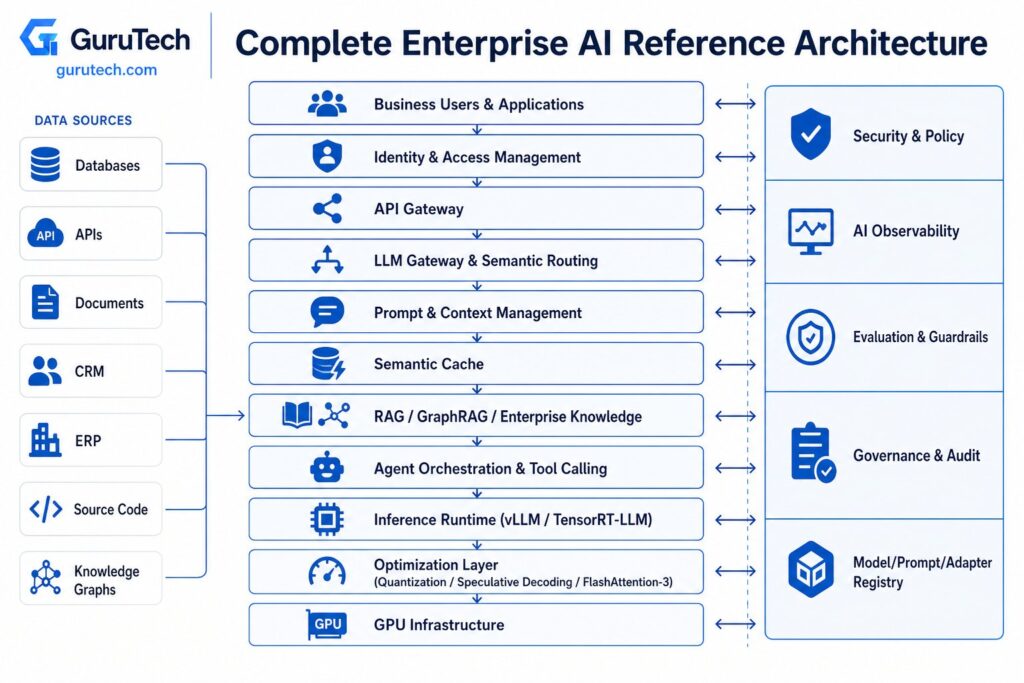
Layer 1: Business Applications and User Workflows
The top of the architecture contains the business applications that consume AI capabilities.
These may include customer-service assistants, legal review systems, engineering copilots, internal knowledge portals, finance automation, document-processing pipelines, security agents, or embedded AI features inside existing enterprise applications.
The business application owns the workflow.
It determines why AI is being used, how results are presented, when human review is required, and what constitutes task success. The platform below it should not absorb business-specific logic merely because AI is involved.
This separation keeps the shared AI platform reusable across departments while allowing applications to evolve independently.
Layer 2: Identity, Authentication, and Authorization
Every request should enter the platform with a known identity and authorization context.
That context must remain available downstream because access decisions may be required long after the initial application login. Retrieval systems may need to filter documents. Tool calls may require specific permissions. Model routing policies may restrict which providers can process sensitive workloads.
Identity is therefore not just an application concern. It becomes part of the AI request context.
Organizations should avoid architectures where user identity disappears at the edge and the AI platform operates internally using broad shared credentials.
That pattern destroys the ability to enforce least privilege across retrieval and tools.
Layer 3: API Gateway and Enterprise Service Boundary
The API gateway provides the conventional service boundary between applications and shared AI infrastructure.
It can enforce authentication, rate limits, request validation, network policy, and routing before traffic reaches AI-specific services.
This layer should remain conceptually distinct from the LLM gateway. The API gateway governs application traffic. The LLM gateway governs model access.
The distinction becomes useful in larger environments where many non-AI services and AI services coexist behind the same enterprise API architecture.
Layer 4: LLM Gateway and Semantic Routing
The LLM gateway orchestration layer separates application intent from model execution.
Applications request a capability. The gateway determines which approved model, provider, or private endpoint should satisfy that request.
Routing decisions can consider:
- model capability;
- data sensitivity;
- context length;
- latency objectives;
- current capacity;
- provider availability;
- cost;
- regional restrictions;
- and workload priority.
At higher levels of maturity, routing can become semantic rather than static. A coding request can be routed differently from a classification request. A low-complexity task can use a smaller model while a more demanding reasoning request is escalated to a stronger one.
The gateway therefore becomes one of the most important policy enforcement points in the architecture.
Layer 5: Prompt and Context Management
Once a model has been selected, the application request must be transformed into the context the model actually sees.
This layer manages system prompts, workflow instructions, user input, retrieved evidence, examples, tool schemas, and formatting requirements.
Because these components influence production behavior, they should be versioned and observable.
Prompt construction should also be conscious of context economics. Excessively large prompts increase token consumption, latency, and memory pressure. The objective is to provide sufficient context, not maximum context.
This layer often becomes the meeting point between application logic, retrieval, model policy, and evaluation.
Layer 6: Semantic Cache
The enterprise semantic cache can intercept requests before expensive retrieval and inference occur.
If a sufficiently similar and still-valid response already exists, the platform may reuse it according to authorization, freshness, and policy constraints.
This position in the stack is important because a successful cache hit can reduce load on several downstream components simultaneously.
It can avoid retrieval, reranking, prompt expansion, model routing, and inference.
The cache should therefore be treated as a cross-layer optimization rather than simply a response store.
Layer 7: Enterprise Knowledge and Retrieval
The knowledge layer supplies proprietary and current information that the model does not contain internally.
It may include conventional RAG, enterprise search, vector databases, metadata filtering, reranking, and graph-based retrieval.
When relationships among entities are central to the task, GraphRAG architecture can extend the retrieval layer beyond independent document chunks.
The knowledge layer should preserve:
- source lineage;
- document freshness;
- authorization metadata;
- sensitivity classification;
- source authority;
- and retrieval traceability.
These properties make enterprise retrieval substantially different from a simple vector-search demo.
Layer 8: Agent Orchestration and Tool Execution
Some workflows require more than a single model response.
An AI system may need to retrieve information, invoke a tool, inspect the result, generate another request, delegate a subtask, verify completion, and decide whether human escalation is necessary.
This is the role of orchestration.
The multi-agent orchestration architecture becomes relevant when a workflow benefits from separating responsibilities among coordinators, specialist agents, tools, memory systems, or evaluation stages.
Agent complexity should be introduced carefully. A multi-agent system adds additional model calls, latency, state management, failure modes, and observability requirements.
If one model plus deterministic tools can complete the workflow reliably, adding multiple autonomous agents may reduce rather than improve system quality.
Engineering Insight: Agent architecture should be justified by workflow decomposition, not by the availability of agent frameworks.
Layer 9: Inference Runtime
The inference runtime converts model requests into accelerator execution.
Hosted providers hide this layer. Private deployments expose it directly.
Production runtimes such as vLLM or TensorRT-LLM can manage scheduling, batching, KV-cache allocation, model loading, parallelism, and hardware execution.
The local LLM deployment infrastructure layer connects these runtimes to Kubernetes, GPU nodes, monitoring, model registries, autoscaling, and enterprise networking.
The runtime should be treated as a shared infrastructure service rather than embedded independently inside each application deployment.
Layer 10: Performance Optimization
Once model serving is operational, optimization techniques can target the specific bottlenecks exposed by production telemetry.
Model quantization can reduce memory pressure and improve deployment density. Speculative decoding can reduce token-generation latency under suitable acceptance conditions. FlashAttention-3 can improve attention execution on compatible accelerator architectures.
These optimizations should remain below the stable application interface.
An application should not need to change because the infrastructure team moved from BF16 to FP8, introduced AWQ, enabled speculative decoding, or replaced one attention kernel with another.
That separation is one of the primary benefits of the platform architecture.
Layer 11: GPU and Compute Infrastructure
At the bottom of the execution stack sits the physical compute required to run the models.
This layer includes accelerators, CPU hosts, system memory, storage, networking, cluster scheduling, and the physical topology connecting them.
GPU selection should consider more than model compatibility.
Important factors include:
- VRAM capacity;
- HBM bandwidth;
- supported precision formats;
- Tensor Core capabilities;
- inter-GPU connectivity;
- power and cooling constraints;
- model parallelism requirements;
- and workload concurrency.
A large model may technically fit on a given accelerator configuration but still provide poor economics if concurrency is low or model parallelism introduces significant communication overhead.
Infrastructure sizing should therefore be based on workload-level throughput, latency, and availability requirements rather than model size alone.
Cross-Cutting Layer: AI Observability
Observability spans the entire architecture.
The AI token observability architecture should connect application behavior to retrieval, routing, inference, and hardware telemetry.
A complete trace may include:
- request identity;
- application and department;
- selected model;
- gateway route;
- cache decision;
- retrieved sources;
- tool calls;
- input and output token counts;
- time to first token;
- generation throughput;
- evaluation result;
- queue latency;
- GPU utilization;
- and cost attribution.
That telemetry transforms optimization from guesswork into engineering.
Cross-Cutting Layer: Evaluation and Guardrails
Production evaluation determines whether infrastructure changes preserve or improve application behavior.
Guardrails provide additional runtime controls around inputs, outputs, tools, structured formats, and policy requirements.
Neither should be treated as a single service placed at the end of the request.
Input validation may occur before inference. Retrieval evaluation may occur after document selection. Tool validation occurs before execution. Output validation occurs after generation. Offline regression testing occurs outside the request path entirely.
Evaluation is therefore a distributed control capability.
Cross-Cutting Layer: Governance and Security
Governance and security influence every layer rather than forming a box at the bottom of the architecture.
Identity governs user access. Retrieval controls govern enterprise knowledge. Gateway policies govern model access. Tool policies govern actions. Infrastructure controls govern deployment locations. Evaluation governs behavioral acceptance. Logging preserves evidence.
The NIST AI Risk Management Framework provides a useful governance reference because it explicitly treats AI risk management as a lifecycle responsibility rather than a point-in-time certification exercise.
Security architecture should follow the same logic.
AI does not remove established requirements for encryption, secrets management, network segmentation, least privilege, audit logging, and secure software delivery. It adds new resources—models, prompts, embeddings, adapters, retrieval indexes, tool interfaces, and generated data—that must be incorporated into those controls.
Enterprise AI Architecture Dependency Matrix
The architecture becomes easier to understand when technologies are mapped according to what they depend on and what they enable.
| Component | Depends On | Enables |
|---|---|---|
| Workflow Automation | Business process definition, evaluation criteria | Repeatable AI-enabled tasks |
| Enterprise API Integration | Identity, service interfaces, authorization | Controlled access to enterprise operations |
| RAG | Document ingestion, embeddings, metadata | Grounded enterprise knowledge access |
| GraphRAG | Entity extraction, graph construction, retrieval | Relationship-aware knowledge reasoning |
| Semantic Cache | Embeddings, authorization, invalidation strategy | Reduced repeated retrieval and inference |
| LLM Gateway | Approved model endpoints, policies, telemetry | Routing, fallback, abstraction, cost control |
| Local LLM Serving | GPU infrastructure, inference runtime, model registry | Private and controlled inference |
| Quantization | Model evaluation, compatible runtime and hardware | Reduced VRAM consumption and improved density |
| FlashAttention-3 | Compatible models, runtimes, and accelerators | More efficient attention execution |
| Speculative Decoding | Target model, draft mechanism, runtime support | Lower generation latency |
| LoRA | Base model, curated training data, training pipeline | Parameter-efficient specialization |
| DPO | Preference data, evaluation, training pipeline | Behavioral alignment |
| Multi-Agent Orchestration | Model access, tools, state, observability | Multi-step autonomous workflows |
| AI Observability | Instrumentation across the stack | Optimization, diagnosis, cost attribution, governance evidence |
| Continuous Evaluation | Representative datasets, telemetry, metrics | Controlled improvement and regression detection |
Technology Decision Matrix
The most important architecture question is not whether a technology is useful. It is whether the production problem justifies the complexity it introduces.
| Technology | Use It When | Do Not Add It Just Because |
|---|---|---|
| GraphRAG | Relationships across entities materially affect answers | Your application already uses basic RAG |
| Semantic Cache | Workloads contain substantial semantic repetition | You want another caching layer |
| LLM Gateway | Multiple models, providers, policies, or routing rules exist | You have only one small application using one model |
| Local LLM | Privacy, specialization, sustained volume, or control justify operations | Self-hosting appears cheaper based only on token price |
| Quantization | VRAM or inference density is a measured constraint | Lower precision sounds more efficient |
| FlashAttention-3 | Attention execution is relevant to measured hardware performance | You are still bottlenecked by retrieval or queues |
| Speculative Decoding | Generation latency matters and acceptance rates support the technique | You want to enable every available runtime optimization |
| LoRA | Repeated domain or task behavior requires learned specialization | A prompt is inconvenient to maintain |
| DPO | High-quality preference data defines desired response behavior | You want a generally “better” model |
| Multi-Agent Systems | Workflow decomposition genuinely benefits from specialized autonomous roles | Agents are fashionable |
The Complete GuruTech Enterprise AI Infrastructure Map
The specialized architectures covered throughout GuruTech can now be placed inside one systems engineering map.
| Architecture Capability | Role in the Enterprise AI Platform | GuruTech Deep Dive |
|---|---|---|
| Human Oversight | Approval, escalation, and controlled automation | Human-in-the-Loop AI |
| Secure Data Access | Controlled database and enterprise data connectivity | Secure Database Connection |
| Enterprise Knowledge | Relationship-aware retrieval and grounding | GraphRAG Architecture for Enterprise AI |
| Request Reuse | Reduce redundant retrieval and inference | Enterprise Semantic Caching |
| Model Access Control | Routing, fallback, policy, and provider abstraction | LLM Gateway Orchestration |
| Private Model Serving | Enterprise-controlled inference infrastructure | Local LLM Deployment Infrastructure |
| Inference Memory Optimization | Reduce VRAM requirements and increase deployment density | Model Quantization Architectures |
| Attention Optimization | Hardware-aware transformer execution | FlashAttention-3 Hardware Acceleration |
| Generation Latency | Reduce sequential decoding cost | Speculative Decoding Architecture |
| Model Specialization | Parameter-efficient domain and task adaptation | LoRA Fine-Tuning Architectures |
| Preference Alignment | Align model behavior with enterprise preferences | DPO Fine-Tuning Architectures |
| Training Data Expansion | Generate and curate additional model-improvement data | Synthetic Data Curation Pipelines |
| Evaluation | Measure quality and prevent regressions | Evaluation Frameworks for GenAI Production |
| Observability | Trace model, token, latency, cost, and infrastructure behavior | AI Token Observability Dashboard |
| Agent Coordination | Coordinate specialized AI workers and tools | Multi-Agent Orchestration |
Architect’s Note: This table is the central linking structure of the pillar. Each deep-dive guide explains one subsystem. The blueprint explains why that subsystem exists and how it interacts with the rest of the platform.
A Practical Enterprise AI Adoption Roadmap
The complete architecture should not be deployed as one large infrastructure program. The safer approach is to introduce capabilities as production demand creates the requirement for them.
Stage 1: Establish the Foundation
- Identify measurable workflows.
- Establish acceptable-use and data policies.
- Create basic evaluation datasets.
- Define human approval requirements.
- Standardize prompt and application ownership.
Stage 2: Build Secure Enterprise Integration
- Connect approved enterprise APIs.
- Implement identity-aware retrieval.
- Establish secure database access patterns.
- Centralize document ingestion where useful.
- Instrument end-to-end traces.
Stage 3: Create Shared AI Platform Services
- Introduce an LLM gateway when model access becomes fragmented.
- Standardize retrieval services.
- Introduce semantic caching where repetition is measurable.
- Centralize token and model observability.
- Integrate evaluation into deployment workflows.
Stage 4: Operate Private Inference Where Justified
- Deploy local inference for workloads that justify it.
- Establish GPU capacity planning.
- Select high-throughput inference runtimes.
- Measure queue depth, tokens per second, latency, and utilization.
- Separate workload classes by service-level objective.
Stage 5: Optimize the Inference Platform
- Apply quantization where memory pressure is measured.
- Optimize batching and scheduling.
- Introduce speculative decoding for suitable latency-sensitive workloads.
- Use hardware-aware attention optimizations where justified.
- Correlate every optimization with quality evaluation.
Stage 6: Build the Continuous Improvement Loop
- Capture production failures.
- Expand evaluation datasets.
- Curate synthetic training data.
- Introduce LoRA specialization where appropriate.
- Use preference optimization for measurable alignment requirements.
- Deploy model and adapter changes through controlled releases.
Common Enterprise AI Architecture Mistakes
The reference architecture also makes several recurring failure patterns easier to identify.
- Starting with infrastructure instead of a business workflow.
- Allowing every application to integrate directly with model providers.
- Building separate vector databases for every department without a governance strategy.
- Allowing retrieval to bypass source-system authorization.
- Giving agents unrestricted database or tool access.
- Treating prompts as unmanaged text rather than production artifacts.
- Measuring uptime without measuring answer quality.
- Fine-tuning before fixing retrieval or workflow design.
- Deploying quantization without task-specific regression testing.
- Optimizing GPU kernels while application queues or retrieval remain the actual bottleneck.
- Assuming one model should serve every workload.
- Introducing multiple agents where one controlled workflow would be more reliable.
- Separating cost telemetry from application and department ownership.
- Failing to version model, prompt, retrieval, adapter, and routing configuration together.
- Treating governance as documentation rather than enforceable architecture.
The common theme is premature complexity without corresponding architectural control.
A strong enterprise AI platform does not contain the largest number of advanced technologies. It contains the smallest set of capabilities required to operate current workloads safely, efficiently, and with enough modularity to absorb future change.
Engineering Insight: Architecture maturity is not measured by how many AI technologies an organization deploys. It is measured by how clearly responsibilities are separated, how easily the system can be observed and changed, and how consistently business workloads can use shared capabilities without rebuilding them.
The reference architecture is now structurally complete. The remaining problem is operational: how to keep this platform reliable after models, prompts, adapters, traffic patterns, providers, and infrastructure begin changing continuously.
That leads to Part VII — Enterprise AI Platform Operations, where the blueprint moves into AI CI/CD, registries, canary releases, capacity planning, cost governance, incident response, reliability engineering, and long-term platform ownership.
Part VII — Enterprise AI Platform Operations
Deploying an enterprise AI platform is only the beginning of the engineering lifecycle.
Once the system enters production, nearly every layer begins changing independently. Models are upgraded. Prompts evolve. retrieval pipelines are modified. New adapters are trained. Routing policies change. traffic grows. providers introduce new endpoints. GPU capacity shifts. evaluation datasets expand. security requirements evolve.
The architecture therefore needs an operational model capable of absorbing continuous change without sacrificing reliability, traceability, or governance.
This is the role of AI platform operations.
Engineering Insight: A production AI platform is not a model deployment. It is a continuously changing distributed system whose behavior depends on models, prompts, data, retrieval, routing, tools, infrastructure, and policy.
AI CI/CD Extends Traditional Software Delivery
Traditional CI/CD pipelines typically validate source code, build artifacts, run automated tests, and promote a release through controlled environments.
Enterprise AI requires that lifecycle to expand beyond code.
A production change may involve a new model, a revised system prompt, a different retrieval configuration, a new embedding model, an updated LoRA adapter, a quantization change, a modified tool schema, or a new gateway routing policy.
Any of these can change system behavior without altering the application source code.
An AI delivery pipeline should therefore validate the complete behavioral configuration.
- Application code passes conventional tests.
- Prompt changes pass regression evaluation.
- Retrieval changes are tested for relevance and access control.
- New model versions are compared against established evaluation sets.
- Adapters are validated against their intended domain tasks.
- Quantization changes are checked for quality regression.
- Routing policies are tested for fallback and failure behavior.
- Tool definitions are validated before agents can invoke them.
The result is not a replacement for conventional CI/CD. It is an extension of it.
Version the Complete Behavioral Configuration
Reproducibility becomes difficult when only the model version is recorded.
Two requests processed by the same model can produce materially different results if they use different system prompts, retrieval indexes, LoRA adapters, temperature settings, tool definitions, or routing policies.
A mature platform should therefore treat the production configuration as a versioned bundle.
That bundle may include:
- foundation model;
- model provider or private endpoint;
- quantization format;
- LoRA adapter;
- prompt version;
- retrieval configuration;
- embedding model;
- reranker;
- tool schema;
- gateway policy;
- evaluation dataset version;
- and runtime configuration.
Without this level of traceability, debugging a quality regression can become extremely difficult because the team cannot reconstruct the exact system that produced the result.
Architect’s Note: In production AI, reproducibility means reproducing the behavior-producing configuration, not merely loading the same model weights.
Model, Prompt, and Adapter Registries
As the number of AI artifacts grows, registries become operational infrastructure.
A model registry records approved models and deployment metadata. A prompt registry tracks behavioral instructions. An adapter registry manages LoRA or other parameter-efficient specialization artifacts. A dataset registry can track evaluation and training data versions.
The purpose of these registries is not simply storage. They provide lineage.
The platform should be able to determine which data produced an adapter, which evaluation approved it, which model it is compatible with, where it was deployed, and which production requests used it.
This lineage becomes especially important when multiple departments maintain specialized AI behavior on top of shared infrastructure.
Canary Releases Reduce AI Deployment Risk
AI changes should not automatically reach the entire user population simply because they perform well offline.
Offline evaluation cannot perfectly represent production traffic. Real users introduce unusual phrasing, unexpected document combinations, rare tool sequences, and edge cases that may not appear in the test dataset.
Canary deployment limits exposure by routing a small percentage of production traffic to the new configuration while the previous version remains available.
The platform can then compare:
- task success;
- latency;
- token consumption;
- user feedback;
- tool-call success;
- retrieval quality;
- policy compliance;
- and operational error rates.
If the candidate performs poorly, traffic can be shifted back without requiring a full rollback event.
This approach is particularly useful for model changes because a candidate can be technically functional while still producing behavior that is subtly worse for the application.
Feature Flags Separate Deployment From Exposure
Feature flags provide another control mechanism by separating whether a capability is deployed from whether users can access it.
A new model can be present in the platform without becoming the default route. A new retrieval strategy can be enabled only for selected applications. A LoRA adapter can be activated for one department. A new agent tool can remain limited to a test group.
This capability becomes increasingly important as the architecture grows because changes are no longer confined to one application release.
Capacity Planning Becomes an AI-Specific Discipline
Traditional capacity planning often focuses on CPU, memory, storage, requests per second, and network throughput.
AI infrastructure adds another set of variables.
- model size;
- VRAM consumption;
- context length;
- KV-cache growth;
- batch size;
- tokens per second;
- time to first token;
- sequence concurrency;
- queue depth;
- and accelerator utilization.
A platform that supports 100 short classification requests may behave very differently when those requests become long-context generation workloads.
Request count alone is therefore an incomplete capacity metric.
Capacity planning should operate at the workload level and incorporate the token and context profile of actual production traffic.
The AI token observability architecture is particularly important here because token volume, queue behavior, model selection, and GPU telemetry provide the signals required to forecast capacity accurately.
Autoscaling AI Infrastructure Is More Complicated Than Scaling Web Servers
Conventional web applications can often add stateless replicas relatively quickly. Large-model inference may involve multi-gigabyte or multi-hundred-gigabyte model artifacts that must be loaded into accelerator memory before a new replica becomes useful.
Scaling therefore has startup cost.
A new GPU pod may require scheduling onto compatible hardware, downloading or mounting model weights, initializing the runtime, allocating memory, and warming the model before it can accept production traffic.
Autoscaling strategies should account for this delay rather than reacting only after a queue becomes saturated.
Organizations operating local LLM infrastructure may therefore use a combination of minimum warm capacity, predictive scaling, queue-based signals, and workload isolation instead of relying exclusively on reactive CPU-style autoscaling.
Platforms built on Kubernetes can use its scheduling and orchestration capabilities, but AI workloads still require GPU-aware resource management and model-specific capacity logic. The Kubernetes deployment model provides the underlying orchestration framework, while the AI platform adds model and accelerator semantics on top of it.
FinOps for AI Requires Cost Attribution
Enterprise AI introduces a cost model that is difficult to control when consumption is invisible to the teams creating it.
Hosted inference may be billed by tokens or request classes. Private inference may be paid through reserved GPU capacity, cloud accelerator hours, or owned infrastructure. Retrieval, vector databases, storage, observability, and data processing add additional costs.
A mature platform should be able to attribute those costs to applications, departments, workflows, and models.
Useful metrics include:
- cost per request;
- cost per successful task;
- cost per department;
- tokens per workflow;
- GPU-hours per workload;
- cache savings;
- model-routing savings;
- and cost avoided through quantization or improved utilization.
Cost per successful task is especially useful because the cheapest inference request is not necessarily the most economical solution. A smaller model that requires multiple retries or produces more failures may cost more operationally than a stronger model that completes the task correctly on the first attempt.
Engineering Insight: Optimize for business outcome per unit of compute, not simply the lowest token price.
Incident Response Must Include AI-Specific Failure Modes
Enterprise AI incidents are not limited to service outages.
A model can remain fully available while producing degraded or unsafe behavior.
Operational teams should therefore define incident categories that include:
- model provider outage;
- inference saturation;
- latency degradation;
- retrieval failure;
- stale or corrupted indexes;
- unexpected model-quality regression;
- tool execution failure;
- prompt or routing misconfiguration;
- unauthorized information exposure;
- unexpected cost spikes;
- adapter incompatibility;
- and evaluation failure after deployment.
The response mechanism depends on the failure.
A provider outage may trigger gateway fallback. A model regression may require traffic rollback. A retrieval incident may require disabling a data source. A problematic adapter may be removed from the routing policy. A tool failure may require temporarily disabling agent access to that capability.
The architecture should support these interventions without requiring a complete platform shutdown.
Observability Determines Mean Time to Resolution
AI incident response depends on being able to reconstruct the path a request followed.
A trace should answer questions such as:
- Which user and application initiated the request?
- Which model was selected?
- Which prompt version was used?
- Which documents were retrieved?
- Was the semantic cache involved?
- Which tools were called?
- Which adapter was loaded?
- What was the token usage?
- How long did each component take?
- What evaluation or guardrail result was produced?
The OpenTelemetry model of traces, metrics, and logs provides a useful distributed-systems foundation for this type of instrumentation, while AI-specific telemetry adds model and behavioral context.
Without end-to-end traces, teams often end up debugging individual components while the actual problem exists in the interaction between them.
Disaster Recovery Must Include Models and AI State
Disaster recovery planning should include more than application databases.
An enterprise AI platform may depend on model artifacts, adapters, prompt registries, vector indexes, graph stores, embedding configurations, tool definitions, evaluation datasets, and gateway policies.
The recovery plan should determine which of these assets can be reconstructed and which require protected backups.
For example, a vector index may be rebuildable from authoritative source documents, while a carefully curated preference dataset may not be easy to reconstruct. A LoRA adapter can potentially be retrained if the data and training configuration are preserved. A production prompt registry may require durable storage and version history.
Recovery priorities should reflect reconstruction cost and business impact rather than treating every AI artifact identically.
AI SRE Requires Quality SLOs in Addition to Availability SLOs
Site reliability engineering traditionally defines service-level indicators and objectives around availability, latency, throughput, and error rates.
Enterprise AI requires another class of objectives related to behavior.
A customer-support assistant may require a minimum grounded-answer rate. A structured extraction service may require a schema-validity target. An agent may require a minimum tool-execution success rate. A retrieval system may require a relevance threshold.
These quality objectives should exist alongside conventional infrastructure SLOs.
| SLO Category | Example Indicator |
|---|---|
| Availability | Successful inference requests |
| Latency | P95 time to first token |
| Throughput | Tokens per second |
| Retrieval Quality | Relevant evidence retrieved |
| Grounding | Responses supported by approved sources |
| Structured Output | Schema-valid responses |
| Agent Reliability | Successful tool and workflow completion |
| Cost Efficiency | Cost per successful task |
| Governance | Policy-compliant requests and outputs |
This broader definition of reliability reflects the reality that an AI service can remain online while failing its business purpose.
Platform Teams Need Clear Ownership Boundaries
Enterprise AI spans application engineering, data engineering, machine learning, infrastructure, security, governance, and business operations.
Without explicit ownership, failures can become organizational as well as technical.
A common operating model separates several responsibilities:
- Application teams own business workflow and user experience.
- AI platform teams own model access, shared retrieval, evaluation infrastructure, observability, and deployment services.
- ML or model teams own training, adapters, alignment, and model evaluation.
- Infrastructure teams own GPU clusters, networking, storage, and runtime reliability.
- Security teams own identity, policy, threat controls, and incident response requirements.
- Governance teams define risk categories, approval requirements, and audit expectations.
The boundaries can vary by organization, but ownership cannot remain ambiguous.
The platform succeeds when these groups interact through defined interfaces rather than relying on informal coordination for every deployment.
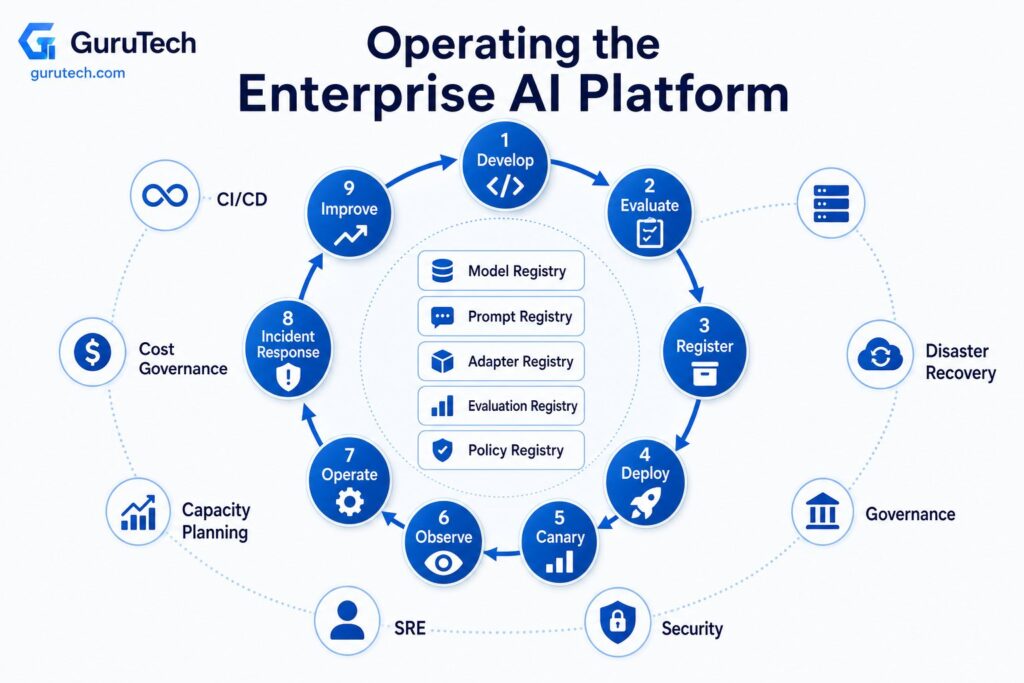
Enterprise AI Platform Operations Readiness Checklist
- AI behavioral artifacts are versioned alongside application code.
- Model, prompt, adapter, retrieval, and routing versions can be traced for every deployment.
- Offline evaluation is part of the release pipeline.
- Production changes can be introduced gradually through canary deployment or feature flags.
- Rollback procedures exist for model and configuration regressions.
- Capacity planning incorporates token and context characteristics, not just request count.
- GPU autoscaling accounts for model-loading and warm-up time.
- Inference costs can be attributed to applications and departments.
- Operational teams track cost per successful task, not only raw token cost.
- Incident response includes AI-quality and retrieval failures.
- End-to-end traces can reconstruct model, retrieval, tool, and routing behavior.
- Critical models, adapters, prompts, datasets, and indexes have a recovery strategy.
- Service-level objectives include both infrastructure reliability and AI quality.
- Application, platform, infrastructure, security, and governance ownership boundaries are explicit.
At this point, the complete enterprise AI platform has been defined from workflow selection through long-term operations.
The final sections can now answer the practical questions architects, engineering leaders, and platform teams encounter when applying the blueprint: which technologies should be introduced first, how the components interact in specific scenarios, and how to avoid unnecessary infrastructure complexity as the platform evolves.
Frequently Asked Questions
What is enterprise AI systems engineering?
Enterprise AI systems engineering is the discipline of designing, integrating, operating, and governing the complete infrastructure required to run AI applications in production. It extends beyond model selection to include identity, APIs, enterprise knowledge, retrieval, model routing, inference runtimes, GPU infrastructure, observability, evaluation, governance, and lifecycle management.
The goal is to treat AI as a reusable enterprise platform rather than as a collection of disconnected applications.
What is the difference between an AI application and an AI platform?
An AI application solves a specific business problem. An AI platform provides shared capabilities that multiple applications can reuse.
For example, a customer-support assistant is an application. Identity, model routing, retrieval, semantic caching, evaluation, observability, and inference infrastructure are platform capabilities.
The platform reduces duplicated infrastructure and allows applications to focus on workflow-specific business logic.
Does every enterprise need to build its own AI infrastructure?
No. Many organizations can rely heavily on managed model APIs and SaaS platforms, especially during early adoption.
Private infrastructure becomes more compelling when workloads require stronger data control, specialized open-source models, predictable capacity, lower marginal inference cost at sustained volume, or deeper control over performance and deployment.
A hybrid architecture is often the most practical model, combining hosted services with local LLM deployment infrastructure where specific workloads justify it.
When should an organization introduce an LLM gateway?
An LLM gateway becomes valuable when applications begin using multiple models, providers, private endpoints, fallback policies, quotas, or data-handling rules.
It can centralize routing, authentication, retries, rate limits, cost attribution, provider abstraction, and policy enforcement. The LLM gateway orchestration layer is especially useful when model selection becomes a platform decision rather than an application-level decision.
What is the difference between an API gateway and an LLM gateway?
An API gateway governs application and service traffic. An LLM gateway governs access to models and inference endpoints.
The API gateway typically handles authentication, request validation, rate limiting, and service routing. The LLM gateway adds model-specific functions such as provider selection, model fallback, token-aware policies, cost attribution, semantic routing, and abstraction across hosted and private model endpoints.
What is the role of RAG in enterprise AI architecture?
Retrieval-augmented generation supplies proprietary or current enterprise information to a model at request time.
Instead of attempting to place organizational knowledge inside model parameters, RAG retrieves relevant documents or records dynamically and adds them to the model context.
This allows enterprise knowledge to change independently from the model while preserving traceability and access control.
When should GraphRAG be used instead of basic RAG?
Basic RAG is usually sufficient when relevant information can be found in a small number of semantically similar passages.
GraphRAG becomes more useful when answers depend on relationships between entities distributed across multiple documents or systems.
Examples include supplier dependencies, organizational relationships, product-component mappings, legal entities, cybersecurity dependencies, or research networks.
What problem does semantic caching solve?
Semantic caching reduces repeated AI work when users ask equivalent questions using different wording.
Unlike exact-match caching, enterprise semantic caching uses meaning or similarity to determine whether a previous result can be reused.
It can reduce model calls, retrieval operations, token consumption, and latency, but it must preserve authorization and freshness rules.
Should enterprises fine-tune models or use RAG?
They solve different problems.
RAG is generally the better choice for information that changes over time, such as policies, documents, customer data, product information, or internal knowledge.
Fine-tuning is better suited to changing how the model performs a task, such as domain behavior, output structure, terminology, or response style.
A useful rule is: use retrieval to provide current knowledge and model adaptation to shape repeated behavior.
What is LoRA and why is it useful in enterprise environments?
LoRA is a parameter-efficient fine-tuning approach that allows organizations to specialize a model without retraining the full parameter set.
LoRA fine-tuning architectures are especially useful when several departments or workloads share the same base model but require different specialized behavior.
This enables a shared base model with lightweight adapters for Legal, Finance, Engineering, Support, or other domains.
What is DPO used for?
Direct Preference Optimization is used to align model behavior using examples of preferred and rejected responses.
DPO fine-tuning can help when an organization wants models to follow consistent preferences around style, policy, conservatism, structure, safety, or domain-specific response quality.
Why is synthetic data important for enterprise AI?
Production systems often do not have enough high-quality labeled data for training and evaluation.
Synthetic data curation pipelines can generate additional examples, but the data should be validated, deduplicated, scored, governed, and evaluated before use.
The strongest synthetic-data programs target specific coverage gaps exposed by evaluation or production telemetry rather than generating additional data indiscriminately.
What is the most important metric for an enterprise AI system?
There is no single universal metric.
Infrastructure teams may care about latency, GPU utilization, queue depth, tokens per second, and cost. Application teams may care about task completion, answer correctness, policy compliance, or user satisfaction.
A mature platform connects both views. The AI token observability architecture should therefore correlate infrastructure telemetry with workload-level outcomes.
Why is normal application monitoring not enough for AI?
An AI system can return HTTP 200 responses with excellent latency while still producing incorrect, poorly grounded, or policy-violating answers.
AI observability must therefore include model selection, token usage, retrieval behavior, cache activity, tool calls, time to first token, structured-output validity, evaluation scores, and workload-specific quality signals in addition to conventional logs, metrics, and traces.
How should enterprises evaluate generative AI systems?
Evaluation should be tied to the actual business task rather than relying only on general model benchmarks.
GenAI production evaluation may include answer correctness, grounding, retrieval relevance, citation quality, schema validity, tool-call success, hallucination rates, policy compliance, latency, and human review.
Offline evaluation should be combined with production telemetry because real usage will expose cases that controlled test datasets miss.
When should an enterprise use model quantization?
Quantization should be introduced when model memory footprint, deployment density, or inference throughput becomes a measured constraint.
Model quantization architectures such as INT8, FP8, GPTQ, or AWQ can reduce memory requirements, but the correct technique depends on model architecture, hardware, runtime compatibility, and quality requirements.
Every quantization change should be followed by task-specific evaluation.
What does FlashAttention-3 improve?
FlashAttention-3 improves the attention execution path by reducing unnecessary memory movement and better exploiting modern accelerator hardware.
It becomes relevant when an organization is already operating advanced GPU inference infrastructure and attention execution is part of the measured performance bottleneck.
What is speculative decoding and when should it be used?
Speculative decoding uses a faster draft mechanism to propose multiple tokens that are then verified by the target model.
It can reduce generation latency when the draft produces sufficiently accurate predictions. The technique should be evaluated using acceptance rate, inter-token latency, throughput, and end-to-end workload performance.
Should every enterprise use local LLMs?
No. Local inference introduces significant operational responsibilities including GPU scheduling, model placement, VRAM planning, scaling, availability, monitoring, and lifecycle management.
It is most appropriate when workloads justify the additional control through privacy, specialization, volume, latency, deployment restrictions, or economics.
For many environments, a hybrid combination of hosted APIs and private LLM infrastructure is more practical than an all-or-nothing strategy.
When should multi-agent orchestration be used?
Multi-agent orchestration is justified when a workflow benefits from decomposing work among specialized roles, tools, planning stages, or validation steps.
It should not be introduced simply because agent frameworks are available. Multiple agents increase model calls, latency, state management, failure modes, and observability requirements.
How should AI systems access enterprise databases securely?
Models and agents should generally avoid unrestricted database access.
A safer architecture uses least-privilege credentials, network isolation, secrets management, audited service interfaces, and deterministic authorization controls. Where practical, approved enterprise APIs should expose specific capabilities rather than allowing models to interact directly with raw database structures.
The secure database connection architecture provides a deeper pattern for implementing this boundary.
What role does human-in-the-loop play in enterprise AI?
Human review acts as a risk-control boundary when the consequence of an incorrect AI decision exceeds the value of full automation.
A human-in-the-loop AI architecture can be used for approval, escalation, exception handling, or expert validation.
Human corrections can also feed evaluation, preference data, synthetic-data generation, and future model improvement.
How should enterprises govern AI systems?
Governance should be implemented across the full AI lifecycle rather than treated as a final review step.
This includes data classification, identity, model access, retrieval permissions, tool authorization, evaluation, logging, human oversight, incident response, and auditability.
The NIST AI Risk Management Framework provides a useful external framework through its Govern, Map, Measure, and Manage functions.
How should AI infrastructure be scaled?
AI capacity should be planned by workload class rather than request count alone.
Important variables include model size, prompt length, context window, output length, KV-cache consumption, concurrent sequences, tokens per second, queue depth, and service-level objectives.
Interactive assistants, batch document processing, embeddings, long-context analysis, and agent workloads may require different infrastructure pools and scaling strategies.
What should an enterprise build first?
Start with the business workflow and evaluation criteria, not advanced infrastructure.
A practical sequence is:
- Identify a measurable business workflow.
- Define governance and human-review requirements.
- Establish evaluation.
- Connect the workflow securely to enterprise systems and knowledge.
- Standardize shared services as repetition appears.
- Introduce an LLM gateway when model access becomes fragmented.
- Deploy private inference only where justified.
- Optimize measured infrastructure bottlenecks.
- Introduce model adaptation only when prompts and retrieval are insufficient.
- Operate the complete system through continuous observability and evaluation.
Does an enterprise need every technology shown in this blueprint?
No.
The blueprint is a map of possible architectural capabilities, not a procurement checklist.
A small organization may use managed models, conventional RAG, and basic evaluation without ever operating a private GPU cluster. A large enterprise may require model gateways, multiple retrieval systems, semantic caching, specialized adapters, private inference, and advanced observability.
The correct architecture is the smallest architecture that reliably satisfies the current workload while preserving enough modularity for expected growth.
How do all the GuruTech AI infrastructure guides fit together?
Each GuruTech deep-dive guide represents one subsystem inside the larger enterprise AI platform.
GraphRAG covers relationship-aware enterprise knowledge. Semantic caching addresses repeated inference. LLM gateways control model access. Local LLM infrastructure provides private serving. Quantization, FlashAttention-3, and speculative decoding optimize inference. LoRA and DPO specialize and align models. Synthetic data expands improvement datasets. Evaluation controls behavioral change, while AI observability measures the complete system.
This pillar exists to show how those specialized technologies connect into one production architecture.
Implementing the Enterprise AI Systems Engineering Blueprint
Enterprise AI does not become scalable when an organization adopts more models. It becomes scalable when the infrastructure surrounding those models is designed as a coherent platform.
That platform begins with business workflows, not accelerators. It connects AI to enterprise systems through governed APIs and retrieval. It separates applications from model providers through routing and policy layers. It treats knowledge, prompts, adapters, evaluation data, and model configurations as managed production assets. It measures both infrastructure health and behavioral quality. It introduces optimization only when production telemetry proves that a real bottleneck exists.
The resulting architecture is not one product and it is not one deployment pattern. It is a collection of responsibilities that mature as AI adoption expands.
At the foundation, organizations identify high-value workflows, define evaluation criteria, establish governance, and determine where human oversight belongs. The integration layer then connects those workflows to databases, APIs, documents, and enterprise knowledge. Retrieval architectures such as GraphRAG can add relationship-aware knowledge when basic retrieval is insufficient, while semantic caching can reduce repeated inference where workloads contain significant semantic reuse.
As model consumption becomes more complex, the LLM gateway provides a stable control plane for routing, fallback, policy enforcement, and model abstraction. Workloads that justify greater control can move toward local LLM infrastructure, where inference runtimes, GPU capacity, batching, model placement, and memory management become platform concerns.
Only then do lower-level optimizations become strategically useful. Model quantization can reduce memory pressure and improve deployment density. FlashAttention-3 can improve hardware-aware attention execution. Speculative decoding can reduce generation latency for suitable workloads. Each solves a different problem, and none should be introduced without measurement.
Model behavior introduces another layer of engineering. LoRA can provide parameter-efficient specialization. DPO can align models toward enterprise preferences. Synthetic data curation can expand training and evaluation coverage. These techniques become most effective when they are connected to continuous evaluation rather than used as isolated training experiments.
Across every layer, AI observability provides the evidence required to understand what the system is actually doing. Without correlated telemetry, organizations cannot reliably distinguish a retrieval problem from a routing problem, a model problem from an infrastructure problem, or a cost problem from a quality problem.
Engineering Insight: The strongest enterprise AI architecture is not the one with the most advanced components. It is the one where every component exists because a measurable production requirement justifies it.
This principle should guide the entire platform lifecycle.
Do not introduce GraphRAG because knowledge graphs are powerful. Introduce it when relationships are preventing basic retrieval from answering important questions. Do not deploy a private GPU cluster because self-hosted AI appears sophisticated. Deploy it when privacy, specialization, sustained volume, latency, or economics justify the operational burden. Do not quantize a model simply because lower precision is available. Quantize it when memory or throughput is constraining the workload. Do not add multiple agents because autonomous systems are fashionable. Add orchestration when workflow decomposition clearly improves reliability or capability.
This is what transforms AI adoption into systems engineering.
Use the Blueprint as an Architecture Map
Organizations can use this blueprint in two directions.
The first is top-down. Begin with a business workflow and move downward through the architecture, adding only the capabilities required to make that workflow secure, observable, reliable, and scalable.
The second is bottom-up. When an existing AI system experiences a production problem, locate that problem in the architecture. High inference cost may point toward routing, caching, quantization, or utilization. Weak grounding may point toward retrieval. Inconsistent domain behavior may point toward prompts or model adaptation. Poor auditability may point toward observability, identity propagation, or governance controls.
The architecture map makes these dependencies visible.
Build for Change, Not for the Current Model Generation
The models, runtimes, accelerators, and frameworks used today will change.
What will remain are the underlying enterprise requirements: secure access to knowledge, controlled execution, predictable performance, measurable quality, cost efficiency, governance, observability, and the ability to improve without destabilizing production.
Architectures that isolate those responsibilities behind stable platform boundaries will be far easier to evolve than systems tightly coupled to individual models or vendors.
The objective is therefore not to predict which AI technology will dominate the next generation. It is to build an enterprise platform capable of absorbing that generation when it arrives.
Final Principle: Models will change. Infrastructure will change. Enterprise knowledge and business workflows will evolve. The architecture should make those changes independent wherever possible.
The GuruTech AI infrastructure guides linked throughout this blueprint explore each subsystem in greater technical depth. Use this pillar as the architectural map, then follow the relevant deep dives as your own platform reaches each stage of maturity.
Graph Memory Scaling: While choosing between low-level graph precision and high-level abstractions dictates your initial framework setup, managing runtime execution variables requires an underlying memory persistence layer. See our technical implementation sheet on deploying stateful agentic ai systems to learn how to preserve data schemas across long-running cyclic graph loops.