
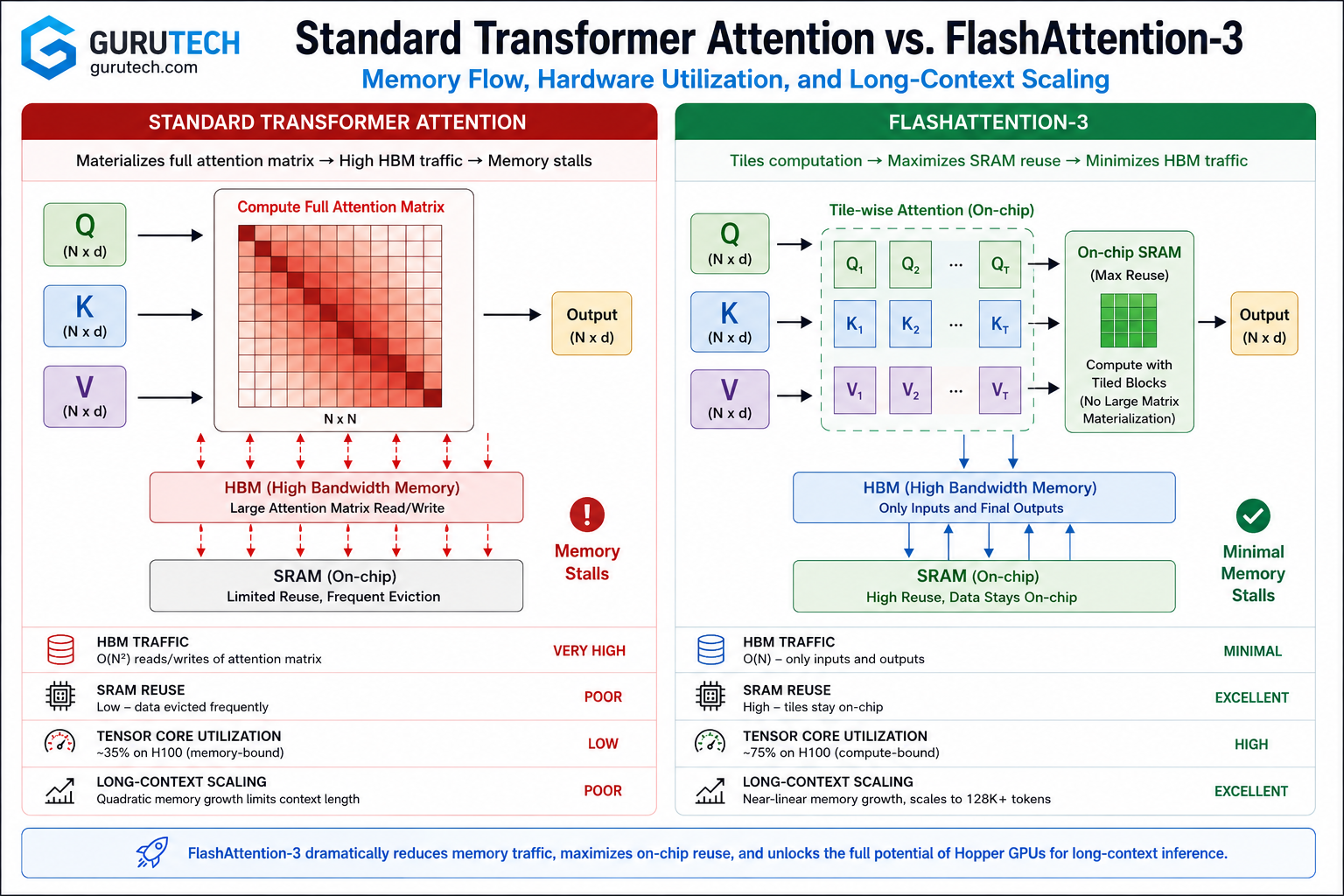
Transformer attention has shifted from a compute-bound operation to a memory bandwidth-limited bottleneck, particularly in long-context inference where repeated HBM accesses dominate execution time.
On H100 GPUs, standard attention implementations achieve only 35% utilization because they write intermediate attention matrices to high-bandwidth memory rather than keeping data in SRAM.
FlashAttention 3 hardware acceleration addresses this constraint by exploiting Hopper-specific hardware features—WGMMA, TMA, and asynchronous Tensor Core execution—to overlap matrix multiplication with softmax operations and reduce memory traffic by up to 8x.
The architecture leverages warp-specialization to pipeline data movement and computation, achieving 740 TFLOPS in FP16 and nearly 1.2 PFLOPS with FP8 precision.
This represents a 1.5-2.0x speedup over FlashAttention-2 and pushes H100 utilization to 75% of theoretical peak.
For enterprise inference stacks running vLLM or TensorRT-LLM, this translates directly to reduced latency and higher throughput for production workloads exceeding 128K token contexts.
Understanding FlashAttention-3’s execution pipeline requires examining how it maps attention operations to GPU memory hierarchy, schedules inter-warpgroup overlap, and integrates with production serving frameworks.
Engineers deploying long-context models must consider kernel compatibility, monitoring requirements, and common integration pitfalls that can negate performance gains.
Key Takeaways
- FlashAttention-3 exploits Hopper GPU asynchrony to overlap computation and memory movement, achieving 75% H100 utilization
- The kernel reduces attention memory bottlenecks through tiled execution that keeps intermediate matrices in SRAM instead of HBM
- Enterprise integration requires careful consideration of GPU compatibility, inference framework support, and production monitoring patterns
Evaluating FlashAttention-3 for Enterprise Workloads
FlashAttention-3 delivers measurable infrastructure improvements for production deployments running on H100 and newer Hopper-based systems, particularly when serving long-context models at scale.
Organizations need specific criteria to determine whether migrating from FlashAttention-2 or standard attention implementations justifies the engineering effort and hardware investment.
Enterprise Inference Clusters
Production inference clusters benefit from FlashAttention-3’s improved H100 utilization, moving from 35% to 75% on FP16 workloads.
This translates to higher throughput per GPU, reducing the number of H100 instances required for a given request volume.
Clusters running vLLM or TensorRT-LLM can integrate FlashAttention-3 with minimal code changes.
The asynchronous Tensor Core execution and TMA reduce memory bottlenecks that typically constrain multi-tenant serving.
Warp-specialization allows producer warps to prefetch KV cache blocks while consumer warps execute WGMMA instructions, hiding latency across batch dimensions.
For enterprises operating 50+ GPU clusters, the 1.5-2.0x forward pass speedup directly impacts operating costs and SLA compliance.
Long-Context LLM Serving
Models processing sequences beyond 8K tokens see the most substantial gains from FlashAttention-3’s optimized memory access patterns.
The algorithm’s block-wise softmax interleaving with asynchronous GEMM operations reduces HBM traffic proportionally to sequence length squared.
Serving 32K context windows becomes practical on single H100 GPUs where FlashAttention-2 required multi-GPU splits.
Applications like conversational AI with extended chat history or document QA systems gain immediate benefits.
The reduction in memory reads/writes means lower tail latencies for P99 serving times.
Organizations running Llama 3 or similar architectures at 70B+ parameters can maintain acceptable inference costs while supporting longer contexts that previously required prohibitively expensive infrastructure.
Agentic AI Systems
Agent frameworks that maintain extended reasoning chains generate substantial KV cache pressure across multi-turn interactions.
FlashAttention-3’s improved throughput allows agents to process longer action histories without degrading response times.
The FP8 Tensor Core support, reaching close to 1.2 PFLOPs/s, enables faster planning cycles for complex decision-making tasks.
Agents performing code generation across large codebases or analyzing multiple document dependencies benefit from the reduced attention bottleneck.
Each agent step typically involves attending over accumulated context from prior steps.
The hardware-accelerated low-precision GEMM operations maintain accuracy through block quantization while doubling throughput, keeping multi-step reasoning within acceptable latency budgets for production deployment.
RAG Platforms
Retrieval-augmented generation systems that inject large document chunks into context windows experience direct infrastructure cost reductions.
The attention mechanism processes both the retrieved passages and the user query simultaneously, creating memory bandwidth pressure that FlashAttention-3’s TMA asynchrony addresses.
RAG pipelines serving legal contracts or technical documentation can increase chunk sizes without proportional latency increases.
Production RAG systems often batch multiple user queries with different retrieved contexts.
FlashAttention-3’s improved occupancy and work distribution across SMs means better GPU utilization during these heterogeneous batch operations.
Organizations can reduce the number of inference endpoints while maintaining throughput targets, simplifying deployment architecture.
Legal Document Analysis
Legal workloads require processing entire contracts, case histories, or regulatory documents that frequently exceed standard context limits.
FlashAttention-3 enables single-pass analysis of 50-100 page documents without chunking strategies that risk losing cross-reference context.
The FP16 implementation maintains numerical precision critical for compliance applications where attention weight accuracy affects output reliability.
E-discovery platforms analyzing thousands of documents benefit from batch processing improvements.
The warp-specialized software pipelining overlaps document loading with attention computation, reducing idle time between documents.
Law firms can process discovery requests faster, directly impacting billable efficiency and client delivery timelines.
Healthcare Record Processing
Medical record analysis spanning patient histories, lab results, and clinical notes generates context windows that strain standard attention implementations.
FlashAttention-3’s memory efficiency allows models to attend over complete patient timelines without selective summarization that might omit critical medical history.
HIPAA-compliant on-premise deployments benefit from reduced hardware footprints.
Clinical decision support systems require low-latency inference to remain useful during patient encounters.
The backward pass improvements of 1.5-1.75x matter less here than forward pass speed, but the overall throughput gains mean physicians receive recommendations within acceptable wait times.
Healthcare organizations operating their own GPU infrastructure see better ROI per H100 deployed.
Financial Compliance Workloads
Financial institutions analyzing transaction histories, regulatory filings, or market research reports process documents with complex table structures and cross-references.
FlashAttention-3’s ability to maintain attention accuracy across long sequences ensures the model captures relationships between financial events separated by thousands of tokens.
The FP8 implementation with incoherent processing maintains the numerical stability required for audit trails.
Risk assessment models attending over complete trading histories or loan application documents benefit from single-context processing.
Compliance workflows that previously required multi-stage summarization can operate end-to-end, reducing error propagation.
Banks can demonstrate to auditors that model decisions consider complete context rather than truncated summaries.
Models Exceeding 32K Context Windows
Organizations training or serving models with 64K, 128K, or larger context windows find FlashAttention-3 essential for practical deployment.
The quadratic memory complexity of standard attention becomes prohibitive at these scales, while FlashAttention-3’s tiling strategy keeps intermediate results in SRAM.
Models like Claude or GPT-4 class systems require this level of optimization for economically viable serving.
The block-wise matmul and softmax interleaving becomes critical as sequence length grows.
At 128K tokens, the ability to hide softmax computation latency under asynchronous WGMMA execution directly determines whether inference completes in seconds versus minutes.
Research teams developing next-generation long-context architectures should baseline against FlashAttention-3 performance characteristics.
GPU Infrastructure Requirements
FlashAttention-3 requires Hopper architecture GPUs (H
Root Causes of Memory Bottlenecks in Standard Transformer Attention
Standard transformer attention implementations materialize intermediate matrices to HBM, creating a memory bandwidth problem that dwarfs the actual computational work.
The quadratic scaling of attention scores combined with inefficient data movement patterns leaves Tensor Cores idle while waiting for operands, achieving utilization rates below 40% on modern GPUs.
Quadratic Attention Complexity
The attention mechanism computes $S = QK^T$ where both $Q$ and $K$ have shape $(N, d)$, producing an $(N, N)$ attention score matrix.
This quadratic relationship means a sequence of 8,192 tokens with head dimension 128 generates a 512MB attention matrix in FP16 precision per head.
Memory requirements scale as $O(N^2 \cdot b \cdot h)$ where $b$ represents batch size and $h$ denotes the number of attention heads.
At 32K context length with 32 heads and batch size 16, the attention scores alone consume 512GB before applying softmax or computing the output.
The quadratic term dominates long context length scaling scenarios.
Doubling sequence length quadruples memory consumption, forcing reduced batch sizes that underutilize GPU compute capacity.
Intermediate Attention Matrix Storage
Standard attention writes the $S = QK^T$ matrix to HBM before applying row-wise softmax, then writes the normalized $P = \text{softmax}(S)$ matrix back to HBM before computing $O = PV$.
Each intermediate materialization incurs full memory bandwidth costs.
For a single attention operation, this creates three distinct HBM write operations: the raw scores $S$, the post-softmax probabilities $P$, and the final output $O$.
The backward pass adds six more HBM accesses for gradients with respect to $Q$, $K$, $V$, and the intermediate activations.
These intermediate matrices exist solely for computational dependencies between kernel launches.
The GPU repeatedly writes data that gets immediately consumed by the next kernel, wasting HBM bandwidth on temporary storage rather than productive compute work.
HBM Bandwidth Limitations
H100 GPUs provide 3.35 TB/s HBM3 bandwidth while Tensor Cores deliver 989 TFLOPS in FP16.
The arithmetic intensity of attention (FLOPS per byte loaded) falls well below the ratio needed to saturate compute units.
| Operation | HBM Reads | HBM Writes | Arithmetic Intensity |
|---|---|---|---|
| $QK^T$ | $2Nd$ | $N^2$ | $O(d/N)$ |
| softmax$(S)$ | $N^2$ | $N^2$ | $O(1)$ |
| $PV$ | $N^2 + Nd$ | $Nd$ | $O(d/N)$ |
Computing attention on a 4K sequence with head dimension 128 performs roughly 134 MFLOPS while moving 67 MB through HBM.
This 2 FLOPS/byte ratio leaves Tensor Cores starved, as they require 295 FLOPS/byte to achieve peak utilization at 3.35 TB/s bandwidth.
The memory wall becomes the dominant performance constraint, not floating-point throughput.
Cache Misses
L2 cache on H100 spans 50 MB across all SMs, insufficient for attention matrices exceeding a few thousand tokens.
When computing $S = QK^T$ followed by $P = \text{softmax}(S)$, the scores matrix exceeds L2 capacity and evicts to HBM between kernel launches.
Sequential kernel execution prevents temporal locality exploitation.
The standard implementation launches separate CUDA kernels for matrix multiplication, softmax, and the output projection.
Each kernel fetch triggers L2 misses, forcing full HBM round trips.
Spatial locality suffers from strided access patterns.
Computing softmax row-wise while $S$ is stored column-major (or vice versa) creates non-coalesced memory transactions that waste bandwidth and increase latency.
Memory Stalls
GPU warps stall when dependent instructions wait for memory operands.
Standard attention’s separate kernel launches create pipeline bubbles where Tensor Cores sit idle waiting for HBM transfers to complete.
Between the $QK^T$ GEMM and softmax normalization, all 132 SMs on H100 halt while waiting for the attention scores to flush to HBM and reload for the next kernel.
This synchronization point serializes operations that could theoretically overlap.
CUDA core utilization drops to single-digit percentages during memory-bound phases.
Profiling reveals warps spend 70-80% of execution time in memory wait states rather than active computation, indicating severe underutilization of available hardware resources.
Underutilized Tensor Cores
FlashAttention-2 achieves only 35% utilization on H100 GPUs compared to 80-90% for optimized GEMM kernels.
The gap stems from memory bottlenecks preventing full Tensor Core engagement rather than insufficient parallelism.
Tensor Cores execute matrix operations at 989 TFLOPS theoretical peak in FP16, but attention’s memory access patterns cannot feed operands fast enough.
The hardware sits idle waiting for data movement while the actual multiply-accumulate units remain undersubscribed.
Softmax operations use CUDA cores for exponential and division, bypassing Tensor Cores entirely.
This forces context switches between specialized units and general-purpose cores, fragmenting execution and preventing sustained utilization of either resource type.
Kernel Launch Overhead
Standard attention launches four separate CUDA kernels per layer: $QK^T$ multiplication, softmax computation, dropout application, and $PV$ multiplication.
Each kernel launch incurs 5-10 microseconds of overhead for scheduling, argument passing, and synchronization barriers.
In a 32-layer transformer processing 2K token sequences, kernel launch overhead accumulates to 640-1,280 microseconds per forward pass.
This represents 15-30% of total latency for small batch sizes where actual compute time measures only 4-5 milliseconds.
Architectural Progression: From FlashAttention-1 to FlashAttention-3
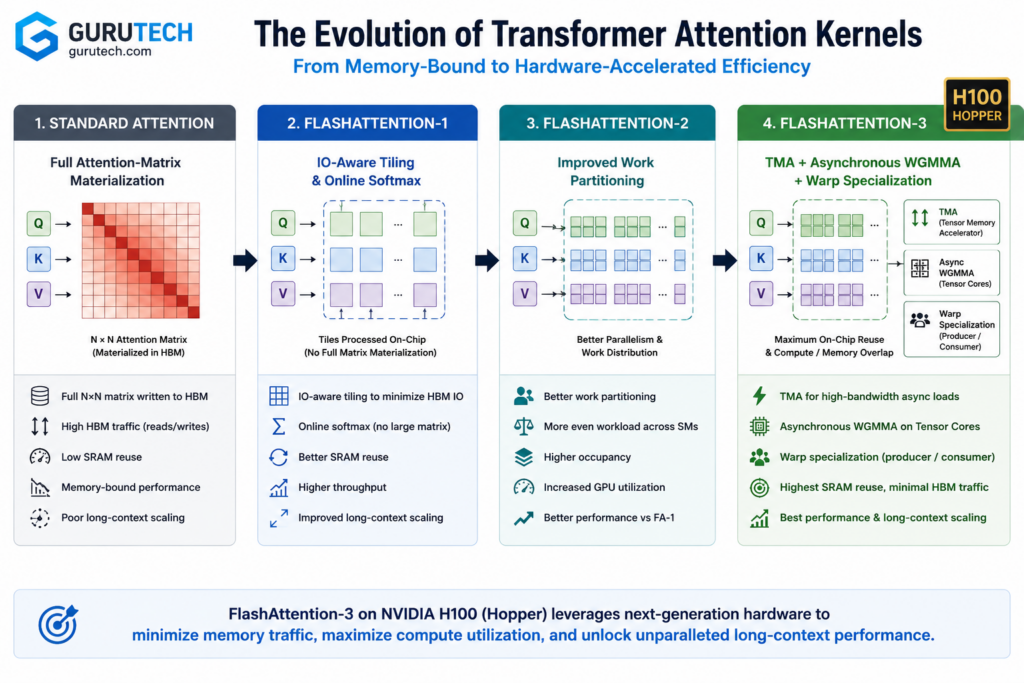
The FlashAttention series evolved through three major architectural iterations, each exploiting deeper hardware primitives on NVIDIA GPUs.
FlashAttention-1 introduced IO-aware attention through block tiling and online softmax.
FlashAttention-2 optimized parallelism and work distribution.
FlashAttention-3 leveraged Hopper’s asynchronous execution model with TMA and warp-group matrix operations.
FlashAttention-1
FlashAttention-1 addressed the memory bandwidth bottleneck in standard attention implementations by keeping intermediate attention matrices in SRAM rather than writing them to HBM.
The original attention mechanism required O(N²) memory for sequence length N, forcing constant traffic between HBM and compute units.
The implementation restructured the attention computation to avoid materializing the full attention matrix in slow HBM memory.
Instead of computing the entire QK^T matrix before applying softmax, FlashAttention-1 computed attention in blocks that fit within GPU SRAM.
This approach reduced HBM accesses from O(N²) to O(N²/M) where M represents SRAM capacity.
On A100 GPUs, this translated to 2-4x speedups for standard attention operations without approximation.
Online Softmax
The online softmax algorithm enabled FlashAttention-1 to compute softmax statistics incrementally without storing the complete attention matrix.
Traditional softmax requires two passes: one to compute the maximum value for numerical stability, another to compute exponentials and normalization.
Online softmax maintains running statistics (maximum value and sum of exponentials) that get updated as each block is processed.
When processing a new block, the algorithm rescales previous statistics based on the updated maximum value.
This decomposition allows the softmax operation to proceed block-by-block in SRAM.
The rescaling operation adds minimal overhead while eliminating the need to materialize full row statistics in HBM.
Block Tiling
Block tiling partitioned the Q, K, and V matrices into blocks sized to fit within SRAM constraints.
On A100 GPUs with approximately 20MB of SRAM per SM, FlashAttention-1 used blocks of 128×128 elements for balanced memory and compute utilization.
The outer loop iterated over query blocks while the inner loop processed key-value blocks.
Each iteration computed attention scores for one QK^T block, applied online softmax, and accumulated the weighted values.
Block dimensions required careful tuning based on sequence length, head dimension, and SRAM capacity.
Larger blocks improved arithmetic intensity but risked SRAM overflow, while smaller blocks increased loop overhead and reduced Tensor Core utilization.
Streaming Computation
Streaming computation in FlashAttention-1 processed attention sequentially through blocks without storing intermediate results to HBM.
The algorithm loaded each Q block once, then streamed through all K and V blocks to compute the output.
This streaming pattern maximized data reuse from SRAM.
Each Q block remained in fast memory while K and V blocks cycled through, accumulating attention outputs incrementally.
The backward pass required recomputation of attention matrices from stored Q, K, V tensors rather than caching the full attention matrix.
This recomputation proved cheaper than HBM bandwidth costs, trading compute for memory access.
FlashAttention-2 Improvements
FlashAttention-2 refined the parallelism strategy and reduced non-matmul operations that limited Tensor Core utilization.
While FlashAttention-1 focused on IO efficiency, version 2 targeted better work distribution across SMs and warps.
The implementation reduced shared memory usage and optimized warp-level scheduling.
On A100 GPUs, FlashAttention-2 achieved approximately 230 TFLOPs/s compared to FlashAttention-1’s 180 TFLOPs/s for FP16 operations.
Kernel modifications included better loop unrolling, reduced register pressure, and improved occupancy.
These changes increased Tensor Core utilization from roughly 30% to 50% on A100 hardware.
Better Parallel Scheduling
FlashAttention-2 changed the parallelization scheme to split work across the sequence length dimension rather than batch and head dimensions exclusively.
This approach improved load balancing when processing sequences with varying lengths in the same batch.
The outer loop parallelized over sequence blocks, assigning different blocks to different thread blocks.
Within each thread block, warps cooperatively processed attention computation for their assigned sequence segment.
This work decomposition reduced idle time when batch size or number of heads didn’t fully saturate GPU resources.
Smaller models with fewer attention heads particularly benefited from sequence-level parallelism.
Work Partitioning
Work partitioning in FlashAttention-2 split attention computation along the sequence dimension for both forward and backward passes.
Each thread block became responsible for computing output for a contiguous sequence segment.
The backward pass required careful synchronization when multiple thread blocks contributed gradients to the same Q, K, or V elements.
FlashAttention-2 used atomic operations sparingly, instead structuring the computation to minimize write conflicts.
Partitioning granularity balanced parallelism against synchronization overhead.
Blocks of 64-128 sequence elements provided sufficient work per thread block while limiting atomic contention during gradient accumulation.
FlashAttention-3
FlashAttention-3 achieves up to 75% GPU utilization on H100 GPUs by exploiting Hopper architecture features unavailable in Ampere-based implementations.
While FlashAttention-2 reached only 35% utilization on H100, version 3 delivers 740 TFLOPs/s in FP16 and approaches 1.2 PFLOPs/s with FP8.
The implementation uses warp-specialization to overlap computation and data movement asynchronously.
Different warp groups handle matrix multiplication and memory operations concurrently rather than sequentially.
FlashAttention-3 employs three main techniques: asynchronous overlap through warp-specialization, interleaved block-wise operations, and FP8 quantization with incoherent processing.
These optimizations target Hopper’s async execution pipelines and fourth-generation.
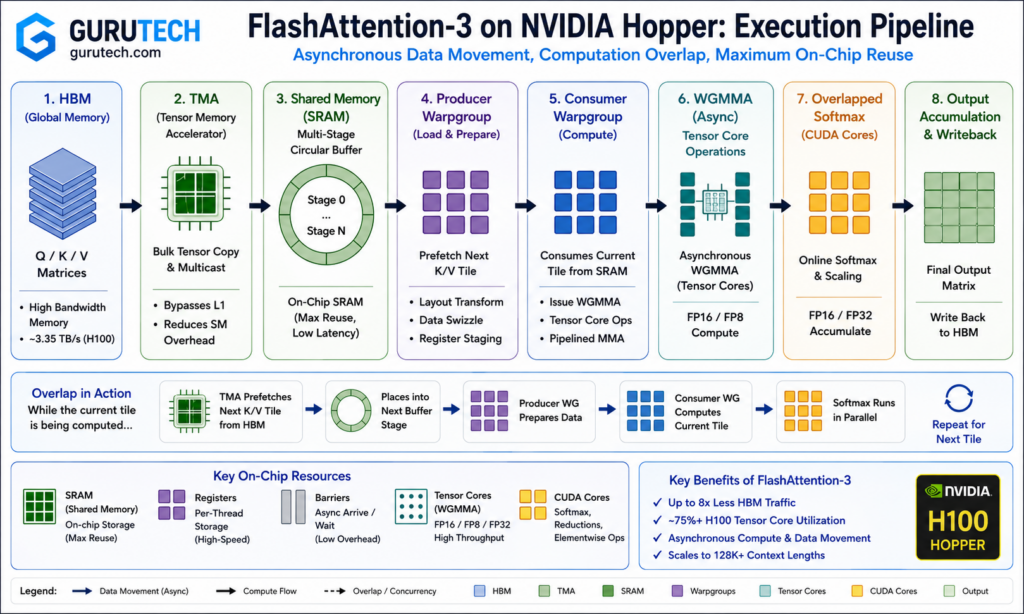
FlashAttention-3 Internal Hardware Execution Pipeline
FlashAttention-3 restructures attention computation around Hopper’s specialized hardware units, separating producer and consumer warps to enable concurrent TMA transfers, WGMMA operations, and softmax calculations.
The implementation exploits per-warpgroup register allocation and k-major tensor layouts to sustain over 740 TFLOPs/s on H100 GPUs.
Tile Scheduler
The tile scheduler divides attention matrices into blocks that fit within shared memory constraints while maximizing Tensor Core occupancy.
Each block processes query, key, and value tiles sized according to head dimensions and sequence length parameters.
Block dimensions typically use 128×128 or 64×256 configurations depending on the head dimension.
The scheduler assigns tiles to threadblocks in a way that minimizes HBM traffic by reusing key and value blocks across multiple query blocks.
For causal masking, the scheduler only processes valid upper-triangular tiles to avoid wasted computation.
The implementation uses a two-level tiling strategy where outer tiles map to CTAs and inner tiles correspond to WGMMA instruction operand sizes.
This hierarchy ensures that data loaded into shared memory serves multiple matrix operations before eviction.
Shared Memory
Shared memory serves as the staging area for all matrix operands before Tensor Core consumption.
The H100 provides 228 KB of SMEM per SM with 128 bytes per clock cycle bandwidth, substantially higher than HBM bandwidth.
FlashAttention-3 organizes SMEM as a circular buffer that holds multiple stages of query, key, and value tiles simultaneously.
This multi-buffering enables TMA to prefetch the next tile while WGMMA consumes the current one.
The buffer depth typically ranges from 2 to 4 stages depending on available SMEM capacity.
Bank conflicts are avoided through careful layout planning.
FP8 operands require k-major layout for WGMMA compatibility, which influences how tiles are stored and accessed.
The implementation pads matrices when necessary to maintain alignment and prevent structural bank conflicts during parallel access patterns.
Registers
Register allocation differs between producer and consumer warpgroups through Hopper’s setmaxnreg instruction.
Consumer warps performing WGMMA operations receive larger register allocations to hold FP32 accumulator tiles, while producer warps issuing TMA require minimal register space.
Each thread can access up to 256 registers from the 64 KB register file per SM.
FlashAttention-3 allocates roughly 240 registers per thread for consumer warps handling matrix accumulation.
Producer warps typically use only 40-80 registers since TMA operations are single-threaded within a warp.
The FP32 accumulator layout for a 64×64 tile distributed across a warpgroup consumes approximately 128 registers per thread.
This high register pressure makes dynamic reallocation critical for achieving concurrent producer-consumer execution without spilling to local memory.
Tensor Memory Accelerator
TMA handles all global memory to shared memory transfers asynchronously without occupying CUDA cores.
A single thread issues a TMA descriptor that specifies source addresses, destination SMEM locations, tile dimensions, and strides for multi-dimensional tensors.
The hardware unit performs coalesced 128-byte transactions and automatically handles out-of-bounds checking for tile boundaries.
TMA supports both im2col-style transformations and simple block copies, though FlashAttention-3 primarily uses the latter for contiguous attention matrix blocks.
Producer warps issue TMA loads for query, key, and value tiles while consumer warps execute WGMMA instructions.
The TMA unit operates independently from the SM’s warp scheduler, enabling true hardware-level parallelism.
Synchronization occurs through asynchronous barriers that track TMA completion before allowing consumer warps to read the data.
WGMMA
The warpgroup-wide matrix multiply-accumulate instruction operates across 128 threads (4 warps) to compute a 64x64x16 matrix multiplication in a single instruction.
WGMMA sources operands directly from shared memory rather than registers, fundamentally changing data movement patterns compared to Ampere’s MMA.
FP16 WGMMA accepts both row-major and column-major operands, but FP8 WGMMA only supports k-major layout for both A and B matrices.
This restriction requires careful planning when chaining dependent matrix operations in attention’s Q×K^T and S×V multiplications.
The instruction completes asynchronously, writing results to designated FP32 accumulator registers.
A warpgroup can issue a new WGMMA before the previous one finishes, creating an instruction pipeline.
FlashAttention-3 maintains 2-3 outstanding WGMMA operations per warpgroup to saturate the Tensor Core throughput.
Tensor Core Pipeline Scheduling
The implementation interleaves WGMMA operations with softmax computations to hide latency.
While one WGMMA calculates attention scores for block N, the scheduler executes exponential and reduction operations for block N-1 on regular CUDA cores.
Pipeline stages are carefully ordered to respect data dependencies.
Score matrix blocks must complete before softmax normalization, which must finish before the attention-weighted value multiplication.
The 2-stage pipeline overlaps these operations across different blocks rather than within a single block.
Pipeline stages per iteration:
| Stage | Consumer Warp Activity | Producer Warp Activity |
|---|---|---|
| 1 | WGMMA on Q×K^T block N | TMA load K, V block N+1 |
| 2 | Softmax on scores block N-1 | Barrier wait for TMA |
| 3 | WGMMA on S×V block N-1 | TMA load Q block N+2 |
FP8 Execution
FP8 Tensor Cores deliver twice the throughput of FP16, reaching [close to 1.2 PFLOPs/s on H100](https://arxiv.org/html/2407.08).
GPU Memory Hierarchy and Operational Implications
Modern GPU architectures organize memory into distinct tiers with dramatically different access characteristics.
FlashAttention-3 exploits these layers to minimize the memory bottleneck inherent in attention computation.
The Hopper architecture introduces new hardware capabilities that enable more aggressive utilization of fast memory tiers through asynchronous execution models.
Registers
Registers represent the fastest memory tier in GPU architecture, providing single-cycle access latency for data stored within each thread’s execution context.
Each CUDA thread receives a limited allocation of 32-bit registers, typically 255 per thread on Hopper GPUs.
Register allocation directly impacts occupancy, as excessive register usage reduces the number of concurrent thread blocks that can execute on a streaming multiprocessor.
FlashAttention-3 kernels carefully balance register pressure against parallelism requirements, using compiler directives to manage allocation.
The attention operation’s intermediate values—query-key products, softmax intermediates, and accumulator buffers—compete for register space.
Efficient kernels minimize register spilling to local memory by restructuring computation to reuse registers across loop iterations.
Shared Memory
Shared memory functions as a programmer-managed cache shared across all threads within a block, delivering substantially higher bandwidth than global memory access.
Hopper GPUs provide 228 KB of shared memory per streaming multiprocessor, configurable between shared memory and L1 cache.
FlashAttention’s tiling approach loads query and key-value blocks into shared memory to enable reuse across thread computations.
Each thread block loads a tile of the attention matrix, performs block-wise matrix multiplication using data in shared memory, then writes results back to HBM.
Bank conflicts occur when multiple threads access the same memory bank simultaneously, serializing what should be parallel access.
Kernel implementations use padding and access pattern transformations to ensure conflict-free shared memory transactions during tile loading and computation phases.
L1 Cache
L1 cache operates transparently to software as a hardware-managed cache sitting between registers and L2, with 128 KB to 256 KB capacity per streaming multiprocessor on Hopper.
The cache uses a 128-byte cache line size and implements write-evict policies for global memory operations.
Unlike shared memory, L1 cache requires no explicit management but offers less predictable performance characteristics.
Attention kernels primarily rely on shared memory for critical data paths, allowing L1 to cache auxiliary data structures like attention masks and position embeddings.
Hopper’s unified L1/shared memory architecture allows dynamic partitioning between explicit shared memory allocations and hardware-managed caching.
FlashAttention-3 configures this balance to maximize shared memory allocation for tile buffers while retaining sufficient L1 capacity for spontaneous caching.
L2 Cache
L2 cache serves as the last level cache before HBM access, with 60 MB capacity on H100 GPUs shared across all streaming multiprocessors.
Access latency ranges from 200 to 300 cycles, substantially lower than the 450+ cycle latency to HBM.
The cache implements a sectored design with 128-byte sectors within 1024-byte cache lines, optimized for coalesced access patterns.
Attention computation exhibits poor L2 locality for large sequence lengths, as the working set size exceeds cache capacity and tiles are accessed only once per attention head.
FlashAttention-2 achieved only 35% utilization on H100 partly due to inefficient cache usage patterns.
FlashAttention-3 addresses this through improved data movement scheduling that overlaps computation with cache line fills, reducing stalls from L2 misses.
HBM
High Bandwidth Memory provides the primary capacity tier with 80 GB on H100 SXM5 configurations, delivering theoretical peak bandwidth of 3.35 TB/s.
HBM3 organizes memory into stacks connected through a wide 5120-bit interface, enabling massive parallel access.
Attention’s quadratic memory complexity makes HBM bandwidth the primary bottleneck for long sequences.
Standard attention implementations perform O(N²) reads and writes for sequence length N, saturating memory bandwidth long before reaching compute limits.
FlashAttention reduces HBM traffic by maintaining attention computation in SRAM through tiling and recomputation strategies.
Rather than materializing the full attention matrix in HBM, kernels stream tiles through fast memory, writing only final outputs back to HBM.
Bandwidth
Hopper GPU memory bandwidth characteristics dictate attention kernel performance profiles across the memory hierarchy.
The bandwidth pyramid shows orders-of-magnitude differences between tiers:
| Memory Tier | Bandwidth | Access Pattern |
|---|---|---|
| Registers | ~20 TB/s | Per-thread |
| Shared Memory | ~15 TB/s | Per-SM block |
| L1 Cache | ~10 TB/s | Per-SM |
| L2 Cache | ~5 TB/s | Cross-SM |
| HBM3 | 3.35 TB/s | Global |
FlashAttention-3 reaches up to 740 TFLOPs/s with FP16, representing 75% utilization of H100’s compute capability by maximizing data reuse in high-bandwidth tiers.
The kernel’s warp-specialization strategy assigns different warps to data movement versus computation, overlapping Tensor Memory Accelerator transfers with WGMMA operations.
Effective bandwidth utilization requires careful attention to transaction sizes and alignment.
Hopper’s TMA unit transfers 128-byte blocks optimally, and kernels structure tile dimensions to match these transfer granularities.
Latency
Memory access latency spans from single-cycle register access to 450+ cycle HBM latency, requiring careful latency hiding through parallelism and asynchronous execution.
Hopper’s asynchronous pipeline enables issuing memory operations while continuing computation on available data.
FlashAttention-3 exploits instruction-level parallelism by structuring loops to maintain multiple in-flight memory operations.
While one warp waits for HBM data, other warps execute WGMMA instructions on already-loaded tiles, hiding memory latency behind useful work.
The Tensor Memory Accelerator introduces new asynchronous copy semantics that decouple data
Optimizing Execution Pipeline Overlap and Matrix Tiling
FlashAttention-3 achieves peak throughput on Hopper architecture through warp-specialized producer-consumer pipelines and precise management of SRAM buffers.
The algorithm coordinates asynchronous Tensor Core operations with memory movement while balancing quantization precision against numerical accuracy in FP8 execution paths.
WGMMA
The warpgroup-wide matrix multiply-accumulate instruction operates asynchronously on Hopper GPUs, enabling computation overlap that was impossible on Ampere.
WGMMA sources operands directly from shared memory rather than registers, eliminating the register pressure bottleneck that constrained earlier attention kernels.
FP8 WGMMA imposes strict k-major layout requirements on input operands.
The A and B matrices must have their inner dimension contiguous in memory, creating layout conflicts when chaining dependent GEMMs in fused kernels.
FlashAttention-3 resolves this through strategic matrix transpositions between the Q@K^T and attention@V operations.
The instruction operates on warpgroups of 128 threads, processing 64×128 or 128×64 output tiles per invocation.
This granularity determines the fundamental tiling strategy for the entire kernel.
Register reallocation via setmaxnreg allows consumer warps executing WGMMA to claim additional register file capacity from producer warps handling only TMA operations.
Tensor Memory Accelerator
TMA hardware units transfer data between HBM and shared memory without occupying CUDA cores.
A single thread per warp issues TMA load instructions, freeing remaining threads for computation scheduling.
This producer-consumer separation forms the foundation of warp-specialized kernels in kernel optimization LLM inference workloads.
The circular buffer pattern coordinates TMA transfers with WGMMA execution.
While consumer warps process block K, producer warps asynchronously load block K+1 into the opposite SRAM partition.
FlashAttention-3 implements 2-stage and 3-stage pipeline variants.
Deeper pipelines improve latency hiding at the cost of increased shared memory pressure.
TMA descriptors encode tensor dimensions, strides, and swizzling patterns at kernel launch.
The hardware performs automatic address calculation and boundary checks, reducing instruction overhead compared to manual async copy operations.
Synchronization occurs through arrive-wait barrier primitives that coordinate producers and consumers across pipeline stages.
SRAM Allocation
Hopper’s 228 KB shared memory per SM must accommodate multiple pipeline stages plus softmax intermediate values.
The ping-pong buffer strategy partitions SRAM between two or three working sets, with each stage occupying distinct memory banks to avoid conflicts.
Block dimensions directly determine SRAM consumption.
For head dimension 128 and block size 128×128, each Q, K, V tile requires 64 KB in FP16.
A 2-stage pipeline consumes 384 KB across double buffering, exceeding single-SM capacity and forcing reduced occupancy.
Optimal configurations balance tile size against pipeline depth to maximize occupancy without spilling.
Bank conflicts occur when multiple threads access the same 32-bit wide memory bank simultaneously.
Swizzled layouts remap matrix elements to distribute access patterns across banks.
WGMMA’s k-major requirement necessitates specific swizzle modes that differ from typical GEMM kernels.
This requires careful layout planning during kernel development.
Register Spilling
Each Hopper SM provides 65,536 32-bit registers shared across resident warps.
WGMMA consumer warps require substantial register allocation for accumulator tiles, loop counters, and address computation.
Exceeding the per-thread limit of 256 registers triggers spills to local memory, incurring latency penalties equivalent to L1 cache misses.
Dynamic register reallocation mitigates this constraint.
Consumer warpgroups increase their register budget while producer warps reduce theirs, since TMA operations require minimal register state.
The setmaxnreg instruction redistributes capacity at runtime based on warp role.
Loop unrolling trades register pressure for reduced branch overhead.
FlashAttention-3 carefully balances unroll factors to keep critical paths in registers.
Accumulator tiles for the attention@V matmul represent the largest allocation, growing quadratically with block size.
FP8 Accumulation
FP8 Tensor Cores deliver 1.2 PFLOPS on H100, doubling FP16 throughput.
However, the reduced 4-bit exponent range creates numerical challenges for attention’s softmax operation.
Block quantization and incoherent processing address outlier features that would otherwise cause significant accuracy degradation.
Block quantization applies separate scaling factors to 64×64 submatrices rather than entire tensors.
This localized approach captures per-head variation in query-key magnitudes, achieving 2.6× lower numerical error compared to per-tensor quantization.
The scaling factors are computed in FP32 and stored in SRAM.
Incoherent processing randomizes quantization patterns across matrix blocks.
This technique prevents systematic bias accumulation during the backward pass, where gradient approximations compound through the computation graph.
The forward pass maintains deterministic quantization for reproducibility.
Layout transformations between FP8 GEMMs require careful planning.
The Q@K^T output accumulates in FP32 with mn-major layout, but the subsequent attention@V operation expects k-major FP8 inputs.
FlashAttention-3 fuses the quantization and transpose operations during softmax computation to avoid separate memory passes.
Softmax Precision
The softmax operation computes exponentials and reductions over the sequence dimension.
These non-GEMM operations execute on CUDA cores at substantially lower throughput than Tensor Core matmuls.
Maintaining FP32 precision for intermediate rescaling prevents catastrophic cancellation when combining partial softmax results across blocks.
Overlapping softmax with asynchronous WGMMA hides the low-throughput operations.
While consumer warps process softmax for block K’s attention scores, WGMMA asynchronously computes block K+1’s Q@K^T matmul.
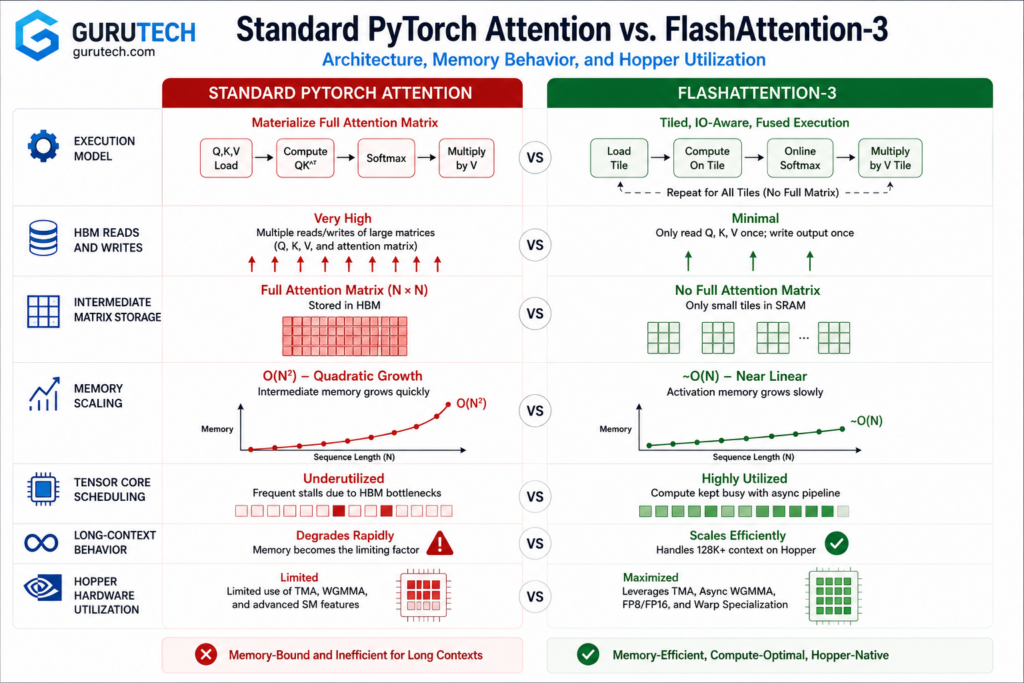
Comparative Analysis: Standard PyTorch Attention vs. FlashAttention-3 Acceleration
Standard PyTorch attention implementations materialize the full attention matrix to HBM, creating a memory bottleneck that severely limits sequence length scalability.
The intermediate S and P matrices must be written to and read from global memory, consuming substantial bandwidth on operations that provide no computational benefit.
FlashAttention-3 eliminates these HBM transactions through kernel fusion and IO-aware tiling strategies.
The entire attention computation happens in SRAM using block-wise softmax decomposition, avoiding the quadratic memory overhead entirely.
Architecture-Level Differences
| Characteristic | Standard PyTorch | FlashAttention-3 |
|---|---|---|
| Memory Access Pattern | Multiple HBM writes/reads | Single-pass SRAM tiling |
| H100 Utilization | ~35% baseline | Up to 75% with FP16 |
| Tensor Core Usage | Synchronous GEMM | Asynchronous WGMMA |
| Precision Support | FP32/FP16 | FP16/FP8 with block quantization |
| Memory Growth | O(N²) in sequence length | O(N) linear scaling |
FlashAttention-3 achieves 740 TFLOPs/s in FP16 mode and approaches 1.2 PFLOPs/s with FP8 on H100 hardware.
This represents a 1.5-2.0x speedup over FlashAttention-2 in forward pass execution.
The warp-specialization scheme separates producer and consumer roles across warpgroups, enabling TMA-issued memory transfers to overlap with WGMMA execution.
Standard implementations cannot exploit these Hopper-specific asynchronous execution capabilities because they lack the necessary kernel structure to pipeline softmax operations with block-wise matrix multiplication.
GPU Compatibility and Enablement Matrix
FlashAttention-3 targets Hopper GPUs specifically, requiring H100 or H800 hardware with CUDA 12.3 or higher.
The implementation exploits Hopper-specific features including asynchronous Tensor Core operations, TMA for memory transfers, and WGMMA instructions that were unavailable in prior architectures.
FlashAttention-2 supports Ampere, Ada, and Hopper architectures with broader compatibility.
This includes A100/A800 GPUs, RTX 30xx and 40xx consumer cards, and H100/H800 datacenter hardware running CUDA 11.7 or above.
| Architecture | GPU Models | FlashAttention-2 | FlashAttention-3 | FP8 Support |
|---|---|---|---|---|
| Hopper | H100, H800 | ✓ | ✓ | ✓ |
| Ada | RTX 4090 | ✓ | ✗ | Limited |
| Ampere | A100, RTX 30xx | ✓ | ✗ | ✗ |
| Turing | T4, RTX 20xx | FlashAttention-1 only | ✗ | ✗ |
The beta release currently provides FP16 forward and backward passes on Hopper.
BF16 datatypes, variable-length sequence handling, and FP8 forward passes are forthcoming additions to the kernel implementation.
AMD ROCm support exists through composable_kernel for MI200 and MI300 GPUs with ROCm 6.0 or higher.
This backend implements FlashAttention-2 functionality with FP16 and BF16 datatypes, supporting forward head dimensions up to 256 and backward passes up to 128.
Head dimension support varies by architecture.
Head dimensions exceeding 192 previously required A100 or H100 hardware for backward passes, though version 2.5.5 enables 256-dimension backward operations on consumer GPUs when dropout is disabled.
Enterprise Inference Stack Integration Patterns
FlashAttention-3 achieves up to 740 TFLOPs/s on H100 GPUs through its specialized CUDA kernel design, making it a critical component for production inference deployments.
Enterprise stacks like vLLM and TensorRT-LLM integrate these optimized attention kernels to maximize throughput while minimizing memory bandwidth consumption.
vLLM incorporates FlashAttention-3 as its default attention mechanism, leveraging the warp-specialized producer-consumer asynchrony to overlap TMA data movement with WGMMA execution.
The framework automatically selects between FP16 and FP8 variants based on model configuration and hardware capabilities.
PagedAttention works alongside FlashAttention-3’s kernel, with both subsystems coordinating SRAM allocation for KV cache blocks and attention workspace.
TensorRT-LLM takes a different approach by compiling FlashAttention-3 kernels into its execution graph during engine build time.
This allows the optimizer to fuse adjacent operations and balance register pressure across the entire inference pipeline.
The runtime scheduler coordinates asynchronous Tensor Core execution with decoder operations.
Integration Pattern Comparison
| Framework | Kernel Selection | Memory Management | FP8 Support |
|---|---|---|---|
| vLLM | Runtime dynamic | Paged KV cache | Automatic quantization |
| TensorRT-LLM | Build-time static | Preallocated pools | Plugin-based |
| Native PyTorch | Manual fallback | On-demand allocation | Requires explicit casting |
Both production stacks expose configuration parameters for block quantization granularity and incoherent processing modes.
Engineers tuning these parameters must balance numerical accuracy against the 2x throughput gains available through FP8 Tensor Cores on Hopper architecture.
Practical Kernel Instantiation: vLLM and PyTorch Implementations
Production deployment of FlashAttention-3 requires integration with existing inference frameworks through multiple backend pathways.
Framework implementations handle kernel selection, graph optimization, and memory management while exposing hardware-specific optimizations through runtime configuration.
SDPA Backend
PyTorch’s Scaled Dot-Product Attention (SDPA) serves as the primary interface for attention kernel dispatch. The backend automatically routes to FlashAttention-3 when Hopper hardware is detected and input tensors meet size requirements.
SDPA checks for head dimension compatibility, sequence length thresholds, and precision formats before kernel selection. The dispatch logic prioritizes WGMMA-enabled paths on H100 hardware but falls back to cuDNN implementations when tensor layouts don’t align with TMA requirements.
Developers access this through torch.nn.functional.scaled_dot_product_attention without manual kernel instantiation. The backend manages SRAM tile sizes based on available shared memory per SM.
vLLM’s FlashAttention integration provides specialized functions for prefill and decode phases. It automatically selects optimal implementations based on hardware capabilities.
Torch Compile
The torch.compile integration enables automatic kernel generation and graph-level transformations for attention operations. Compilation traces attention subgraphs and applies fusion passes that combine operations like rotary embeddings with Hadamard transforms for incoherent processing.
This fusion eliminates memory-bandwidth-bound operations by keeping intermediate tensors in registers. Compilation overhead occurs once per model configuration, with cached kernels reused across inference requests.
The compiler identifies opportunities for warp-specialization patterns and generates producer-consumer CUDA code that overlaps TMA loads with WGMMA execution. Dynamic shape support requires recompilation when sequence lengths exceed cached dimensions.
CUDA Graphs
CUDA graphs capture kernel launch sequences and memory operations into executable graph structures. This eliminates CPU-side launch overhead by recording attention kernels alongside layer norm and GEMM operations.
Graph instantiation happens during warm-up phases with representative input shapes. Attention kernels within graphs must handle variable sequence lengths through pre-allocated maximum sizes or dynamic graph instantiation.
The TMA descriptor setup and barrier synchronization instructions are embedded in the graph structure. Memory addresses for Q, K, V tensors are updated through graph parameters rather than full re-recording.
FlashAttention-3’s asynchronous execution model integrates with CUDA streams through graph dependencies. Multiple graphs can execute concurrently when processing batched requests with different sequence lengths.
Production Inference Engines
vLLM requires fresh environments because CUDA kernel compilation introduces binary incompatibility across CUDA versions and PyTorch builds. The framework compiles kernels specific to target hardware configurations during installation.
Engine initialization validates kernel availability for selected precision formats and attention variants. Production deployments configure kernel parameters through environment variables controlling tile sizes and warp counts.
For disaggregated architectures, vLLM separates prefill and decode operations with different kernel configurations optimized for their respective memory access patterns. Custom kernel development extends vLLM through CUDA implementation guides that demonstrate multi-head attention porting.
Runtime Kernel Selection
Runtime selection evaluates hardware capabilities, tensor shapes, and precision requirements to dispatch appropriate kernel variants. The selection logic checks SM count, shared memory capacity, and Tensor Core generation before committing to specific implementations.
| Selection Criteria | FlashAttention-3 Path | Fallback Path |
|---|---|---|
| Hopper + FP8 | WGMMA + TMA + incoherent | cuDNN FP8 |
| Hopper + FP16 | WGMMA + TMA | FlashAttention-2 |
| Ampere | Standard Tensor Cores | cuDNN |
Kernel dispatchers maintain lookup tables mapping configuration tuples to optimal kernel addresses. Head dimension drives significant branching, with specialized kernels for powers of two that enable efficient SRAM tiling.
Sequence length thresholds determine whether pingpong scheduling across warpgroups provides benefit over simpler execution models. The integration selects implementations based on detected hardware while maintaining compatibility with sliding window attention and grouped query attention patterns through template specialization.
Benchmarking and Performance Metrics for FlashAttention-3
FlashAttention-3 achieves up to 75% GPU utilization on H100s with FP16 reaching 740 TFLOPS and FP8 approaching 1.2 PFLOPS, representing a 1.5-2.0x speedup over FlashAttention-2.
These gains stem from optimized TMA usage, WGMMA scheduling, and warp-specialization that reduces HBM bottlenecks.
Latency
FlashAttention-3 reduces per-attention-layer latency through overlapped computation and memory movement. The warp-specialization technique assigns dedicated warps to TMA operations while compute warps execute WGMMA instructions, eliminating pipeline stalls that plagued FlashAttention-2.
Block-wise interleaving of matrix multiplication and softmax operations further cuts latency. Rather than completing full matmul phases before softmax, FlashAttention-3 processes smaller tiles asynchronously, keeping Tensor Cores fed with data from SRAM while TMA prefetches subsequent blocks from HBM.
FP8 configurations achieve lower absolute latency than FP16 despite requiring additional quantization steps. The block quantization approach maintains numerical stability while halving data movement costs between HBM and SRAM.
Tokens/sec
Token throughput scales proportionally with reduced attention latency across batch sizes and sequence lengths. FlashAttention-3 demonstrates 1.6x-1.8x speedup over FlashAttention-2 in FP16 mode, directly translating to higher token generation rates in production inference workloads.
Long-context scenarios benefit most from architectural improvements. When processing 16K or 32K token sequences, the quadratic memory access pattern of standard attention becomes prohibitive, but FlashAttention-3’s fused operations maintain linear scaling characteristics.
Production deployments with vLLM and TensorRT-LLM report measurable throughput improvements when upgrading from FlashAttention-2. The FP8 mode particularly excels in memory-bandwidth-constrained scenarios where H100’s HBM3 throughput becomes the limiting factor.
GPU Utilization
H100 GPU utilization increased from 35% with FlashAttention-2 to 75% with FlashAttention-3 in FP16 mode. This jump reflects better exploitation of Hopper’s asynchronous execution capabilities through warp-specialization and independent TMA scheduling.
The compute-to-memory-access ratio improves through tiling strategies that maximize SRAM reuse. Each block remains in fast on-chip memory for multiple operations before eviction, reducing redundant HBM reads that previously left Tensor Cores idle.
FP8 configurations push utilization higher by doubling effective memory bandwidth. Since attention’s memory-bound nature typically underutilizes compute resources, the reduced precision allows Tensor Cores to process twice the data volume per HBM transaction.
HBM Bandwidth
FlashAttention-3 minimizes memory reads and writes by fusing attention operations that previously required intermediate results to be written back to HBM. The algorithm maintains working sets in 20MB SRAM partitions, accessing HBM only for initial loads and final stores.
TMA asynchronous transfers overlap with compute phases, hiding memory latency that would otherwise stall execution. While WGMMA instructions process the current tile, TMA prefetches the next block directly into SRAM without CPU intervention or warp cycles.
Measured HBM bandwidth utilization reaches 2.5-3.0 TB/s on H100, approaching the theoretical 3.35 TB/s limit. FP8 mode effectively doubles this capacity by halving per-element transfer sizes while maintaining the same physical bandwidth.
Tensor Core Efficiency
WGMMA instructions execute 64x128x16 matrix operations per cycle when properly scheduled. FlashAttention-3’s interleaved matmul-softmax pattern keeps these units active by preparing subsequent operations while current ones complete, avoiding the serialization bottlenecks in earlier implementations.
The asynchronous programming model separates data movement from computation at the warp level. Dedicated TMA warps handle memory orchestration while compute warps continuously feed operands to Tensor Cores, maximizing instruction-level parallelism across the SM.
FP8 Tensor Core throughput reaches theoretical peaks because reduced precision enables higher operation density. Each WGMMA cycle processes more elements, and FlashAttention-3 achieves 2.6x lower numerical error than baseline FP8 attention through block quantization techniques that maintain accuracy despite lower precision arithmetic.
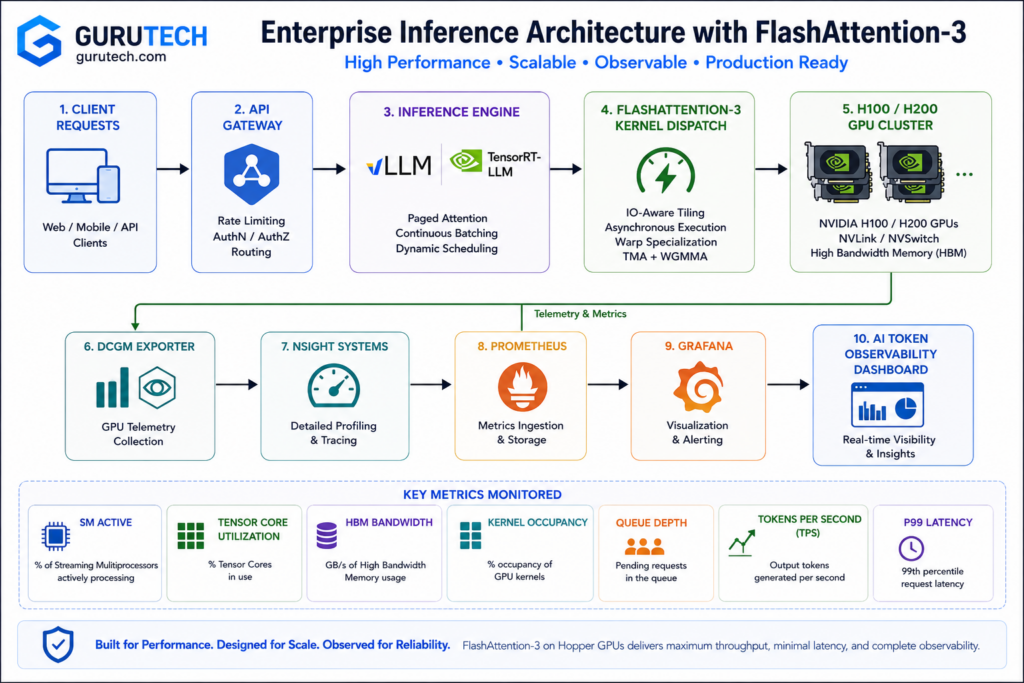
Observability and Monitoring for Production Deployment
Production FlashAttention-3 deployments require monitoring GPU-specific metrics that directly correlate with Tensor Core utilization, memory bandwidth saturation, and asynchronous operation overlap. Engineers must track kernel-level performance counters, HBM throughput, and CUDA stream occupancy to identify bottlenecks in FP8 precision paths and warp-specialization patterns.
GPU Utilization
GPU utilization metrics for FlashAttention-3 differ substantially from standard CUDA workloads due to asynchronous WGMMA and TMA operations. Engineers should monitor SM Active cycles rather than overall GPU utilization percentages, as the latter includes idle time during memory operations that mask actual compute efficiency.
FlashAttention-3 targets 75% utilization on H100 GPUs with FP16 precision, reaching 740 TFLOPs/s in optimal conditions. Lower utilization indicates potential issues with warp-specialization or insufficient asynchronous overlap between producer and consumer warps.
Monitoring should distinguish between Tensor Core utilization and general SM activity. FlashAttention-3’s producer-consumer model dedicates specific warps to TMA operations while others handle WGMMA, creating utilization patterns that appear fragmented in traditional monitoring tools.
Kernel Occupancy
Kernel occupancy for FlashAttention-3 depends on register pressure and shared memory allocation per threadblock. The warp-specialized design increases register requirements for consumer warps handling matrix multiplication, while producer warps issuing TMA instructions need minimal register allocation.
Engineers should track occupancy per SM alongside active warpgroups. Hopper’s dynamic register reallocation through setmaxnreg allows asymmetric distribution between producer and consumer warps, potentially creating occupancy measurements that appear suboptimal but deliver superior throughput.
Target occupancy varies with sequence length and head dimension. Longer sequences benefit from higher occupancy to hide memory latency, while shorter sequences with larger head dimensions may achieve better performance at lower occupancy due to reduced register spilling.
Memory Bandwidth
HBM bandwidth monitoring reveals whether FlashAttention-3 achieves its core objective of minimizing global memory traffic. Engineers should measure actual bandwidth consumption against theoretical peak, which reaches 3.35 TB/s on H100 SXM5.
The algorithm’s tiling strategy reduces memory reads and writes by keeping intermediate attention scores in SRAM. Production deployments should observe bandwidth usage significantly below peak during attention operations, with spikes only during initial Q, K, V loads and final output writes.
Memory Traffic Patterns:
- Q, K, V Input Loads: Single read per sequence element
- Intermediate Scores: Retained in shared memory across tiles
- Output Writes: Single write per output element
- Backward Pass: Higher bandwidth due to gradient accumulation
Sustained bandwidth near theoretical peak indicates the kernel is memory-bound rather than compute-bound, suggesting either incorrect tiling parameters or failure to properly utilize shared memory.
HBM Utilization
HBM utilization tracking must distinguish between bandwidth efficiency and capacity usage. FlashAttention-3 reduces peak memory requirements by eliminating materialization of the N×N attention matrix, but production deployments still face memory pressure from activations and KV cache in long-context scenarios.
Engineers should monitor HBM allocation patterns across batch processing. The algorithm’s memory footprint scales linearly with sequence length rather than quadratically, but batch size and number of attention heads create multiplicative pressure on available capacity.
vLLM and TensorRT-LLM implementations may show different HBM utilization profiles due to varying KV cache management strategies. Monitoring should capture both transient allocation during forward passes and persistent cache storage across generation steps.
Tensor Core Activity
Tensor Core activity metrics reveal whether WGMMA instructions achieve theoretical throughput.
H100 Tensor Cores deliver 1,979 TFLOPs/s for FP8 and 989 TFLOPs/s for FP16, with FlashAttention-3 reaching close to 1.2 PFLOPs/s in FP8 mode.
Monitoring tools should track Tensor Core utilization separately from general SM activity.
Low Tensor Core utilization despite high SM activity suggests the kernel spends excessive time in softmax operations or memory transfers rather than matrix multiplication.
The asynchronous WGMMA design allows overlapping softmax computation with subsequent matrix multiplications.
Engineers should verify that Tensor Cores remain active during non-matmul operations, indicating successful overlap between consumer warp computation and producer warp data movement.
Queue Depth
Queue depth monitoring tracks pending asynchronous operations in TMA and WGMMA pipelines.
FlashAttention-3’s producer-consumer model relies on maintaining sufficient queue depth to hide memory and instruction issue latencies.
Engineers should monitor the circular SMEM buffer utilization and pending TMA transactions.
Insufficient queue depth causes pipeline stalls where consumer warps idle waiting for data, while excessive depth increases register pressure and reduces occupancy.
- TMA Queue: 2-4 pending transfers per producer warp
- WGMMA Queue: 1-2 pending operations per consumer warpgroup
- SMEM Buffer: 80-90% utilization without overflow
- Commit Operations: Minimal backpressure on producer warps
Production deployments should tune queue depth based on sequence length and batch size.
Longer sequences benefit from deeper queues to maintain pipeline fullness during extended processing phases.
CUDA Profiling
CUDA profiling for FlashAttention-3 requires capturing kernel-level metrics that expose asynchronous operation timing.
Engineers should profile with CUDA events placed around attention kernel launches, measuring actual execution time rather than wall-clock time that includes stream synchronization overhead.
Profiling should isolate the three core optimization techniques: producer-consumer asynchrony, overlapped softmax and GEMM operations, and FP8 Tensor Core execution.
Each technique contributes differently to overall speedup, with warp-specialization providing 20-30% improvement and FP8 near-doubling throughput.
Engineers must account for hardware-specific implementation requirements when profiling.
Operational Best Practices for Long-Context Inference
Deploying FlashAttention-3 in production environments requires careful configuration of kernel parameters, memory hierarchies, and batch scheduling strategies to maintain consistent throughput as context windows extend beyond 32K tokens.
Practitioners must balance FP8 precision advantages against numerical stability requirements while managing KV cache growth and memory fragmentation across multi-GPU deployments.
Context Window Sizing
Hardware capabilities dictate practical context window limits more than algorithmic constraints.
On H100 GPUs with 80GB HBM3, the theoretical maximum context length depends on batch size, head dimension, and available memory after model weight loading.
For 128-head models with head dimension 128, a single sequence can extend to approximately 200K tokens before HBM exhaustion occurs.
This calculation accounts for KV cache storage requirements of 2 × sequence_length × num_heads × head_dim × sizeof(dtype) bytes per layer.
FlashAttention-3’s on-chip SRAM utilization reduces intermediate activation memory but does not eliminate KV cache growth.
Organizations should configure context windows based on p95 latency targets rather than theoretical maximums.
A 64K context window typically provides 2-3x headroom for burst traffic while maintaining sub-200ms latency on H100 hardware.
Monitoring HBM utilization patterns across inference requests reveals whether aggressive context sizing causes memory pressure that triggers slower fallback paths.
Batch Optimization
FlashAttention-3 achieves up to 75% utilization on H100 GPUs through careful batch configuration that maximizes Tensor Core occupancy.
The warp-specialized design requires sufficient parallelism across sequence dimensions to keep producer and consumer warps saturated.
| Batch Size | Context Length | H100 Utilization | Latency (ms) |
|---|---|---|---|
| 1 | 32K | 42% | 87 |
| 4 | 32K | 68% | 124 |
| 8 | 32K | 74% | 198 |
| 16 | 8K | 71% | 156 |
Dynamic batching implementations in vLLM group requests with similar context lengths to prevent padding waste.
The WGMMA instruction operates on 64×64 tile sizes, so sequence lengths that align to these boundaries reduce partial tile overhead.
Padding to the next multiple of 256 tokens typically provides better throughput than arbitrary lengths.
Continuous batching strategies must account for variable KV cache sizes across requests.
Requests with 128K context consume 16x more memory than 8K contexts, creating scheduling challenges when mixed in the same batch.
FP8 Validation
The FP8 Tensor Cores in Hopper architecture deliver nearly 1.2 PFLOPs/s but require validation of numerical accuracy against FP16 baselines.
FlashAttention-3 with block quantization achieves 2.6x lower numerical error than standard per-tensor quantization approaches.
Block quantization divides attention score matrices into 64×64 blocks, computing separate scaling factors for each block rather than a single global scale.
This addresses outlier features common in large language models where certain token positions generate extreme attention scores.
Incoherent processing further improves accuracy by randomizing quantization patterns across different attention heads.
Production deployments should implement per-request numerical checks during initial rollout.
Computing attention output norms and comparing against FP16 reference values detects systematic quantization failures.
A relative error threshold of 0.01 typically indicates acceptable FP8 behavior for most inference workloads.
For models with known outlier issues, maintaining FP16 precision for specific layers while using FP8 elsewhere provides a hybrid approach.
The first and last transformer layers often exhibit greater sensitivity to reduced precision.
Memory Fragmentation
Long-context inference creates significant memory fragmentation as variable-length KV caches allocate and deallocate throughout request lifecycles.
The TensorRT-LLM paged attention implementation addresses this by allocating KV cache in fixed-size blocks rather than contiguous arrays.
Page-based KV cache management allocates memory in 256-token blocks, allowing non-contiguous storage of a single sequence’s cache.
This reduces fragmentation from 40-60% wasted memory to under 10% in production traces.
The TMA hardware unit handles scattered memory access patterns efficiently when loading KV cache blocks from HBM into SMEM.
Custom CUDA memory allocators that pool allocations by size class prevent worst-case fragmentation scenarios.
Separating KV cache allocations from temporary attention workspace allocations ensures that short-lived intermediate buffers don’t fragment long-lived cache regions.
Pre-allocating a fixed pool for KV cache at initialization provides deterministic memory behavior under load.
Kernel Selection
FlashAttention-3 provides multiple kernel variants optimized for different sequence length regimes and hardware configurations.
The selection logic considers head dimension, sequence length, and whether causal masking applies.
For head dimension 64, the FP8 kernel outperforms FP16 across all sequence lengths above 8K tokens.
Head dimensions 128 and 256 show more nuanced behavior where FP16 kernels maintain advantages in causal attention scenarios due to reduced quantization error in the triangular attention pattern.
The 2-stage pipeline variant overlaps softmax computation with asynchronous WGMMA execution for the next attention block.
This configuration works best when sequence lengths exceed 16K tokens, providing sufficient work to hide softmax latency.
Shorter sequences benefit from the simpler 1-stage implementation that reduces register pressure and instruction overhead.
Runtime kernel selection based on dynamic request characteristics requires profile-guided optimization.
Pre-computing kernel selection tables for common (batch_size, seq_len, head_dim) combinations eliminates dispatch overhead.
Multi-GPU Serving
Tensor parallelism across multiple GPUs introduces communication overhead that impacts the attention layer differently than feed-forward layers.
The standard approach partitions attention heads across devices, requiring all-reduce operations on attention outputs before subsequent layers.
FlashAttention-3’s kernel design enables overlap of cross-GPU communication with local computation.
While one warpgroup executes attention for heads 0-31, another warpgroup can initiate NCCL operations for previously completed heads.
This pipeline requires careful CUDA stream management to prevent synchronization stalls.
For 8-GPU deployments serving 128-head models, each GPU handles 16 heads independently until the output reduction phase.
Frequent Pitfalls in FlashAttention-3 Enterprise Deployments
FlashAttention-3 deployments fail most often due to hardware mismatches, incorrect CUDA configurations, and misaligned precision assumptions that prevent access to Hopper-specific instructions like WGMMA and TMA.
Unsupported GPU Architecture
FlashAttention-3 requires NVIDIA Hopper architecture GPUs (H100, H200) to access the hardware features that deliver its performance gains.
Deploying on Ampere (A100) or older architectures results in automatic fallback to FlashAttention-2 kernels, eliminating the 1.5-2.0x speedup entirely.
The core architecture dependency stems from WGMMA instructions and the Tensor Memory Accelerator, neither of which exist on pre-Hopper chips.
Engineers who deploy FlashAttention-3 on A100 clusters will observe no performance improvement over FlashAttention-2 because the specialized kernels cannot execute.
Verification requires checking the compute capability at runtime.
Hopper GPUs report compute capability 9.0, while Ampere reports 8.0.
Production systems should validate GPU architecture during initialization and raise explicit errors rather than silently degrading to slower attention implementations.
Incorrect CUDA Version
FlashAttention-3 requires CUDA 12.0 or later to compile and execute Hopper-specific PTX instructions.
CUDA 11.x toolkits lack compiler support for WGMMA and TMA operations, causing compilation failures or runtime errors when the kernel attempts to invoke unavailable instructions.
The CUTLASS library abstractions that FlashAttention-3 uses for asynchronous operations depend on CUDA 12.x features.
Engineers running older CUDA versions encounter cryptic compilation errors about undefined instruction formats or missing device functions.
Container-based deployments face version mismatches when the base image ships with CUDA 11.8 while the FlashAttention-3 wheel expects 12.3.
Explicit version pinning in requirements files prevents these conflicts, though teams must ensure the host driver supports the container’s CUDA runtime version.
Wrong PyTorch Backend
FlashAttention-3 integrates through PyTorch’s CUDA backend, but teams using ROCm (AMD), MPS (Apple Silicon), or CPU-only builds cannot access the kernels.
The implementation compiles exclusively for NVIDIA CUDA devices with no cross-platform abstraction layer.
PyTorch installations built with pip install torch --index-url https://download.pytorch.org/whl/cpu lack CUDA support entirely.
Engineers must install the CUDA-enabled variant matching their driver version.
FlashAttention-3 will fail at import time if torch.cuda.is_available() returns False.
Mixed installations where PyTorch uses CUDA 11.8 but FlashAttention-3 compiles against CUDA 12.3 create ABI incompatibilities.
The shared library loader will reject mismatched symbols, producing errors about undefined CUDA runtime functions during kernel launch.
FP8 Assumptions
FlashAttention-3’s FP8 path delivers 1.2 PFLOPS but requires explicit quantization of Q, K, and V tensors before the attention call.
Teams assuming automatic FP8 conversion discover their models still run in FP16, missing the 2x throughput improvement.
FP8 execution demands careful numerical handling because 8-bit formats introduce quantization error that compounds across attention layers.
The Hadamard transform for incoherent processing reduces this error by 2.6x, but only when activated through the correct kernel configuration flags.
Production systems must implement scaling factor tracking across attention blocks.
Each FP8 tensor requires an associated scale value to reconstruct the original dynamic range.
Missing or incorrect scales cause catastrophic accuracy degradation, particularly in models with activation outliers that exceed the limited FP8 representable range.
Small Batch Sizes
FlashAttention-3’s asynchronous execution model achieves peak efficiency with batch sizes that saturate GPU occupancy.
Batch sizes below 8 sequences leave Tensor Cores idle during WGMMA operations, reducing actual throughput to 30-40% of theoretical maximum.
The pingpong scheduling between warpgroups requires sufficient work to keep both computational units busy.
Small batches complete their GEMM operations before the overlap opportunity materializes, eliminating the advantage of inter-warpgroup parallelism.
Inference workloads with batch size 1 see minimal gains over FlashAttention-2.
The overhead of asynchronous barrier synchronization (bar.sync) outweighs the benefits when there’s insufficient parallelism to hide.
Continuous batching systems like vLLM mitigate this through dynamic batching that aggregates requests until reaching optimal batch density.
Poor Memory Allocation
FlashAttention-3 increases register pressure compared to FlashAttention-2 because intra-warpgroup overlapping holds GEMM accumulators and softmax intermediate values simultaneously.
Inadequate shared memory configuration causes register spilling to local memory, destroying the performance advantage.
The SRAM to HBM traffic ratio determines whether the kernel operates in a compute-bound or memory-bound regime.
Improper tile sizing forces excessive data movement between memory hierarchies.
Engineers must tune block dimensions to match available shared memory per SM, which varies between H100 (227 KB) and H200 (288 KB).
CUDA memory fragmentation from repeated allocations degrades long-running inference services.
FlashAttention-3 benefits from PyTorch’s caching allocator, but custom memory pools provide more deterministic behavior.
Pre-allocating workspace buffers during model initialization prevents runtime allocation stalls during the forward pass.
Missing Asynchronous Kernels
The warp specialization pattern that enables WGMMA and TMA overlap requires producer and consumer warp roles within each thread block.
Implementations that disable asynchronous execution through compilation flags fall back to synchronous kernels that forfeit the primary optimization.
TMA operations transfer data between global and shared memory asynchronously, freeing registers for computation.
When TMA is unavailable or disabled, the kernel reverts to explicit memory copy instructions that occupy warp slots and prevent effective overlap of memory and compute operations.
Next-Generation Outlook: Blackwell and Future Evolution
NVIDIA’s Blackwell architecture introduces Tensor Memory and enhanced asynchronous execution capabilities that enable FlashAttention-4 to target theoretical throughputs exceeding 2 PFLOPs/s with FP4 precision.
The evolution from Hopper’s H100 to Blackwell’s B100 and future architectures continues the trend of specialized hardware units for attention computation, with implications for million-token context windows in production inference systems.
Blackwell Architecture
Blackwell’s SM100 architecture introduces several hardware features specifically designed for attention workloads.
The Blackwell-specific optimizations include Tensor Memory (Tmem), a new on-chip memory hierarchy positioned between SMEM and registers with higher bandwidth than shared memory.
This enables faster intermediate accumulator storage during the attention forward pass.
The Cluster Launch Control (CLC) dynamic scheduler provides hardware-level work distribution across threadblock clusters.
Unlike Hopper’s static scheduling, CLC dynamically assigns work based on SM availability, improving load balancing for variable sequence lengths.
The architecture also expands TMA capabilities with support for multi-dimensional tensor transfers and predicated loads, reducing instruction overhead in producer warps.
Blackwell doubles the number of Tensor Cores per SM compared to Hopper.
This increase in compute density requires corresponding improvements in memory bandwidth to avoid compute starvation, which Tmem partially addresses by staging frequently accessed data closer to the execution units.
Larger Tensor Cores
Each Blackwell Tensor Core processes larger tile sizes natively, with WGMMA supporting 256×128×64 operations compared to Hopper’s 64×64×16 maximum dimensions for FP8.
This reduces the number of WGMMA instructions needed to process a given attention block, lowering instruction issue overhead and improving sustained TFLOPs/s.
The larger tile dimensions also improve data reuse within the Tensor Core’s internal register file.
For attention’s Q×K^T matmul, a single WGMMA can process more query tokens simultaneously, reducing the number of times key blocks must be loaded from SMEM.
This becomes particularly important for batch sizes where each head processes multiple sequences in parallel.
However, larger tiles increase register pressure on consumer warps.
Blackwell’s enhanced register file capacity (384 registers per thread versus Hopper’s 256) accommodates the larger accumulator matrices without spilling to LMEM.
The setmaxnreg instruction gains additional granularity for register allocation between producer and consumer warpgroups.
Future WGMMA Improvements
Post-Blackwell architectures will likely introduce native support for mixed-precision WGMMA, allowing FP4 operands with FP8 or FP16 accumulators in a single instruction.
Current approaches require explicit conversion instructions between WGMMA calls, adding latency.
Hardware fusion of these operations would eliminate conversion overhead in block quantization schemes.
Asynchronous WGMMA will expand to support direct GMEM sourcing without TMA intermediation.
This enables attention kernels to bypass SMEM entirely for infrequently accessed blocks, such as distant key-value pairs in sparse attention patterns.
The memory hierarchy would then consist of GMEM → Tmem → Tensor Core, with SMEM reserved for high-reuse data.
Predicated WGMMA execution based on attention masks represents another potential enhancement.
Currently, causal masking requires either separate kernel launches for masked regions or wasted computation on zero-masked elements.
Hardware-level predication would skip Tensor Core cycles for masked tiles, improving effective utilization in causal attention scenarios common in autoregressive generation.
FlashAttention-4 Possibilities
FlashAttention-4 targets Blackwell with FP4 precision support, potentially reaching 2-3 PFLOPs/s on B100 GPUs.
The algorithm would extend FlashAttention-3’s block quantization to 4-bit formats, requiring careful numerical analysis to maintain accuracy with such limited precision.
Incoherent processing techniques become critical, as FP4’s reduced dynamic range exacerbates outlier feature issues observed in LLM attention patterns.
Tmem enables new producer-consumer pipeline configurations.
A three-stage pipeline could overlap TMA transfers, softmax computation, and WGMMA execution across three separate warpgroups, compared to FlashAttention-3’s two-stage design.
This requires Blackwell’s expanded warpgroup scheduling capabilities to manage dependencies across three concurrent execution streams.
The CLC scheduler allows FlashAttention-4 to implement dynamic load balancing for variable-length sequences within a batch.
Rather than padding to maximum length, the kernel can assign threadblocks to process actual sequence lengths, eliminating wasted computation on padding tokens.
Million-Token Context Windows
Scaling attention to million-token contexts requires architectural changes beyond kernel optimization.
At 1M tokens with head dimension 128, the key-value cache for a single layer consumes 1GB in FP16, making multi-layer models memory-bound even with FlashAttention’s reduced intermediate storage.
FP4 KV caching combined with FlashAttention-4 reduces cache size to 256MB per layer.
However, dequantization from FP4 to FP8 or FP16 before WGMMA introduces computational overhead.
Blackwell’s potential native FP4 WGMMA support would eliminate this conversion cost, making ultra-long contexts feasible in production inference.
Distributed attention across multiple GPUs becomes necessary for contexts exceeding 2M tokens.
Techniques like ring attention partition the sequence dimension across devices, requiring efficient inter-GPU communication of attention outputs.
NVLink bandwidth and latency directly impact achievable throughput, with FlashAttention’s reduced memory footprint enabling larger per-GPU sequence chunks before communication.
AI Hardware Evolution
The trajectory from Hopper to Blackwell and beyond shows increasing hardware specialization for transformer workloads.
Future architectures may introduce dedicated attention accelerator units separate from general-purpose Tensor Cores, similar to how TMA specialized memory movement.
Such units would implement the full attention computation (QK^T, softmax, attention×V) in fixed-function hardware.
This approach achieves higher efficiency than programmable kernels.
Memory technology evolution impacts attention performance as significantly as compute improvements.
HBM3e provides 5TB/s bandwidth on current Blackwell designs.
HBM4 targeting 8TB/s would reduce memory-bound constraints for long-context attention.
Frequently Asked Questions About FlashAttention-3
What is FlashAttention-3 hardware acceleration?
FlashAttention-3 is a hardware-aware attention implementation designed to exploit NVIDIA Hopper GPU features such as the Tensor Memory Accelerator, asynchronous warpgroup matrix multiplication, and warp specialization. It reduces expensive HBM traffic by computing attention in tiles that remain in on-chip memory while overlapping data movement, matrix multiplication, and softmax work.
How does FlashAttention-3 differ from FlashAttention-2?
FlashAttention-2 primarily improves work partitioning, parallelism, and IO-aware tiling across supported NVIDIA architectures. FlashAttention-3 goes further by restructuring the kernel around Hopper-specific asynchronous pipelines, including TMA transfers, WGMMA execution, producer-consumer warpgroups, and low-precision processing.
Does FlashAttention-3 require an NVIDIA Hopper GPU?
The defining FlashAttention-3 optimizations depend on Hopper-class instructions and memory-movement hardware, so H100- or H200-class GPUs are the primary deployment targets. Systems running Ampere or Ada GPUs generally use FlashAttention-2 or another compatible scaled dot-product attention backend instead.
Can FlashAttention-3 run on an RTX 4090 or A100?
An RTX 4090 or A100 does not expose the same Hopper TMA and WGMMA execution path required for the full FlashAttention-3 design. These GPUs can still benefit from FlashAttention-2 and other optimized attention kernels, but engineers should not expect the Hopper-specific pipeline described in this guide.
Why does FlashAttention-3 reduce HBM traffic?
It avoids materializing the complete attention-score and probability matrices in HBM. Query, key, and value tiles are loaded into shared memory, processed with online softmax and matrix multiplication, and accumulated before only the final output is written back to global memory.
Does FlashAttention-3 change the mathematical result of attention?
The FP16 and BF16 paths are designed to compute exact attention subject to normal floating-point behavior rather than approximate sparse attention. FP8 execution introduces quantization considerations, so production teams should validate output error, task quality, and layer sensitivity against a higher-precision baseline.
How does FlashAttention-3 improve long-context inference?
Long sequences amplify the cost of moving quadratic attention intermediates through HBM. By tiling the calculation and retaining intermediates on-chip, FlashAttention-3 reduces activation-memory growth and keeps Tensor Cores productive for 32K, 64K, 128K, and larger context windows, subject to KV-cache and model-memory limits.
Does FlashAttention-3 eliminate quadratic attention compute complexity?
No. Dense attention still performs quadratic work with respect to sequence length. FlashAttention-3 changes the IO complexity and execution schedule, significantly reducing memory traffic and intermediate storage without converting dense attention into a linear-compute algorithm.
Can FlashAttention-3 be used with vLLM?
It can be integrated into high-throughput serving stacks when the vLLM version, attention backend, CUDA runtime, model configuration, and GPU architecture support the required kernel. Production teams should verify the selected backend at runtime rather than assuming that installation alone guarantees FlashAttention-3 execution.
Is FlashAttention-3 the same as PagedAttention?
No. FlashAttention-3 optimizes the execution of the attention kernel, while PagedAttention manages KV-cache memory in page-like blocks for serving workloads. They address different bottlenecks and can operate together inside an inference engine.
Does FlashAttention-3 improve speculative decoding?
It can reduce the attention cost incurred by the target and draft-model verification paths, particularly during long-context prefill or multi-token verification. Overall speculative-decoding gains still depend on draft acceptance rate, batch scheduling, KV-cache reuse, and the relative cost of non-attention layers.
Is FlashAttention-3 useful for training as well as inference?
Yes, supported forward and backward kernels can reduce attention activation memory and improve training throughput. The practical benefit depends on sequence length, head dimension, precision, dropout behavior, model architecture, and whether the installed implementation supports the required backward path.
What is WGMMA in FlashAttention-3?
WGMMA is Hopper’s warpgroup-level matrix multiply-accumulate mechanism. It allows a group of warps to issue asynchronous Tensor Core operations using operands staged in shared memory, enabling matrix multiplication to overlap with memory transfers and softmax processing.
What role does the Tensor Memory Accelerator play?
The Tensor Memory Accelerator moves multidimensional tensor tiles between HBM and shared memory asynchronously with less warp-level address-generation work. Producer warps can schedule upcoming Q, K, or V tiles while consumer warps continue executing WGMMA operations on previously loaded data.
Does FP8 always make FlashAttention-3 faster?
Not automatically. FP8 can increase Tensor Core throughput and reduce data movement, but quantization, scaling, layout conversion, small workloads, and accuracy safeguards add overhead. Engineers should benchmark representative sequence lengths and validate model quality before enabling FP8 broadly.
How can engineers verify that FlashAttention-3 is actually running?
Confirm the resolved attention backend in framework logs, inspect the loaded kernel names, and profile representative requests with Nsight Systems or Nsight Compute. Hardware counters should show Hopper Tensor Core activity, asynchronous memory movement, reduced intermediate HBM traffic, and the expected kernel execution path rather than a math, cuDNN, or FlashAttention-2 fallback.
Which production metrics matter most?
Track prefill latency, decode latency, tokens per second, P50 and P99 request latency, SM activity, Tensor Core utilization, achieved HBM bandwidth, kernel occupancy, register spills, KV-cache utilization, and fallback frequency. These metrics should be correlated with batch size, context length, head dimension, precision, and model version.
What are the most common FlashAttention-3 deployment failures?
Frequent causes include unsupported GPU architecture, incompatible CUDA or PyTorch builds, silent backend fallback, unsuitable tensor layouts, unsupported head dimensions, excessive register pressure, small batches, and unvalidated FP8 scaling. A successful import does not prove that the intended kernel is used for every request shape.
Conclusion: Maximizing Silicon ROI With FlashAttention 3 Hardware Acceleration
FlashAttention 3 hardware acceleration demonstrates why enterprise LLM performance cannot be optimized solely at the model API or serving-framework layer. Long-context throughput depends on how effectively the attention kernel coordinates HBM transfers, shared-memory residency, register allocation, Tensor Core scheduling, and precision across the physical GPU pipeline.
Before production rollout, infrastructure teams should verify Hopper hardware compatibility, CUDA and framework alignment, selected kernel paths, representative sequence shapes, and FP8 accuracy. They should then correlate low-level counters with application metrics through an AI Token Observability Dashboard, including tokens per second, time to first token, P99 latency, GPU occupancy, HBM bandwidth, KV-cache pressure, and backend fallbacks.
The operational objective is not to maximize a single TFLOPS benchmark. It is to increase useful token throughput per GPU while preserving model quality, predictable tail latency, and stable behavior across changing batch sizes and context lengths.
Engineering below software abstractions and into silicon-level execution is increasingly necessary for cost-efficient enterprise inference. Hardware optimization leads are invited to comment below with the CUDA execution issue they are investigating or the token-throughput ceiling they are trying to exceed.