
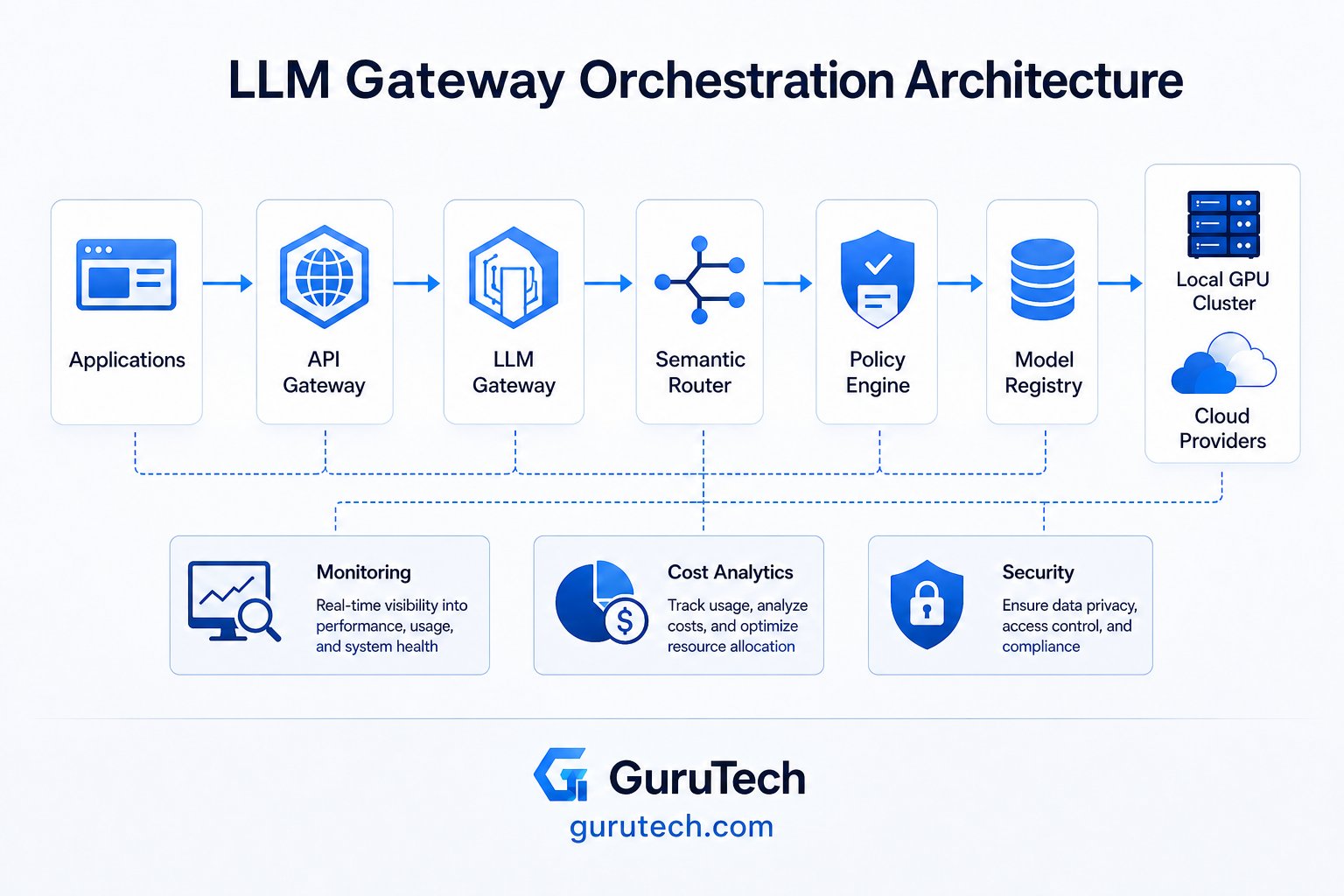
Modern enterprise AI platforms operate across a fragmented infrastructure landscape that includes dedicated GPU clusters for local inference, private model servers hosted on-premises or in virtual private clouds, and multiple external foundation model providers accessed through REST APIs.
This heterogeneity creates significant integration complexity at the application layer, where engineering teams must manage distinct SDKs, authentication mechanisms, rate limiting policies, and fallback logic for each provider.
LLM gateway orchestration solves this problem by implementing a centralized control plane that abstracts provider-specific complexity behind a unified API endpoint, enabling intelligent routing, automatic failover, policy enforcement, and comprehensive observability across the entire model infrastructure.
The orchestration layer coordinates models, providers, and request workflows through a highly available proxy architecture that applies routing rules, caching policies, and security guardrails before forwarding requests to the appropriate backend.
Gateway platforms evaluate each incoming request against semantic classifiers and policy engines to determine optimal model selection, directing high-volume classification tasks to quantized local models while reserving expensive cloud-based reasoning models for complex analytical workloads.
This approach reduces infrastructure costs by 60-80% in production deployments while maintaining strict latency and quality requirements.
Enterprise gateway architectures integrate with existing observability platforms, identity providers, and cost management systems to provide token-level usage attribution, real-time anomaly detection, and budget enforcement across business units.
Teams that operate without orchestration experience 15-30% higher LLM costs from duplicate calls and multi-minute outages during provider incidents due to lack of automated failover mechanisms.
Key Takeaways
- LLM gateway orchestration provides a unified control plane that abstracts multi-provider complexity through intelligent routing, failover, and policy enforcement
- Gateway platforms reduce operational costs by directing routine requests to local quantized models while reserving premium cloud models for advanced reasoning workloads
- Enterprise deployments gain token-level observability, cost attribution, and automated resilience patterns that prevent provider outages from impacting production applications
Defining the Role of LLM Gateways
An LLM gateway serves as infrastructure that sits between applications and model providers, centralizing access control, routing logic, and operational governance.
This architectural pattern addresses the complexity of managing multiple model endpoints, enforcing enterprise policies, and maintaining observability across distributed AI workloads.
Unified API Endpoint
An enterprise LLM gateway consolidates all model interactions through a single entry point, eliminating the need for applications to maintain direct connections to multiple provider APIs. This consolidation reduces integration complexity when working with providers like OpenAI, Anthropic, Azure OpenAI, AWS Bedrock, and self-hosted models. Applications make requests to the gateway’s unified interface rather than implementing provider-specific client libraries.
The unified endpoint pattern simplifies dependency management and version control across application teams. When a provider updates their API specification or deprecates endpoints, changes are isolated to the gateway layer rather than requiring updates across hundreds of microservices. This architectural boundary reduces deployment risk and accelerates provider migrations.
For organizations operating in hybrid cloud environments, the unified endpoint provides a consistent access pattern regardless of where models are hosted. Internal teams can switch between cloud-hosted and on-premises models without modifying application code, supporting data residency requirements and regulatory compliance constraints common in banking and healthcare deployments.
Provider Abstraction
Provider abstraction normalizes API differences across model vendors through a standardized request and response schema. Different providers use varying authentication mechanisms, token counting methods, streaming protocols, and error response formats. The gateway translates these provider-specific implementations into a consistent interface that applications can depend on.
This abstraction layer enables organizations to implement routing decisions based on token usage, prompt complexity, and model availability without application-level logic.
A financial services platform can route simple classification tasks to cost-efficient models while directing complex reasoning queries to more capable models based on centralized routing policies.
The application remains unaware of which specific model or provider handles each request.
Model registries integrate with the abstraction layer to maintain metadata about available models, their capabilities, token limits, and pricing structures. This metadata drives intelligent routing and enables the gateway to select appropriate models based on request characteristics rather than hardcoded provider selections.
Authentication
An AI inference gateway centralizes authentication and authorization for all model access, replacing scattered API keys and credentials across application repositories.
The gateway authenticates incoming application requests using enterprise identity providers like OAuth 2.0, SAML, or mutual TLS, then manages provider-specific API credentials internally. This separation prevents credential exposure in application code and deployment pipelines.
Role-based access control (RBAC) policies at the gateway level restrict which teams, applications, or users can access specific models or providers.
A healthcare organization can ensure that only HIPAA-compliant applications route to models deployed in approved regions, while development teams access sandbox endpoints.
These policies enforce organizational governance without requiring individual developers to understand compliance requirements.
The gateway also implements rate limiting per authenticated principal, preventing individual applications or users from consuming excessive quota.
Token-based budgets can be allocated to different business units, with the gateway rejecting requests that would exceed allocated limits.
This control mechanism prevents runaway costs from experimental workloads or misconfigured applications.
Routing
Routing strategies within an LLM gateway determine which model handles each request based on configurable criteria including prompt characteristics, cost constraints, latency requirements, and model availability.
Organizations implementing LLM orchestration define routing rules that balance performance objectives against operational costs.
A common pattern routes queries below a token threshold to smaller models while directing complex multi-step reasoning to frontier models.
Semantic routing examines request content to match queries with specialized models.
A banking platform might route customer service inquiries to a fine-tuned model trained on historical support tickets, while directing fraud detection queries to models optimized for anomaly detection.
Content-based routing enables organizations to leverage domain-specific models without exposing this complexity to calling applications.
Geographic routing becomes critical for organizations with data residency requirements.
Requests originating from European users route to models hosted in EU regions, while US-based requests use domestic endpoints.
The gateway evaluates request metadata and enforces regional policies transparently, ensuring compliance with regulations like GDPR without application-level logic.
| Routing Strategy | Use Case | Implementation Complexity |
|---|---|---|
| Cost-based | Route to least expensive model meeting requirements | Low |
| Semantic | Match request content to specialized models | High |
| Geographic | Enforce data residency and latency requirements | Medium |
| Load-based | Distribute requests across available endpoints | Low |
Policy Enforcement
Policy engines integrated with LLM gateways enforce content filtering, prompt guardrails, and compliance requirements before requests reach model providers.
These policies detect and block prohibited content, personally identifiable information (PII), or prompts that violate acceptable use policies.
Financial institutions implement policies that prevent customer data from being included in prompts sent to third-party providers.
Input validation policies examine request structure, token counts, and parameter ranges to prevent malformed requests that could cause errors or unexpected model behavior.
The gateway rejects requests exceeding token limits, containing invalid parameters, or missing required fields before consuming API quota.
This validation reduces wasted inference costs and improves application reliability.
Output filtering policies scan model responses for sensitive information, bias indicators, or content that violates organizational standards.
A healthcare provider might implement policies that detect and redact protected health information (PHI) in responses before returning them to applications.
These controls operate as a last line of defense against unintended data exposure.
Observability
Centralized logging through an LLM gateway captures request metadata, latency metrics, token consumption, costs, and error rates across all model interactions.
This telemetry feeds into observability platforms like Datadog, New Relic, or Prometheus, providing unified visibility that would be impossible with distributed direct integrations.
Platform teams monitor trends in model usage, identify performance degradation, and troubleshoot issues without accessing individual application logs.
AI token observability becomes critical for cost attribution and capacity planning.
The gateway tracks token consumption per team, application, model, and time period, enabling finance teams to allocate costs accurately and identify optimization opportunities.
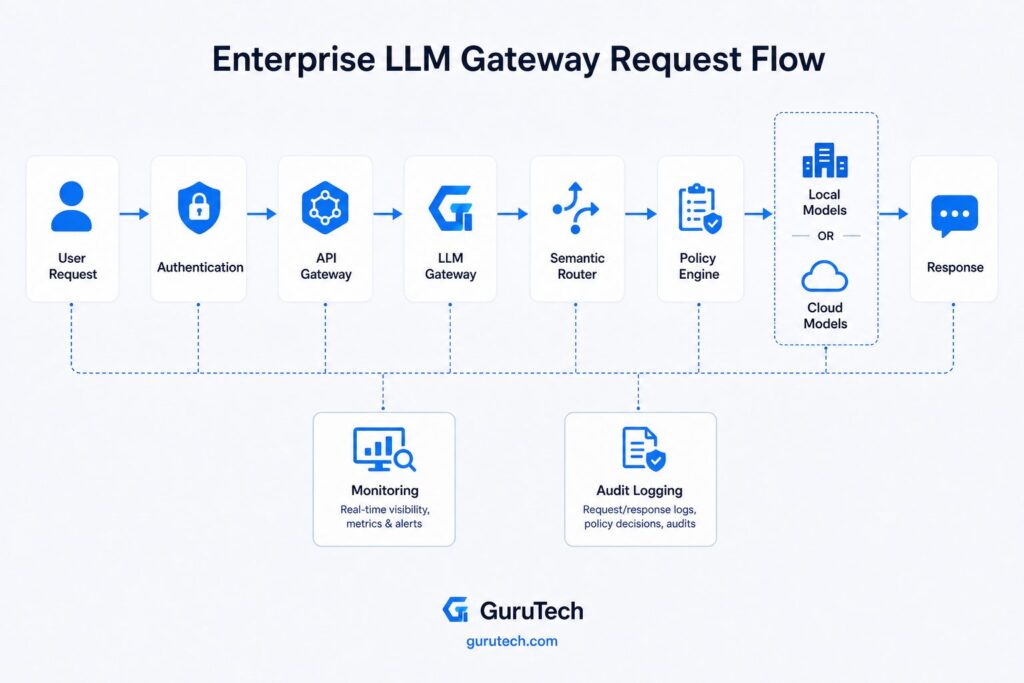
Enterprise Gateway Architecture
Enterprise gateway architecture establishes a multi-layered control plane that sits between applications and language models, enforcing governance policies while managing traffic across distributed model providers.
The architecture separates concerns through distinct components that handle routing decisions, policy enforcement, observability, and model abstraction.
Applications
Applications interact with the LLM gateway through standardized API contracts rather than directly calling model provider endpoints.
This abstraction allows engineering teams to swap providers, implement fallback strategies, and enforce organizational policies without modifying application code.
Enterprise systems typically authenticate using OAuth 2.0 or API keys that map to cost centers, enabling granular budget tracking across departments.
A healthcare claims processing system might route requests through the gateway with departmental identifiers that tie token consumption to specific business units.
Banking applications enforce compliance tags that trigger policy evaluation before requests reach model endpoints.
The gateway exposes OpenAI-compatible endpoints alongside provider-specific interfaces, allowing teams to maintain existing integrations while gaining centralized control.
Applications receive normalized error responses regardless of which underlying model failed, simplifying error handling logic.
API Gateway
The API gateway layer handles traditional cross-cutting concerns before requests reach LLM-specific processing.
Rate limiting, authentication, TLS termination, and request validation occur at this boundary to protect downstream components from malformed or malicious traffic.
Organizations running enterprise AI infrastructure deploy API gateways with token-aware rate limiting that understands LLM request patterns.
A financial services firm might implement tiered rate limits that allow 10,000 tokens per minute for standard users while granting elevated quotas to critical trading systems.
The API gateway enforces network-level isolation for regulated workloads.
Healthcare providers route PHI-containing requests through dedicated gateway instances that never traverse public networks, maintaining HIPAA compliance boundaries.
LLM Gateway
The LLM gateway serves as a standardized abstraction layer that normalizes API interfaces across multiple model providers while enabling intelligent routing and fallback mechanisms.
This component transforms provider-specific request formats into a unified schema, allowing applications to switch between Anthropic, OpenAI, Google, and Amazon Bedrock without code changes.
The gateway implements circuit breaker patterns that detect provider failures and redirect traffic to healthy alternatives within milliseconds.
When Azure OpenAI experiences regional outages, the gateway automatically fails over to AWS Bedrock deployments while logging the transition for operational review.
Cost attribution occurs at the gateway level through virtual key management that maps logical identifiers to actual provider credentials.
A multinational bank assigns project-specific virtual keys that roll up token consumption to business units, enabling chargeback models for AI infrastructure costs.
Semantic Router
Semantic routing analyzes request content to determine optimal model selection based on query complexity, domain requirements, and cost constraints.
Rather than static routing rules, semantic routing uses embeddings to classify requests and match them to appropriate model tiers.
Insurance underwriting systems route straightforward policy lookups to efficient models like Claude 3.5 Haiku.
They direct complex risk assessments to Claude 3.5 Opus.
The router maintains embedding-based classifiers that categorize incoming prompts without requiring explicit rule definitions.
Financial compliance applications implement domain-specific routing that directs regulatory interpretation questions to models fine-tuned on legal corpora.
The semantic router evaluates prompt embeddings against learned category boundaries, achieving 94% accuracy in model selection while reducing inference costs by 40% compared to uniform routing.
Policy Engine
The policy engine evaluates governance rules before allowing requests to reach model providers, enforcing content filtering, data classification requirements, and compliance boundaries.
Policy decisions occur synchronously in the request path, blocking prohibited content before tokens are consumed.
Healthcare organizations implement HIPAA-aligned policies that scan prompts for protected health information patterns and reject requests containing patient identifiers.
Banking systems enforce policies that prevent customer PII from reaching cloud-hosted models, routing sensitive queries exclusively to on-premises deployments.
Policy definitions use declarative rule languages that separate compliance logic from application code.
A pharmaceutical company maintains policies as version-controlled YAML files that specify which model providers can process clinical trial data based on BAA agreements and data residency requirements.
Model Registry
The model registry maintains metadata about available models, including pricing, token limits, capability profiles, and deployment locations.
This centralized catalog enables dynamic routing decisions and provides a single source of truth for model availability across hybrid environments.
Registry entries capture SLA commitments, acceptable use policies, and cost structures for each model deployment.
Financial institutions track which models have undergone internal validation for specific use cases, preventing production systems from accessing unvetted providers.
The registry integrates with deployment pipelines to automatically register new model endpoints as they become available.
When a bank deploys a fine-tuned model for fraud detection, the registry updates to include performance benchmarks, cost per token, and approved use case classifications.
Local Models
Local model deployments run within organizational data centers or private cloud environments to satisfy data sovereignty requirements and reduce latency for high-throughput applications.
These models connect to the gateway through private network links that never traverse public internet paths.
Healthcare providers deploy HIPAA-compliant model instances on dedicated hardware that processes patient data without sending information to external providers.
The gateway routes PHI-containing requests exclusively to these local endpoints while directing general queries to cost-effective cloud alternatives.
Organizations running local models balance infrastructure costs against data governance requirements.
A European bank operates Mistral models on-premises to comply with GDPR data residency rules, accepting higher per-token costs in exchange for regulatory certainty.
Cloud Models
Cloud model integrations connect the gateway to managed AI services from AWS, Azure, Google Cloud, and specialized providers like Anthropic and OpenAI.
The gateway maintains credential vaults and connection pools for each provider, abstracting authentication complexity from calling applications.
Multi-cloud strategies distribute requests across providers to avoid vendor lock-in and maintain availability during regional outages.
A trading platform splits model calls between AWS Bedrock in us-east-1 and Azure OpenAI in westeurope, automatically shifting traffic when either region experiences degradation.
Cloud model selection considers pricing tiers, regional availability, and service level agreements.
Organizations route batch processing workloads to providers offering committed use discounts while reserving on-demand capacity for interactive applications that require guaranteed latency.
Monitoring
Monitoring infrastructure captures request traces, routing decisions, provider latency, token consumption, cache efficiency, and error rates across every model invocation.
Most enterprise deployments export metrics to Prometheus or OpenTelemetry before visualizing them in Grafana or commercial observability platforms. Operations teams monitor P95 latency, time to first token, routing distribution, fallback events, and per-provider costs to detect issues before they affect production workloads.
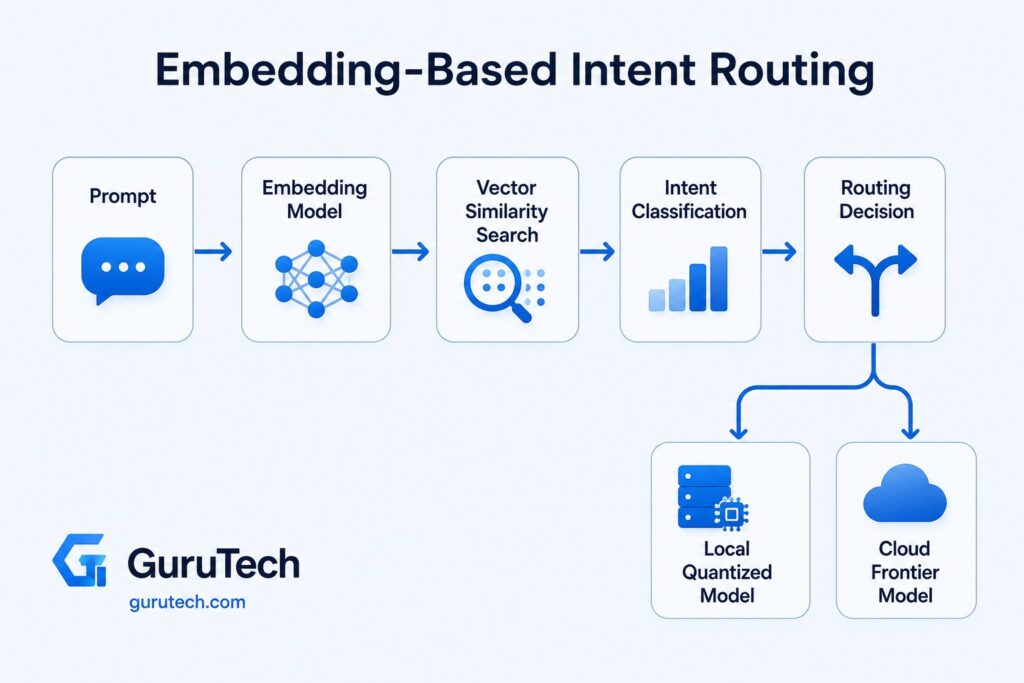
Runtime Semantic Routing and Request Classification
Runtime semantic routing intercepts incoming prompts, generates embeddings, performs vector similarity searches against predefined intent categories, and routes requests to appropriate model endpoints based on classification confidence scores.
This process enables cost reduction of 40-98% while maintaining output quality by matching query complexity to model capability.
Prompt Interception
The gateway intercepts every inbound request before it reaches any model endpoint, extracting the prompt text, metadata, and contextual signals.
Platform engineers configure interception at the API gateway layer or within a dedicated orchestration service that sits between client applications and model backends.
This architectural decision determines latency characteristics and failure domain boundaries.
Financial services implementations typically deploy interception logic within a dedicated routing service that runs alongside model inference containers.
The service extracts user_id, tenant_id, task type hints, and priority flags from normalized request payloads.
Healthcare platforms add PHI detection and sensitivity classification at this stage to enforce data governance policies before routing decisions execute.
Embedding Generation
The router generates dense vector embeddings from intercepted prompts using lightweight encoder models optimized for sub-10ms inference latency.
Organizations select embedding models based on language coverage, dimensionality trade-offs, and computational overhead relative to the target inference backend.
Common architectures deploy sentence-transformers or distilled BERT variants that produce 384 or 768-dimensional vectors.
Production systems cache embedding generation for frequently repeated queries to reduce computational costs.
Banking platforms processing high volumes of similar customer service queries report 60-70% cache hit rates on embedding lookups.
The embedding model version must remain consistent across the routing infrastructure to prevent vector drift that degrades classification accuracy over time.
Vector Similarity Search
The system performs cosine similarity or dot product operations between the generated prompt embedding and pre-computed intent category embeddings stored in vector indexes.
Teams deploy specialized vector databases like Pinecone, Weaviate, or FAISS for sub-millisecond retrieval at scale.
Simpler deployments use in-memory NumPy operations for small intent catalogs.
Enterprise architectures maintain separate vector indexes per tenant or business unit to enforce data isolation and enable customized routing policies.
A pharmaceutical research platform might maintain distinct intent categories for regulatory compliance queries, clinical trial analysis, and general scientific literature review.
Index updates follow blue-green deployment patterns to prevent classification disruption during intent category modifications.
Intent Classification
The router assigns the prompt to the intent category with the highest similarity score, typically requiring scores above a minimum confidence threshold to proceed with routing.
Semantic routing platforms support 15-50 intent categories in production deployments, balancing classification granularity against operational complexity and maintenance burden.
Organizations define intent taxonomies based on task complexity, domain specialization, and cost tier boundaries.
A retail banking implementation might classify intents as: account_balance_simple, transaction_dispute_medium, loan_underwriting_complex, and fraud_analysis_critical.
Each intent maps to specific model endpoints with appropriate capability levels and cost structures.
Multi-label classification enables routing to multiple models for ensemble or verification workflows.
Healthcare diagnostic support systems route certain queries to both a specialized medical model and a general reasoning model, comparing outputs before returning results to clinicians.
Routing Thresholds
Platform engineers configure minimum confidence thresholds that determine whether a classified intent triggers routing to a specialized model or falls back to a default endpoint.
Thresholds typically range from 0.65 to 0.85 depending on the cost differential between specialized and default models.
Lower thresholds increase specialized model utilization and costs while higher thresholds prioritize cost optimization at the expense of potential quality degradation.
Threshold strategies vary by workload criticality and financial constraints:
| Threshold Range | Routing Behavior | Use Case |
|---|---|---|
| 0.85-0.95 | Conservative specialized routing | High-stakes regulated workflows |
| 0.70-0.85 | Balanced cost-quality optimization | General enterprise applications |
| 0.50-0.70 | Aggressive cost reduction | Non-critical batch processing |
Production systems implement dynamic threshold adjustment based on real-time cost metrics and quality feedback.
A financial analysis platform might lower thresholds during off-peak hours when compute costs decrease, then raise them during market volatility when accuracy requirements increase.
Execution Branching
Once classification and threshold validation complete, the router executes branching logic that directs the request to the selected model endpoint with appropriate context, parameters, and retry policies.
Enterprise implementations maintain routing tables that map intent categories to model endpoints, fallback chains, and circuit breaker configurations.
The vLLM Semantic Router architecture supports complex branching logic including multi-stage routing where classification results trigger additional semantic analysis or policy evaluation.
A healthcare claims processing system might route high-confidence simple queries directly to a small model while triggering human review workflows for ambiguous classifications below confidence thresholds.
Execution branches inherit observability context from the initial request, enabling distributed tracing across routing decisions and model invocations.
Platform teams correlate classification scores, routing paths, model responses, and latency metrics to identify optimization opportunities and detect routing policy drift.
Embedding-Based Routing Efficiency
Embedding-based semantic routing delivers 5-15ms classification overhead compared to 50-200ms saved by routing simple queries away from frontier models.
The LLMRouter system demonstrates that routing accuracy above 85% produces net cost savings even with classification overhead factored into total request latency.
Organizations balance embedding dimensionality, index size, and lookup performance based on query volume and latency requirements.
A customer service platform processing 10,000 requests per second might deploy quantized 256-dimensional embeddings with approximate nearest neighbor search to maintain sub-5ms classification times.
Lower-volume research applications use full-precision 768-dimensional embeddings with exact similarity search for maximum classification accuracy.
Production deployments co-locate embedding generation and vector search on the same infrastructure tier as the routing service to minimize network hops.
Cloud-based implementations deploy regional routing clusters that maintain synchronized intent indexes and embedding model replicas to reduce cross-region latency and improve resilience during availability zone failures.
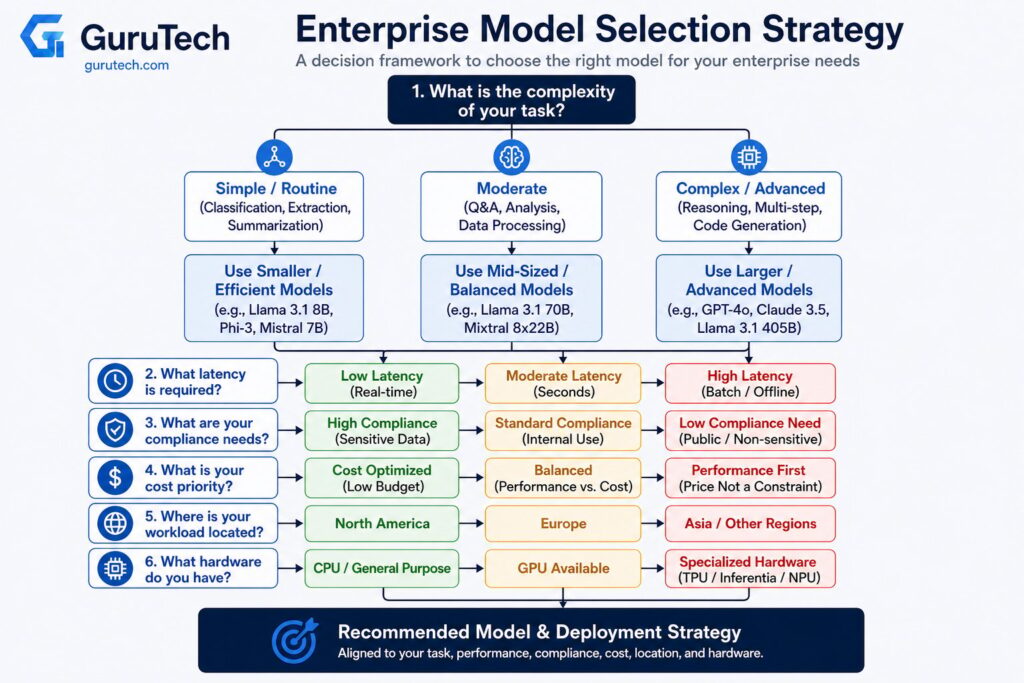
Intelligent and Policy-Based Model Selection
LLM gateways implement intelligent model selection through multiple routing dimensions simultaneously—matching requests to models based on capability requirements, latency constraints, cost budgets, compliance mandates, geographic proximity, and available hardware.
Production systems combine these policies into composite routing strategies that balance competing objectives across heterogeneous model deployments.
Capability-Aware Routing
Capability-aware routing analyzes task requirements and routes requests to models with appropriate competencies for each workload.
Simple classification tasks route to smaller models like GPT-3.5, while complex reasoning workflows route to frontier models like GPT-4 or Claude Opus.
Intelligent model routing frameworks use semantic analysis, domain classification, and preference learning to predict which model will produce optimal results for each query type.
BERT classifiers and matrix factorization approaches learn from preference data to identify patterns indicating task complexity.
Enterprise implementations segment workloads by capability domains.
Customer service chatbots handling routine inquiries route to cost-efficient models, while escalated queries requiring nuanced understanding route to larger models.
Code generation tasks route to specialized models like Codex or Code Llama rather than general-purpose models.
Financial institutions implement capability routing for document analysis workloads.
Simple data extraction from standardized forms routes to lightweight models, while complex contract analysis requiring legal reasoning routes to models with superior comprehension capabilities.
The gateway tracks routing decisions and model performance across capability categories for continuous optimization.
Latency-Aware Routing
Latency-aware routing prioritizes response time requirements by selecting models and providers based on observed inference performance.
Real-time applications like conversational interfaces require sub-second response times. Batch processing workflows tolerate higher latency in exchange for cost savings.
Gateways maintain performance metrics for each model-provider combination including time-to-first-token, tokens-per-second throughput, and P95 latency percentiles.
Routing decisions incorporate these measurements alongside current load conditions and geographic proximity to inference endpoints.
Cache-aware routing strategies maximize KV cache hit rates by maintaining affinity between similar requests and specific model replicas.
Random round-robin routing destroys cache locality, causing tail latency spikes and underutilized cache memory.
Intelligent routing to cache-warm replicas delivers 3x improvements in P90 latency.
Healthcare platforms implement latency-aware routing for clinical decision support systems where response time directly impacts patient care.
High-priority clinical queries route to dedicated low-latency endpoints. Administrative document processing routes to shared capacity with higher latency tolerances.
Cost-Aware Routing
Cost-aware routing optimizes inference spending by selecting models that meet quality thresholds at minimum cost per request.
Production deployments achieve 42-85% cost reduction by routing simpler queries to smaller models while preserving quality through selective use of expensive frontier models.
Routing algorithms balance per-token pricing differences across providers, input versus output token costs, and total request cost including routing overhead.
Matrix factorization approaches achieve 95% GPT-4-level performance using only 26% GPT-4 calls, while causal LLM routers require 54% GPT-4 calls for equivalent quality.
Gateways implement cost budgets at multiple granularities—per user, per application, per department, and organization-wide.
When budgets approach limits, routing policies shift toward more aggressive use of smaller models or implement rate limiting to prevent overruns.
Enterprise deployments combine cost routing with semantic caching to eliminate redundant inference costs.
Semantic similarity detection identifies queries that match cached responses, reducing API spending by 30-40% for workloads with repetitive patterns.
Banking platforms cache responses for common customer inquiries while routing unique questions through cost-optimized model selection.
Compliance-Aware Routing
Compliance-aware routing enforces regulatory requirements and data governance policies through model and provider selection rules.
Regulated industries implement geographic data residency, model approval workflows, and audit logging requirements that constrain routing decisions.
Healthcare organizations subject to HIPAA requirements route protected health information exclusively to compliant providers with executed Business Associate Agreements.
Financial services firms route regulated data to models deployed in approved regions with appropriate certifications and encryption standards.
Gateways implement role-based access control that restricts certain user groups or applications to approved model subsets.
Development environments access a broader model catalog while production systems enforce stricter compliance policies.
Policy engines validate routing decisions against governance rules before forwarding requests to providers.
European banking institutions implement compliance routing that keeps customer data within EU borders by routing to regional model deployments.
The gateway blocks routes to providers without GDPR compliance certifications and maintains audit trails documenting routing decisions for regulatory examination.
Geographic Routing
Geographic routing selects model endpoints based on physical proximity to minimize network latency and satisfy data residency requirements.
Edge deployments route requests to the nearest available inference capacity while respecting regional compliance constraints.
Multi-region architectures deploy model replicas across geographic zones and route based on client location, provider availability, and network conditions.
Automatic failover to alternate regions maintains availability when primary endpoints experience outages or capacity constraints.
Hybrid cloud deployments combine on-premises models for sensitive workloads with cloud-based models for elastic capacity.
The gateway routes regulated data to private cloud infrastructure while routing general workloads to public cloud providers with lower costs and broader model selection.
Global enterprises implement geographic routing policies that align with operational footprints.
Asia-Pacific requests route to regional endpoints during business hours, falling back to other regions during maintenance windows.
CDN-style routing strategies minimize cross-region data transfer costs while maintaining acceptable latency profiles.
Hardware-Aware Routing
Hardware-aware routing considers underlying compute infrastructure when selecting model endpoints.
Different GPU architectures, memory configurations, and batch processing capabilities create performance variations across deployments running identical models.
Gateways track hardware specifications for each inference endpoint including GPU type, memory capacity, and concurrent request handling.
Routing decisions match workload characteristics to optimal hardware—large batch processing routes to high-memory systems while low-latency requests route to dedicated GPU instances.
Quantized models running on specialized hardware like AWS Inferentia or Google TPUs offer cost advantages for specific workload types.
The gateway routes compatible requests to specialized accelerators while routing workloads requiring full precision to standard GPU infrastructure.
Financial modeling platforms implement hardware-aware routing that directs complex simulation workloads to multi-GPU systems with high memory bandwidth.
Simple calculations route to cost-efficient single-GPU endpoints.
The routing strategy maximizes hardware utilization across heterogeneous infrastructure.
Combining Routing Policies
Production LLM gateways implement composite routing strategies that balance cost, latency, quality, compliance, and hardware availability simultaneously. Rather than relying on a single rule, the gateway evaluates multiple policies in priority order and selects the model that best satisfies business objectives. This layered approach allows organizations to optimize costs while maintaining service-level objectives and regulatory compliance.
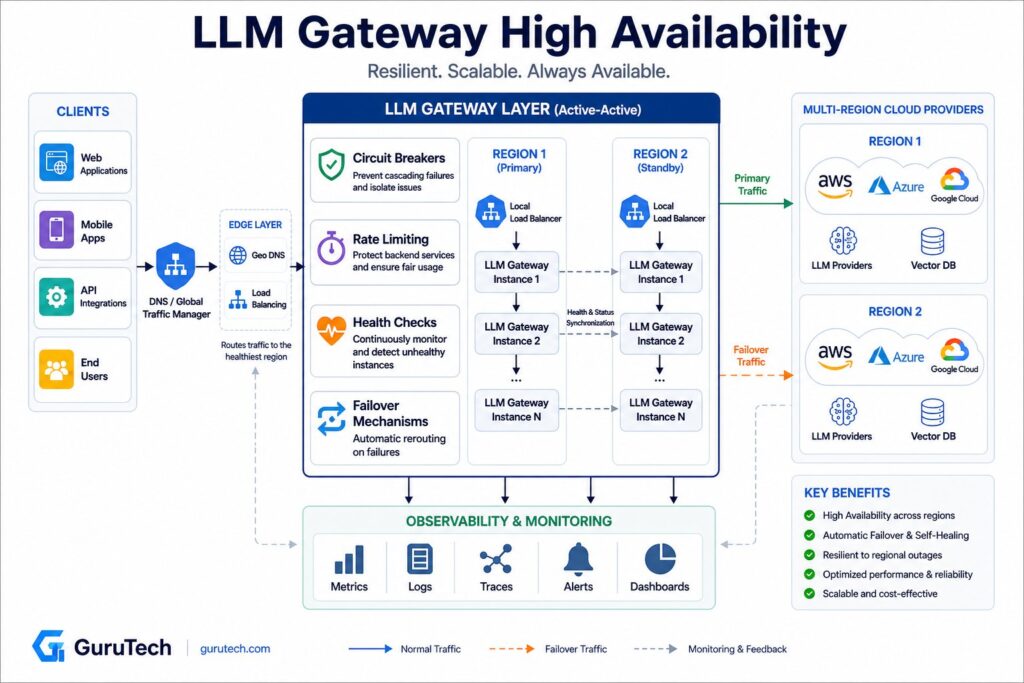
Production Resilience Patterns and Failure Mitigation
LLM gateway orchestration requires deliberate architectural patterns to maintain service continuity during provider outages, quota exhaustion, and latency spikes.
Organizations implement dynamic model fallback mechanisms, token bucket rate limiting, circuit breakers, geographic distribution strategies, and exponential backoff to prevent cascading failures across production workloads.
Dynamic Model Fallback
Model failover logic routes requests to alternative models when primary endpoints experience throttling, timeout errors, or service disruptions.
The gateway maintains a prioritized list of model endpoints ranked by cost, latency characteristics, and quota availability.
When the primary model returns HTTP 429 rate limit errors or fails health checks, the orchestration layer automatically redirects traffic to secondary models without application-level intervention.
Financial services platforms configure fallback chains that route from premium models to cost-effective alternatives during quota exhaustion events.
The architecture typically implements weighted routing during steady-state operations, directing 90% of traffic to primary models while reserving secondary capacity for overflow.
Healthcare systems configure fallback strategies that maintain HIPAA compliance by restricting failover targets to models with appropriate data residency guarantees.
Banking applications enforce policy constraints that prevent fallback to models lacking required audit logging capabilities.
Token Bucket Rate Limiting
Token bucket algorithms enforce per-consumer quotas at the gateway layer to prevent resource exhaustion and noisy neighbor problems in multi-tenant environments.
Each consumer receives an allocated request rate measured in tokens per minute, with the bucket refilling at a predetermined interval.
The gateway tracks token consumption per tenant, API key, or service account across all distributed gateway instances using shared state in Redis or DynamoDB.
When a consumer exhausts their token allocation, subsequent requests receive HTTP 429 responses until the bucket refills.
Multi-tenant SaaS platforms implement hierarchical token buckets with organizational quotas subdivided across business units and individual applications.
This isolation strategy ensures that a single tenant’s burst traffic cannot degrade service quality for other consumers sharing the same model endpoints.
Financial institutions configure conservative token limits for development environments while allocating higher quotas to production workloads requiring guaranteed throughput.
Circuit Breaking
Circuit breakers monitor failure rates per model endpoint and temporarily halt traffic to degraded providers, preventing request queuing and timeout accumulation.
The circuit transitions through closed, open, and half-open states based on error thresholds and time windows.
In the closed state, the gateway forwards all requests to the model endpoint while tracking failure rates.
When error rates exceed configured thresholds—typically 50% failures over a 60-second window—the circuit opens and immediately rejects requests without attempting endpoint calls.
After a cooldown period, the circuit enters a half-open state, allowing a small percentage of test requests to determine if the endpoint has recovered.
Enterprise deployments configure circuit breakers per model provider rather than globally to isolate failures to specific vendors.
Healthcare platforms set conservative thresholds to fail fast during provider outages, preventing request backlog that would delay patient-facing applications.
The pattern integrates with observability platforms to trigger alerts when circuits open, enabling operations teams to investigate root causes before quota limits reset.
Geographic Failover
Cross-region model distribution routes requests to geographically dispersed inference endpoints to maximize availability during regional service disruptions.
The gateway maintains model registries that map logical model identifiers to physical endpoints across AWS regions, Azure availability zones, or Google Cloud locations.
Amazon Bedrock cross-Region inference automatically distributes traffic based on real-time availability and latency metrics without manual intervention.
Financial institutions configure primary regions in us-east-1 with automatic failover to us-west-2 and eu-west-1 to maintain service during regional outages.
The architecture accounts for data residency requirements by restricting failover targets to compliant regions.
European healthcare systems configure geographic routing policies that prevent request redirection to non-EU regions regardless of availability.
Multi-account strategies distribute requests across AWS accounts, each with independent quotas and cross-region profiles to multiply aggregate throughput beyond single-account limits.
Retry With Exponential Backoff
Exponential backoff patterns space retry attempts with progressively longer delays to reduce load on degraded endpoints while maintaining eventual consistency.
The gateway implements jittered backoff intervals to prevent thundering herd problems when multiple clients retry simultaneously.
Initial retry attempts occur after 100-200ms with exponential multipliers that extend delays to 1s, 2s, 4s, and 8s for subsequent failures.
The pattern applies specifically to transient errors including HTTP 429 rate limits, 503 service unavailable responses, and network timeout exceptions.
Permanent failures such as HTTP 400 bad request or 401 authentication errors trigger immediate failure without retry logic.
Banking applications configure maximum retry limits of 3-5 attempts to balance availability against user experience, preventing excessive latency during sustained outages.
The orchestration layer coordinates retry logic with circuit breakers to halt retry attempts when circuits open, avoiding wasted compute on known-failed endpoints.
Pattern-Mitigation Table Reference
| Failure Mode | Primary Pattern | Secondary Pattern | Detection Window | Recovery Time |
|---|---|---|---|---|
| Provider rate limit | Dynamic Model Fallback | Token Bucket Rate Limiting | <1s | Immediate |
| Regional outage | Geographic Failover | Circuit Breaking | 30-60s | 2-5min |
| Transient network error | Retry With Exponential Backoff | Circuit Breaking | <5s | 10-30s |
| Quota exhaustion | Token Bucket Rate Limiting | Dynamic Model Fallback | <1s | Next quota period |
| Provider degradation | Circuit Breaking | Geographic Failover | 60s | 5-10min |
Organizations combine multiple patterns to address common LLM failure modes including prompt fragility, retrieval degradation, and latency spikes.
The orchestration layer coordinates pattern execution through policy engines that encode business rules for failover precedence, cost constraints, and compliance requirements.
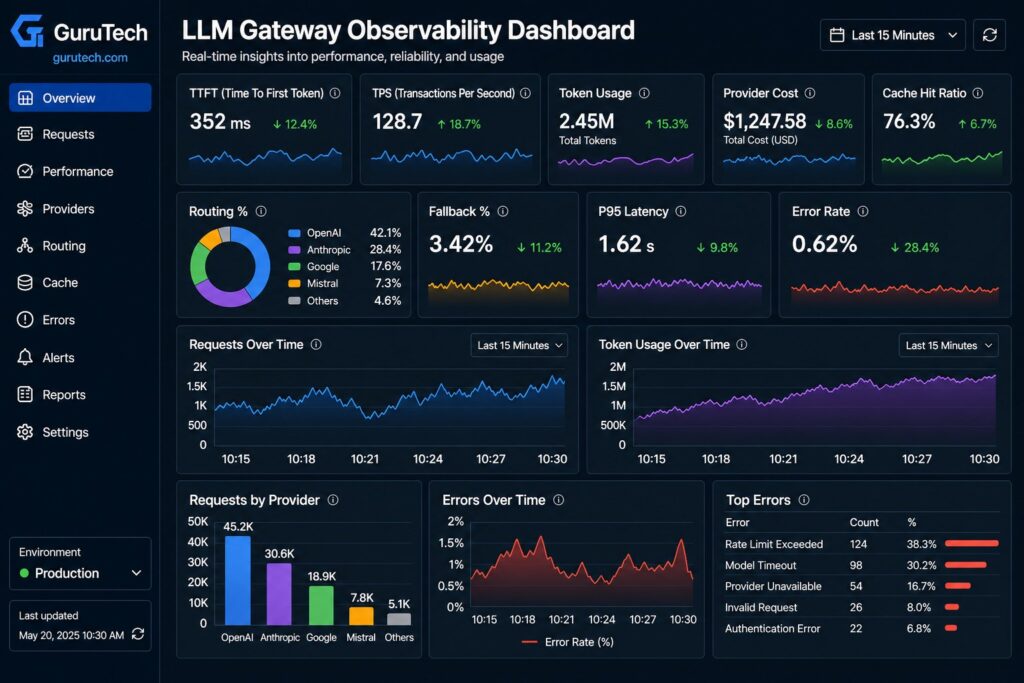
Observability, Telemetry, and Cost Governance
Production LLM gateway deployments require comprehensive telemetry to track latency distributions, token consumption patterns, provider costs, routing decisions, and cache efficiency across multi-model environments.
Enterprise teams need granular metrics tied to budget controls, security policies, and governance frameworks that satisfy regulatory requirements in banking, healthcare, and other regulated industries.
Latency Analytics
Latency analytics capture end-to-end request duration from gateway ingress to provider response, decomposed into constituent phases including request validation, routing decisions, provider API calls, and response streaming. Platform engineers typically instrument P50, P95, and P99 latency distributions per model, provider, and customer segment to identify performance degradation before it impacts service-level agreements.
Gateway observability platforms aggregate latency data across distributed deployments, correlating performance anomalies with specific routing rules, model versions, or provider availability zones. Teams operating in hybrid cloud environments often discover that cross-region provider calls introduce 100-300ms of additional latency compared to same-region routing.
Financial services organizations frequently set P95 latency targets below 2 seconds for customer-facing AI features and configure automated alerts when distributions exceed thresholds. Advanced implementations track latency variance across prompt complexity tiers, identifying whether performance degradation stems from infrastructure issues or prompt engineering patterns that trigger excessive token generation.
This correlation enables architectural decisions about prompt optimization versus infrastructure scaling.
TTFT Monitoring
Time to first token (TTFT) measures the interval between request initiation and the first streaming response token, directly impacting perceived application responsiveness in conversational interfaces and real-time AI features.
TTFT performance depends on provider cold start latency, model loading times, and network round-trip delays between gateway infrastructure and provider endpoints. Enterprise architectures typically monitor TTFT separately from total request latency because streaming applications prioritize fast initial response over total throughput.
Healthcare platforms serving clinical decision support tools often require TTFT below 500ms to maintain physician workflow continuity. Banking fraud detection systems may accept higher TTFT for batch processing workloads while enforcing stricter limits on customer-facing chatbots.
Gateway telemetry systems correlate TTFT degradation with specific providers, geographic regions, and traffic patterns to inform failover configurations. Some implementations automatically route latency-sensitive requests to providers with consistently lower TTFT even when per-token costs are marginally higher.
Tokens per Second
Tokens per second (TPS) quantifies streaming throughput for LLM responses, affecting user experience in applications rendering AI-generated content in real time. Low TPS rates create perceptible delays in typewriter-style interfaces, while excessively high rates may overwhelm client rendering pipelines or violate rate limits on downstream systems consuming gateway outputs.
Platform engineers monitor TPS distributions across models and providers to validate that streaming performance meets application requirements. Anthropic Claude models typically deliver 40-60 tokens per second on standard tier access, while OpenAI GPT-4 Turbo averages 30-50 tokens per second depending on regional deployment and current load.
Provider-specific TPS variance influences routing decisions for latency-sensitive workloads. Gateway implementations track TPS degradation as an early indicator of provider capacity constraints or network congestion.
Some architectures implement adaptive concurrency controls that reduce request parallelism when TPS drops below acceptable thresholds, preventing cascade failures across distributed gateway clusters.
Token Accounting
Token accounting systems track input tokens, output tokens, and cached tokens across every request to enable precise cost attribution and budget enforcement. Enterprise gateways implement hierarchical accounting that aggregates consumption by team, project, customer, and cost center while maintaining request-level granularity for audit trails.
Accurate token counting requires provider-specific tokenization logic because different models use distinct tokenizer implementations. GPT-4 uses tiktoken with cl100k_base encoding, while Claude uses a custom tokenizer that produces different token counts for identical inputs.
Gateway implementations either replicate provider tokenization logic locally or rely on provider-reported token counts, accepting slight timing delays in cost attribution. Financial services organizations enforce hard budget limits at the team and project level, automatically rejecting requests that would exceed allocated quotas.
Healthcare platforms implement soft limits with approval workflows that require management authorization before exceeding predefined thresholds. AI token observability dashboards aggregate token consumption trends to forecast monthly spending and identify cost optimization opportunities.
Provider Cost Metrics
Provider cost metrics translate token consumption into actual spending across multiple LLM vendors with different pricing models, regional variations, and volume discount structures. Gateway cost tracking normalizes provider-specific pricing into unified dashboards that compare effective cost per request, cost per user session, and cost per business outcome.
Enterprise architectures maintain real-time cost telemetry that updates within seconds of request completion, enabling teams to detect cost anomalies before they accumulate into significant budget overruns. Cost governance systems correlate spending patterns with routing configurations, identifying whether cheaper models deliver acceptable quality for specific use cases.
Banking platforms often route routine customer service inquiries to lower-cost models while directing complex fraud analysis to frontier models, achieving 60% cost reduction without compromising critical workflows. Cost control capabilities include daily budgets and automatic model selection based on price optimization.
Routing Percentages
Routing percentage telemetry tracks the distribution of requests across providers, models, and availability zones, validating that traffic patterns match intended routing policies. Platform engineers monitor routing distributions to detect configuration drift, provider availability issues, and unexpected fallback behavior.
Production gateways typically implement weighted routing that distributes load across multiple providers to reduce concentration risk and avoid rate limits. A typical enterprise configuration might route 60% of requests to OpenAI, 30% to Anthropic, and 10% to AWS Bedrock, with automatic rebalancing when any provider experiences degraded availability.
Routing telemetry surfaces deviations from these targets that indicate provider outages or misconfigured policies. Semantic routing implementations track how often intent classification triggers specific routing rules, measuring the accuracy of routing decisions against ground truth labels.
Healthcare platforms routing medical coding queries to specialized fine-tuned models monitor routing precision to ensure that domain-specific requests consistently reach appropriate model endpoints rather than defaulting to general-purpose alternatives.
Fallback Frequency
Fallback frequency measures how often primary routing targets fail and trigger automatic failover to backup providers or models. Elevated fallback rates usually indicate provider reliability issues, capacity constraints, aggressive rate limiting, or routing policy drift. Teams should monitor fallback percentages over time and investigate sustained increases before they affect customer-facing applications.
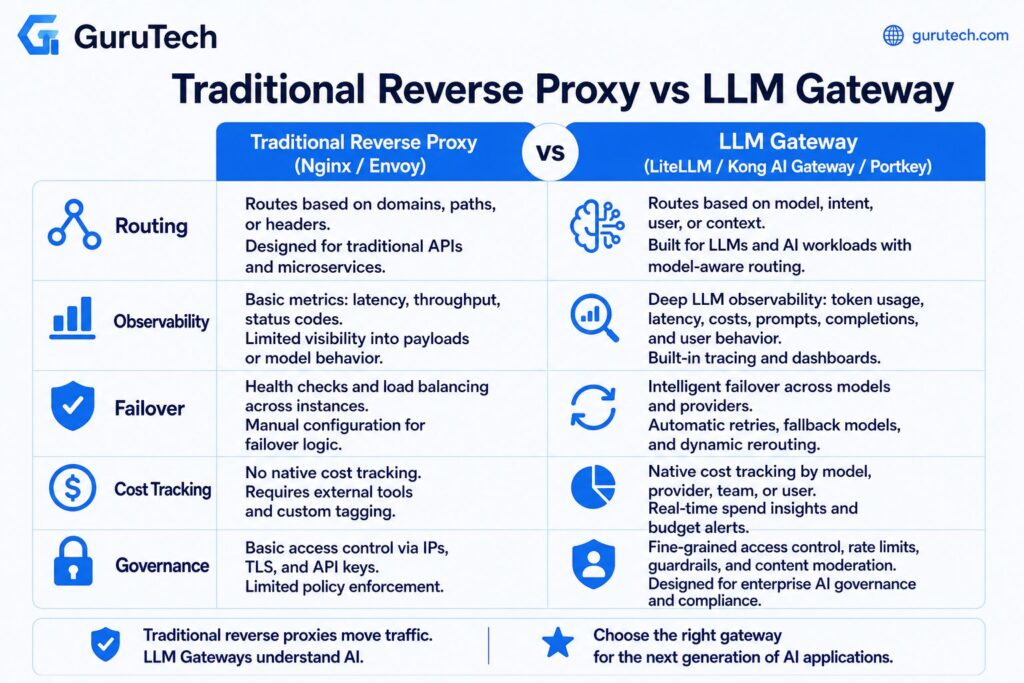
Reverse Proxies Versus LLM Gateway Platforms
Traditional reverse proxies route HTTP traffic without understanding token semantics, model-specific formats, or inference costs. LLM gateway platforms extend proxy capabilities with AI-aware features including token accounting, semantic caching, provider abstraction, budget enforcement, and prompt transformation.
Comparison Table: Legacy Versus AI Gateways
Standard reverse proxies like NGINX or HAProxy handle generic HTTP load balancing and SSL termination. They cannot interpret streaming tokens, track per-request costs, or route based on model capabilities.
| Feature | Traditional Reverse Proxy | LLM Gateway Platform |
|---|---|---|
| HTTP routing | Yes | Yes |
| Load balancing | Round-robin, least-conn | Token-aware, latency-based |
| Request transformation | Header manipulation | Provider format normalization |
| Cost tracking | No | Per-token, per-request, per-tenant |
| Semantic caching | Generic HTTP cache | Embedding-based similarity |
| Fallback routing | Health check only | Model capability + rate limit aware |
| Streaming support | Generic SSE passthrough | Token-level buffering and failover |
| Budget enforcement | No | Virtual keys with hard limits |
An LLM gateway functions as a model-aware reverse proxy that parses token usage from responses, maintains rate limit state per provider, and enforces session-scoped budgets. Kong AI Gateway extends traditional API management with AI-specific plugins while maintaining backward compatibility with existing Kong deployments.
Token Accounting and Semantic Routing
Token accounting requires parsing completion_tokens and prompt_tokens from provider responses to calculate costs in real time. Each provider reports usage differently—OpenAI returns usage objects, Anthropic includes token counts in headers, and self-hosted models require instrumentation at the inference server.
Gateways aggregate token counts across sessions to enforce budget caps. A financial services platform might allocate 100,000 tokens per customer interaction with hard stops at threshold to prevent runaway agent costs.
Healthcare applications require per-patient token attribution for compliance auditing. Semantic routing matches request characteristics to optimal models.
Cost-based routing strategies route simple queries to GPT-4o-mini and complex reasoning tasks to Claude Opus, achieving 60-85% cost reduction while maintaining quality thresholds.
Production implementations use classifier models to predict task complexity before routing decisions.
Provider Abstraction and Fallback Management
Provider abstraction normalizes incompatible API formats into a unified interface. Applications send OpenAI-compatible requests regardless of backend provider.
The gateway translates requests to Anthropic Messages API, Google Vertex AI, or Cohere formats as needed. Fallback chains define provider sequences with timeout thresholds.
A banking application might configure Claude Opus as primary with 5-second timeout, GPT-5 as secondary, and self-hosted Llama 3.3 as final fallback within the VPC. The gateway tracks which model served each request for accurate cost attribution.
Rate limit management requires tracking provider-specific quotas in real time. When approaching limits, the gateway reroutes to alternate providers or queues requests.
Key pooling multiplies effective rate limits by rotating through multiple API keys per provider—essential for platforms exceeding single-key quotas.
Observability and Governance
LLM gateways provide unified observability across heterogeneous providers. Distributed tracing links individual LLM calls to parent agent workflows or user sessions.
Latency metrics track time-to-first-token and total completion time per provider and model. Audit logging captures every prompt and response for compliance requirements in healthcare and financial services.
Portkey implements SOC 2, HIPAA, and GDPR-compliant logging with PII detection and redaction. Per-tenant log isolation ensures one customer cannot access another’s audit trail.
Governance policies enforce which models and tools agents can access. Virtual keys scoped to specific teams restrict model access—data science teams access frontier models while customer support uses cheaper alternatives.
MCP tool governance controls which external services agents can invoke through OAuth-managed credentials at the gateway layer.
Prompt Transformations
Prompt transformations modify requests before forwarding to providers. PII stripping removes sensitive data using regex patterns or named entity recognition before prompts leave infrastructure.
Injection detection scans for malicious payloads attempting to manipulate model behavior. Template enforcement standardizes prompt formats across applications.
A regulated industry might require all prompts to include compliance disclaimers or specify output constraints. The gateway injects these elements transparently without application code changes.
Response filtering removes prohibited content from completions. Healthcare platforms might strip medical advice disclaimers or redact patient identifiers from responses.
The gateway buffers streaming responses to apply filters before forwarding tokens to clients.
OpenAI-Compatible APIs
Most gateways expose OpenAI-compatible endpoints to minimize application changes. Developers point existing OpenAI SDK code at the gateway URL with a virtual API key.
The gateway handles provider translation, routing, and policy enforcement transparently. This compatibility accelerates migration from direct provider integration to gateway-mediated access.
An LLM proxy deployment requires only configuration changes rather than application rewrites. Feature parity limitations exist—some gateways lag behind the latest OpenAI API features during provider updates.
Streaming support requires careful implementation to maintain backpressure and handle mid-stream failover. The gateway must buffer token chunks, apply transformations, and forward downstream while tracking cumulative token usage for budget enforcement.
Relevant Platforms Overview
LiteLLM supports 100+ providers with broad compatibility but suffers performance degradation above 500 requests per second. Python-based architecture limits throughput compared to compiled alternatives.
Best suited for internal tools and development environments rather than high-scale production.
Portkey operates as a managed control plane with enterprise authentication, distributed tracing, and compliance certifications.
The platform handles 10 billion requests monthly with 99.9999% uptime claims but introduces 20-40ms overhead when guardrails activate.
Pricing starts at $49 monthly for basic tiers with enterprise contracts exceeding $5,000.
Bifrost focuses on extremely low-latency gateway performance and is designed for organizations requiring high request throughput. As with any emerging platform, evaluate benchmark methodology, ecosystem maturity, and operational tooling against your own production requirements before standardizing on it.
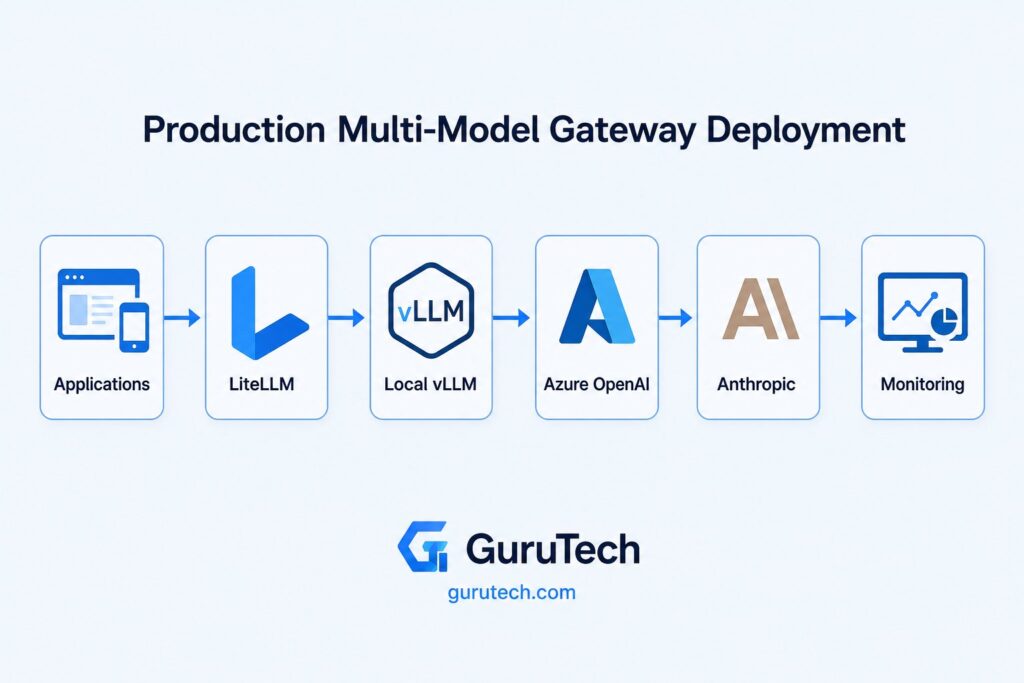
Production Deployment Example: Multi-Model Gateway Configuration
A production LLM gateway requires explicit configuration of model endpoints, failover behavior, rate limits, and authentication across multiple providers.
The following configuration demonstrates how LiteLLM handles multi-model routing through declarative YAML definitions that specify local inference servers, cloud provider endpoints, and operational guardrails.
LiteLLM YAML Proxy Example
LiteLLM uses a declarative YAML configuration file that defines all model endpoints, routing logic, and operational parameters in a single location.
This approach enables version-controlled infrastructure-as-code deployments where gateway configurations can be tested, reviewed, and rolled back through standard CI/CD pipelines.
The proxy configuration separates model definitions from runtime secrets, allowing the same configuration artifact to deploy across development, staging, and production environments with environment-specific credentials.
Teams managing multi-model routing strategies benefit from centralized configuration that reduces deployment errors and maintains consistency across distributed AI workloads.
model_list:
  - model_name: gpt-4-turbo
    litellm_params:
      model: azure/gpt-4-turbo
      api_base: ${AZURE_API_BASE}
      api_key: ${AZURE_API_KEY}
Local vLLM Endpoint
Organizations running on-premises inference servers configure local vLLM endpoints to route requests to self-hosted models for data sovereignty and cost control.
The configuration specifies the base URL of the vLLM server, model identifier, and any custom parameters required for prompt formatting or sampling.
Local endpoints eliminate egress costs and latency penalties associated with cloud-based inference while providing complete control over model versions and deployment topology.
Financial institutions and healthcare systems often deploy vLLM clusters within private networks to satisfy regulatory requirements that prohibit external API calls containing sensitive data.
  - model_name: llama-3-70b
    litellm_params:
      model: vllm/meta-llama/Llama-3-70b-instruct
      api_base: http://vllm-cluster.internal:8000
      rpm: 500
The rpm parameter enforces request-per-minute throttling at the gateway layer to prevent overwhelming the inference cluster during traffic spikes.
Azure OpenAI Endpoint
Azure OpenAI endpoints require specific configuration for API versioning, deployment names, and regional availability zones.
The gateway configuration maps logical model names to Azure-specific deployment identifiers, abstracting provider details from application code.
  - model_name: gpt-4-turbo
    litellm_params:
      model: azure/gpt-4-turbo-2024-04-09
      api_base: https://eastus.api.cognitive.microsoft.com/
      api_version: "2024-02-15-preview"
      api_key: ${AZURE_OPENAI_KEY}
Teams operating in regulated industries configure Azure deployments within customer-managed virtual networks and specify availability zones to meet disaster recovery requirements.
The configuration supports multiple Azure regions with identical deployment names to enable geographic failover without application changes.
Failover Status Codes
The gateway monitors HTTP status codes from model providers and triggers automatic failover when specific error conditions occur.
This configuration defines which status codes indicate transient failures that warrant routing to backup endpoints versus permanent errors that should return immediately.
litellm_settings:
  fallbacks:
    - gpt-4-turbo: ["gpt-4", "claude-3-opus"]
  allowed_fails: 3
  failure_status_codes: [429, 500, 502, 503, 504]
Status code 429 indicates rate limiting, while 5xx codes signal provider infrastructure issues.
The gateway tracks failure counts per endpoint and removes unhealthy providers from the routing pool until health checks succeed.
Banking platforms configure aggressive failover for customer-facing applications where latency directly impacts user experience and revenue.
Environment Variable API Keys
Production deployments inject API keys through environment variables rather than hardcoding credentials in configuration files.
This separation enables secure secret management through HashiCorp Vault, AWS Secrets Manager, or Kubernetes secrets without exposing keys in version control systems.
environment_variables:
  AZURE_API_KEY: "os.environ/AZURE_OPENAI_KEY"
  ANTHROPIC_API_KEY: "os.environ/ANTHROPIC_KEY"
  OPENAI_API_KEY: "os.environ/OPENAI_KEY"
The gateway retrieves environment variables at startup and refreshes credentials on SIGHUP signals to support zero-downtime secret rotation.
Organizations with compliance requirements implement automatic key rotation policies that update secrets in the backing store and trigger gateway configuration reloads without service interruption.
Request Limits
Gateway-level rate limiting prevents individual teams or applications from consuming disproportionate quota and protects backend model providers from request floods.
Configuration defines limits per model, per API key, and per virtual key assigned to internal teams.
litellm_settings:
  rpm: 1000
  tpm: 100000
  max_parallel_requests: 50
  timeout: 600
The tpm parameter enforces token-per-minute budgets based on prompt and completion token counts reported by model providers.
Healthcare organizations configure conservative limits during initial rollouts and gradually increase capacity as teams demonstrate responsible usage patterns and implement proper error handling.
Unified Model Naming
The gateway exposes consistent model names to applications regardless of underlying provider implementations.
This abstraction enables provider migrations without modifying application code or reconfiguring deployed agents.
| Unified Name | Backend Provider | Use Case |
|---|---|---|
fast-chat | gpt-3.5-turbo | High-volume support chatbots |
reasoning | gpt-4-turbo | Complex financial analysis |
long-context | claude-3-opus | Document summarization |
Applications request models by capability rather than vendor-specific identifiers, allowing platform teams to swap providers based on cost, performance, or availability without coordinating application deployments.
Enterprise teams operating multi-provider AI gateways update backend mappings during maintenance windows while maintaining API contract stability for downstream applications and services during provider migrations.
Operational and Engineering Best Practices
Production LLM gateway deployments require disciplined operational patterns that balance latency, cost, reliability, and governance.
Engineering teams must implement centralized routing, robust monitoring, and policy enforcement to maintain service quality across multiple models and providers.
Centralize Routing Logic
Centralizing routing logic within the gateway layer removes decision-making complexity from application code and enables consistent model orchestration across all services.
Rather than embedding provider selection logic in dozens of microservices, teams configure routing rules once at the gateway level using metadata such as cost thresholds, latency requirements, and compliance constraints.
A centralized approach allows platform teams to modify routing behavior without application deployments.
When a provider experiences degraded performance or a new model becomes available, updates occur at the gateway configuration level rather than requiring changes across multiple codebases.
This separation of concerns reduces deployment risk and accelerates model adoption timelines.
Banking platforms typically implement routing quality measurement with centralized decision trees that factor in data residency requirements, model certifications, and cost caps.
The gateway evaluates each request against predefined rules and selects the appropriate backend without exposing these complexities to calling services.
Provider Abstraction
Provider abstraction ensures applications remain decoupled from specific LLM vendors by presenting a unified API interface regardless of backend implementation.
Teams build against a standard contract that the gateway translates into provider-specific formats, enabling seamless migration between vendors without application code changes.
This abstraction layer handles differences in authentication schemes, request formats, response structures, and error codes across providers.
The gateway normalizes responses into a consistent schema and maps vendor-specific errors to standard HTTP status codes that applications can handle uniformly.
Healthcare organizations leverage provider abstraction to maintain compliance flexibility.
When regulatory requirements shift or vendor certifications change, the gateway redirects traffic to compliant providers while applications continue using the same API endpoints.
This architectural pattern reduces vendor lock-in risk and preserves optionality for future infrastructure decisions.
Request Monitoring
Request monitoring at the gateway layer provides comprehensive visibility into LLM usage patterns, performance characteristics, and failure modes across all applications and models.
Monitoring systems capture request metadata, latency distributions, token consumption, error rates, and cost attribution without requiring instrumentation in individual services.
Gateway-level monitoring integrates with enterprise observability platforms to correlate LLM performance with broader system health metrics.
Platform teams track p50, p95, and p99 latencies across model types and providers, identifying performance regressions before they impact user experience.
Token-level observability reveals cost drivers and enables chargeback models for multi-tenant environments.
Financial services firms implement AI token observability that tracks consumption by business unit, application, and user cohort.
These metrics inform budget allocation decisions and identify optimization opportunities where smaller models could replace expensive frontier deployments without sacrificing quality.
Aggressive Caching
Aggressive caching at the gateway reduces latency, cuts costs, and improves reliability by serving repeated requests from memory rather than invoking backend models.
Semantic caching goes beyond exact match lookups by identifying semantically similar prompts and returning cached responses when embedding similarity exceeds configured thresholds.
Cache hit rates directly impact operational costs since cached responses eliminate token consumption and API calls.
A well-tuned cache configuration can achieve 30-40% hit rates for common query patterns in customer support and documentation search scenarios.
The gateway handles cache invalidation based on time-to-live policies and content versioning rules.
Enterprise semantic caching implementations store embeddings alongside cached responses and use vector similarity search to identify near-matches.
When a request falls within the similarity threshold, the gateway returns the cached result immediately rather than incurring the latency and cost of a new model invocation.
This approach requires careful tuning to balance freshness requirements against efficiency gains.
Routing Quality Measurement
Routing quality measurement evaluates whether gateway routing decisions achieve intended outcomes across cost, latency, and accuracy dimensions.
Platform teams define quality metrics for each routing strategy and continuously monitor actual performance against targets to identify drift or misconfiguration.
Quality metrics include cost per request, average latency, error rates, and downstream application success indicators.
When routing logic prioritizes cost optimization, teams measure whether cheaper models maintain acceptable accuracy levels for specific use cases.
Latency-optimized routes track p95 response times and timeout rates.
Production implementations instrument routing decisions with metadata tags that flow through observability pipelines.
Dashboards segment performance metrics by routing rule, allowing teams to quantify trade-offs between different strategies.
A healthcare application might measure routing quality by tracking clinical accuracy rates alongside cost metrics to ensure savings initiatives don’t compromise patient safety.
Automated Failover
Automated failover maintains service availability when primary providers experience outages or performance degradation by redirecting traffic to backup endpoints without manual intervention.
The gateway monitors provider health through periodic health checks and request success rates, triggering failover when thresholds are breached.
Failover logic accounts for different failure modes including complete outages, elevated error rates, and latency spikes.
Configuration defines provider priority lists and fallback chains that preserve critical requirements such as data residency and compliance certifications.
The gateway attempts providers in order until receiving a successful response or exhausting available options.
Banking platforms implement circuit breaker patterns that temporarily disable failing providers to prevent cascading failures.
When error rates exceed configured thresholds, the circuit opens and routes traffic to healthy providers while periodically testing the failing endpoint for recovery.
This approach prevents request queuing and maintains predictable latency profiles during partial outages.
Enforced Governance
Enforced governance implements policy controls at the gateway layer to ensure all LLM interactions comply with security, privacy, and regulatory requirements.
Policy engines evaluate requests against rules covering data classification, content filtering, prompt injection detection, and allowed model types before forwarding to backend providers.
Governance policies enforce data residency constraints by blocking requests that would send regulated data to non-compliant regions or providers.
Content filters scan prompts and responses for sensitive information such as personally identifiable information or protected health information, redacting or blocking violating requests.
Rate limiting and quota management prevent resource exhaustion and control costs.
Regulated industries implement governance requirements that shape framework selection and architecture decisions.
A financial services gateway might enforce policies requiring audit logs for all LLM interactions, encryption in transit and at rest, and model versioning controls that prevent unauthorized model updates.
API Isolation
API isolation separates LLM traffic from other application workloads to prevent resource contention and enable independent scaling of AI infrastructure.
Dedicated gateway instances handle LLM requests with isolated compute, networking, and security policies. Separating AI traffic from traditional application APIs allows each environment to scale independently, simplifies troubleshooting, and reduces the risk that AI workloads will impact unrelated production services.
Common Implementation Pitfalls
Organizations moving LLM gateway orchestration to production encounter predictable failures around vendor dependency, routing logic, visibility, rate management, and operational hygiene.
Teams without experience in LLM orchestration for enterprises often replicate application logic inside the gateway layer or deploy gateways with no circuit breaker protection, creating cascading failures during provider outages.
Provider Lock-In
Teams that hardcode provider-specific request formats, error codes, or authentication schemes into application code create tight coupling that blocks future migration.
A banking client discovered this after embedding OpenAI function-calling syntax in 47 microservices, making Anthropic Claude adoption require six weeks of refactoring.
The gateway should normalize provider interfaces using the OpenAI-compatible format as a baseline, then translate requests and responses for non-compatible providers like Cohere or AI21.
Provider lock-in also appears in semantic caching layers when teams store cache keys with provider-specific metadata rather than normalized prompt hashes.
This forces cache invalidation during provider switches and eliminates reuse across models.
Governance policies encoded as provider API parameters rather than gateway-level rules create similar migration friction in regulated industries where audit requirements mandate centralized policy enforcement.
Cost-Only Routing
Routing requests solely on price-per-token metrics ignores latency, context window limits, tool-use support, and output quality requirements.
A healthcare SaaS provider that routed all requests to the cheapest available model experienced 34% higher hallucination rates in clinical documentation workflows, forcing manual review that eliminated cost savings.
Model routing strategies must incorporate quality thresholds, task classification, and SLA requirements alongside cost constraints.
Production routing logic should evaluate requests against a decision matrix that includes token budget, required capabilities, latency SLA, and compliance requirements.
Simple queries with strict latency needs route to fast, smaller models; complex reasoning tasks with accuracy requirements route to frontier models regardless of cost.
Financial services teams often implement tiered routing where customer-facing queries use premium models while internal summarization workloads use cost-optimized alternatives.
Lack of Observability
Gateways deployed without structured logging, distributed tracing, and token-level cost attribution create blind spots that prevent teams from diagnosing latency spikes, identifying expensive prompts, or auditing model decisions.
One insurance company discovered a single misconfigured batch job consumed 68% of monthly LLM spend only after implementing per-API-key cost tracking three months into production.
Without observability, teams experience 15-30% higher LLM costs from duplicate calls and no per-team attribution.
Proper instrumentation requires integration with enterprise observability platforms like Datadog, New Relic, or Grafana using OpenTelemetry standards.
Each request should emit trace IDs that correlate application spans with gateway routing decisions, provider API calls, cache hits, and token consumption.
Teams should track cache hit rate, P95 latency by model and route, cost per request, and error rate by provider to identify optimization opportunities and capacity constraints before they affect end users.
Inadequate Rate Limiting
Global rate limits applied uniformly across all consumers prevent high-priority workloads from accessing capacity during traffic spikes while allowing low-priority batch jobs to exhaust provider quotas.
A fintech platform experienced customer-facing chatbot timeouts when nightly document processing jobs consumed the entire rate limit pool.
Effective rate limiting requires per-tenant quotas, priority tiers, and burst allowances that align with business criticality.
Gateway rate limiters should implement token bucket algorithms with separate pools for interactive, batch, and admin workloads.
High-priority requests receive guaranteed baseline capacity plus burst access during normal conditions; lower-priority requests fill remaining capacity without blocking critical paths.
Teams operating in regulated industries often implement rate limits per compliance domain to prevent a single business unit from monopolizing shared infrastructure and creating audit gaps in unrelated systems.
Missing Circuit Breakers
Gateways without circuit breaker patterns attempt indefinite retries against failing providers, amplifying outages and exhausting rate limits across healthy backends.
When Anthropic experienced a 12-minute API degradation in March 2026, one healthcare client without circuit breakers sent 340,000 retry requests that triggered rate limiting and extended the customer-visible outage to 47 minutes.
Circuit breakers should fail fast and route to fallback providers after detecting elevated error rates.
Production implementations monitor error rate and P99 latency per provider in sliding windows, typically 30-60 seconds.
When error thresholds exceed 25% or latency degrades beyond 3x baseline, the circuit opens and requests route to secondary providers or return cached responses.
After a cooldown period, the circuit enters half-open state and tests recovery with a small percentage of traffic before fully closing.
This pattern prevents cascading failures and enables zero per-team cost attribution during provider incidents.
Duplicated Application Logic
Teams that embed business logic, prompt assembly, or data transformation inside both application code and gateway configurations create inconsistent behavior and deployment coupling.
A banking client discovered their fraud detection prompts existed in three locations: application YAML, gateway route configs, and a separate prompt registry, each with different versions and validation rules.
This anti-pattern violates the single responsibility principle and makes testing, versioning, and rollback operations unreliable.
The gateway should handle infrastructure concerns like routing, failover, caching, and observability while applications maintain ownership of domain logic, prompt templates, and response parsing.
Prompt templates belong in version-controlled registries with semantic versioning, not hardcoded in gateway route definitions.
Governance policies implemented as gateway middleware should enforce constraints like PII redaction or content filtering without duplicating application-level validation that checks business rule compliance.
No Audit Trails
Gateways that fail to log complete request context, routing decisions, and model responses create compliance gaps in regulated industries where audit requirements mandate explainability and decision reconstruction.
A healthcare provider faced HIPAA audit failures when they could not prove which model version processed specific patient data or whether PII redaction policies applied correctly.
Audit trails must capture immutable records linking each request to authenticated principals, applied policies, selected models, and output decisions.
Production audit systems write structured logs to append-only storage with tamper-evident hashing and retention policies matching regulatory requirements.
Each audit record should include the authenticated principal, timestamp, selected model, routing decision, applied policies, prompt and response identifiers, token usage, and the final outcome. Comprehensive audit trails support compliance investigations, operational troubleshooting, and long-term governance.
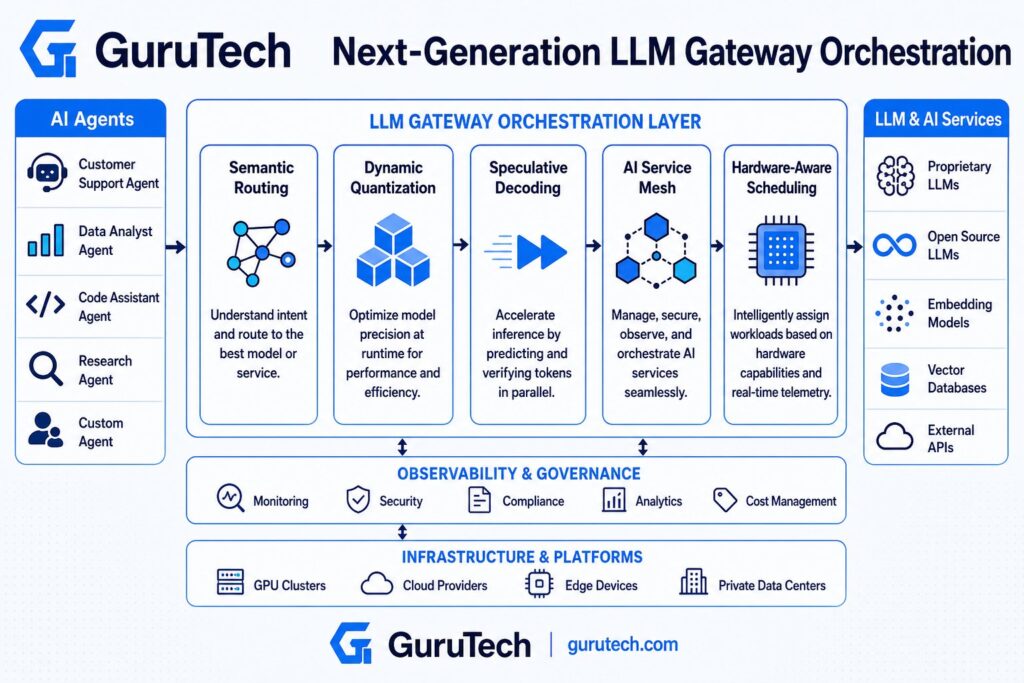
Emerging Trends in Gateway Orchestration
Gateway orchestration is shifting from static routing tables to adaptive systems that make real-time decisions based on model performance, cost constraints, hardware availability, and agent workload patterns.
These capabilities are moving beyond experimental features into production requirements for enterprises managing multi-model AI platforms.
Autonomous Model Selection
Autonomous model selection replaces manual routing rules with systems that evaluate model performance against specific task requirements and cost constraints.
The gateway analyzes prompt characteristics, historical performance data, and latency requirements to select the optimal model without predefined routing logic.
LiteLLM and similar orchestration frameworks implement cost-aware routing that compares token pricing across providers in real time.
Financial services firms use this approach to route low-complexity queries to cheaper models while reserving premium models for complex analysis tasks.
The system tracks accuracy metrics per model and adjusts routing weights based on actual production outcomes rather than static benchmarks.
Healthcare organizations apply autonomous selection to balance HIPAA compliance requirements with performance targets.
The gateway evaluates which providers meet data residency constraints before considering cost or latency factors.
This layered decision process ensures regulatory requirements take precedence over optimization goals.
Agent-Aware Routing
Agent-aware routing treats multi-step agentic workflows differently from single-turn requests.
Intelligent orchestration systems coordinate multi-step agent workflows by maintaining conversation state, tracking tool usage patterns, and routing sequential requests based on the agent’s execution context.
Banking platforms implement sticky routing for agent sessions to maintain conversation continuity across multiple model calls.
When an agent executes a planning phase followed by tool execution and response synthesis, the gateway routes all related requests to the same model instance to preserve context.
This reduces token overhead from repeated context injection and improves response consistency.
The architecture separates stateless query routing from stateful agent orchestration.
Stateless requests flow through standard load balancing logic while agent workflows receive dedicated routing paths with memory management and tool integration handled at the gateway layer.
Enterprises running concurrent agents see this separation improve throughput by preventing agent state conflicts.
Multimodal Gateways
Multimodal gateways route requests across text, vision, audio, and code generation models through unified APIs.
Portkey AI supports multi-modal LLM capabilities including text, image, audio, and vision models with routing logic that handles format conversion and provider-specific requirements.
Insurance claim processing systems use multimodal routing to analyze document images, extract text, and classify claim types through different specialized models.
The gateway handles format normalization, routes image analysis to vision models, and sends extracted text to language models for classification.
All provider interactions occur through a single API surface that abstracts provider-specific formats.
Healthcare diagnostic platforms route medical imaging through vision models while simultaneously processing patient history through text models.
The gateway coordinates parallel requests, aggregates responses, and handles failure scenarios where one modality succeeds while another fails.
This coordination logic moves complexity from application code into gateway infrastructure.
Dynamic Quantization
Dynamic quantization adjusts model precision at inference time based on latency requirements and hardware constraints.
Gateways with quantization awareness route requests to int8, int4, or fp16 model variants depending on acceptable accuracy trade-offs and current system load.
Manufacturing quality control systems use dynamic quantization to maintain real-time inspection speeds during peak production periods.
The gateway routes requests to quantized models when queue depth exceeds thresholds and reverts to full-precision models when capacity permits.
This approach maintains throughput targets without provisioning infrastructure for worst-case scenarios.
Financial fraud detection platforms apply quantization selectively based on transaction risk scores.
High-risk transactions route to full-precision models while routine transactions use quantized variants.
The gateway evaluates risk scores before model selection and adjusts routing in real time as transaction patterns change throughout the trading day.
Speculative Decoding
Speculative decoding uses smaller draft models to generate candidate tokens that larger verification models accept or reject.
Gateways coordinate this two-stage process by managing draft model requests, batching verification calls, and handling acceptance rate monitoring.
Customer service platforms implement speculative decoding to reduce response latency for common inquiries.
The gateway routes requests through a small local model that generates candidate responses at high speed.
A larger cloud model verifies the draft response and either accepts it immediately or generates a correction.
This reduces median latency by 40-60% for routine questions while maintaining accuracy for complex issues.
The architecture requires careful orchestration of model availability and fallback behavior.
When draft model acceptance rates drop below thresholds, the gateway bypasses speculation and routes directly to the verification model.
Enterprises measure acceptance rates per query type and adjust speculation policies based on observed patterns rather than static rules.
Hardware-Aware Scheduling
Hardware-aware scheduling routes inference requests based on available accelerator types, memory capacity, and interconnect topology.
The gateway evaluates which hardware configurations minimize total execution time for specific model architectures and batch sizes.
Research institutions running mixed GPU clusters use hardware-aware routing to match model requirements with available resources.
Large language models route to A100 instances with 80GB memory while smaller vision models run on T4 instances.
The gateway tracks real-time GPU utilization, memory availability, and queue depth per hardware type to prevent resource contention.
Telecommunications providers implement topology-aware routing for edge inference workloads.
The gateway evaluates network latency between edge nodes and data sources before selecting execution locations.
This prevents situations where model inference completes quickly but data transfer dominates total request time.
The system continuously measures end-to-end latency and adjusts routing policies as network conditions change.
AI-Native Service Meshes
As organizations adopt multiple foundation models, local inference clusters, and autonomous AI agents, LLM gateway orchestration has evolved from a convenience layer into a core component of enterprise AI infrastructure. Rather than exposing applications directly to individual model providers, the gateway establishes a centralized control plane responsible for intelligent routing, resilience, governance, security, and cost optimization across the entire AI platform.
Modern gateways make routing decisions based on task complexity, latency requirements, regulatory constraints, hardware availability, and operational costs. Combined with technologies such as semantic caching, speculative decoding, and model quantization, they enable organizations to deliver higher throughput while significantly reducing infrastructure costs without sacrificing response quality.
The gateway also becomes the operational foundation for production AI. It provides centralized authentication, policy enforcement, automated failover, distributed tracing, token-level cost attribution, and comprehensive observability across heterogeneous model deployments. Instead of maintaining provider-specific integrations throughout application code, engineering teams gain a unified API layer that simplifies upgrades, supports multi-cloud deployments, and reduces vendor lock-in.
These capabilities become even more critical as enterprises deploy autonomous AI agents. Multi-agent systems require session-aware routing, secure tool invocation, budget enforcement, audit logging, and dynamic model selection throughout every reasoning step. An intelligent gateway coordinates these operations while maintaining governance, compliance, and operational visibility across thousands of concurrent workflows.
Organizations that continue connecting applications directly to individual model APIs face increasing operational complexity, fragmented monitoring, inconsistent security policies, and unnecessary infrastructure costs as their AI footprint grows. By contrast, a well-designed gateway architecture provides the scalability, resilience, and governance required for long-term enterprise adoption.
As AI platforms continue evolving toward multimodal models, specialized accelerators, distributed inference, and agentic workflows, LLM gateway orchestration will increasingly serve as the intelligent backbone that coordinates every model request. For enterprises building production AI systems, the gateway is no longer simply another proxy—it is the control plane that enables scalable, secure, and cost-efficient AI infrastructure.
Adaptive Cost Optimization
Adaptive cost optimization adjusts routing decisions based on observed costs per request rather than published pricing.
Gateways with semantic caching capabilities continuously measure cache hit rates, provider pricing, and response quality to adjust routing policies automatically. By combining semantic caching with cost-aware model selection, organizations reduce redundant inference calls while maintaining consistent response quality.
Conclusion: LLM Gateway Orchestration Is the Enterprise AI Control Plane
As organizations adopt multiple foundation models, local inference clusters, and autonomous AI agents, LLM gateway orchestration has evolved from a convenience layer into a core component of enterprise AI infrastructure. Rather than exposing applications directly to individual model providers, the gateway establishes a centralized control plane responsible for intelligent routing, resilience, governance, security, and cost optimization across the entire AI platform.
Modern gateways make routing decisions based on task complexity, latency requirements, regulatory constraints, hardware availability, and operational costs. Combined with technologies such as semantic caching, speculative decoding, and model quantization, they enable organizations to deliver higher throughput while significantly reducing infrastructure costs without sacrificing response quality.
The gateway also becomes the operational foundation for production AI. It provides centralized authentication, policy enforcement, automated failover, distributed tracing, token-level cost attribution, and comprehensive observability across heterogeneous model deployments. Instead of maintaining provider-specific integrations throughout application code, engineering teams gain a unified API layer that simplifies upgrades, supports multi-cloud deployments, and reduces vendor lock-in.
These capabilities become even more critical as enterprises deploy autonomous AI agents. Multi-agent systems require session-aware routing, secure tool invocation, budget enforcement, audit logging, and dynamic model selection throughout every reasoning step. An intelligent gateway coordinates these operations while maintaining governance, compliance, and operational visibility across thousands of concurrent workflows.
Organizations that continue connecting applications directly to individual model APIs face increasing operational complexity, fragmented monitoring, inconsistent security policies, and unnecessary infrastructure costs as their AI footprint grows. By contrast, a well-designed gateway architecture provides the scalability, resilience, and governance required for long-term enterprise adoption.
As AI platforms continue evolving toward multimodal models, specialized accelerators, distributed inference, and agentic workflows, LLM gateway orchestration will increasingly serve as the intelligent backbone that coordinates every model request. For enterprises building production AI systems, the gateway is no longer simply another proxy—it is the control plane that enables scalable, secure, and cost-efficient AI infrastructure.